Buy Now, Pay Later for Fashion Ecommerce: How Klarna and Afterpay Increase Conversion Rate, AOV and First-Purchase Rate
Most fashion brands activate Klarna, check the box, and move on. They add the badge to the product page and assume the work is done. What we see across our client base tells a different story.
BNPL is not a passive feature. When it is positioned correctly - on the right pages, in the right ads, in the right email flows - it actively shifts buying behaviour. When it is positioned poorly, it adds friction, attracts higher-return customers, and erodes margin without delivering the conversion lift that justifies the cost.
This guide covers what we have learned from rolling out Klarna and Afterpay across 40+ fashion brands. What moves, what does not, and where the real gains are.
Key Takeaways
- •BNPL has the highest CVR impact in the €100-€250 price range - this is where buyers feel the most friction
- •Visibility matters as much as availability: BNPL shown at product level outperforms checkout-only display
- •AOV lift is real but varies significantly by price segment and product type
- •BNPL in Meta Ads and Klaviyo abandoned cart flows reduces purchase hesitation at key decision moments
- •Return rate risk is manageable - it is driven more by fit and size issues than by payment method
- •For luxury fashion (€300+), Klarna's 'Pay in 3' framing works better than 'Pay Later' messaging
Why BNPL Behaves Differently in Fashion Than in Other Categories
In electronics or travel, BNPL solves a pure affordability problem. The purchase is large, the product is clear, and the buyer knows exactly what they are getting. Fashion is different.
Fashion buyers face a different type of hesitation. They are often not blocked by affordability - they are blocked by uncertainty. Will this fit? Is the quality worth it? Do I really need this or am I just caught up in the scroll?
BNPL in fashion does two things that are easy to underestimate:
It lowers the perceived risk of a first purchase. Splitting a €180 jacket into three payments of €60 feels like a lower-stakes experiment. If it does not work out, the financial exposure feels smaller - even if the return process is the same.
It removes the 'not today' moment. A buyer who would have bookmarked the product to think about it over the weekend sometimes converts immediately when they see 'pay €58 today'. The friction between intent and action disappears.
This is why BNPL has a different profile in fashion than in most other ecommerce categories. It is as much a psychological tool as a financial one.
We see the highest BNPL conversion uplift in the €100-€250 price range. Below €100, most buyers do not need instalment options. Above €300, different framing is required - splitting a €450 dress into three payments works better when positioned as 'flexibility' rather than 'affordability'.
The CVR Impact of Klarna: What We See Per Price Segment
We are careful not to state a universal conversion rate benchmark - CVR depends on your traffic source, product type, store quality, and audience. What we can share is what we observe directionally across our client base.
The impact of BNPL on conversion is not uniform. It is concentrated in specific price bands:
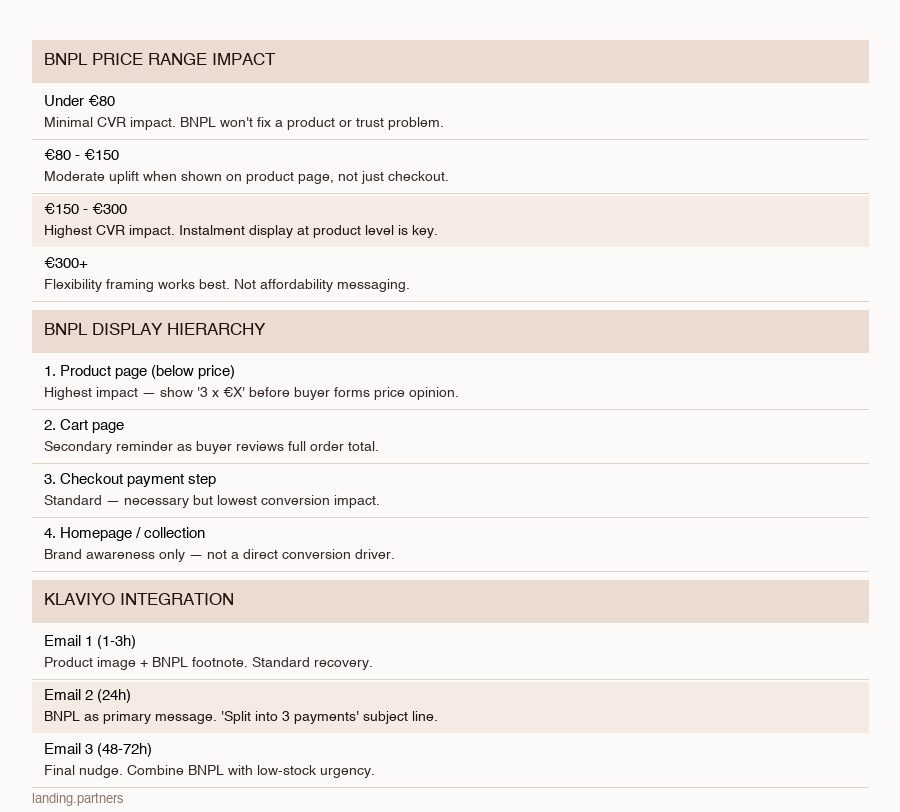
Under €80: BNPL visibility rarely moves the needle on conversion. At this price point, buyers are not hesitating because of payment terms. If your CVR is low here, it is a product, trust, or traffic quality problem - not a payment problem.
€80-€150: Moderate uplift when BNPL is visible on the product page. This is the range where a subset of buyers benefits from seeing the split payment, but it is not the primary purchase driver for most.
€150-€300: This is where BNPL has the clearest, most consistent conversion impact. The purchase feels meaningful, the instalment amounts feel manageable, and the 'pay over 3 months' frame is genuinely persuasive. We see measurable CVR differences when BNPL is visible at product level versus checkout only.
€300 and above: BNPL still works, but the positioning shifts. At this price point, 'flexibility' resonates more than 'spread the cost'. The buyer is not stretched - they are making a deliberate choice. Klarna's messaging at this level should reflect that.
Not sure which payment options are actually blocking conversion on your store? We do free webshop analyses where we walk through your checkout flow and identify the friction points specific to your price point and audience. Book a free webshop analysis.
AOV Lift: Real, But Not Automatic
The AOV effect of BNPL is one of the most cited benefits - and also one of the most misunderstood.
Yes, we see AOV increases when BNPL is properly activated. But they do not happen automatically. They happen when two conditions are met:
BNPL is visible at the point where the buyer is making size or quantity decisions. If a buyer sees 'pay €60/month' on the product page before they add to cart, they are more likely to add a second item or upgrade to the higher-quality version. If they only see it at checkout after they have already decided, the AOV moment has passed.
The product range supports outfit or bundle logic. BNPL AOV lift is strongest in brands where buying two or three items together makes contextual sense. A 'complete the look' section next to a BNPL badge on a product page is a simple but effective combination.
What does not work: adding BNPL at checkout and expecting AOV to lift automatically. That is a missed opportunity. The product page is where the AOV decision happens.
Across our fashion clients, we see the clearest AOV lift when BNPL is displayed prominently at product level - not just in the checkout. Brands that show instalment amounts next to the product price (not just a badge) consistently see higher cart values than those that surface BNPL only at the payment step.
Where to Display BNPL on Your Webshop
This is where most fashion brands leave money on the table. They activate Klarna, add the checkout integration, and stop. The CRO impact of BNPL is heavily tied to where and how it appears on the page.
The hierarchy that works:
Product page, below the price: This is the highest-impact placement. Show the instalment amount next to the product price - '3 payments of €58 with Klarna' - before the buyer has formed a final opinion about whether they can afford it. This is the moment to intervene.
Cart page: A secondary reminder as the buyer reviews their full order. Especially useful if the cart total has crossed a threshold that might trigger hesitation.
Checkout, payment step: Standard integration point, but lowest impact because the buyer has already committed by this stage. Still necessary - do not remove it - but do not rely on it as your primary BNPL touchpoint.
Homepage and collection pages: Useful for brand-level awareness ('Shop now, pay later') but not a conversion driver on its own. Use sparingly.
The BNPL widget or badge should always display the instalment amount in euros, not just a logo. 'Pay with Klarna' does nothing. '3 x €52' does something.
BNPL in Meta Ads: How to Use It as a Creative and Copy Element
One of the most underused applications of BNPL is in paid advertising. Most fashion brands run Meta Ads without ever mentioning payment terms. This is a missed opportunity, especially for products in the €120-€300 range.
How we use BNPL in Meta Ads for fashion clients:
In ad copy: A simple mention of 'Pay in 3 with Klarna - from €X/month' in the primary text removes a mental barrier before the buyer even clicks through. It does not need to be the hero message - it can be the supporting line that converts a hesitant scroller.
In creative: Overlay text on video or static ads that shows the instalment amount. For a €165 jacket, '3 x €55' is a concrete piece of information that makes the price feel different. This works especially well in retargeting ads where the buyer has already seen the product.
In retargeting sequences: If someone viewed a product but did not purchase, a retargeting ad that surfaces the BNPL option can be the nudge that converts. The buyer has already evaluated the product. The remaining barrier is often financial - or perceived financial. Showing the payment split addresses that directly.
One caution: do not lead with BNPL as the primary value proposition in prospecting ads. It signals affordability before it signals quality. For fashion brands, that can work against you at the brand-building stage. Use it as a secondary element, not a headline.
Running Meta Ads for your fashion brand and not using BNPL in your creative strategy? We can review your current ad setup and identify where payment messaging could reduce your cost per purchase. Book a free Meta campaign review.
BNPL in Klaviyo: The Abandoned Cart Flow
The abandoned cart email is where BNPL integration in Klaviyo has the clearest measurable impact.
Most abandoned cart flows lead with the product image and a 'you forgot something' subject line. Adding a BNPL mention - specifically the instalment amount for the abandoned cart value - gives the buyer a concrete reason to reconsider.
How we structure this for fashion clients:
First abandoned cart email (1-3 hours after abandonment): Standard recovery email. Product image, price, return to cart CTA. Optionally add a BNPL line below the price: '3 payments of €X available at checkout'.
Second abandoned cart email (24 hours): This is where BNPL earns its place as a standalone mention. Subject line variants we have tested: 'Split it into 3 payments' or 'From €X today with Klarna'. The email body leads with the payment option as the primary message, not just a footnote.
Third email (48-72 hours): If relevant for your brand, a final nudge. BNPL can be combined with a low-stock or back-in-stock message to create dual urgency.
This structure works because different buyers abandon for different reasons. Some abandon because they got distracted. Others abandon because they are genuinely hesitating on the price. The BNPL mention in email 2 reaches the second group in a way that email 1 does not.
In our Klaviyo setups, adding a BNPL-specific email to abandoned cart sequences - rather than only mentioning BNPL as a footnote - consistently outperforms the version without BNPL messaging in the second email. The improvement is most pronounced for carts in the €120-€250 range.
Welcome Series: Setting the Expectation Early
One application that is frequently overlooked: the welcome series.
If a new subscriber signs up via a pop-up, quiz, or checkout opt-in, they are likely a first-time buyer or someone who is evaluating your brand. Mentioning BNPL in the welcome series - specifically in the email that introduces your product range or bestsellers - plants the payment option in their mind before they have encountered a price on your site.
This is not about leading with 'we have Klarna'. It is about including it naturally: 'Our [product name] is our bestseller at €195. You can pay in 3 with Klarna.' One line. It removes an objection before the objection arises.
For brands in the €150-€350 range, this one change in the welcome series is one of the simplest first-purchase conversion improvements we make.
Return Rate: Is BNPL a Risk for Fashion?
This is the question we get most often when recommending BNPL to fashion clients. The assumption is that BNPL buyers return more because they feel less financially committed to the purchase.
Our observation is more nuanced. Return rate in fashion is primarily driven by fit and size - not by payment method. Buyers who purchase the wrong size with Klarna return at similar rates to buyers who purchase the wrong size with a credit card.
What does correlate with higher returns in BNPL contexts:
Enabling BNPL for impulse-category products without strong size guidance. If your product pages do not have detailed sizing information and BNPL lowers the barrier to a first purchase, you will see some uplift in returns from buyers who would not have purchased at all without BNPL - and who return because the fit was not right.
Bundled BNPL with a promotional offer. Combining 'pay later' with a discount creates a purchase incentive layer that can attract less-considered purchases. These return at higher rates.
Mitigation: pair your BNPL rollout with a size guide review and clear sizing information on product pages. This addresses the root cause of fashion returns regardless of payment method.
Return rate management is part of how we approach webshop audits for our clients. The payment method is rarely the lever - the product page is.
Which BNPL Providers to Use for European Fashion
The European BNPL landscape for fashion has four main players, each with meaningful differences:
Klarna: The dominant provider for Benelux, Germany, and Scandinavia. Strong consumer recognition, multiple product types (Pay in 3, Pay in 30, Financing). Best for mainstream to premium fashion (€50-€500 range). The Klarna badge is well-recognised by European consumers aged 25-45.
Afterpay (Clearpay in the UK): Stronger in the UK and among younger demographics (18-28). Four-payment model. Works well for streetwear and contemporary fashion. Less brand recognition in Belgium and the Netherlands than Klarna.
Alma: French-origin BNPL, growing in Belgium and France. Up to 4 instalments, lower merchant fees than Klarna in some configurations. Worth considering if your customer base skews French-speaking.
PayPal Pay Later: Lower consumer trust than Klarna for fashion specifically, but useful as a secondary option. Wide payment ecosystem integration.
Our general recommendation for Belgian and Dutch fashion brands: Klarna as primary, Afterpay as secondary for brands with a UK or younger international audience. Add Alma if you have significant French-speaking traffic.
Offering more than two BNPL options in checkout creates choice paralysis. One or two, clearly presented, is enough.
Every brand's situation is different. Whether BNPL is the right move for you depends on your price point, margin, customer profile, and current checkout performance. If you want to know what the right approach looks like for your specific brand, book a free call with our team.