YouTube Shopping for Fashion Brands: How to Turn Long-Form Content, Shorts and Live Streams Into a Shoppable Revenue Channel

Most fashion brands on YouTube are leaving money on the table. They upload a lookbook, get a few thousand views, and call it a content channel. They're missing the point entirely.
YouTube Shopping is a fundamentally different channel from YouTube as a content platform. When it's set up correctly - with product tags in Shorts, shoppable lookbooks, and Live Shopping for drops - YouTube becomes a sales channel with one property that Meta and TikTok can't match: purchase intent.
YouTube viewers are in research mode. They're not passively scrolling a feed. They searched for something. That changes the economics of every sale you make from it.
Key Takeaways
- •YouTube Shopping buyers have a higher AOV than TikTok buyers - they're further along in the decision process when they click
- •Three formats matter for fashion: Shorts (discovery), long-form lookbooks (conversion), Live Shopping (drops)
- •Setup requires Google Merchant Center linked to your Shopify feed - not complicated, but most brands skip it
- •YouTube Affiliate lets you activate creators on commission - no upfront influencer fee
- •A lookbook video has a 12-month sales tail via Google Search - Meta and TikTok ads stop working when you pause spend
- •We're seeing fashion brands generate meaningful incremental revenue from YouTube Shopping without it cannibalising their Meta performance
Why YouTube Shopping Is Different from Meta and TikTok for Fashion
The difference comes down to intent. On Meta and TikTok, your ad interrupts someone. On YouTube, your product appears when someone is actively looking.
A woman searching 'summer linen dress outfit ideas' on YouTube isn't just browsing. She's in the consideration phase. She has a purchase decision forming. When your lookbook appears in her results with shoppable product tags, the path to purchase is shorter than any paid ad you run.
The purchase intent gap
We see this consistently across fashion clients: YouTube Shopping buyers have a higher first-order AOV than buyers coming from TikTok. The TikTok buyer impulsively clicks on a product that caught their eye mid-scroll. The YouTube buyer watched a 6-minute lookbook, clicked a product tag, read the product page, and converted. That's a different kind of customer.
The content longevity advantage
A Meta ad has a shelf life of 2-4 weeks before creative fatigue sets in. A TikTok video might get 3 days of reach. A YouTube lookbook video indexed by Google Search keeps generating traffic and tagged-product clicks for 12+ months. We've seen fashion clients get consistent video-driven sales from content that's 8 months old. That's a fundamentally different ROI model.
YouTube Shopping buyers convert at a higher AOV than TikTok buyers in fashion - they arrive at the product page further along in the decision process, which shortens the path from click to purchase.
Not sure how to integrate YouTube Shopping with your existing paid media mix? Book a free call and we'll map out what makes sense for your brand's stage.
The Three YouTube Shopping Formats for Fashion
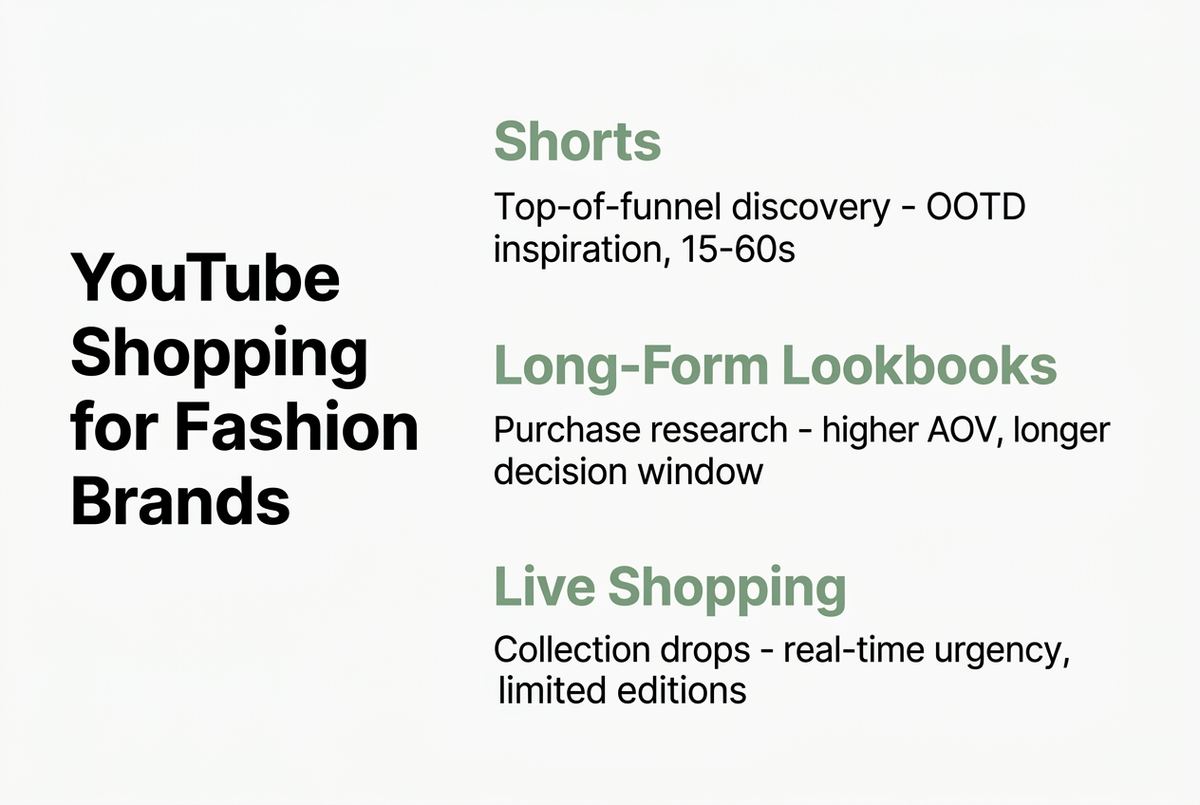
Each format has a different role in your funnel. Using only one misses the full opportunity.
Format 1: Shorts (top-of-funnel discovery)
YouTube Shorts are 60 seconds or under, displayed in a dedicated Shorts feed and in the main YouTube mobile experience. For fashion, they work as OOTD (outfit of the day) inspiration - quick, engaging, product-forward.
What works in Shorts for fashion: fast outfit transitions, 'what I ordered vs. what I got' formats, styling the same piece three ways. The critical difference from TikTok is that YouTube Shorts also appear in Google Search results. A Short titled 'How to style a summer linen set' gets indexed and surfaces for that query months later.
Product tags in Shorts allow you to pin specific products that appear as a shopping shelf below the video. When a viewer taps, they go directly to your product page. No landing page friction, no redirects.
Format 2: Long-Form Lookbooks (conversion)
Long-form videos (6-15 minutes) are where fashion YouTube Shopping actually converts. These are editorial-quality lookbooks, collection reveals, or styling videos where you tag every product shown.
The key insight we see across fashion clients: long-form YouTube is a consideration channel, not an impulse channel. The viewer is doing research. They're comparing options. The brands that win here treat YouTube lookbooks like a moving product catalogue - every item tagged, every look broken out.
Videos above 8 minutes can include mid-roll placements and get ranked differently by YouTube's algorithm. Longer watch time signals quality content, which increases organic reach.
Format 3: Live Shopping (drops and launches)
YouTube Live Shopping allows you to stream a live video with a real-time product panel on the side. Viewers can purchase without leaving the stream. For fashion, this format works for collection drops, limited editions, and collaborations - moments with inherent urgency.
When it works: you have an existing audience on YouTube (5,000+ subscribers), the product has scarcity or exclusivity, and you're prepared to host an engaging 45-60 minute live. When it doesn't: smaller brands without an established YouTube audience, commodity products without urgency. Going live to 40 viewers is demoralising and doesn't convert.
Our recommendation: activate Live Shopping after your channel has organic momentum. Build Shorts and long-form content first.
A fashion lookbook video generates shoppable traffic for 12+ months via Google Search. Meta and TikTok ad performance drops to near zero when you pause spend. YouTube Shopping content compounds over time.
Technical Setup: Google Merchant Center, Shopify and Product Tags
The setup is not as complex as most brands expect. The blockers are usually administrative rather than technical.
Step 1: Google Merchant Center
If you're running Google Shopping ads, you already have a Merchant Center account. If not, create one at merchants.google.com. This is where your product catalogue lives.
Step 2: Shopify product feed synchronisation
Install the official Google and YouTube channel app from the Shopify App Store. This syncs your Shopify product catalogue to Google Merchant Center automatically. Products must pass Google's product data requirements - clear titles, accurate descriptions, in-stock status, valid GTIN or MPN for fashion items.
Common approval issues for fashion: missing size and colour variants, vague product titles ('black dress' instead of 'Linen Midi Dress - Black'), or missing brand fields.
Step 3: Link YouTube channel to Merchant Center
In Google Merchant Center, go to Growth, then Manage programs, then YouTube Shopping. Link your YouTube channel. This is the step most brands miss. Without it, you can't tag products in videos.
Step 4: Tag products in videos and Shorts
Once linked, when you upload a video in YouTube Studio, you'll see a 'Shopping' tab in the video details panel. You can search your product catalogue and tag specific items. For Shorts, product tagging is done through the YouTube mobile app during or after upload.
Setting up Google Merchant Center and YouTube Shopping for the first time? Get a free setup review - we check feed quality, product approval status, and make sure the tagging is set up correctly before you start investing in content.
Content Strategy for YouTube Shopping Fashion
The content strategy for YouTube Shopping is different from content strategy for YouTube as a brand channel. The goal isn't brand awareness. It's tagged-product clicks.
Structure videos around products, not stories
In a standard YouTube brand video, you might open with a brand narrative and build to a product reveal. In a YouTube Shopping video, products appear immediately. The first 30 seconds of a lookbook should show products. Viewers are there to see clothes - give them clothes.
Tag strategically, not exhaustively
You can tag up to 30 products in a video, but more isn't better. Tag the hero pieces from each look - the ones you most want to sell. Accessories are worth tagging too: they have a lower commitment for the buyer but can add meaningful AOV to orders.
Title and description for Google Search
Every YouTube Shopping lookbook should be titled as a search query: 'Spring 2026 Collection Lookbook | Linen and Silk Dresses'. Write descriptions that include the product names and links to your webshop. YouTube descriptions are indexed by Google - this is free SEO.
Shorts cadence
For Shorts, consistency matters more than volume. Three Shorts per week outperforms seven inconsistent ones. Each Short should have 1-3 tagged products. Keep Shorts native to the platform: quick transitions, on-screen text, vertical format.
YouTube Affiliate for Fashion: Creators on Commission
YouTube's affiliate programme changes the economics of creator partnerships for fashion brands. Instead of paying a flat influencer fee upfront, you activate creators through the YouTube Shopping affiliate programme - they tag your products in their own videos and earn a commission on sales they drive.
How it works
You enable the affiliate programme in your Merchant Center settings. Creators who are part of the YouTube Shopping programme can then browse your product catalogue and tag your products in their videos. When their viewers purchase, the creator earns a commission you set (typically 5-15% for fashion).
Why this is better for most fashion brands
Traditional influencer deals for fashion can cost 500 to 5,000 euros per post with no guaranteed performance. The YouTube affiliate model flips this: you only pay when a sale happens. For a brand with a healthy margin, this means the cost is always below the CAC you'd accept from a paid channel.
The other advantage: creator content stays live indefinitely and keeps driving affiliate sales. A creator's 'spring wardrobe haul' featuring your brand from 8 months ago still sells.
Finding the right creators
Fashion YouTube creators with 10,000-100,000 subscribers often outperform mega-influencers for affiliate conversion. They have engaged, niche audiences who trust their recommendations. Their viewers are style-researchers, not passive entertainment consumers.
Look for creators whose existing content vocabulary matches your brand: the same colour palette, price point, and styling sensibility. A 180-euro linen dress will convert on a sustainable minimalist channel. It probably won't convert on a fast-fashion haul channel.
YouTube affiliate creators on commission deliver trackable CAC with no upfront spend. We see fashion brands achieve positive ROI on creator affiliate within the first 60 days of activation when product-creator fit is strong.
YouTube Shorts for Fashion: Discovery at Scale
Shorts deserve separate treatment because they behave differently from long-form. They're not mini-versions of lookbooks - they're a distinct format with a distinct audience behaviour.
The Shorts feed is where discovery happens. Someone who has never heard of your brand encounters a 30-second clip of an outfit they love, taps the product tag, and buys. The conversion path is short. The audience is broader.
What performs in Shorts for fashion
The formats we consistently see driving Shorts views and product clicks for fashion brands: outfit transitions (multiple looks in one Short), 'get ready with me' content, styling challenges (one piece, five ways), 'summer edit' or 'new arrivals' product showcases. What doesn't work: long voiceover, brand story narrative, heavily edited cinematic content. Shorts rewards fast, native content.
Google Search integration
This is the underused advantage: Shorts appear in Google's main search results, not just in YouTube. A Short titled 'How to style a slip dress for summer' surfaces as a video result when someone searches that phrase on Google. This is organic search traffic from short-form video content - something you can't get from TikTok or Instagram Reels.
YouTube Live Shopping for Fashion: When It Works
Live Shopping on YouTube is not for every fashion brand. When it works, it's extraordinary - real-time urgency, direct conversation with buyers, products selling out mid-stream. When it doesn't, it's a wasted afternoon.
When it works
Collection launches and drops with genuine scarcity. Collaborations with a creator or designer. Seasonal sales previews. A brand with an existing YouTube audience that already watches the channel. If your Live stream gets 500+ concurrent viewers organically, Live Shopping can generate significant sales volume in a short window.
When to skip it
If your YouTube channel has fewer than 5,000 subscribers, Live Shopping is premature. You need an audience first. Streaming a collection reveal to 35 viewers doesn't justify the production effort.
Build the channel first with Shorts and long-form content. Earn the audience. Then activate Live Shopping as a moment of reward for that audience.
Want to know whether YouTube Shopping makes sense as your next channel or whether Meta and Klaviyo still have untapped runway? Book a free growth call and we'll tell you what we'd do in your position.
Benchmark: YouTube Shopping vs. Meta Ads vs. TikTok Shop for Fashion
We're careful about benchmarks because every brand's situation is different - price point, audience, product category, and creative quality all affect results. With that caveat, here's what we observe across fashion brands that are actively running YouTube Shopping alongside Meta and TikTok:
Average Order Value
YouTube Shopping buyers consistently show higher AOV than TikTok Shop buyers. The delta varies by brand, but we see YouTube AOV running 15-30% above TikTok in fashion. This reflects the later-stage intent of YouTube buyers, not necessarily a platform advantage in absolute terms.
Conversion rate from click
YouTube product-tag clicks convert at a higher rate than TikTok Shop clicks for fashion brands with an average price above 80 euros. Below that price point, TikTok's impulse-purchase behaviour closes the gap.
Traffic volume
YouTube Shopping generates lower raw traffic volume than Meta Ads in most cases. It's not a replacement for paid social - it's an additive channel. The brands that win use YouTube Shopping to capture buyers who would never have converted via a Meta interruption ad.
Content longevity
12+ months of continued traffic from a single lookbook video is realistic. This compounds the ROI of YouTube content in a way that paid social cannot.
Frequently Asked Questions
Every brand's path to YouTube Shopping is different. The right starting point depends on your content capacity, product category, price point, and whether your Shopify-Merchant Center setup is clean enough to support product tagging. If you want to know what the right approach looks like for your specific brand - book a free call with our team.