Creator Commerce for Fashion Brands: How to Build an Affiliate and Creator Program That Drives Measurable Sales

Most fashion brands we talk to are still running influencer marketing the old way: send product, hope for content, try to measure the impossible. Creator commerce is a fundamentally different model - one where creators drive actual sales, not just reach.
Key Takeaways
- •Creator commerce is performance-based. Influencer marketing is awareness-based. The distinction matters for how you allocate your advertising budget, brief, and measure.
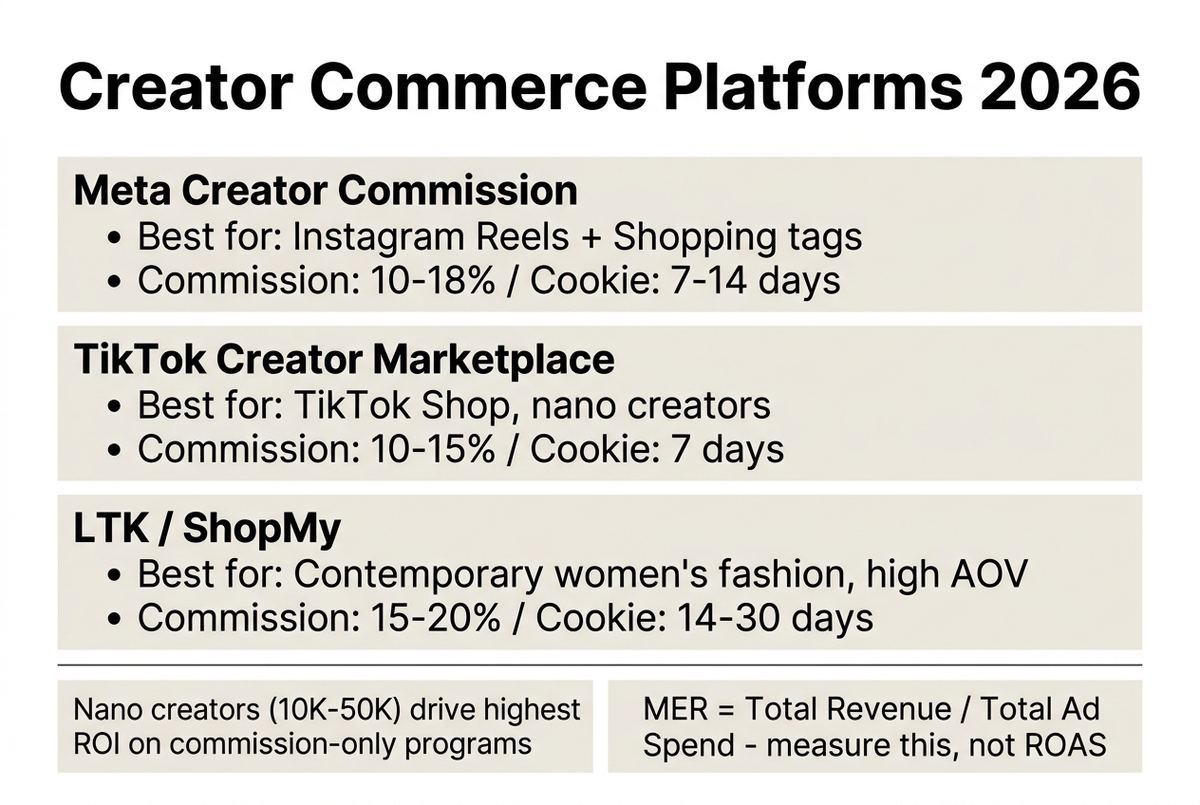
- •The three platforms that matter in 2026 are Meta's creator commission tools, TikTok Creator Marketplace, and LTK/ShopMy for mid-to-high-end fashion.
- •Commission rates for fashion typically run 10-20%, with cookie windows of 7-30 days depending on the platform and purchase consideration period.
- •Attribution overlap with Meta Ads is inevitable - measure at MER level, not individual channel ROAS, to avoid double-counting. When it comes to Meta ads benchmarks for fashion brands, the same principle applies.
- •Creator commerce works best as a complement to paid media, not a replacement - at least until you have data to say otherwise for your specific brand.
Creator Commerce vs. Influencer Marketing: What Is Actually Different
The terms get used interchangeably. They should not. Here is the practical difference that changes how you run the whole program.
Influencer marketing is an awareness play. You pay for reach - a flat fee, a gifted product, or a mix. The influencer posts, some people see it, some visit your site, a few buy. You can measure it roughly, but attribution is murky by design.
Creator commerce is a performance model. Creators earn a commission on every sale they drive. They have a trackable link or promo code. You pay when a customer converts - not when someone posts. The incentive is aligned: the creator only gets paid if you get a customer.
**The result is a fundamentally different relationship.** Creators who earn on commission are more invested in your conversion rate, your product presentation, and your offer. They are not just delivering a post - they are running a mini sales channel for your brand. If you're also weighing your broader DTC vs wholesale channel strategy, creator commerce sits naturally on the DTC side of that equation.
In our experience working with fashion brands building creator programs, commission-based creators produce 2-3x more content iterations than gifted-product influencers - because their payout depends on what converts, not what looks good.
This does not mean flat-fee influencer marketing is dead. High-reach awareness campaigns still have a role. But if your goal is measurable customer acquisition, creator commerce is the structure to build.. For help deciding between micro and macro influencers as part of this mix, see our influencer ROI comparison for fashion brands.
The Three Platforms for Creator Commerce in 2026
Not all creator commerce infrastructure is equal. Here is where fashion brands are building their programs in 2026 and what each platform actually delivers.
Meta's Creator Commission Tools
Meta has rolled out native commission tracking within Instagram Shopping. Creators can tag products directly in posts and Reels, and earn a commission when someone purchases through the tag. For fashion brands with a Shopify-connected Meta catalog, this is the lowest-friction path to starting a creator program.
What works: Reels with direct product tags convert better than Story links for fashion. The in-app checkout flow reduces friction significantly for repeat purchasers already inside Instagram.
What to watch: Attribution reporting in Meta's native tool counts the commission window separately from your ad attribution window. If both are set to 7-day click, you can easily double-count a sale that touched both a creator Reel and a retargeting ad. Set up MER tracking before you scale.
TikTok Creator Marketplace
TikTok's affiliate structure is the most integrated with TikTok Shop. Creators in the Marketplace can link directly to your TikTok Shop products and earn commission through TikTok's native checkout. For fashion brands running TikTok Shop, this is increasingly the primary creator channel.
What works: Educational and 'get ready with me' content formats consistently outperform pure product showcase for fashion on TikTok. Nano creators (under 50K followers) often outperform macro on a per-follower conversion basis, because their audiences follow them specifically for style guidance.
What to watch: TikTok Creator Marketplace is more accessible than it was in 2024, but European availability for TikTok Shop checkout is still uneven. Check your specific market's rollout status before building infrastructure around it.
Not sure which platform makes sense for your brand at your current stage? Book a free call - we will map out what is realistic for your market and budget.
LTK (LikeToKnowIt) and ShopMy
For fashion brands targeting a slightly older or more fashion-forward audience - contemporary women's fashion, accessories, jewellery - LTK and ShopMy remain the dominant creator affiliate platforms. These are creator-facing networks where fashion and lifestyle creators have built audiences specifically for shoppable content.
LTK in particular has deep penetration in the 25-40 women's fashion category. Brands set up a retailer account, creators apply to promote, and commission tracking runs through LTK's platform with reporting built in.
What works: LTK creators tend to have higher intent audiences - followers who use the platform specifically to discover and buy fashion. AOV is typically higher than TikTok-driven purchases because the purchase consideration is longer.
What to watch: LTK has minimum brand requirements. Brands without a meaningful social following or established product range often struggle to attract strong creators. This platform rewards brands that already have some market recognition.
Across fashion brands on LTK in our network, average creator commission rates sit at 15-18%, with top-performing creators driving 3-8% of total monthly revenue for brands with established, well-managed programs.
Commission Structures for Fashion: What Actually Works
Commission structure is where most fashion brands make their first mistake - usually by starting too low and then wondering why no quality creators join.
Standard commission ranges for fashion in 2026
For apparel and footwear: 10-18% is the working range. Below 10% and you will struggle to attract creators who have other options. Above 20% starts to compress margin unless your AOV is high enough to absorb it.
For accessories and jewellery: 12-20% is common, given the typically higher margins in these categories and the aspirational purchase dynamic that makes creator endorsement particularly effective.
For luxury or high-AOV fashion (above €200 average order): the percentage can be lower - 8-12% - because the absolute commission value is still meaningful at that price point, and luxury brands have less need to compete aggressively on commission rates.
Cookie windows
Most fashion brands run 7 or 14-day cookie windows to start. Longer windows (30 days) favour the creator but increase your risk of attributing sales that would have happened without the creator's direct influence.
Our approach with fashion clients: start with 7-day windows for new programs. Extend to 14 days once you understand your typical purchase consideration period for that brand. Luxury fashion consideration can run to 30+ days - 7-day windows systematically undercount creator impact in that segment.
Exclusivity and category rules
Some programs require creators not to promote direct competitors during a partnership period. For fashion specifically, hard exclusivity is difficult to enforce and often counterproductive. Creators who work across multiple fashion brands tend to have more engaged, fashion-interested audiences. Focus on content quality and conversion performance rather than trying to lock creators in.
Building a commission structure and want to check whether your margin can support a viable program? Book a free strategy call - we can model this against your actual numbers.
Recruiting Creators: Micro vs. Nano and When Which Tier Works
Creator tier selection is one of the most consequential decisions in building a program. The conventional logic - bigger audience means more sales - is consistently wrong for fashion affiliate programs.
Nano creators (5K-50K followers)
Nano creators have the highest engagement rates and the most trust within their specific niche. A 20K-follower fashion creator with 8% engagement in the sustainable fashion space will often outperform a 500K generalist lifestyle creator on a per-follower conversion basis.
For fashion brands starting a creator program: **begin with nano creators.** Lower barrier to entry, more flexibility in creative direction, faster testing cycles, and a genuine willingness to work on commission-only arrangements while building their own income from content.
Micro creators (50K-500K followers)
Micro creators are the core of most established fashion affiliate programs. They have meaningful reach without the management overhead of macro talent, and many are professional enough to handle regular content output on performance terms.
The catch: micro creators increasingly expect either a flat fee plus commission (hybrid model) or guaranteed minimum payouts, particularly for established brands. Pure commission-only works best when the brand has sufficient market recognition that promotion feels like a genuine endorsement rather than a risk.
Based on our observation across creator programs in our client base, nano and micro creators with audiences of 10K-200K drive the highest ROI on commission-only programs. Macro creators above 1M followers rarely participate in pure commission structures at rates that work for fashion margins.
Attribution: The Part Every Fashion Brand Gets Wrong
If you are running Meta Ads and a creator affiliate program at the same time - and you should be - attribution overlap is inevitable and needs to be managed from day one.
Here is what happens: a customer sees a creator's Reel, clicks through but does not buy. Three days later, they see your retargeting ad and convert. Who drove the sale?
**Your Meta Ads account says: the retargeting ad.** Your creator affiliate platform says: the creator. Both are technically claiming the same customer.
How to manage attribution overlap
The cleanest approach is to use distinct UTM parameters for every creator link and track at the MER (Marketing Efficiency Ratio) level, not just individual channel ROAS. MER means total revenue divided by total marketing spend - Meta Ads, creator commissions, and any other spend combined.
Within that framework, you can still measure creator program performance in isolation, but you are not trying to defend each channel's attributed revenue as if it is additive. The channels assist each other - that is the point.
For brands running Shopify: use a dedicated tracking link generator (most platforms include this) and combine it with Shopify's native source attribution to get a secondary read on which creator sessions actually convert within your defined window.
The honest reality: **some overlap is unavoidable and acceptable.** The question is whether the combined program drives more total revenue than paid media alone. In most cases where we have seen creator commerce done well, the answer is yes - but the margin is only visible when you are measuring MER, not channel ROAS.
Content Briefing for Affiliate Creators: What to Control and What to Release
Creator commerce briefing is different from influencer marketing briefing. When someone earns on commission, they have genuine incentive to test what converts - which means you want to give them more creative freedom, not less.
What you should control
- Brand safety guardrails: what cannot be said, what claims are off-limits for your category
- Product representation accuracy: sizing, colour fidelity, care context if relevant to purchase decision
- Disclosure requirements: clear #ad or #sponsored labelling per platform rules, non-negotiable
- Minimum posting frequency if the creator is in a formal, structured program
What you should let creators own
- Format and editing style - their audience knows what they produce
- Hook and opening framing - they know what stops their specific audience from scrolling
- Caption copy and call to action language
- How they style or wear the product in context
Creators who know their audience know what lands with them. Over-scripted creator content reads like a branded ad, which defeats the purpose of creator commerce entirely. **The best-converting creator content sounds like a personal recommendation, because it is one.**
When Creator Commerce Beats Paid Media - and When It Does Not
Creator commerce is not a replacement for paid media. For most fashion brands at the scaling stage, it is a complement - and a strategically important one at specific moments.
When creator commerce wins
For fashion brands with strong aesthetics and a defined audience segment, creator commerce can drive new customer acquisition at a lower cost than paid media - particularly when CPMs are high (Q4, election cycles, major sporting events).
When Meta CPMs spike, commission-only creator content costs you nothing until a sale happens. That is a meaningful hedge against platform volatility.
Creator commerce also tends to outperform paid media in the consideration phase for higher-AOV fashion. A 5-minute styling video from a creator a customer already trusts does more for a €200 dress decision than a 15-second Meta ad in most cases. For the paid creative formats that complement creator content, see our Meta ad creative playbook for fashion brands.
When paid media wins
Speed and scale. If you need to drive volume in a short window - a flash sale, a product drop, BFCM - paid media is controllable in ways that creator programs are not. You cannot ask 50 creators to all post on the same day and expect coordinated performance.
For new brands or brands entering new markets, paid media also builds the awareness layer that makes creator commerce viable. Creators cannot sell a product their audience has never encountered.
Want to know what the right mix looks like for your brand at your current stage? Book a free call and we will assess your specific situation.
Frequently Asked Questions
Every brand's situation is different. How creator commerce fits into your acquisition mix depends on your margin, your audience segment, your current paid media setup, and your stage. If you want to know what the right approach looks like for your specific brand - book a free call.