Klaviyo for Supplement and Vitamin Brands: Subscription Flows, Replenishment Sequences and the Education Funnel That Retains Customers

Key Takeaways
- •Supplement email marketing works differently than fashion or general ecommerce - the buying cycle, education needs, and replenishment timing all require a different Klaviyo structure
- •Welcome flows for supplement brands must educate before selling - customers need to understand why the product works before they commit to a second purchase
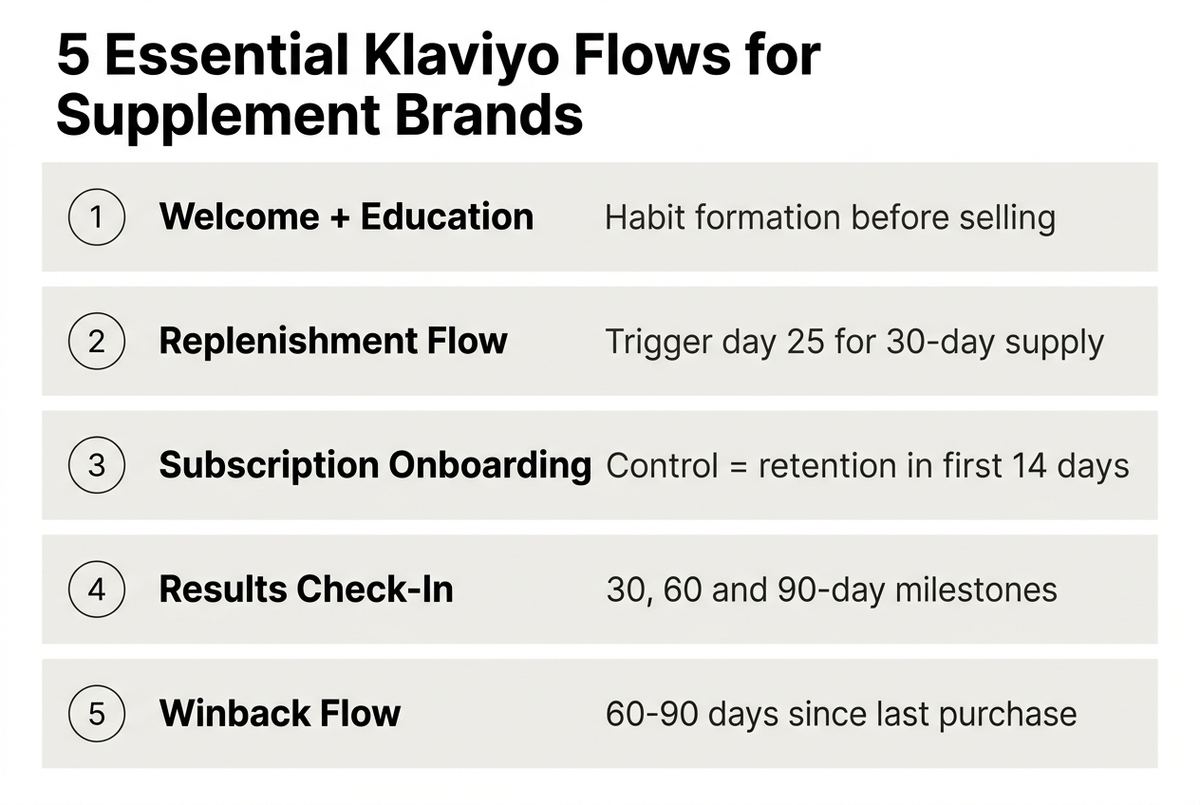
- •Replenishment timing is the single most powerful email trigger: a 30-day supply needs a flow that fires on day 25, not day 30
- •Subscription churn prevention starts at onboarding - the first 14 days after subscription activation are the most critical window
- •Goal-based segmentation (weight management, energy, sports, wellness) drives 2-3x higher engagement than demographic segmentation
Supplement email marketing is not just fashion email with different products. The psychology is completely different. A fashion customer buys impulsively. A supplement customer needs to believe. And that belief takes time.
We work with supplement and vitamin brands across wellness, sports nutrition, and beauty supplements. The brands that build durable email revenue are not the ones with the biggest lists. They are the ones who understand that a supplement customer needs three things before they rebuy: they need to have used the product consistently, they need to attribute results to it, and they need to trust the brand enough to not look elsewhere.
Email is the primary tool that delivers all three. Done wrong, it becomes noise. Done right, it becomes the engine that keeps a customer buying for 18 months.
Why Supplement Email Marketing Is Fundamentally Different
Most Klaviyo guides are written with fashion or general retail in mind. Supplement brands that copy those structures miss the fundamental difference: your customer bought a promise, not a product.
A moisturiser delivers an immediate sensory experience. A protein powder shows results over weeks. A collagen supplement takes 60-90 days. The entire email structure needs to account for this gap between purchase and perceived value.
We see three failure patterns consistently across supplement accounts we audit.
The first is treating the welcome flow like a fashion welcome flow. Fashion brands can push a second purchase within 3-7 days because the buying decision is fast and emotional. Supplement brands that do this see high unsubscribes and low second-purchase rates. The welcome period for supplements should focus on habit formation, not conversion.
The second is no replenishment flow. This is the most expensive omission we see. A supplement brand with a 30-day supply product that does not send a replenishment email before day 30 is leaving significant repeat revenue on the table. The customer runs out, forgets to reorder, and moves on.
The third is segmenting by demographic instead of goal. Whether a customer is 25 or 45 matters less than whether they are buying for weight management, sports performance, energy, or skin health. Goal-based segmentation consistently outperforms demographic segmentation in supplement Klaviyo accounts.
Replenishment flows alone account for 15-25% of total Klaviyo-attributed email revenue for supplement brands in our client base - higher than abandoned cart flows in most accounts.
Flow 1: Welcome + Product Education
The welcome flow is where supplement brands win or lose the second purchase. The goal is not to sell again immediately. It is to get the customer to use the product consistently and to attribute their early results to it.
The timing structure we use:
Email 1 (immediately after purchase): Thank you, what to expect, and how to use the product correctly. Include dosage instructions, when to take it, and what early signs to look for. Keep it practical, not salesy.
Email 2 (day 3): Address the most common doubt. For energy supplements: 'You may not feel the difference yet - here is why.' For protein: 'Consistency matters more than timing.' This email alone reduces early churn significantly when done well.
Email 3 (day 7): Results timeline. Be honest about when customers can realistically expect to notice a difference. Brands that overpromise create disappointed customers. Brands that set realistic timelines create loyal ones.
Email 4 (day 14): First check-in. 'How are you getting on?' This can be a simple survey or just a reassuring email. It creates a conversation and surfaces potential issues before they become cancellations.
Email 5 (day 21): Social proof from customers at the day 21-30 stage. Real testimonials from customers who were exactly where this new customer is now.
One rule that applies to every email in this flow: no promotional discounts in the welcome series. Discounts in the welcome flow train the customer to wait for offers. Instead, deliver value - education, community, practical tips.
Not sure how your welcome flow is performing? Book a free Klaviyo audit and we will review your flows, open rates, and revenue per recipient.
Flow 2: Replenishment Flow Based on Daily Dose
This is the most mechanical - and most valuable - flow in supplement email marketing. The logic is simple: if you know the product is a 30-day supply and the customer bought one unit, you know when they will run out.
The formula: purchase date + (supply days - 5) = trigger date for replenishment email 1.
For a 30-day supply, trigger on day 25. For a 60-day supply, trigger on day 55. The minus-5 buffer accounts for the time needed to process a new order and receive delivery before the current supply runs out.
The flow structure:
Email 1 (day 25 for 30-day supply): 'Your supply is almost done.' Simple, direct, one clear call to action to reorder. No discount yet.
Email 2 (day 28, if no purchase): Gentle reminder. Still no discount. Add social proof: 'X customers reordered this month and are seeing strong results.'
Email 3 (day 30, if no purchase): Offer a discount or free shipping to convert hesitant reorderers. This is the only place in the replenishment flow where a promotional incentive makes sense.
Email 4 (day 35, if no purchase): Winback tone. 'We miss you. Here is what you might be missing.' Address the gap in their routine and the results timeline they may be interrupting.
One nuance: if the customer is on a subscription, suppress the replenishment flow entirely. Sending replenishment emails to subscribers creates confusion and erodes trust. Always check subscription status before triggering this flow.
Supplement brands with properly timed replenishment flows see a 35-45% higher 90-day repeat purchase rate compared to brands with no replenishment automation, based on what we observe across our client base.
Flow 3: Subscription Onboarding and Churn Prevention
If you offer subscriptions, your Klaviyo strategy needs a dedicated subscription track that runs parallel to your standard flows. The first 14 days after subscription activation are critical. This is when the customer decides whether the subscription is worth keeping. Most churn happens at the first renewal - not months later.
Subscription onboarding flow:
Email 1 (immediately after subscription activation): Confirm the subscription, remind them of the benefits (usually a discount and convenience), and set clear expectations for their first renewal date.
Email 2 (day 3): How to manage the subscription. Show them how to pause, skip, or modify their order. This seems counterintuitive - why show customers how to pause? Because customers who know they have control are far less likely to cancel outright.
Email 3 (day 7): Education about why consistency matters. For supplements, results are dose-dependent and time-dependent. This email is the primary retention tool in the subscription onboarding flow.
Pre-renewal emails (3-5 days before each renewal):
Send a pre-renewal email that reminds the customer what is coming, how much they have saved through the subscription, and what results they might be experiencing by now. Give them a clear option to skip or pause. Customers who feel in control do not cancel.
If a customer pauses: start a re-engagement flow at pause day 30. If they cancel: trigger a winback flow immediately and ask for the reason in the first email.
Subscription retention in Klaviyo is one of the more technical setups we build. Book a free call to see how we structure subscription onboarding and churn prevention for supplement brands.
Flow 4: Results Check-In After 30, 60 and 90 Days
This flow is unique to supplement brands and rarely exists in general Klaviyo setups. The results check-in sequence contacts the customer at the key result milestones for your specific product category.
The structure:
Day 30 email: 'How are you getting on after month one?' For products with faster results (energy, protein), this email asks for early feedback and reviews. For slower products (collagen, hair growth), this email validates that the customer is on the right track and sets expectations for month two.
Day 60 email: More substantive check-in. By now, customers using the product consistently should be noticing something. Use this email to surface success stories from customers at the same stage. If results take longer for your specific product, this email should address the timeline honestly.
Day 90 email: This is the review request email for slower-result categories. Day 90 is when the customer has enough experience to give a meaningful, positive review - if the product has worked as expected.
A key rule: do not ask for a review at day 7. Supplement reviews written at day 7 are useless at best and misleading at worst. Time your review request to match your actual results timeline.
Goal-Based Segmentation for Supplement Brands
The most effective segmentation for supplement brands is goal-based, not demographic. Here is the segmentation structure we build for supplement clients.
Goal segments to build: weight management, energy and focus, sports performance and recovery, general wellness, beauty supplements (skin, hair, nails).
How to capture goal data:
At checkout, add a single optional question: 'What is your primary goal?' This one data point enables segmentation that changes everything downstream - from which flows a customer enters to which products you cross-sell.
Alternatively, use a post-purchase quiz in the welcome flow. A two-question survey (goal and routine frequency) gives you the data you need without creating friction at the point of purchase.
How to use segments in Klaviyo:
Each goal segment gets a different version of welcome flow email 3 (results timeline). A customer buying for energy gets a different 21-day email than a customer buying collagen for skin health. The product may even be the same - but the framing of expected results is entirely different.
For cross-sell, goal segments define the recommended next product. A sports performance customer should not receive the same cross-sell recommendation as a weight management customer, even if both are buying protein.
Goal-based segmentation in Klaviyo drives 40-60% higher CTR on welcome flow emails compared to unsegmented sends in our supplement client accounts. The difference is relevance - the customer receives messaging that matches why they bought, not just what they bought.
Winback for Supplement Customers
A supplement customer who has not purchased in 60-90 days is in a critical window. They have either run out and not reordered, switched to a competitor, or stopped the supplement habit altogether.
The winback flow timing we use:
Email 1 (day 60 since last purchase for 30-day supply products): 'It has been a while. Here is what you might be missing.' Frame the absence in terms of the goal they had when they bought - not in terms of the product itself.
Email 2 (day 75): Add a reactivation incentive. Make it meaningful - a free product sample, a discount on a larger supply, or a subscription offer. For supplement winback, subscription offers often outperform straight discounts because they solve the underlying problem (forgetting to reorder).
Email 3 (day 90): Final attempt. Keep it direct and honest: 'We are about to remove you from our active list. Here is one last reason to come back.'
After 90 days without a purchase, move to low-frequency nurture (one email per month) rather than active winback. The goal at that point is staying top of mind, not direct conversion.
Email Revenue Benchmarks for Supplement Brands
The benchmarks that matter for supplement brands differ from fashion benchmarks. Here is what we observe across our supplement client accounts.
Welcome flow: open rates of 45-60% on email 1, dropping to 25-35% by email 5. Revenue per recipient from the welcome flow tends to be lower than in fashion (the goal is retention, not immediate conversion), but the downstream impact on 90-day AOV and repeat purchase rate is significant.
Replenishment flow: open rates of 35-50% on the first replenishment email. CTR of 8-15%. This flow consistently delivers the highest revenue per recipient of any automated flow in supplement Klaviyo accounts.
Subscription pre-renewal: open rates of 50-65%. This is the highest-performing email category in supplement Klaviyo setups. Customers are highly engaged because the email is directly relevant to an upcoming action that affects them.
AOV note: supplement brands with higher AOV (bundle packs, 90-day supplies) see lower conversion rates on replenishment emails but higher revenue per conversion. When building your flow, optimise for the offer that matches your AOV and margin structure - not the offer that generates the most clicks.
Frequently Asked Questions
Every supplement brand's email strategy depends on its specific product, result timeline, and customer behaviour. The flows above are the framework we use across our client base, but the details - timing, copy, incentive structure - need to match your product's actual use cycle and your customers' actual behaviour.
If you want to know what the right Klaviyo setup looks like for your supplement brand, book a free call with our team.