Fashion Ecommerce Marketing Glossary: Every Abbreviation Explained

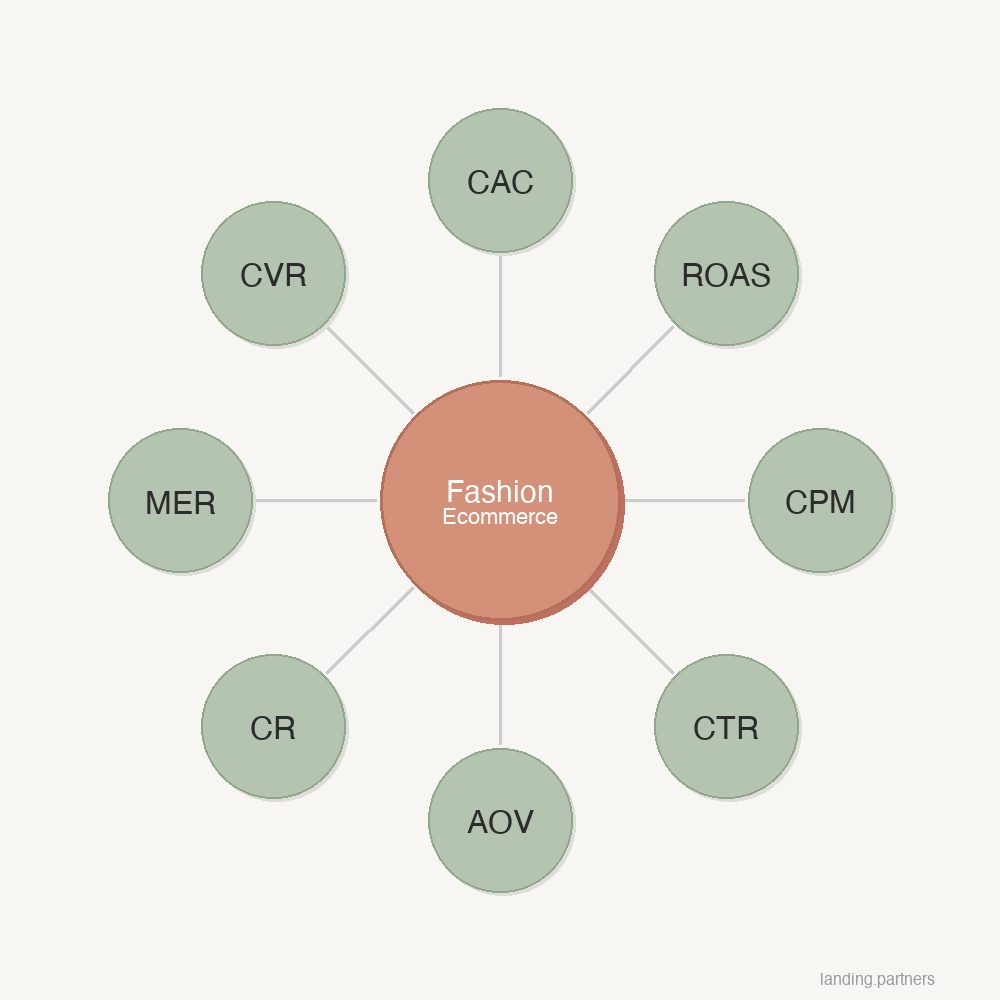
If you've ever sat in a meeting or read a report full of abbreviations and nodded along without being sure what half of them mean - this page is for you. We use these terms constantly with our clients, and we reference them across all our blog content. Bookmark this page.
The Core Performance Metrics
MER - Marketing Efficiency Ratio
Total revenue ÷ total ad spend, across all channels. This is the metric we use above all others. Unlike ROAS, it's not manipulated by platform attribution - it's simply what your business earns per euro spent on marketing. A MER of 5 means every €1 in ad spend generates €5 in revenue. We set MER targets by month, adjusted for seasonality.
ROAS - Return on Ad Spend
Revenue attributed to ads ÷ ad spend, as reported by the advertising platform (Meta, Google, etc.). Be careful with this number - it's reported by the platform itself, using its own attribution model, which often inflates results. We use MER as the reliable version of this metric.
CAC - Customer Acquisition Cost
The cost to acquire one new customer. Ad spend ÷ number of new customers acquired. This is different from cost per purchase - a returning customer buying again doesn't count. CAC is one of the most important metrics for long-term profitability, and the right target depends entirely on your AOV and margin.

CR - Conversion Rate
The percentage of visitors to your store who make a purchase. CR = orders ÷ sessions × 100. There is no universal benchmark - a luxury brand at €300 AOV will convert very differently than a streetwear brand at €80. The right question isn't 'what's my CR?' but 'does my store sell to people who find it organically?'
AOV - Average Order Value
Total revenue ÷ number of orders. One of the most important inputs for setting your CAC target and evaluating channel performance. A higher AOV gives you more room to spend on acquisition. AOV is also a lever - bundles, upsells, and free shipping thresholds all influence it.
LTV / CLV - Lifetime Value / Customer Lifetime Value
The total revenue a customer generates over their entire relationship with your brand. Brands with high LTV can afford higher CAC because a customer who buys three times is worth three times as much as one who buys once. Fashion brands with strong retention typically have LTV 2–3x their first-order AOV.
Ad & Campaign Metrics
CPM - Cost Per Mille
Cost per 1,000 impressions. What you pay to show your ad to 1,000 people. CPM varies by platform, audience, season, and competition. High CPM isn't necessarily bad - if it's a high-quality audience that converts, the cost is justified.
CPC - Cost Per Click
What you pay each time someone clicks on your ad. CPC = total spend ÷ number of clicks. Useful for comparing creative efficiency, but not a primary KPI on its own.
CTR - Click-Through Rate
The percentage of people who see your ad and click on it. CTR = clicks ÷ impressions × 100. A higher CTR usually means your creative is relevant to the audience seeing it. In fashion, strong visual creative is the primary driver of CTR.
CPA - Cost Per Acquisition
What you pay per conversion (purchase, lead, or whatever your campaign goal is). Similar to CAC, but CPA can include returning customers - CAC is specifically about new customers only.
CPP - Cost Per Purchase
What you pay per purchase as reported by the ad platform. Different from CAC because it includes all purchases (new and returning) and uses platform attribution, which may be inflated.
Email Marketing Terms
Flow
An automated email sequence triggered by a specific behaviour - a customer signing up, abandoning their cart, making a purchase, or going quiet. Flows run in the background 24/7 and are the most efficient part of any email programme. In Klaviyo, flows are the foundation; campaigns are the complement.
Campaign
A one-off email sent to a segment of your list - a newsletter, a promotion, a product launch. Campaigns are manual and time-specific. They can drive revenue, but their impact is harder to measure cleanly because Klaviyo's attribution credits purchases within a 5-day window, whether or not the email actually drove the sale.
Open Rate
The percentage of recipients who open your email. Note: since Apple's Mail Privacy Protection (2021), open rates are partially inflated for Apple Mail — see Klaviyo benchmarks for fashion brands for realistic targets users. Use click rate as a more reliable engagement signal.
Click Rate
The percentage of recipients who click a link in your email. More reliable than open rate as a measure of genuine engagement.
Attribution Window
The time period in which a platform credits a sale to an ad or email. Klaviyo's default is a 5-day click window - any purchase within 5 days of clicking an email gets credited to that email. This inflates reported email revenue, especially for campaigns. Meta uses a 7-day click / 1-day view window by default.
Business Model Terms
DTC - Direct-to-Consumer
Selling directly to customers through your own channels (webshop, own retail) rather than through third-party retailers or wholesalers. DTC brands control the customer relationship, collect first-party data, and keep more margin - but bear all the cost of customer acquisition.
AOD / AOV
Sometimes written as AOD (Average Order Discount) when discussing promotional periods - not to be confused with AOV.
SS / AW - Spring-Summer / Autumn-Winter
The two main fashion season cycles. SS collections are typically presented in autumn for the following spring, AW collections in spring for the following autumn. These cycles drive content planning, creative production, and media buy timing for fashion brands.
BFCM - Black Friday / Cyber Monday
The peak promotional weekend at the end of November. For most fashion brands, this is the most efficient acquisition period of the year - high consumer intent, elevated budgets across the industry. The brands that are best prepared (creative ready, budgets pre-loaded) consistently outperform those who react.
We use all of these terms across our blog content. When we reference a metric, we try to explain what it means in context - but this page exists as a reference you can return to. If there's a term you're not finding here, get in touch and we'll add it.