Sports Nutrition Brand Marketing: Meta Ads, Klaviyo Flows and the Retention Strategy That Turns Gym Goers Into Subscribers

Key Takeaways
- •Sports nutrition has a faster purchase cycle than general wellness supplements - buyers decide in days, not weeks, because daily use creates natural urgency.
- •Meta Ads for sports nutrition require benefit-first creative that stays compliant - no medical efficacy claims, no before/after body transformation promises.
- •Replenishment flows in Klaviyo are the single highest-ROI automation for protein and pre-workout brands: a 30-day supply means a trigger on day 25.
- •A subscribed customer has 3-5x the lifetime value of a one-time buyer in sports nutrition - subscription mechanics change the unit economics entirely.
- •Community acquisition through gym partnerships and athlete ambassadors is systematically underused and often outperforms paid acquisition at early stages.
Sports nutrition is one of the most commercially interesting categories to market in 2026 - but also one of the most misunderstood. Most generic supplement guides treat protein powder the same as a general wellness vitamin. They are not the same.
The buyer is different. The purchase cycle is different. The creative strategy is different. The Klaviyo flows are different. And the compliance requirements sit in a unique grey zone between lifestyle products and health claims.
We work with sports nutrition brands alongside fashion and beauty clients at Landing Partners. Here is what we have learned about building an acquisition and retention engine that works specifically for protein, pre-workout, creatine and recovery products.
Why Sports Nutrition Is a Different Marketing Category
The core difference between sports nutrition and general wellness supplements is purchase intent and purchase frequency.
A person buying a general wellness supplement - a daily multivitamin, a sleep aid, an immune booster - makes an infrequent, considered purchase. They research, compare and read reviews for weeks. The purchase cycle is long and brand loyalty tends to be relatively sticky once established.
Sports nutrition buyers move faster and switch more easily.
A gym-goer who uses 30g of protein per day will empty a 1kg tub in roughly 33 days. They run out. They need to reorder. If your brand does not reach them at day 25 with a replenishment message, they will walk into a physical store or reorder whatever comes up first in a Google search.
That consumption frequency creates a structural advantage: if you build the right flows and retention mechanics, sports nutrition is one of the highest-LTV supplement categories. But it also creates a structural vulnerability: high consumption frequency means high churn risk if your brand is not front-of-mind at the exact repurchase moment.
Sports nutrition buyers consume product daily - a 1kg protein tub lasts 30-35 days. Repurchase windows are fully predictable. Brands that build replenishment flows around consumption data consistently outperform brands that rely on generic winback campaigns and hope the buyer comes back on their own.
The second major difference is community. Fashion has Instagram aesthetics. Beauty has skincare routines. Sports nutrition has gyms, training communities, subreddits and YouTube coaches. The discovery path for a new protein brand often starts not with a paid ad but with a recommendation in a Discord server, a YouTube review or a post in a training community.
This means community-driven acquisition is not optional for sports nutrition brands at early stages - it is where the most cost-efficient growth happens.
The Sports Nutrition Buyer in 2026
Understanding who is buying and where they discover products is the foundation of any acquisition strategy.
The sports nutrition buyer in 2026 skews male (22-38 years old), training 3-5 times per week - though women's sports nutrition is one of the fastest-growing segments, particularly in protein and recovery categories. **They read ingredient labels.** They know the difference between whey isolate and concentrate. They compare amino acid profiles. They are not passive consumers.
Discovery happens across multiple touchpoints:
- YouTube coaches and review channels are a major discovery path, especially for pre-workout and creatine
- TikTok is growing fast for protein, particularly for younger buyers and women's sports nutrition
- Reddit communities (r/fitness, r/bodybuilding, r/xxfitness) generate organic social proof that directly influences purchase decisions
- Meta Ads are the primary paid acquisition channel for scaling, but they follow organic interest - cold traffic converts poorly if the brand lacks external credibility
- Gym distribution and sampling remains highly effective for taste-dependent products
The implication for paid media: social proof and third-party credibility are prerequisites for paid acquisition to work at scale. Before you increase Meta spend significantly, make sure your product pages have enough reviews and that your brand has some organic presence outside of paid channels.
Not sure whether your sports nutrition brand is ready to scale paid acquisition? We review brands before we take them on. Book a free strategy call and we will tell you exactly what needs to be in place first.
Meta Ads for Sports Nutrition: Creative Formats That Work
Meta is the primary acquisition channel for most direct-to-consumer sports nutrition brands. But creative strategy for sports nutrition is distinct from fashion or beauty.
Format 1: Athlete UGC - the highest performer across all subcategories.
An athlete or regular gym-goer filming themselves preparing a shake, mid-workout or reviewing the product after training outperforms studio-produced content almost universally. The key is authenticity: the camera quality should not be too polished, the backdrop should be a gym or home gym setting, and the hook must be immediate.
Hooks that work: 'I have tried 12 different protein powders and this is the only one I keep coming back to,' 'This pre-workout changed how I train,' 'Finally a protein that does not bloat me.' Specific, personal, no hyperbole.
Format 2: Ingredient breakdown carousel or short video.
Because sports nutrition buyers read labels, ingredient-led creative performs well - especially for informed buyers comparing products. A carousel showing 'why we use whey isolate, not concentrate' or a 15-second video breaking down the amino acid profile converts well for warm and retargeting audiences.
Format 3: Training routine integration.
Showing the product as part of a training routine - pre-workout before session, protein immediately after - contextualises the product in daily use and reduces the cognitive distance between seeing the ad and imagining using it. This format works particularly well on Instagram Reels and TikTok.
Format 4: Taste and flavour focus for protein.
Taste is one of the top purchase barriers for protein powders - buyers have been burned by chalky, artificial-tasting products. Creative that directly addresses this (taste test videos, 'finally a protein that actually tastes good') consistently lifts conversion on cold audiences.
Meta Ads Policy for Sports Nutrition: What You Can and Cannot Say
This is where many sports nutrition brands get caught out. Meta's health and wellness advertising policies apply to supplements, and they are enforced inconsistently - which makes it more dangerous to push boundaries, not less.
What is generally allowed:
- Benefit-first language focused on lifestyle and fitness goals: 'supports muscle recovery,' 'fuel your training,' 'helps you hit your daily protein targets'
- General performance framing: 'for athletes,' 'made for serious training,' 'clean ingredients, no fillers'
- Taste and quality claims: 'best-tasting protein in its category,' 'no artificial sweeteners'
What gets flagged or rejected:
- Medical efficacy claims: 'builds muscle,' 'increases testosterone,' 'burns fat'
- Before/after body transformation imagery
- Weight-related claims that imply body change as a direct product effect
- Targeting fitness audiences combined with body transformation claims
The practical approach: use EFSA-approved language for any functional claim, and frame everything around training lifestyle rather than body transformation. 'Fuel your training session' clears. 'Build lean muscle mass' does not. This line is clearer than it feels in practice - once you understand where it sits, building a compliant creative library is straightforward.
Ad account restrictions are disproportionately common in the supplement category. Brands that invest in a compliant creative library before scaling avoid the most common growth interruption in this space. One suspended account during peak season costs more than a thorough compliance review done upfront.
Klaviyo Flows for Sports Nutrition Brands
Email and SMS retention is where sports nutrition brands generate their highest return on investment per euro spent. The flows below are category-specific and different from what you would build for fashion or beauty.
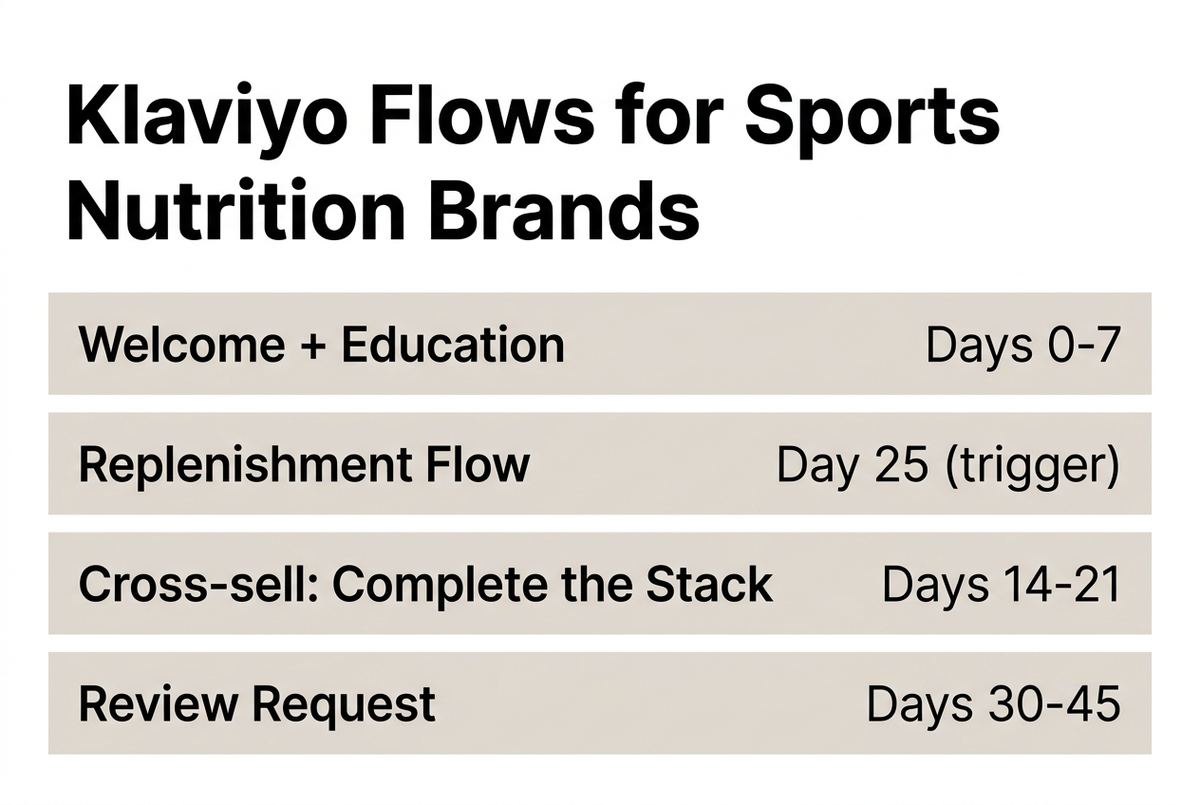
Flow 1: Welcome series with product education (days 0-7)
The welcome sequence for a sports nutrition brand should not just introduce the brand - it should educate the buyer on how to get the best results from the product. Protein dosing protocol, timing relative to training, mixing tips, how to track progress toward their goal. This reduces returns, reduces negative reviews and increases the chance of a second purchase.
Flow 2: Replenishment flow - the most important automation you will build
A 1kg protein tub at 30g per day runs out in approximately 33 days. Set a flow trigger at day 25 post-purchase: 'Your protein supply is probably running low - order now and we will deliver before you run out.' Add urgency at day 30. Add a winback incentive at day 37 if no repurchase has occurred.
For pre-workout at typical dosing (one serving per training session, four sessions per week), a 30-serving tub lasts about 7 weeks. Map every product SKU in your catalogue to its consumption timeline and build individual replenishment flows by product. This is one of the highest-ROI setups you can do in Klaviyo.
Flow 3: Post-workout routine cross-sell (days 14-21)
After the buyer has received their first product and used it for two weeks, introduce the complementary product in their training routine. Protein buyers get a creatine or recovery product recommendation. Pre-workout buyers get a protein recommendation. This is the highest-converting cross-sell window in sports nutrition because the buyer is already in an active usage mindset.
Flow 4: Results check-in and review request (days 30-45)
Unlike beauty supplements where results take 60-90 days, sports nutrition buyers feel effects within 2-4 weeks of consistent use. The review request window is earlier than in beauty. Trigger a 'how is your training going?' email at day 30, and include a review request at day 45. Reviews collected from engaged, active buyers are significantly higher quality than generic post-purchase requests sent on day 7.
Building the right Klaviyo flow structure for a sports nutrition brand is not the same as copying a fashion or beauty template. The replenishment logic, cross-sell sequencing and education content are all category-specific. Book a call to see how we build this for sports nutrition brands.
Subscription Models: The LTV Game-Changer in Sports Nutrition
Subscriptions fundamentally change the unit economics of a sports nutrition business. A subscribed customer eliminates the repurchase anxiety, reduces your paid acquisition dependency and dramatically improves CAC-to-LTV ratios.
But subscriptions are not appropriate at every stage and need to be set up correctly to avoid churn.
When to introduce subscriptions: Once your product has enough reviews to support a subscription offer (typically 50+ verified reviews) and your logistics are reliable enough to ship on a fixed cadence without disruption. A bad first subscription experience - late delivery, wrong product, no communication - destroys trust faster than any other single failure.
Subscription discount positioning: The discount for subscribing (typically 10-15% in sports nutrition) needs to be framed around the benefit of never running out, not just the savings. 'Never run out of protein - get it automatically at 12% off' consistently outperforms '12% off when you subscribe' because it leads with the functional benefit.
Churn prevention in Klaviyo: The biggest churn moment is the second or third delivery. Set a flow trigger at day 20 of each subscription cycle asking 'is everything going well?' and giving the subscriber an easy way to pause or adjust rather than cancel. Pause options reduce cancellations significantly - a subscriber who pauses is far more likely to remain a long-term customer than one who cancels outright.
In sports nutrition, a subscribed customer typically generates between 3x and 5x the revenue of a one-time buyer over a 12-month period. The acquisition cost is identical. The unit economics difference is entirely driven by the retention mechanics built into the post-purchase experience.
Community as an Acquisition Channel
Paid acquisition gets most of the attention in sports nutrition marketing discussions. Community acquisition gets almost none - and that is a significant gap in how most brands allocate their early-stage marketing investment.
Community acquisition for sports nutrition works across three distinct formats:
Gym partnerships and product sampling: A partnership with three to five local gyms in your target city - where you provide sample sachets or a small product supply for the gym's shake bar - generates direct brand exposure to your exact target audience at very low cost per trial. Conversion from trial to purchase, when the product tastes good and delivers on its promise, is high.
Athlete ambassador programmes: Not macro-influencers with broad audiences, but committed gym-goers with 2,000-15,000 followers who train seriously and speak authentically to their community. **Micro-athletes outperform macro-influencers in sports nutrition because credibility matters more than reach.** A recommendation from someone who visibly trains hard and uses the product every day is more persuasive than a sponsored post from a fitness account with 500,000 followers.
Forum and community presence: Reddit's fitness communities, Discord servers run by coaches, Facebook groups around specific training disciplines - these are where purchase decisions get made through peer recommendation. Direct promotional posts do not work and often backfire. Genuine contribution to the community, combined with brand transparency where relevant, builds organic credibility over time.
Benchmarks: What to Expect from Meta, Klaviyo and Repurchase
Benchmarks in sports nutrition depend heavily on product category, price point and brand maturity. A single-SKU protein brand at €35 per kg will see different numbers than a premium performance stack at €120. With that context, here is what we observe across our sports nutrition clients:
Meta Ads: A ROAS in the 2.5x-4.5x range is realistic for brands with a solid creative library, strong reviews and a product that has found market fit. Early-stage brands testing cold audiences should expect lower numbers (1.8x-2.5x) while they learn what creative and what audience works. CPM in the fitness and health category runs higher than fashion because the space is competitive - factor that into your budget planning.
Klaviyo email: Open rates of 35-50% for replenishment flows are common in sports nutrition because the timing is highly relevant and the buyer is in an active usage mindset. Generic campaign sends to the full list perform closer to 20-28% open rates. CTR on replenishment flows at 4-8% is achievable with well-written subject lines and clear replenishment messaging.
Repurchase rate: Without subscriptions, a repurchase rate of 35-50% within 90 days is realistic for brands with good product quality and active Klaviyo flows. With subscriptions, that number becomes largely irrelevant because the repurchase is already locked in.
Subscription conversion: Between 15-25% of first-time buyers can be converted to subscribers within the first 60 days if the post-purchase experience (product quality, delivery, education flow) is strong and the subscription offer is well-positioned.
Every sports nutrition brand has a different starting point - product range, price point, current retention mechanics. There is no universal playbook that applies without adapting to your specific situation. Book a free call and we will walk through your brand specifically.
Frequently Asked Questions
Sports nutrition marketing rewards brands that build the infrastructure early - the right Klaviyo flows, a compliant Meta creative library and the first community relationships. The fundamentals are not complicated, but they need to be adapted specifically to how sports nutrition buyers think and behave. Generic supplement guides will not get you there.
Every brand's situation is different. The right Meta strategy, Klaviyo structure and subscription mechanics depend on your product range, price point and current stage. If you want to know what the right approach looks like for your specific sports nutrition brand - book a free call with us.