Paid Membership Programs for Beauty Brands: How to Build a Subscription-Based Loyalty Model That Lifts LTV

Most beauty brands spend the bulk of their marketing budget acquiring new customers. But the brands that are building the most durable businesses in 2026 have a different priority: keeping the customers they already have - and making those customers worth dramatically more over time.
Paid membership programs have become the fastest-growing LTV strategy in beauty ecommerce. Brands like Sephora Beauty Pass and LOOKFANTASTIC Beauty Box proved the model at scale. Now DTC beauty brands are building their own versions - and seeing members deliver 50 to 157% higher lifetime value than non-members.
We work with beauty brands across Belgium, the Netherlands and the UK and have helped clients migrate from basic points-based loyalty toward real membership models. This guide explains how to build one that actually works.
Key Takeaways
- •Paid members typically generate 50-157% higher LTV than non-members in beauty ecommerce
- •The right membership model depends on your price point, AOV, and margin - not just what looks good on paper
- •Klaviyo is the core infrastructure: member-exclusive flows, churn prevention sequences, and VIP early access automations
- •Price point and perceived value are the two biggest levers - get either wrong and members churn fast
- •Churn happens fastest in months 2 and 3 - that is where your intervention sequences matter most
- •Recharge, Bold Subscriptions and Shopify Subscriptions each suit different growth stages
Paid Membership vs. Free Loyalty: When Does the Switch Make Sense?
Most beauty brands start with a free loyalty program - points for purchases, a birthday discount, maybe a referral reward. Free programs are easy to launch, require no commitment from the customer, and accumulate a database of engaged buyers.
The problem is that free programs create a discount expectation without creating genuine retention. When a customer in a free program is close to a reward, they buy. When they are not, they don't. The program tracks behaviour more than it changes it.
A paid membership flips the psychology
A customer who has paid €29 or €49 per year for membership status is not neutral about your brand. They have committed. That commitment creates behaviour change: higher purchase frequency, higher AOV, lower price sensitivity, and a genuine reason to stay loyal rather than shop around.
The shift from free to paid makes sense when:
- Your brand has an existing customer base with repeat purchasers (at least 20-30% of revenue from second+ purchases)
- Your product range supports multiple purchases per year - replenishable items, routines, seasonal launches
- You can offer perks that have genuine perceived value above the membership fee
- Your current loyalty program is mostly used by your existing loyalists and barely moves the needle for the middle tier
Not sure if your brand is ready for a paid membership model? Book a free call and we will assess your current retention metrics and tell you whether it makes sense.
The Business Case: What the LTV Data Shows
The most common question we get is: does a paid membership actually increase LTV, or does it just reward customers who would have bought anyway?
The data from beauty DTC brands is consistent. Members outperform non-members across every key retention metric. Across the brands we work with and the broader DTC beauty category:
Beauty brand members show 50-157% higher LTV than non-members. The variance depends on price point, perk value, and how well the member experience is maintained after sign-up.
The mechanism is straightforward. A member who has paid for access has a financial and psychological reason to extract value from that membership. That means:
- **Higher purchase frequency** - members buy more often because they have a reason to engage with the brand on a regular basis
- **Higher AOV** - members use their perks (discounts, early access, free shipping) more confidently because they feel entitled to them
- **Lower churn to competitors** - a member who is actively receiving value from your program has a real switching cost that a free loyalty member does not
- **Higher referral rate** - members who feel genuine affinity share more, particularly when they have tangible benefits to talk about
The key word is "genuine". A membership that delivers weak perks relative to the price will see churn spike in month 2 and 3 as customers realise the value is not there. A membership with genuinely valuable perks at a fair price creates the compounding effect that improves all of the above metrics.
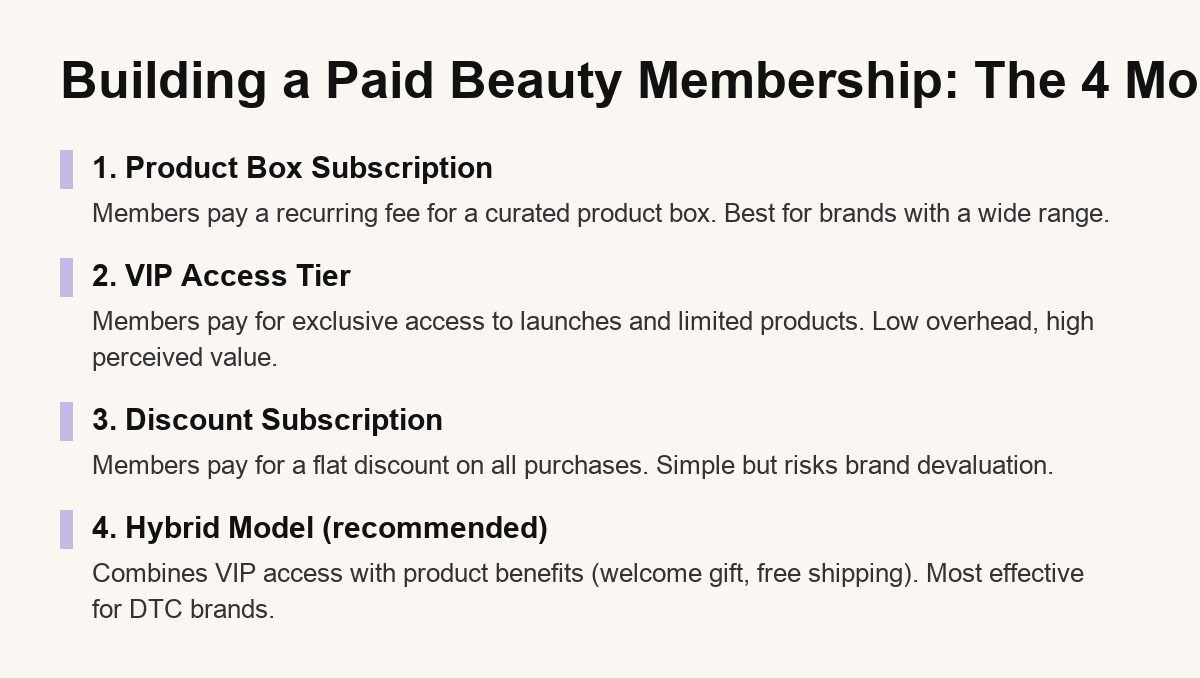
Membership Structures for Beauty: Four Models and When to Use Each
1. Product box subscription
The customer pays a monthly or quarterly fee and receives a curated product box. This is the LOOKFANTASTIC Beauty Box model. It works best for brands with a wide product range or the ability to include partner products that add perceived value.
Strengths: guaranteed recurring revenue, product discovery for slower-selling SKUs, high perceived value if curation is strong. Risk: high operational complexity, customer expectations around curation quality are unforgiving.
2. VIP access tier
The customer pays an annual fee for access to a tier with specific benefits - early access to launches, exclusive products, members-only events, priority customer service. This is closer to the Amazon Prime model: the value is in the privilege and access, not in the product box itself.
Strengths: lower operational overhead than a box model, scales well, aligns with aspirational brand positioning. Risk: if launches are infrequent or the exclusive experience is underwhelming, perceived value evaporates fast.
3. Discount subscription
The customer pays a monthly fee in exchange for a flat percentage discount on all purchases. This is the simplest model to launch and the easiest to understand. The risk is that it trains customers to expect a discount on every order, which compresses margin and creates problems when you exit the program.
We generally advise against pure discount subscriptions for beauty brands with positioning above the mass market. **The discount model works against the premium perception you are trying to build.**
4. Hybrid model
The most effective structure for established DTC beauty brands combines elements of VIP access and product benefits: annual or monthly membership with a combination of early access, a welcome product gift, free shipping thresholds, exclusive formulations, and occasional member pricing.
This is the model that the highest-performing beauty brands we work with use. It gives enough tangible benefit to justify the fee, enough experiential benefit to create genuine affinity, and enough operational simplicity to maintain consistently.
Hybrid membership models - combining product benefits with VIP access - show the strongest retention across beauty DTC. The welcome gift alone drives 35-40% of early membership satisfaction scores.
Price Point and Perks: Getting the Value Equation Right
This is where most membership programs fail. The price point has to be low enough to convert, but the perks have to be strong enough that members feel they are winning. Getting either wrong collapses the model.
Price point benchmarks for beauty membership
Based on what we see across DTC beauty brands in the Benelux, UK and broader European market:
- €19-29/year: entry-level, works for mass-market and affordable skincare brands. Low barrier to entry, but perks need to be proportionate.
- €39-59/year: the sweet spot for contemporary DTC beauty brands (€30-80 AOV). Enough to signal commitment, low enough not to create friction at signup.
- €79-99/year: premium tier, works for luxury or science-led beauty brands with €100+ AOV. The perks at this level need to include genuine product value (a welcome kit at minimum).
Monthly membership (€5-9/month) works when your customer has high purchase frequency - replenishment brands, multi-step routine brands, or brands where the customer is buying at least monthly already.
What perks actually convert (and what doesn't)
Perks that drive membership sign-ups and retention:
- Welcome gift (a full-size product or curated sample set) - the single most important perk for initial conversion
- Free shipping above a lower threshold than non-members (e.g. free shipping at €30 for members vs. €60 for non-members)
- Early access to launches - works best for brands with strong product drops or limited editions
- Members-only formulations or shades - creates genuine exclusivity that cannot be replicated
- Annual birthday gift - low cost, high perceived value
Perks that underperform:
- Generic points multipliers (members already feel they are in a loyalty program - they want something different)
- 10-15% discount that requires a minimum spend (feels conditional, not like a privilege)
- "Priority customer service" as a standalone perk - customers only value this when they have a problem
Getting the price-to-perk ratio right requires understanding your margin per order and your existing customer purchase behaviour. Book a free call and we will look at your retention data to find the right structure for your brand.
Klaviyo for Members: The Flows That Retain and Convert
Klaviyo is the operational backbone of a beauty membership program. Without the right flow architecture, you are leaving most of the LTV uplift on the table.
Member welcome flow (trigger: membership purchase)
This flow fires immediately when a customer becomes a member. It should do three things: confirm the value of their decision (reinforce that they made a smart choice), deliver the practical details of their membership (what they have access to, where to find it), and set expectations for what is coming.
**A strong member welcome flow dramatically reduces month-1 churn.** We structure it as:
- Day 0: Welcome email with membership confirmation, welcome gift fulfilment details, and a direct link to the member portal or benefits page
- Day 3: "Here's everything you can do as a member" - a practical guide to each perk with clear instructions
- Day 7: First member-exclusive offer or early access teaser, reinforcing that membership is active and delivering value
VIP early access automations
When your brand has an upcoming launch, members should receive access 24-72 hours before the general public. In Klaviyo, this is a segment-triggered flow: members get a specific email while non-members receive the standard launch email at a delayed send time.
This is one of the highest-perceived-value perks you can offer at low operational cost. The email needs to reinforce that this access is exclusive. **"As a member, you get first access" should be explicit, not implied.**
Churn prevention sequences
Churn in beauty membership programs peaks in months 2-3. The customer signed up, used the welcome gift, and has not found another reason to stay engaged. Without intervention, the renewal reminder in month 11 will see a spike in cancellations.
The churn prevention flow fires based on member engagement signals - email open rate, purchase frequency, website activity. Members who have gone 45+ days without a purchase or meaningful email engagement get a re-engagement sequence:
- "You haven't used [benefit] yet" - remind them of an unused perk
- "Members-only recommendation" - personalised product based on purchase history
- A clear statement of what they would lose by cancelling
In beauty membership programs, churn intervention at day 45-60 of inactivity recovers 20-35% of at-risk members. Without intervention, the same cohort shows 60%+ cancel at renewal.
Renewal reminder sequence
Annual members need a renewal sequence 30, 14, and 3 days before their anniversary. This is not just a payment reminder - it is a value recapitulation. What did they receive this year? What is coming in the next 12 months? Why should they renew?
The renewal email at day -30 should include a personalised summary of member benefits used in the past year. Klaviyo's dynamic content makes this straightforward: pull purchase count, estimated savings from free shipping, and any exclusive products accessed.
Meta Ads for Membership Acquisition: How to Advertise a Paid Program
Advertising a paid membership is different from advertising a product. You are selling a relationship and ongoing value, not a single purchase. The creative and copy strategy needs to reflect that.
What works in membership acquisition ads
**Social proof from existing members is the strongest creative format.** A member testimonial that references a specific benefit ("I got early access to the summer launch and it sold out an hour later - non-members couldn't even get it") outperforms generic membership ads in our experience.
Concrete benefit visualisation works better than abstract claims. Show the welcome gift. Show the early access email. Show the free shipping threshold comparison. Make the value tangible.
The landing page for membership acquisition needs to do the conversion work - a dedicated membership page with clear price, clear perks, clear testimonials, and a simple checkout. Sending membership ads to a generic homepage is the most common mistake we see.
CTR and ROAS benchmarks for beauty membership ads
Membership ads have a different performance profile than product ads. Expect lower CTR (you are selling something less immediately gratifying than a product) but higher quality traffic. The customer who clicks a membership ad and converts is worth significantly more than a standard product customer - their LTV justifies a higher CAC.
We recommend treating membership CAC separately from product CAC in your reporting. A customer acquired via membership with €45 CAC who generates €380 LTV is a very different calculation than a product customer acquired at €18 who generates €95 LTV.
Churn Prevention: The Interventions That Work
Every beauty membership program loses members. The question is whether your churn rate is structural (the program design is wrong) or operational (the experience is inconsistent). These require different responses.
Structural churn signals
If you see high churn in months 1-2, the problem is usually the value proposition: the perks were not worth the price, the welcome gift was underwhelming, or the member experience started strong and immediately went quiet.
If you see high churn at renewal (month 11-12 for annual programs), the problem is usually the sustained experience: members used the welcome gift, got a few early access emails, and did not feel the program was actively delivering value throughout the year.
Operational interventions in Klaviyo
The most effective churn reduction tactics across the beauty membership programs we manage:
- Mid-year check-in email: "Here's what you've received as a member" - a personalised summary at the 6-month mark
- Surprise benefit delivery: an unexpected perk (sample, discount, exclusive content) sent 2-3 months after sign-up, when engagement is most at risk
- Pre-cancellation save flow: if a member clicks the cancellation link, trigger an immediate email with a pause option, a retention offer, or a reminder of upcoming perks
**The pause option is often more effective than a retention discount.** A member who pauses is not generating revenue but has not fully disengaged. 40-60% of paused members resume before the pause period ends in our experience.
Tools: Recharge, Bold Subscriptions, Shopify Subscriptions and Okendo Loyalty
The right tool depends on your growth stage, your membership complexity, and your existing Shopify infrastructure.
Shopify Subscriptions
Best for: early-stage beauty brands launching a first membership program. It is free, native to Shopify, and handles basic recurring billing without complexity. Limitations: minimal flexibility for multi-tier programs or complex perk structures. If you want more than a simple recurring charge, you will outgrow it quickly.
Recharge
The most widely used subscription infrastructure for Shopify beauty brands. Recharge handles complex membership billing, supports trial periods, pause flows, and integrates directly with Klaviyo for flow triggers. It is the right choice for brands building a serious membership program at scale. Pricing starts at a percentage of subscription revenue, which adds cost as you scale but aligns incentives.
Bold Subscriptions
A solid alternative to Recharge with strong Shopify integration. Works well for beauty brands that want more control over the cancellation flow and member portal without the Recharge price point. Less native Klaviyo integration - you will need to use webhooks to pass membership events into Klaviyo properly.
Okendo Loyalty (with membership tier)
Okendo's loyalty platform now supports paid membership tiers alongside its review product. For beauty brands already using Okendo for reviews, adding the loyalty and membership layer creates a unified customer experience. The integration with Klaviyo is clean. The limitation is that Okendo is weaker than Recharge on complex billing scenarios.
For DTC beauty brands at €500K-€2M annual revenue, Recharge + Klaviyo is the most common membership infrastructure stack we see. Below €500K, Shopify Subscriptions or Bold Subscriptions reduce operational complexity at lower cost.
Frequently Asked Questions
Every beauty brand's situation is different. Whether a paid membership program is the right move depends on your current retention rate, product range, margin, and customer base. If you want to know what the right model looks like for your specific brand - book a free call with our team.