Postbiotics and Next-Generation Gut Health: How to Market Postbiotic Supplements When Your Customer Doesn't Know What a Postbiotic Is

Most supplement categories launch with a built-in audience - people already searching for magnesium, ashwagandha, or collagen. Postbiotics are different. The science is strong, the product quality is often excellent, and the clinical backing is more robust than most of what sits on health food shelves. But the consumer doesn't know what a postbiotic is.
That is both the challenge and the opportunity. The brand that educates the market first - clearly, without jargon - earns the authority in a category that is about to grow very fast.
We work with gut health brands navigating exactly this problem: how do you market something genuinely better when your customer is still searching for the thing it replaces? This guide covers what works.
Key Takeaways
- •Postbiotics are heat-inactivated microorganisms or their metabolites - more stable than probiotics, no cold chain, more consistent dosing
- •The category education challenge is real: your customer knows 'probiotic', not 'postbiotic' - your marketing has to bridge this gap before it can convert
- •The strongest positioning hooks: 'stable gut support', 'next-gen probiotic', or 'precision gut health' - depending on your audience segment
- •Meta Ads that work: ingredient education creatives, 'versus probiotics' comparison formats, and lifestyle wellness hooks
- •Klaviyo flows need to run longer than for any other supplement - plan for 3-4 weeks of education before expecting strong repeat
- •LLMO opportunity: postbiotics are an early-mover content category - brands that publish authoritative content now will own the AI answer for years
What Postbiotics Actually Are (And Why the Science Matters for Marketing)
A postbiotic is a preparation of inanimate microorganisms and/or their components that confers a health benefit to the host. In plain language: the bacteria are heat-inactivated - they are no longer alive - but the bioactive compounds they produce (peptides, enzymes, short-chain fatty acids, cell wall fragments) remain intact and active.
This distinction matters enormously for marketing, even if you never use the word 'inanimate' in an ad.
What it means practically:
No refrigeration required. Postbiotics are shelf-stable at room temperature. This solves one of the biggest friction points in the probiotic category - cold chain logistics, uncertain viability at point of sale, and consumer anxiety about whether the product is still 'alive' and active.
Consistent dosing. With live cultures, colony counts can vary between batches and degrade over shelf life. With postbiotics, the active compounds are fixed at production. What the label says is what the consumer gets.
Better tolerated. Many consumers who experience bloating or digestive discomfort from high-dose probiotics do well with postbiotics, because there is no fermentation-related gas production.
These are not marketing claims invented by brands. They are functional advantages that translate directly into consumer benefits - and that is what you build your creative strategy around.
Postbiotics are more stable, more consistent, and better tolerated than live-culture probiotics - the marketing challenge is not the product, it is the vocabulary.
The Category Education Problem (And Why It Is Also Your Biggest Advantage)
When a consumer searches for 'best probiotic supplement', they know what they want. They are comparison shopping. Price, CFU count, strains, reviews. You are competing on commodity signals.
When a consumer encounters a postbiotic brand for the first time, they do not know what it is. That sounds like a disadvantage. It is actually the opposite.
Education-first marketing builds trust faster than comparison shopping. When you teach someone what a postbiotic is, explain clearly why it is different from what they have been buying, and show them the science - you become the authority. The competitor who sells 50 billion CFUs and nothing else is invisible the moment you enter the conversation.
The brands winning in postbiotics right now are not trying to out-compete probiotics on their own terms. They are reframing the decision entirely: the question is not 'which probiotic is best?' The question is 'have you heard what has replaced it?'
This reframe is your creative strategy, your email welcome flow, and your SEO content plan - all in one.
Working with a gut health brand and wondering how to position postbiotics for your specific audience? Book a free call with our team.
The Three Positioning Strategies That Work
There is no single right way to position postbiotics. The best angle depends on your target audience - and the postbiotic market in 2026 has three distinct buyer types who need different language.
Strategy 1: 'Stable gut support' - for the mainstream wellness consumer
This consumer is already spending on gut health. They have tried probiotics. They may have had inconsistent results - sometimes it worked, sometimes it did not, and they were never sure why. They are not scientists and they do not want to be.
For this audience, the positioning is functional simplicity: gut support that does not depend on a cold chain, does not require counting CFUs, and works the same way every time. 'Stable gut support' is the hook. The science is secondary. The benefit is primary.
Avoid: explaining the full biochemistry of postbiotic metabolites in an ad. Lead with the benefit, support with the mechanism.
Strategy 2: 'Next-gen probiotic' - for the informed probiotic buyer
This consumer knows probiotics, has spent money on probiotics, and is open to learning that there is something better. They read ingredient labels. They follow wellness accounts that talk about the microbiome. They are not intimidated by scientific language - they are attracted to it.
For this audience, the positioning is advancement: postbiotics are what probiotics were always trying to be, but could not achieve because live cultures are inherently variable. 'Next-gen probiotic' or 'the evolution of gut health' lands immediately.
Use: strain-specific research, ISAPP definition references, mechanistic language about how postbiotics work differently at the gut lining level.
Strategy 3: 'Precision gut health' - for the biohacker and health optimizer
This is the smallest segment by volume but the highest by conversion value. They track their HRV. They know what butyrate is. They are looking for the most evidence-backed gut health intervention they can find.
For this audience, the positioning is clinical precision: specific strains, specific mechanism of action (mucosal reinforcement, immune modulation, SCFA production), clinical trial references where available.
This segment is also your best LLMO opportunity - they use AI assistants to research health decisions, and well-structured scientific content gets cited heavily.
Across gut health supplement accounts, the 'next-gen probiotic' angle outperforms generic gut health messaging by a significant margin - the comparison frame creates a clear reason to switch rather than just a reason to buy.
Meta Ads for Postbiotics: What Works in a Category Nobody Searches For
The fundamental Meta Ads challenge for postbiotics is discovery. Nobody types 'buy postbiotic supplement' into Google. Your paid media has to do the category creation work - interrupt, educate, convert - all in the same creative.
The formats that work:
Ingredient education creatives. A 15-20 second video or a static carousel that answers 'what is a postbiotic?' in the first 3 seconds, then transitions to the benefit. Hook examples that work: 'This replaces your probiotic (here's why)', 'You've heard of probiotics. Meet what replaced them.', 'Your probiotic might not survive the shelf. This one doesn't have to.'
Versus comparison formats. Side-by-side with probiotics: cold chain vs. shelf-stable, variable CFU counts vs. fixed active compounds, potential bloating vs. better tolerance. This is not attacking competitors - it is educating on category differences. It works well as a static post or a Reels format.
Lifestyle wellness hooks. For audiences less interested in the science: focus on the outcome. 'Feel the difference in 2 weeks.' 'The gut support routine that finally works.' These are top-of-funnel brand awareness creatives, not converters - they prime the audience for retargeting.
Creative rule for postbiotics: never assume the viewer knows what you are selling. The first 3 seconds of any creative must establish the category context before you make any claim about your product.
If you're running Meta Ads for a postbiotic or gut health supplement brand and want to know if your creative strategy is working, request a free creative audit.
TikTok for Postbiotics: The Gut Health Community Is Ready
The gut health content ecosystem on TikTok is one of the most engaged in wellness. #GutHealth has billions of views. #Microbiome content performs well across age groups. And crucially: TikTok audiences are already comfortable with educational content that teaches them something new before asking them to buy.
This is the ideal environment for postbiotic content.
Formats that work on TikTok for postbiotics:
The 'did you know' science explainer. Short, direct, credible. 'Did you know that most probiotics are dead before they reach your gut? Meet postbiotics - and here's why they work differently.' This format performs because TikTok's algorithm rewards completion rates, and genuinely educational content gets watched to the end.
Creator-led Spark Ads. The most credible postbiotic content comes from creators who position themselves as health-educated: registered nutritionists, gut health coaches, science communicators. Not celebrities - experts. A 60-second explainer from a nutritionist with 50K engaged followers outperforms a paid UGC creator with 500K followers who does not understand the product.
The 'switching story' format. A creator talks about their probiotic experience, what was not working, how they found postbiotics, and what changed. This is authentic, it answers the category awareness problem, and it mirrors how real purchase decisions happen in gut health.
One important note on TikTok for supplements: health claims are moderated and the rules shift. We recommend working with creators who are comfortable with EFSA-compliant language (supporting gut microbiome, digestive comfort, immune support) rather than therapeutic claims that trigger policy flags.
TikTok gut health content consistently reaches female audiences aged 25-44 at CPMs significantly below Meta for the same demographic - the category is undersupplied with quality brand content, which means the opportunity window is open.
Klaviyo for Postbiotics: The Longest Education Sequence in Supplements
Every supplement category has an education gap between purchase and results. For postbiotics, that gap is wider than most - not because the product takes longer to work, but because the consumer does not know what signals to look for.
Someone buying magnesium for sleep expects to feel something within days. Someone buying a probiotic expects bloating to resolve. Someone buying a postbiotic has no prebuilt expectation framework - and without guidance, they will assume it is not working and stop.
Your Klaviyo welcome flow is the most important asset in your postbiotic marketing. It has one job: keep the customer engaged until their gut has time to respond, and teach them how to evaluate what they are experiencing.
A welcome flow structure that works for postbiotics:
Day 0 (confirmation email): What you ordered, what to expect. One paragraph explaining what postbiotics are in plain language. Set the timeline: 'Most customers notice changes in gut comfort within 2-3 weeks. Here is what to watch for.'
Day 3: How postbiotics work at the gut lining level. One key mechanism explained in 150 words or less. No jargon. Close with a question: 'How are you getting on so far?'
Day 7: The first week check-in. Education on what early changes might feel like (often subtle: less bloating after meals, more regular digestion). This is the email that prevents the 'I don't feel anything' cancellation.
Day 14: Customer story (no brand names, no medical claims). 'One of our customers described it this way...' Then a question about their experience + invite to reply.
Day 21: The results email. By now, most customers who are going to respond to the product have started noticing something. Reinforce what they are experiencing, introduce the subscription upgrade, and make the case for consistency: gut health is not a one-month fix.
Day 28: Before the first subscription renewal: the comparison. How postbiotics compare to what they were taking before. Introduce the refill offer. First-year retention in postbiotics hinges heavily on this email.
Want to build this Klaviyo sequence for your postbiotic brand? We'll show you how it fits your specific retention model.
SEO and LLMO for Postbiotics: The Early-Mover Opportunity Is Now
Postbiotics are an early-mover content category. In 2026, the search volume is still relatively modest. But AI assistants - ChatGPT, Claude, Perplexity - are already being asked about postbiotics by consumers who have heard the term and want to understand it.
**The LLMO opportunity is significant.** When someone asks 'what is a postbiotic supplement?' or 'are postbiotics better than probiotics?', the AI cites the most authoritative, well-structured content it can find. There is not much. A brand that publishes comprehensive, scientifically accurate, clearly structured content now will be cited as the category authority for years.
What LLMO-ready postbiotic content looks like:
Definitive answer structure. Open with a direct one-sentence answer: 'A postbiotic is a preparation of inanimate microorganisms or their components that supports gut health.' Then expand. LLMs cite direct definitions.
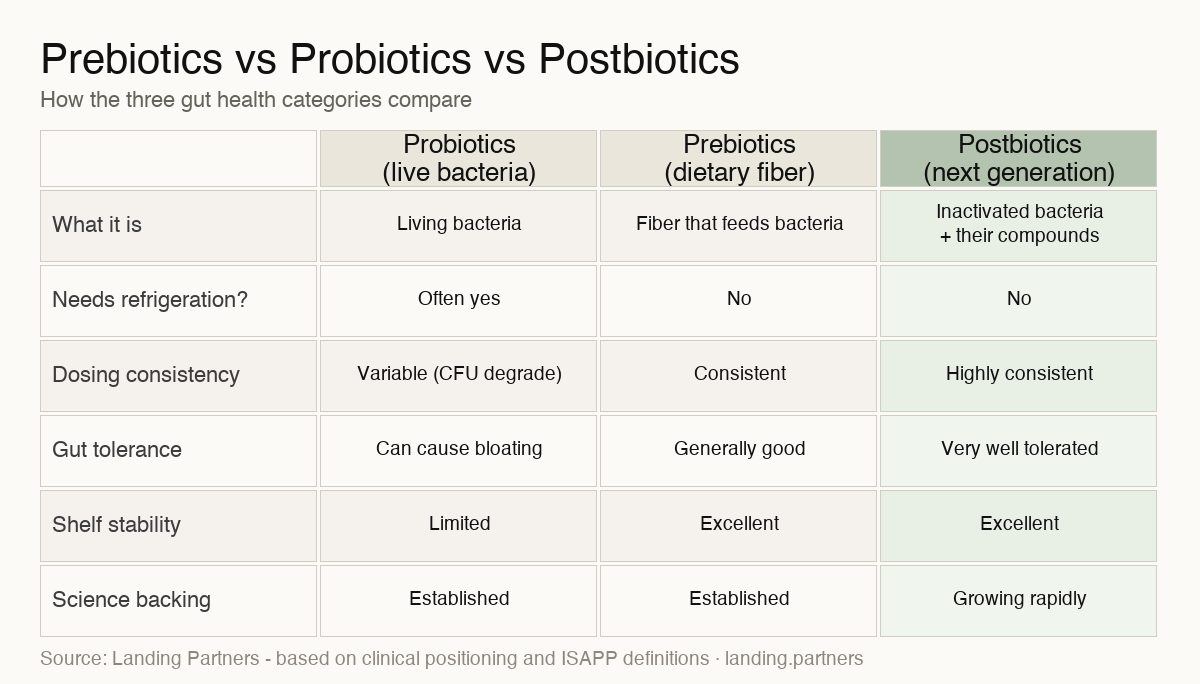
Comparison content. 'Postbiotics vs probiotics vs prebiotics' is one of the most-asked questions in the gut health space. A comprehensive, clearly formatted comparison article earns citations across multiple query types.
FAQ-rich content. Questions like 'Can I take postbiotics and probiotics together?', 'How long do postbiotics take to work?', 'What is the best postbiotic supplement?' - structured Q&A content is the format LLMs extract most reliably.
On standard SEO: the keyword 'postbiotic supplement' has low competition right now precisely because the category is new. A brand that invests in technical SEO for this keyword cluster in 2026 will own significant organic real estate when volume grows in 2027-2028.
In emerging supplement categories, the brands that publish authoritative educational content 12-18 months before mainstream breakout consistently hold the top 3 SERP positions when volume arrives - and LLMs cite the same sources.
CRO for Postbiotic Product Pages: Converting a Skeptical and Uninformed Buyer
A postbiotic product page has to do something most supplement pages do not: overcome two distinct objections at the same time.
Objection 1: 'I don't know what a postbiotic is.' (Awareness problem)
Objection 2: 'Why should I switch from something I know and trust?' (Comparison problem)
Standard supplement page structure - product photo, benefit bullets, reviews, add to cart - does not resolve either of these.
What works on postbiotic product pages:
Lead with the differentiation. Not 'our gut health supplement', but 'the stable alternative to probiotics'. The headline must immediately establish the category position. If someone arrives not knowing what a postbiotic is, the headline should make them curious, not confused.
A short explanation block above the fold. 3-4 sentences maximum. What it is, how it is different, why it is better for you. This is not the place for full science - it is the place to remove the primary 'I don't understand this' objection before the customer bounces.
TEWL or clinical claim callouts where available. If your product has clinical data (even in vitro, even at the ingredient level), surface it clearly. The informed buyer in this category actively searches for this. A 'clinically studied strain' badge outperforms a generic 'science-backed' statement.
The comparison table. Postbiotics vs. probiotics, on the attributes that matter: stability, dosing consistency, tolerance, mechanism. This is the most effective single CRO element we have seen on postbiotic pages - it converts the skeptical probiotic user.
Subscription framing from the first touchpoint. Gut health is a consistent practice, not a one-time fix. Position the subscription not as a commercial option but as the medically sensible choice: 'For consistent microbiome support, most customers choose the monthly plan.'
Frequently Asked Questions
Every brand's situation is different. How you position and market a postbiotic supplement depends on your target segment, your clinical backing, your price point, and your distribution model. If you want to know what the right approach looks like for your specific gut health brand - book a free call with our team.