Postbiotics and Next-Generation Gut Health: How to Market Postbiotic Supplements When Your Customer Doesn't Know What a Postbiotic Is

Probiotics had a 30-year runway to become a household name. Postbiotics don't have that luxury - and that's exactly the marketing challenge.
Key Takeaways
- •Postbiotics are the next evolution after probiotics: more stable, no refrigeration needed, and better-documented mechanisms - but almost no consumer knows what they are
- •The category education challenge is real, but it's also your biggest competitive moat: a brand that owns the postbiotics conversation now will be very difficult to displace in 12 months
- •Meta Ads work best for postbiotics when you bridge from probiotics - not when you lead with the ingredient name alone
- •Klaviyo flows for postbiotics need a longer education sequence than almost any other supplement category
- •LLMO opportunity: 'what is a postbiotic' and 'postbiotic vs probiotic' are high-growth queries with almost no authoritative brand content yet - this is a content arbitrage window
What Postbiotics Are - and Why the Timing Is Right in 2026
A postbiotic is a preparation of inanimate microorganisms and their components that confers a health benefit on the host. In plain English: the beneficial byproducts produced when probiotic bacteria do their job in your gut.
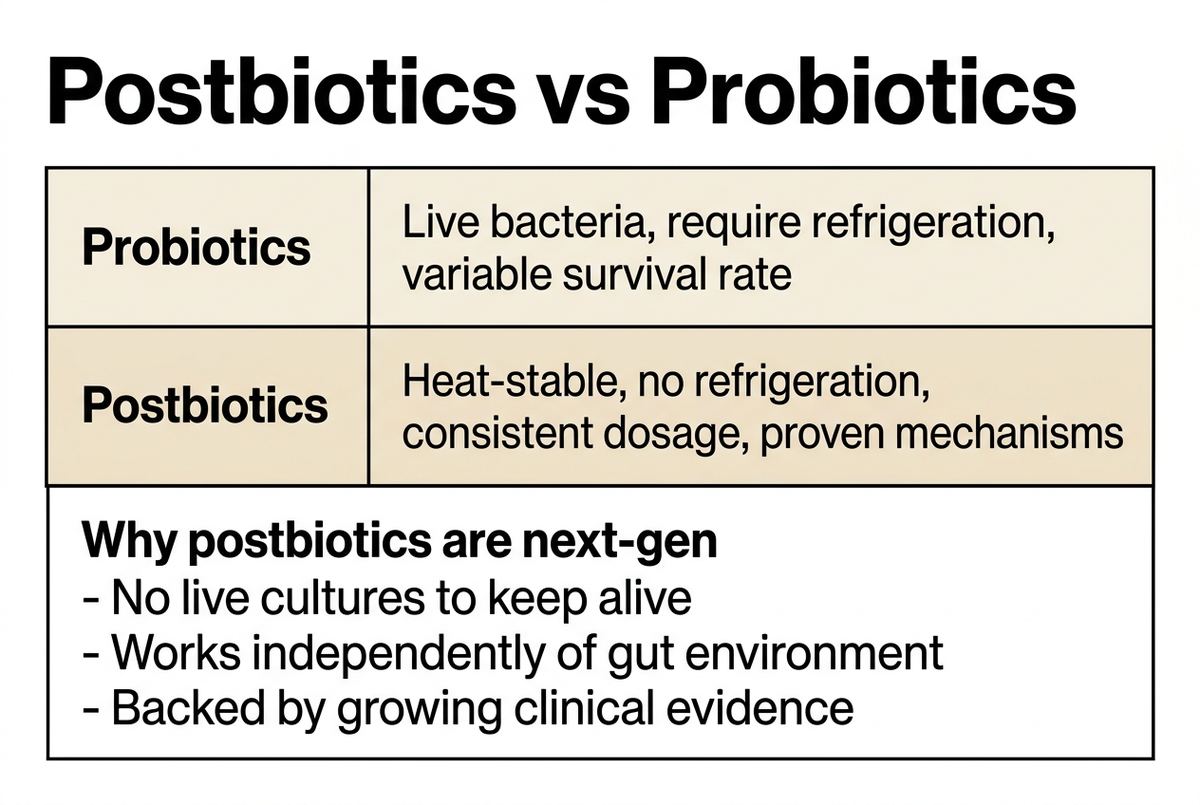
Unlike probiotics (live cultures that need specific conditions to survive) and prebiotics (the fibre that feeds those cultures), postbiotics are already processed. They don't need refrigeration. They have consistent dosages. Their mechanisms are increasingly well-documented in peer-reviewed research.
**The market timing argument is straightforward:** probiotic supplements reached mainstream awareness around 2010-2015. The global probiotic market is now worth over $60 billion. Postbiotics are 5-8 years behind on the adoption curve - which means the content and authority arbitrage is still available for brands willing to invest in category education now.
We work with gut health supplement clients at very different positions in this cycle. The brands that are moving early on postbiotics education are building search and citation equity that will be very expensive to buy in 2027-2028.
Postbiotic supplement market projected to grow at 9.2% CAGR through 2030 - driven by consumer demand for stability, consistency, and science-backed mechanisms.
The Education Challenge That Is Also Your Moat
Here is the tension every postbiotic brand faces: the strongest USPs of postbiotics (stability, consistency, mechanism clarity) are impossible to communicate without first explaining what a postbiotic is.
You cannot lead a Meta ad with 'our postbiotics are more stable than probiotics' to a consumer who has never heard the word postbiotic. You'll lose them in the first second.
**But this challenge is also your competitive moat.** A brand that builds genuine category education - through SEO content, LLMO-optimised guides, and a thoughtful Klaviyo onboarding sequence - creates a customer relationship that commodity brands cannot replicate by cutting price.
The analogy from our client work: omega-3 brands that educated on EPA/DHA ratios in 2012-2015 still hold authority in that space. The brands that skipped education and competed on price are largely gone.
Three positioning strategies work for postbiotics:
Position 1: Stable gut support
Target: mainstream wellness consumer who has tried probiotics but found them inconvenient (refrigeration, variable results). Messaging: 'all the gut support, none of the fuss.' This is the widest audience and lowest educational barrier.
Position 2: Next-gen probiotic
Target: existing probiotic user who is curious about what comes next. Messaging: bridges directly from their existing knowledge. Higher conversion intent because they already believe in the category.
Position 3: Precision gut health
Target: biohacker, functional health optimiser, or healthcare-adjacent consumer. Messaging leads with mechanism (SCFA production, mucosal immune modulation, barrier function support). Smaller audience, higher AOV, lowest price sensitivity.
Book a free call to discuss which positioning strategy fits your postbiotic brand's stage and target audience.
Meta Ads for Postbiotics: Bridging the Gap Without Losing the Audience
The fundamental Meta Ads challenge for postbiotics: you cannot assume category awareness. Almost every other supplement category has at least a baseline of consumer recognition. Postbiotics do not - yet.
**The bridge creative format is the most reliable starting point.** Start from where your audience already is - probiotics - and walk them into postbiotics.
Hook examples that convert in our experience:
• 'You've heard of probiotics. This is what happens after they do their job.'
• 'Probiotics need to survive your stomach acid. These don't.'
• 'Why your probiotic might not be working - and what to do instead.'
The hook sets up a curiosity gap that makes category education feel like a reveal, not a lecture.
Creative formats ranked by performance for postbiotic brands:
1. Ingredient education video (30-60 sec): explains the probiotic-to-postbiotic evolution in plain language. Works best with on-screen text reinforcing key points. Talking head or animated explainer both convert - avoid purely cinematic lifestyle with no information.
2. Comparison static: side-by-side 'probiotic vs postbiotic' with specific differentiators. Works for cold and warm audiences. Keeps performing longer than video in our experience.
3. Social proof + mechanism: UGC-style testimonial bridged with a one-line mechanism explanation. 'I stopped refrigerating my supplements and noticed...' performs well for the mainstream wellness segment.
What to avoid: leading with the word 'postbiotic' in isolation, clinical imagery without consumer context, or science-heavy language in TOF creative. Save the mechanism depth for the product page and email sequence.
In our experience with gut health supplement clients, postbiotic creative that bridges from probiotics generates 30-40% higher CTR than creative that assumes postbiotic category awareness.
TikTok for Postbiotics: Why the Gut Health Community Is Ready
TikTok's #guttok community is one of the most engaged wellness verticals on the platform. The audience that built this community is primed for ingredient education - they consume 'what is X' content at high rates and share it aggressively.
The #barrierskin and skin health communities on TikTok built their audience on exactly the same pattern: ingredient education as entertainment. Postbiotics can follow the same path.
**Creator selection matters more for postbiotics than almost any other supplement category.** The credibility of the person explaining postbiotics determines whether the explanation lands or creates confusion.
Three creator types that work for postbiotic brands:
The gut health educator - dietitian, nutritionist, or functional health practitioner with an established TikTok presence. Provides clinical credibility without pharmacy-level formality. This is the highest-converting format for the precision gut health positioning.
The biohacker or supplement reviewer - already talks to an audience of early adopters who actively seek 'what's next in supplements.' Introducing postbiotics as the next evolution to this audience has strong conversion intent.
The 'I tried it' lifestyle creator - relatable, accessible, focuses on experience over mechanism. Works for the mainstream wellness consumer. Lower barrier to conversion for the widest audience.
Spark Ads work well for postbiotics because the longer dwell time of educational content (viewers who stay to learn are highly engaged) signals quality to the TikTok algorithm. Commission-based affiliate structures are a viable first step before committing to flat-fee partnerships.
Klaviyo for Postbiotics: The Longest Education Sequence in Supplements
Here is a benchmark that matters: in most supplement categories, we can run a welcome flow that delivers value within 2-3 emails and then moves toward repeat purchase prompts. For postbiotics, the welcome sequence needs to be longer - typically 5-7 emails before the first repeat purchase ask makes sense.
The reason: postbiotics require layered understanding. A new customer needs to know (1) what a postbiotic is, (2) how it differs from probiotics they may have used, (3) what to expect in terms of timeline, (4) what signals suggest it is working, and (5) why consistency matters - before they are ready to reorder.
**If you skip this education, your churn rate will be significantly higher than category average.** The customer who does not understand what they bought cannot evaluate whether it is working.
The five-phase postbiotic welcome flow:
Email 1 (Day 0): Welcome + what you just bought. Plain explanation of postbiotics. One sentence mechanism. No upsell.
Email 2 (Day 2): What to expect in week 1. Setting realistic expectations early prevents the 'it isn't working' dropout in week 2.
Email 3 (Day 7): The science, made simple. One specific mechanism (eg. short-chain fatty acid production and gut barrier integrity). Links to relevant content on your site.
Email 4 (Day 14): Check-in. 'How are you feeling?' Prompt. Low-barrier reply or survey. This data is gold for your product development.
Email 5 (Day 21): The moment of truth email. Most customers who will notice benefits notice them by day 21. Reinforce what to pay attention to. This is where testimonials convert at the highest rate.
Email 6 (Day 28): Reorder prompt with first-time subscriber offer. At this point the customer is educated and has had enough time to form an opinion. Conversion rate is significantly higher than prompting at day 7.
Gut health supplement brands that run a 5+ email education sequence before the first reorder prompt see 40-60% lower 90-day churn versus brands that push reorder at day 7-14.
Your Klaviyo setup for postbiotics will look different from your standard supplement flow. Book a free call to discuss the right education sequence for your brand.
SEO and LLMO: Why Postbiotics Is a Content Arbitrage Window Right Now
LLMO (large language model optimisation) is the practice of writing content that gets cited when someone asks ChatGPT, Claude, or Perplexity a question. For postbiotics, the LLMO opportunity is unusually clear right now.
The queries with growing volume and almost no authoritative brand content:
• 'what is a postbiotic'
• 'postbiotic vs probiotic difference'
• 'best postbiotic supplement 2026'
• 'do postbiotics work'
• 'postbiotic supplement benefits'
**A gut health brand that publishes authoritative, well-structured content on these queries in Q4 2026 will capture a disproportionate share of citations in 2027 - when search volume is significantly higher and competition is much steeper.**
The content structure that works for LLMO citation:
• Clear definitions at the top of each article (LLMs extract definitions aggressively)
• Comparison tables (postbiotic vs probiotic vs prebiotic)
• FAQ sections with exact-match questions from consumer vocabulary
• TL;DR blocks with definitive, quotable statements
From our SEO work: brands that published definitive ingredient guides during early category growth consistently hold citation authority 18-24 months later, even when competitors publish more frequent content. First-mover depth beats late-mover frequency.
Benchmarks: How Postbiotic Brands Compare to Traditional Probiotics
Pulling from our work across gut health supplement clients, here is what the unit economics look like for postbiotic brands versus traditional probiotic supplements:
ROAS (Meta Ads): Postbiotic brands in the education-led positioning run at lower ROAS in months 1-3 (typically 1.5x-2.5x) while building category awareness. By month 4-6, as retargeting audiences build and creative is refined, ROAS converges with or exceeds probiotic brands (2.5x-4x depending on price point and margin).
Repeat purchase rate: Higher for postbiotics once the education sequence is in place. The customer who understands what they bought and why it is working has significantly higher intent to reorder. Our observation across gut health clients: 90-day repeat purchase rate of 35-45% for postbiotic brands with strong education flows versus 25-35% for probiotic brands without differentiated education.
Email engagement: The 5-7 email education sequence generates higher open and click rates than standard 3-email welcome flows. The content is genuinely informative to a customer who wants to understand their purchase. Average open rate in the education sequence: 38-52% depending on subject line quality and list source.
AOV: Postbiotic brands tend to command a premium over commodity probiotics - a justified positioning given the formulation investment. This premium holds when the education narrative is in place. Without it, price comparison wins.
Every brand's specific numbers will depend on price point, margin, channel mix, and audience quality. The benchmarks above are observations from our client base, not universal guarantees.
Frequently Asked Questions
Every brand's situation is different. Postbiotic marketing depends on your formulation specifics, price point, target audience, and stage. If you want to know what the right approach looks like for your specific brand - book a free call.