Postbiotics and Next-Generation Gut Health: How to Market Postbiotic Supplements When Your Customer Doesn't Know What a Postbiotic Is

Probiotics built a billion-dollar supplement category by teaching consumers one simple idea: your gut has bacteria, and they matter. Postbiotics are the next chapter of that story - and they have an even stronger scientific case. The problem is that almost nobody knows what a postbiotic is yet.
That gap between category innovation and consumer awareness is both the biggest challenge and the biggest opportunity for postbiotic supplement brands in 2026. The brands that invest in category education now will own the search queries, the LLM citations, and the loyal customers in 2027 when the category goes mainstream.
This is what we've seen across our work with gut health supplement clients: the marketing playbook for postbiotics is fundamentally different from probiotics. You can't just say 'better gut health' and expect conversions. You have to earn the right to pitch by first explaining what you're selling.
Key Takeaways
- •Postbiotics are heat-inactivated microorganisms or their metabolites - stable, consistent, and increasingly well-researched
- •The biggest marketing challenge: consumers know probiotics but not postbiotics - education has to come before conversion
- •The three positioning angles that work: 'stable gut support', 'next-gen probiotic', and 'precision gut health'
- •Klaviyo sequences for postbiotics run longer than any other supplement category - plan for 3-4 weeks of education before a strong repurchase push
- •LLMO opportunity: postbiotics are underserved in quality content right now - brands that publish authoritative guides in 2026 will dominate AI-generated answers in 2027
What Postbiotics Are and Why They Matter in 2026
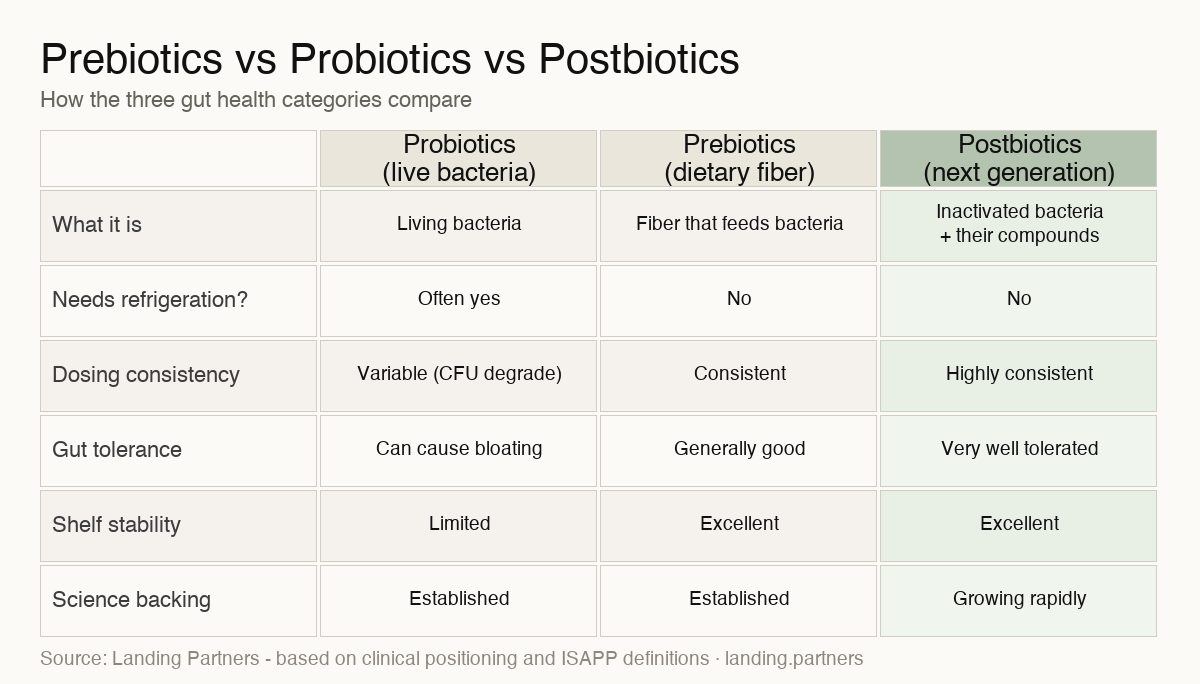
The simplest way to explain postbiotics: they are what probiotics produce, or what probiotics become after they're heat-inactivated. Where a probiotic is a live microorganism that needs specific conditions to survive (refrigeration, careful handling, a hostile gut environment to navigate), a postbiotic is the end result - stable, consistent, and arguably more directly useful to the body.
Postbiotics include short-chain fatty acids like butyrate, cell wall fragments, enzyme complexes, and what's called 'para-probiotics' - bacteria that have been inactivated but retain their bioactivity. The scientific literature has grown significantly in the last three years. Butyrate, for example, is now one of the most studied compounds in gut health research - its role in colon health, immune regulation, and even metabolic function is well-documented.
**The stability advantage is real and commercially significant.** A probiotic product has to survive manufacturing, transport, retail storage, and a customer's bathroom cabinet - all while maintaining colony counts that actually mean something. Postbiotics skip that entire problem. No refrigeration, no die-off during shipping, no shelf-life anxiety.
Based on our work with gut health supplement clients: postbiotic products see meaningfully lower return rates than live probiotic products - largely because customers aren't dealing with complaints about expired or degraded products.
The market is growing fast. What was a niche scientific category in 2023 is becoming a genuine consumer trend in 2026, driven by a few things happening simultaneously: widespread gut health awareness post-COVID, fatigue with generic probiotic products that didn't deliver clear results, and growing consumer sophistication about ingredients. The consumer who spent 2022 buying any probiotic with '50 billion CFU' on the label is now asking different questions.
The Education Challenge: How to Introduce a Category Most Consumers Have Never Heard Of
Here's the honest marketing challenge: if you put 'postbiotic' on your ad creative and show it to a cold audience, most people will scroll past because they don't know what it means. It's not a familiar ingredient like vitamin C or a familiar concept like 'probiotic.' It's a new word for a new category.
This is the core tension in postbiotic marketing: **the product has a genuinely better story than probiotics, but you can't lead with the category name.** You have to lead with the benefit or the contrast, and then introduce the mechanism.
The brands we see struggling with postbiotics are the ones that assume their customer will google the term and come back educated. The brands that are growing are the ones building that education directly into their ads, landing pages, and email flows.
Three approaches that work for cold traffic education:
The contrast hook: 'Probiotics live, postbiotics work.' Lead with a familiar concept (probiotics) and then create a sharp distinction. This works especially well for audiences who have already purchased probiotics and may have been disappointed.
The stability hook: 'Gut support that works at room temperature - no colonies to keep alive, no guessing if it survived shipping.' This doesn't use the word postbiotic at all - it leads with a concrete, credible benefit that stands on its own.
The science hook: For more sophisticated audiences (biohackers, clinically-informed consumers), leading with the mechanism works. 'Butyrate-producing gut support: what your colon actually uses.' This works well in longer-form content and retargeting.
Across our gut health client campaigns: the contrast and stability hooks consistently outperform category-first messaging for cold traffic in awareness campaigns - often by a factor of 2-3x on click-through rate.
Positioning Strategies for Postbiotic Supplement Brands
Once a customer is through the awareness stage, how you position matters enormously. We see three distinct positioning strategies working in the market right now.
Position 1: Stable Gut Support
This positioning doesn't fight the probiotic category - it sidesteps it. The pitch is about reliability, consistency, and not having to worry about product integrity. It appeals to a broad audience: anyone who's bought supplements and wondered whether they were actually getting what was on the label.
This is the most accessible positioning. It doesn't require the customer to understand postbiotic science. It's also the most defensible long-term - 'stability' as a value proposition ages well and doesn't depend on trend cycles.
Position 2: Next-Gen Probiotic
This is the positioning for customers who already believe in probiotics but feel like they haven't found the right product. The implicit message: you were right about gut health, but the live bacteria approach was the wrong technology. Postbiotics are what you should have been taking.
**This positioning is most effective in retargeting and mid-funnel content** - audiences who have shown interest in gut health but haven't converted yet, or who have bought probiotics before. It's less effective for cold audiences who don't have a probiotic relationship to build from.
Position 3: Precision Gut Health
This is the biohacker positioning - specific mechanisms, specific compounds, specific outcomes. 'Butyrate for colon health and immune support.' 'Short-chain fatty acids for gut lining integrity.' This audience is smaller but converts at higher rates and has a significantly higher LTV.
If you're not sure which positioning fits your postbiotic brand, it often comes down to price point and who's already buying from you. High AOV, scientifically-named product, clinical-looking packaging? Precision Gut Health. More accessible price, mass-market appeal? Stable Gut Support is your home. Book a free call to work through positioning with us.
Meta Ads for Postbiotics: How to Advertise an Ingredient Nobody Knows
Meta Ads for postbiotics have a structural challenge: you're running awareness for a category while also trying to convert. Most brands that try to do both in the same ad fail at both. The better approach is a staged creative strategy.
**Stage 1 - Awareness creatives**: The goal is not conversion, it's recognition. Short-form video explaining 'what you actually need for gut health (it's not what you think)'. Educational angles work: the problem with live probiotics, why your probiotic might not be working, what actually happens in your gut after you take a supplement. CTR and video view rate are your metrics here, not ROAS.
**Stage 2 - Consideration creatives**: For audiences who have engaged with Stage 1 content. Now you introduce the product more explicitly, with the category name, the specific mechanism, and a credibility signal (clinical study, formulator credential). These can be longer - 45-60 second video or well-structured image ads with clear copy.
**Stage 3 - Conversion creatives**: For audiences who have visited the product page or added to cart. Social proof dominates here. Testimonials from people who came from probiotics, results-focused language, strong offer. This is where you close.
The brands we've seen scale postbiotic products successfully on Meta spent the first 60-90 days investing heavily in awareness and consideration, not demanding ROAS from cold traffic. The accounts that gave awareness content room to work saw 3-4x better efficiency in conversion campaigns 8 weeks later.
On creative formats: video dramatically outperforms static for postbiotics. The category requires explanation, and 15-30 seconds of educational video can do more work than any static ad. Carousel can work for comparison content ('probiotic vs. postbiotic: what's the difference?'), but it requires high creative quality to earn the swipe.
TikTok for Postbiotic Brands: The Gut Health Community Is Ready
#GutHealth has over 8 billion views on TikTok. The community has been primed for years by probiotic content, fermented food content, and increasingly sophisticated content about the microbiome. The postbiotic story fits naturally into this world - it just needs the right entry point.
The education format: TikTok's native educational style ('things you didn't know about your gut') is perfectly suited to postbiotic category building. A 30-second video explaining why live bacteria struggle to survive your stomach acid - and what works instead - is genuinely shareable content for this audience.
The creator types that convert: Not lifestyle influencers - science communicators and gut health advocates. Registered dietitians, functional medicine practitioners, and science educators who already have engaged gut health audiences. Their audiences are pre-qualified and the credibility transfer is real.
**Spark Ads from creator content** work particularly well for postbiotics compared to branded content. The educational tone and messenger credibility of a creator explaining the science converts better than a brand explaining its own product. Spark Ads preserve that authenticity while giving you the targeting and optimization levers.
Klaviyo for Postbiotic Supplements: The Longest Education Sequence in the Category
Postbiotics have the longest education requirement of any supplement category we work with. Other categories have shorter pathways: a vitamin C customer doesn't need three weeks of emails before they understand why they should reorder. A postbiotic customer does.
The reason is the category gap. A customer who has never heard the word 'postbiotic' before clicking your ad needs to learn: what a postbiotic is, why it's different from what they've taken before, how to recognize that it's working, and what to expect on the timeline. That's a substantial amount of trust-building before you can start driving repurchase.
**Our recommended Klaviyo sequence structure for postbiotics:**
Days 1-3 (Welcome flow): Category orientation
Email 1 (immediately after purchase): Welcome + what they've just bought. Explain postbiotics in plain language - one paragraph, no jargon. 'You're taking postbiotics, not probiotics. Here's why that's different and why it matters.'
Email 2 (Day 2): How postbiotics work in the body. The mechanism, simply explained. What's happening in their gut right now.
Email 3 (Day 3): What to expect and when. This is critical - postbiotic results don't come with a dramatic 'feeling' the way some supplements do. Set expectations: gut health improvements are often subtle. What to watch for.
Days 7-14 (Education continuation): Building the belief
Email 4 (Day 7): The science behind your specific product. Reference clinical research in plain language. This is where credibility compounds - by week 1, they've started the product; now you give them the intellectual confidence that they made the right choice.
Email 5 (Day 11): Customer perspective. A story from someone else who came from probiotics and made the switch. Validation from a peer.
Email 6 (Day 14): Check-in email. 'Two weeks in - here's what our customers typically notice.' Invite them to reply if they have questions. This email has high open and reply rates in our experience.
Days 21-30 (Conversion window): Repurchase trigger
Email 7 (Day 21): 'You're approaching the end of your first supply.' Frame the continue-vs-stop decision. Explain why consistency matters for gut health specifically (unlike supplements that work acutely).
Email 8 (Day 28): Subscription offer. A subscription product with a meaningful discount and pause/cancel flexibility.
Based on our gut health client experience: the brands that front-load education in their Klaviyo sequences - four or more emails before the first repurchase ask - see meaningfully higher 90-day LTV than brands that start pushing repurchase at Day 7.
Getting the Klaviyo education sequence right for a category-education product is detailed work. The email cadence, subject line approach, and content sequencing all matter. Book a free call if you want us to review your existing flows or build them from scratch.
SEO and LLMO for Postbiotics: Why Now Is the Moment to Act
Here is a fact that matters commercially: right now, if you search for 'postbiotic supplement guide' or 'what are postbiotics and how do they work', the quality of content available is poor. Generic articles, thin manufacturer pages, and academic papers that aren't written for a consumer audience.
**That's a gap, and gaps in content quality are SEO and LLMO opportunities.** The brands that publish comprehensive, accurate, practically-useful postbiotic content in 2026 will own the search results and the AI-generated answers in 2027 when the category hits mainstream consumer awareness.
This is exactly what happened with probiotics 10-15 years ago. The brands that published credible gut health content early built audiences, backlinks, and brand authority that persisted for years. Postbiotics are at that same inflection point.
For LLMO specifically, postbiotics are an ideal target category. LLMs are frequently asked 'what are postbiotics', 'postbiotics vs probiotics difference', and 'best postbiotic supplement'. The content that gets cited is authoritative, comprehensive, and specifically answers those questions with clarity. The threshold to rank in AI answers for postbiotics is much lower than probiotics right now - and that window won't last.
Content targets that matter for postbiotic brands in 2026:
- 'What are postbiotics?' - definitional, high traffic, underserved by quality content
- 'Postbiotics vs probiotics: what's the difference?' - comparison content, used in every LLM comparison query
- 'Best postbiotic supplement' - transactional, growing fast
- 'Postbiotic butyrate benefits' - ingredient-specific, rising fast with clinical interest in butyrate
- 'How do postbiotics work?' - mechanistic, high LLM-citation potential
Benchmarks: Postbiotics vs Traditional Probiotics
Benchmarks in an emerging category are necessarily provisional - the postbiotic category is young enough that we're still building our own data. What we can share from our gut health supplement client work:
Customer acquisition cost: Postbiotic brands currently see higher CAC than established probiotic brands at the same spend level - this is the category education cost. Awareness campaigns spend money that doesn't show up as immediate conversions. Plan for a 30-60 day ramp period before ROAS stabilizes.
Repeat purchase rate: Where postbiotics appear to have a genuine edge over generic probiotics is in repeat purchase behavior. When a customer understands what they're taking and has been educated through a proper Klaviyo sequence, they're less likely to abandon after the first month. We see better 90-day retention than with comparable probiotic products.
Klaviyo engagement: Email open rates for postbiotic education sequences are significantly above supplement category averages. Educational content gets opened. Customers who are learning about a new category are genuinely curious, and that curiosity shows up in engagement metrics.
Subscription conversion: Higher than standard probiotic products for educated customers. The mechanism is simple - a customer who understands that gut health is a long-term commitment is more open to subscription framing than a customer who bought casually.
The category signal we watch: as postbiotics move from emerging to mainstream, the CAC differential between probiotics and postbiotics will narrow. The brands with brand equity, content authority, and refined Klaviyo sequences built in 2026 will have a structural cost advantage when that happens.
Frequently Asked Questions
Every brand's situation is different. Postbiotic marketing depends heavily on your specific formulation, your price point, and your existing customer base. If you want to know what the right strategy looks like for your specific gut health brand - book a free call.