AI Tools for Fashion Marketing: What We're Actually Using and What's Hype

AI tools are everywhere in marketing right now. Every platform has added an AI feature. Every vendor claims their tool will save you hours a week. Most of it is noise. To get the most out of AI for paid media, it helps to start from a strong creative foundation — our Meta ads creative playbook for fashion brands covers the hooks, formats and structures that AI tools can then help you scale.
We've been testing AI tools across our client base for the past two years - not as a side experiment, but as part of live campaigns for fashion brands generating real revenue. Here's what actually works, what's genuinely useful, and where the hype is running far ahead of reality.
Key Takeaways
- •AI delivers real value in three areas: ad copy generation, reporting automation, and email subject line testing.
- •Creative concepting (mood boards, brief alignment) is a legitimate use case - but AI-generated hero images still underperform real photography for fashion ads.
- •Klaviyo's native AI features are worth using - once you have 1,000+ subscribers and enough data.
- •Most 'AI strategy tools' that summarise your own data back to you are not worth the subscription.
- •AI speeds up execution. It doesn't replace the brand judgment and market context that drives strategy.
What We Actually Use AI For (and What We Don't)
The honest answer: most AI tools that get hyped in marketing circles solve problems a good marketer doesn't actually have. The tools that genuinely work are often less flashy than the ones dominating LinkedIn.
Here is our breakdown - by use case, not by vendor.
AI for Creative: Where It Actually Saves Time
Fashion advertising is a creative business. The quality of your visuals determines whether someone stops scrolling. That part hasn't changed.
What has changed is the iteration speed.
Where AI helps: concepting and variation
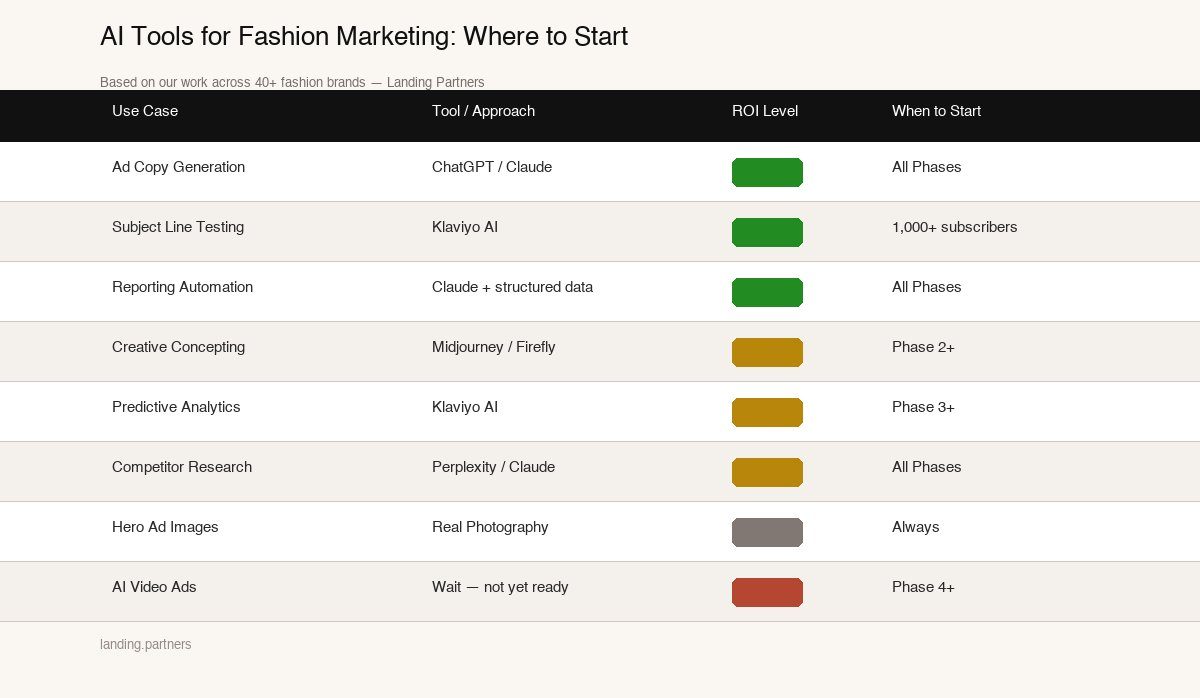
Before a shoot, tools like Midjourney and Adobe Firefly are useful for generating mood boards and concept variations quickly. We use this to pressure-test creative directions before committing to a full shoot - not to replace the shoot, but to align creative teams faster and arrive at the brief with less back-and-forth.
We've reduced creative briefing cycles from 3-4 rounds to 1-2 rounds using AI-generated concept visuals. The brief arrives clearer, the shoot brief is tighter, and fewer expensive reshoots happen downstream.
A fashion brand shooting its AW26 collection can generate 20 visual directions in an afternoon instead of spending two days on mood board presentations. At the briefing stage, this matters more than at the output stage.
Where it doesn't work: hero creative
AI-generated images still can't replace editorial photography for actual ads. Fashion is tactile - consumers evaluate fabric texture, fit, how something moves on a person. AI imagery looks clean but lacks the specific qualities that high-converting fashion ads carry.
We've tested AI-generated visuals against real photography across multiple clients. Real photography consistently outperforms. Don't use AI for your primary hero images.
Not sure what your creative testing setup should look like? Book a free creative audit and we'll walk through what's working in your sector.
Where it helps most: copy variants and hooks
Ad copy is where AI tools earn their place. Testing different hooks, body copy variations, and CTAs used to take a copywriter a full day. With the right prompting, you can generate 20-30 variants in an hour - and then apply judgment to pick the five worth testing.
We use AI copy assistance for: Facebook and Instagram primary text variants, hook testing on UGC scripts, email subject line A/B options, and product description updates across large catalogues.
The key: AI generates options. Humans decide what to test. Never let AI pick its own best output - your brand knows things the model doesn't.
AI for Email Marketing: Klaviyo's Built-In Tools
Klaviyo now has native AI features that are worth using - specifically subject line recommendations, send time optimisation, and predictive segments.
Subject line optimisation
Klaviyo's subject line AI predicts open rate based on historical patterns in your account. In our experience, it works best as a gut-check - not a final decider. We'll generate 8-10 subject lines ourselves, run them through Klaviyo's predictor, and use the score to pressure-test our own judgment before selecting what to test.
Across our client accounts, A/B testing subject lines generated with AI assistance has produced open rate improvements of 8-15% in the first 60 days of adopting the workflow. The improvement comes from higher testing volume - not because AI writes better subject lines than experienced marketers.
Predictive analytics
Klaviyo's predictive CLV and churn risk scores are genuinely useful for fashion brands with enough data - typically 1,000+ active customers. We use these to build smarter winback segments and prioritise high-value subscriber targeting in campaign planning.
One important caveat: Klaviyo's AI features only become reliable with sufficient data. For brands under 1,000 active customers, the predictions are too noisy to act on. Build your list first - AI features become meaningful at scale.
Send time optimisation
Useful, but not magic. We recommend testing it against your existing send windows, especially if you've built strong open habits with your audience. Some fashion brands have conditioned subscribers to open at specific times - disrupting that with AI send time recommendations can hurt performance short-term.
AI for Reporting and Data Analysis
This is where AI delivers the most underrated value for fashion marketing teams.
Automated performance summaries
Pulling weekly Meta, Klaviyo, and Google performance data and writing a coherent summary used to take 1-2 hours per client per week. With AI-assisted reporting, that drops to 15-20 minutes of review and editing.
We built an internal AI-assisted reporting system that pulls data from all channels, identifies anomalies, flags risks, and surfaces insights. Brand managers review and approve - they don't start from scratch. The infrastructure is built on Claude and GPT-4 connected to structured data exports from Meta, Klaviyo, and Google Analytics 4.
AI-assisted reporting has reduced weekly performance preparation time by approximately 70% across our client portfolio. That time goes back into actual strategic thinking rather than data assembly.
Anomaly detection
AI is good at catching things humans miss in large datasets. When key KPIs like ROAS drop 15% while impressions stay flat, that signal is easy to miss on a Monday morning. Automated checks catch this reliably, every week.
For fashion brands managing Meta, Google, and Klaviyo simultaneously, the volume of signals is high enough that automated anomaly alerts genuinely reduce the risk of problems compounding before anyone notices.
What AI can't do: interpret brand context
The data will tell you that CTR dropped 22% last week. AI surfaces that fact reliably. What it can't tell you is that this happened because your campaign ran during a competitor's major sale, or because your new creative featured the wrong model for your audience.
Context is the human layer. Data is what AI handles well.
If your team spends more than 3 hours per week assembling reports instead of acting on the data, that's a structural problem worth fixing. Book a free strategy call and we'll show you how we've streamlined this.
AI for Creative Strategy and Research
Copy and briefing: ChatGPT and Claude
For fashion brands, the primary use cases are: drafting creative briefs from performance data, generating UGC scripts for creators, writing product descriptions at scale, and drafting email sequences and campaign copy.
The quality depends entirely on the prompting and review process. Untouched AI copy reads generic - and in fashion, generic kills conversion. The value is in generating a fast first draft that a skilled marketer refines. That's a 60-70% time saving on copy tasks, not a replacement for copy judgment.
Competitor analysis: AI-powered research
Tools like Perplexity, Claude, and GPT-4 with web browsing are genuinely useful for fast competitive research. Scanning competitor ad strategies, tracking market positioning, understanding how a new entrant is messaging their product - this used to take half a day. It now takes 20 minutes with the right prompting.
We use this for new client onboarding: understanding the competitive landscape in their specific category before we start building strategy.
SEO and content: useful for structure, not substance
AI tools for content help with keyword clustering, content structure, and meta descriptions. For fashion brands publishing regular editorial or blog content, this speeds up the structural work significantly.
What AI can't manufacture: the proprietary insight that makes an article worth reading. In fashion content, the 'we've seen this across 40+ clients' observation is what differentiates useful content from generic filler. AI can write around that statement - but it can't create the underlying data.
What's Actually Hype in 2026
AI-generated video ads
Multiple vendors are selling AI video generation as a replacement for video production. The output is improving rapidly - but for fashion specifically, it still underperforms real video. Fashion sells movement, texture, and aspiration. AI video tends to look uncanny on fabric and skin. We don't recommend using AI video as primary ad content for fashion brands yet. Test small, compare against your real video benchmarks before scaling.
Strategy tools that summarise your own data back to you
Several platforms now offer AI-powered insight layers on top of your existing marketing data. Most summarise what you already know in slightly different language, at a significant monthly cost. If a tool's primary output is a paragraph about what happened last week, that's reporting - not insight. Insight requires knowing your brand's history, context, and the judgment to understand what a metric change actually means.
Personalisation AI at early-stage scale
AI-powered website personalisation - showing different content to different visitor segments - requires significant data volume to function reliably. For a fashion brand with under 10,000 monthly visitors, the segments are too small for meaningful personalisation. This is technology worth watching and implementing later, after the data foundation is built.
How to Evaluate an AI Tool Before You Buy
A simple filter we use across our client work:
1. Does it solve a problem we have right now? Not a theoretical future problem - an actual bottleneck in the current workflow.
2. Can we measure the time or cost saving? If you can't measure it, you won't know whether it's working.
3. Does it require significant data to function? If yes - what is the minimum viable dataset to get real value?
4. What is the human review layer? If there's no human review step built in, the risk of quality failures is too high for any client-facing output.
By phase:
Fashion brands in the 0-€1M revenue range should focus on: copy AI tools (immediate ROI, low cost), reporting automation (medium setup effort, high ongoing value), and Klaviyo's native AI features (already included in your subscription).
Fashion brands in the €1M+ range can layer in: creative concepting AI, predictive analytics, and competitive research tools. The data foundation is there to make these work.
Every brand's situation is different. Which AI tools make sense depends on your team size, budget, and growth stage. If you want to know what the right setup looks like for your specific brand - book a free call.