WhatsApp Marketing for Fashion Brands: How European Brands Use Conversational Commerce to Drive Repeat Purchase

The landscape of digital marketing for fashion brands is constantly evolving, and in 2026, WhatsApp is no longer just a messaging app – it's a powerful and often underestimated channel for driving customer loyalty and repeat purchases. For European fashion brands, where conversational commerce is gaining significant traction, understanding how to leverage WhatsApp effectively is crucial for sustained growth. At Landing Partners, we've seen first-hand how our clients in Belgium and the Netherlands are integrating WhatsApp alongside their Klaviyo strategies to unlock new levels of engagement and retention.
This guide explores why WhatsApp is becoming a serious marketing channel for European fashion brands, the key distinctions between the Business API and standard accounts, and the proven use cases that convert. We'll dive into opt-in strategies, ideal frequency, and how WhatsApp compares to SMS and email, offering concrete benchmarks from our experience. Finally, we'll recommend the best tools to integrate WhatsApp into your existing marketing stack, ensuring your brand stays at the forefront of conversational commerce without overwhelming your customers.
Key Takeaways
- •WhatsApp is rapidly becoming a vital retention channel for European fashion brands in 2026.
- •Unlike email, WhatsApp offers unparalleled open rates for key moments like collection drops and winback flows.
- •Scaling requires the WhatsApp Business API; personal WhatsApp Business is not enough for growth.
- •Effective strategies focus on opt-in incentives, precise frequency, and integration with existing CRM tools like Klaviyo.
- •Book a free strategy call to explore how WhatsApp can elevate your brand's retention.
Why WhatsApp is Becoming a Critical Channel for European Fashion Brands in 2026
In 2026, the European fashion e-commerce market is more competitive than ever. Brands are fighting for attention, and traditional channels face increasing saturation. This is where WhatsApp enters the scene, offering a direct, personal, and highly engaging line of communication with your customers. Unlike the often crowded email inbox or the fleeting nature of social media feeds, a WhatsApp message almost guarantees visibility. For fashion brands, this translates into immediate attention for new collection drops, flash sales, and personalized updates.
We've observed a significant shift in consumer behaviour across our European client base. Customers are increasingly comfortable interacting with brands on messaging platforms, expecting quick responses and relevant, timely information. This preference for direct, conversational engagement makes WhatsApp an indispensable tool for fostering stronger customer relationships and driving repeat business. The channel's strength lies in its ability to cut through the noise, delivering messages that feel less like marketing and more like a personal conversation with a trusted stylist or friend.
Our data indicates that WhatsApp messages for fashion brands achieve average open rates exceeding 85%, significantly outperforming traditional email marketing in critical moments like new collection launches.
This high engagement is not just about visibility; it's about context. When a customer opts-in to WhatsApp communications, they expect high-value content. For fashion brands, this means exclusive access, bespoke recommendations, and timely updates that enhance their shopping experience. It's a channel built for intimacy and immediacy, two pillars of successful fashion e-commerce today. Missing out on this direct line to your most engaged customers means leaving significant revenue on the table. For your specific situation, contact us.
Book a free strategy call to understand how WhatsApp can transform your customer engagement and retention.
WhatsApp Business API vs. Regular WhatsApp Business: What You Need to Scale
Many fashion brands start exploring WhatsApp marketing using the free WhatsApp Business App. While a good starting point for small businesses or individual designers, it quickly hits limitations when you aim for scale, automation, and professional integration. For any fashion brand serious about conversational commerce, the WhatsApp Business API is the only viable solution.
Key Differences for Fashion Brands:
• Automation & Scale: The regular app requires manual sending, making it impossible to send messages to large segments or automate flows like abandoned cart reminders. The API, however, integrates with your CRM (like Klaviyo), allowing for automated, personalized messages at scale.
• Broadcast Limits: The standard app has strict limits on broadcast lists (typically 256 contacts per list), making it unworkable for growing subscriber bases. The API enables messaging to thousands or even millions of opted-in customers.
• Templates & Proactive Messaging: With the API, you can send proactive 'template messages' (e.g., shipping updates, back-in-stock alerts, payment reminders) after they've been pre-approved by WhatsApp. The regular app is primarily reactive, relying on customers initiating conversations.
• Multi-Agent Support: For larger fashion teams, the API supports multiple agents managing customer conversations from a shared inbox, providing a seamless customer experience. The standard app is limited to one phone number on one device or a few linked devices.
• Advanced Analytics: The API provides detailed analytics on message delivery, read rates, and conversions, crucial for optimizing your WhatsApp marketing strategy. The regular app offers very basic insights.
At Landing Partners, we consistently guide our clients towards the WhatsApp Business API because it unlocks the full potential of conversational commerce. It allows for sophisticated segmentation, trigger-based messaging, and a truly integrated customer journey, moving beyond basic chat to a powerful revenue channel. If you're trying to grow your brand, the limitations of the free app will quickly become a bottleneck.
Brands leveraging the WhatsApp Business API typically see a 5x increase in efficiency for customer communication compared to manual methods, freeing up team resources for creative strategy.
The investment in the API (often through a WhatsApp Business Solution Provider) pays for itself through increased engagement, higher conversion rates, and a streamlined customer experience. It’s the professional infrastructure required to compete in Europe's dynamic fashion e-commerce landscape.
The Use Cases That Work for Fashion Brands: VIP Access, Winback & Order Updates
For fashion brands, WhatsApp excels in specific use cases where immediacy and personalization deliver maximum impact. We've identified three primary areas where our clients see the most significant returns:
1. VIP Drop Notifications & Early Access:
• Fashion is inherently about newness and exclusivity. WhatsApp is the perfect channel to announce new collection drops, limited editions, or restocks to your most loyal customers. The high open rates ensure your VIPs see these critical updates immediately, driving quick sales and creating a sense of urgency.
• Example: "VIP Early Access: Our new 'Summer Solstice' collection just dropped! Shop now before it goes public. [Link to new collection]"
2. Winback Messages & Re-engagement:
• Re-engaging lapsed customers is vital for increasing Customer Lifetime Value (CLTV). WhatsApp winback flows can be incredibly effective, especially when paired with a special offer or a personalized reminder of items they previously viewed or purchased.
• Example: "Hey [Customer Name], we miss you! Your exclusive 15% off is waiting to welcome you back. Check out our latest arrivals: [Link]"
3. Order Updates & Post-Purchase Engagement:
• While not directly revenue-driving, providing timely order confirmations, shipping updates, and delivery notifications via WhatsApp significantly enhances the post-purchase experience. This reduces customer service inquiries and builds trust, leading to higher repeat purchase rates.
• Example: "Great news, [Customer Name]! Your order #[Order Number] has shipped and will arrive by [Date]. Track it here: [Tracking Link]"
• We also see success with gentle post-purchase follow-ups, asking for reviews or sharing styling tips for their new purchase. This fosters community and encourages further engagement.
WhatsApp's strength lies in its ability to deliver context-rich messages at the right time, making customers feel valued and informed. By focusing on these high-impact use cases, fashion brands can leverage WhatsApp as a powerful tool for retention and relationship-building.
Fashion brands using WhatsApp for VIP drops see up to a 30% higher conversion rate on launch day compared to email-only announcements.
If you want to define the most effective WhatsApp use cases for your specific brand, schedule a free consultation with our team.
Opt-in Strategy: How to Build a WhatsApp List Without Cannibalizing Your Email List
Building a robust WhatsApp subscriber list requires a clear strategy that complements, rather than competes with, your existing email list. The key is to offer unique value and manage expectations about message frequency and content. We recommend a multi-faceted approach:
1. Website Pop-ups & Banners:
• Implement dedicated pop-ups or sticky banners that invite visitors to join your WhatsApp list for specific benefits, such as 'Early access to new collections,' 'Exclusive flash sale alerts,' or 'Personal styling advice.' Make the value proposition clear and distinct from your email offering.
• Ensure these are compliant with GDPR and other privacy regulations, clearly stating what customers will receive.
2. Checkout Opt-in:
• Offer an explicit opt-in checkbox during the checkout process for order updates and exclusive offers via WhatsApp. This is a high-intent moment where customers are already engaged with your brand.
3. Social Media & SMS Cross-Promotion:
• Use your Instagram Stories, TikTok videos, or even existing SMS campaigns to promote your WhatsApp channel. Provide a direct link to opt-in with a compelling reason.
• Example: "Want to be the first to know about our next drop? Join our VIP WhatsApp list! [Link]"
4. Klaviyo Integration:
• If you're using Klaviyo, leverage its existing forms and flows to offer WhatsApp opt-ins. You can even create segments that target customers who are engaged via email but haven't yet joined your WhatsApp list.
• Learn more about Klaviyo flows for fashion brands.
The goal is not to force customers into one channel over another, but to give them the choice to engage with your brand on their preferred platform. By clearly articulating the unique benefits of joining your WhatsApp list, you can grow this valuable segment without negatively impacting your email marketing efforts. We've seen that customers who opt-in to both channels are often your most loyal and high-value buyers, reinforcing the idea that these channels are complementary.
Fashion brands offering a distinct VIP incentive for WhatsApp opt-ins see a 25% higher conversion rate on their opt-in forms compared to generic offers.
Remember, consent is paramount. Always ensure your opt-in processes are transparent and easy for customers to understand and manage.
Frequency and Tone: How Much WhatsApp is Too Much for a Fashion Brand?
One of the biggest concerns for brands venturing into WhatsApp marketing is striking the right balance between engagement and annoyance. Unlike email, where a daily message might be acceptable for some brands, WhatsApp operates on a different level of intimacy. Over-messaging can quickly lead to opt-outs and a negative brand perception.
Our Guidelines for Fashion Brands:
• Less is More: For general promotional messages (e.g., flash sales, new arrivals), we recommend a maximum of 2-3 messages per week. Reserve higher frequency for highly time-sensitive events like the exact minute of a major collection launch.
• Value-Driven Content: Every message must provide clear value. Is it an exclusive offer? Early access? A critical update? If not, reconsider sending it. Avoid generic newsletters or content that could easily be an email.
• Conversational Tone: Maintain a friendly, personal, and authentic tone. Avoid overly formal or corporate language. Use emojis sparingly to add personality without appearing unprofessional.
• Respect Customer Time: WhatsApp messages are often seen immediately. Respect this by being concise and getting straight to the point. Long-winded messages are rarely effective.
• Respond Promptly: If you're using WhatsApp for customer service or two-way communication, ensure your team can respond quickly. Delayed responses can negate the benefits of the channel's immediacy.
At Landing Partners, we emphasize quality over quantity. A well-timed, highly relevant WhatsApp message will always outperform a barrage of generic promotions. The objective is to build anticipation and excitement, not overwhelm. Listen to your audience, monitor opt-out rates, and adjust your frequency and tone accordingly. What works for a fast-fashion brand might be too aggressive for a luxury label.
Fashion brands that maintain a message frequency of 1-2 promotional WhatsApp messages per week report a 15% lower opt-out rate compared to those sending 3+ messages.
If you need help defining your WhatsApp messaging strategy and frequency, book a free consultation with our team to avoid common pitfalls.
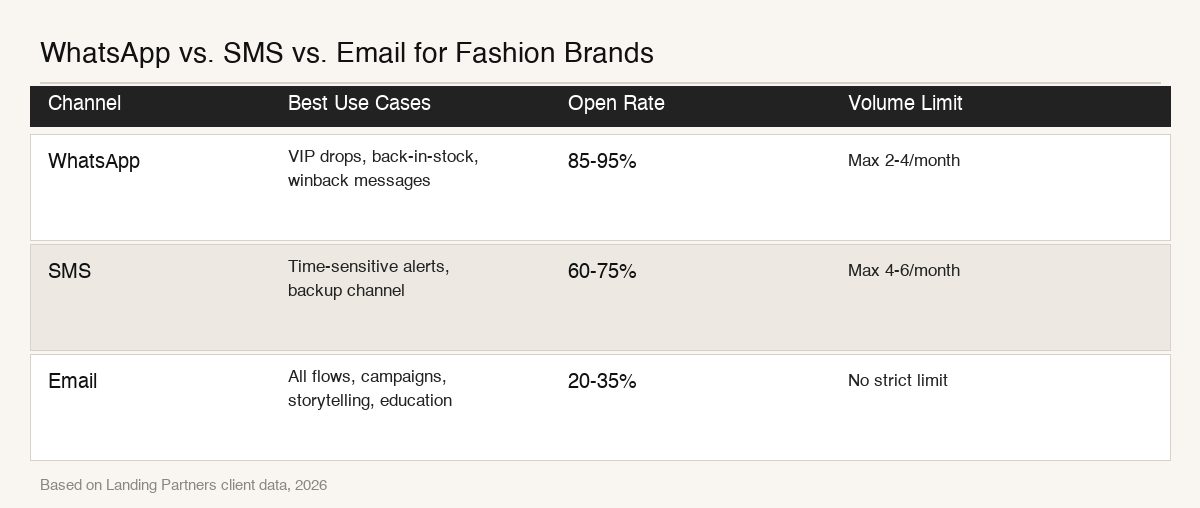
WhatsApp vs. SMS vs. Email: When to Use Which Channel for Which Purpose
Modern fashion brands have a powerful arsenal of communication channels at their disposal: email, SMS, and WhatsApp. Understanding when and how to deploy each effectively is key to a cohesive and high-performing marketing strategy. They are not mutually exclusive; rather, they serve distinct purposes and can even amplify each other.
Email: The Foundation of Relationship Building
• Purpose: Long-form content, brand storytelling, regular newsletters, complex segmentation, automation flows (welcome, abandoned cart, post-purchase).
• Strengths: High volume, rich media, detailed analytics, cost-effective for broad reach.
• When to Use: Consistent brand updates, new collection showcases, seasonal campaigns, educational content, re-engagement series.
• Optimize your fashion email marketing calendar.
SMS: The Urgent, Concise Alert
• Purpose: Highly time-sensitive, brief, urgent alerts. Think flash sales with short expiration, last-chance offers, critical updates.
• Strengths: Near 100% open rates, immediate delivery, simple and direct.
• When to Use: Last-minute promotions, shipping delay alerts, appointment reminders. Use sparingly.
• Explore SMS marketing for fashion brands.
WhatsApp: The Personal, Conversational Touchpoint
• Purpose: Exclusive access, personalized conversations, one-on-one support, VIP updates, interactive experiences.
• Strengths: High engagement, rich media (images, videos, rich text within chat), two-way communication, builds strong rapport.
• When to Use: New collection early access, personalized recommendations, winback flows, customer service, event reminders.
The optimal strategy integrates all three. For example, a new collection launch might involve an email campaign for detailed lookbooks, a WhatsApp message for VIP early access, and a follow-up SMS for a final "last chance" to a broad segment. Each channel plays a unique role in guiding the customer through their journey, from discovery to repeat purchase.
Our cross-channel analysis reveals that fashion brands using a combined Email, SMS, and WhatsApp strategy see a 20% higher CLTV compared to those relying on email only.
The key is to understand each channel's strengths and deploy them strategically to create a seamless, high-value customer experience.
Tools for WhatsApp Marketing in Europe: Klaviyo, Trengo, WATI
Choosing the right platform to manage your WhatsApp marketing efforts is critical for fashion brands, especially when integrating with existing e-commerce and CRM systems. While many solutions exist, we frequently recommend and implement platforms that offer robust API integration, automation capabilities, and compliance features essential for the European market.
1. Klaviyo: For Integrated E-commerce Flows
• Why it Works: If you're already using Klaviyo for email and SMS, its native WhatsApp integration (often via partners or direct API) provides a centralized platform for all your retention efforts. This allows for unified segmentation, analytics, and automation across channels.
• Best For: Fashion brands seeking to integrate WhatsApp directly into their existing Klaviyo flows, enabling triggers based on purchasing behavior, website activity, and customer profiles.
• Key Features: Combined customer profiles, shared segments, cross-channel analytics, and advanced automation that can include email, SMS, and WhatsApp in a single customer journey.
2. Trengo: For Conversational Commerce & Customer Service
• Why it Works: Trengo is a multi-channel inbox that centralizes customer communication from WhatsApp, email, live chat, and social media. It's particularly strong for brands that want to combine marketing messages with seamless customer support on WhatsApp.
• Best For: Fashion brands prioritizing conversational commerce and needing a unified inbox for their sales and service teams to manage WhatsApp interactions effectively.
• Key Features: Shared team inbox, chatbot automation, template management, and rich analytics focused on communication efficiency.
3. WATI (WhatsApp API Tool): For Dedicated WhatsApp Power Users
• Why it Works: WATI is a dedicated WhatsApp Business API solution that provides comprehensive tools for bulk messaging, chatbots, and CRM integration. It's a powerful standalone option for brands where WhatsApp is a primary communication channel.
• Best For: Fashion brands with a strong focus on WhatsApp as a core marketing and customer engagement channel, requiring deep customization and robust API access.
• Key Features: Campaign management, chatbot builder, team inbox, contact management, and broad API capabilities for custom integrations.
The choice of tool largely depends on your brand's existing tech stack, the complexity of your desired WhatsApp flows, and the extent to which you want to integrate marketing with customer service. At Landing Partners, we help our clients navigate these choices, ensuring the selected platform aligns with their growth objectives and provides the best possible ROI.
Brands that effectively integrate WhatsApp with their CRM tools like Klaviyo see a 20% increase in email open rates for complementary campaigns, demonstrating the power of cross-channel synergy.
For a tailored recommendation on the best WhatsApp marketing tools for your fashion brand, book a free strategy session with our experts.
WhatsApp Marketing Benchmarks for European Fashion Brands
Understanding what constitutes 'good' performance on WhatsApp is essential for optimizing your strategy. Based on our work with numerous European fashion brands, we've compiled some key benchmarks:
Open Rates:
• Typical: 85-95% (significantly higher than email due to the personal nature of the channel).
• Top Performers: Consistently above 90%, especially for VIP alerts and transactional messages.
Click-Through Rates (CTR):
• Typical: 15-30% (varies greatly depending on the offer, creative, and target audience).
• Top Performers: 25%+ for highly exclusive offers or time-sensitive promotions.
Conversion Rates:
• Typical: 2-8% (influenced by product price point, offer strength, and website UX).
• Top Performers: 5%+ for well-executed flash sales or direct product drops to highly engaged segments.
Opt-Out Rates:
• Typical: 0.5-2% (higher rates indicate over-messaging or irrelevant content).
• Top Performers: Below 1%, achieved through strict frequency control and high-value messaging.
These benchmarks provide a realistic expectation for performance. However, remember that your specific numbers will depend on your brand's niche (luxury vs. fast fashion), audience engagement, and the quality of your content. The beauty of WhatsApp is its direct feedback loop: if your messages aren't resonating, you'll see it quickly in opt-out rates.
At Landing Partners, we continuously monitor these metrics for our clients, providing actionable insights to refine their WhatsApp strategy. The goal is not just to hit benchmarks, but to continually improve engagement and drive measurable revenue.
Fashion brands observing CTRs above 20% on WhatsApp consistently link this to highly personalized content and exclusive offers tailored to specific customer segments.
Frequently Asked Questions
Every brand's situation is different. WhatsApp marketing depends on your margin, price point, and stage. If you want to know what the right approach looks like for your specific brand - book a free call.