Reviews and Social Proof for Beauty Brands: How to Collect, Display and Use Customer Reviews to Increase Conversion
In beauty, no amount of ad budget replaces a product page with 800 reviews and a 4.8-star average. Reviews are not just a trust signal - they are your primary conversion lever.
Fashion brands convert on aesthetics. Beauty brands convert on proof. Your potential customer is asking one question: 'Did this actually work for people like me?' If the answer isn't immediately visible on your product page, they leave.
Key Takeaways
- •Beauty reviews need more volume than fashion to move the needle - we see a steep CVR lift between 50 and 200 reviews per product
- •Photo and video reviews outperform text-only reviews for beauty, but only when they show the product in real use - not staged studio shots
- •Klaviyo post-purchase flows are the most consistent source of reviews we see across beauty clients
- •Review content can be recycled into Meta ads without making medical claims - done right, it is some of the highest-performing ad creative we run
- •Tool choice matters less than the process - a solid review collection flow in Klaviyo outperforms any premium platform without one
Why Reviews Work Differently in Beauty
In fashion, social proof is visual - a well-styled photo answers the question. In beauty, the question runs deeper: does this moisturiser actually reduce redness? Will this serum fade dark spots?
Beauty purchase decisions are trust-driven first, visual second. A stunning product photo builds desire, but it does not close the sale. What closes the sale is seeing 340 reviews where customers describe solving the exact problem your potential buyer has.
Three things make beauty reviews different from fashion reviews:
First, ingredient trust. Beauty buyers read ingredient lists. They look for niacinamide, retinol, hyaluronic acid - and they want reviews confirming the ingredient actually delivered results. Generic 'love this product!' reviews carry far less weight.
Second, result timelines. A dress either fits or it does not. A skincare product takes 4-8 weeks to show results. This means the most valuable reviews come from customers who have used the product long enough to see change - which has direct implications for when and how you collect them.
Third, skin type specificity. A review from someone with oily, acne-prone skin means nothing to a customer with dry, sensitive skin. Reviews need to be filterable - or at minimum tagged - by skin type for them to do their job.
In beauty ecommerce, we consistently see conversion rate lift between a product with under 20 reviews and the same product after reaching 100+ reviews. The difference is rarely marginal - it moves the needle by several percentage points depending on price point and category.
How Many Reviews Does a Beauty Product Page Actually Need?
There is no universal number. But based on what we observe across our beauty clients, clear thresholds exist where buyer behaviour shifts.
Under 20 reviews: The product is essentially unproven. Conversion is heavily dependent on brand trust and price point. At this stage, ads are expensive because the product page does not convert cold traffic reliably.
20-50 reviews: Enough to establish basic credibility. You see CVR improve, but primarily for warm audiences who already know the brand. Cold traffic still hesitates.
50-200 reviews: This is where meaningful conversion lift happens for cold audiences. The product has enough social proof to stand on its own. This is also the range where filtering by skin type or concern begins to matter.
200+ reviews: You are in trust territory. At this point, review quality, recency, and display strategy matter more than volume.
Not sure how your product pages perform for cold traffic? Book a free webshop audit - we look at your conversion rate and identify exactly where reviews are costing you revenue.
For high-AOV beauty products - serums and treatments above €80 - the threshold shifts up. Customers doing more research need more reassurance. A €120 vitamin C serum may need 150+ reviews before cold traffic converts reliably.
How to Collect Reviews at Scale: The Klaviyo Post-Purchase Flow
The most effective review collection system we run for beauty clients is a dedicated post-purchase flow in Klaviyo, timed around the product's result cycle.
The timing principle: Send the review request when the customer has had enough time to actually experience the product. For a daily moisturiser: 21-28 days after delivery. For a serum targeting hyperpigmentation: 6-8 weeks. Sending at 7 days is a mistake - the customer has no story to tell yet.
Email 1 - The check-in (Day 21 for most beauty products)
Subject: 'How's [Product Name] working for you so far?' Keep it short. Ask how they are getting on. Include a single call to action: leave a review. No discount incentive in email 1 - this filters for genuine experience over incentivised feedback.
Email 2 - The nudge (Day 28 if no review left)
Offer a small incentive - 10-15% on their next order. Make it feel like a thank-you, not a transaction. Include examples of useful review formats: 'Mention your skin type, how long you have been using it, and one thing you noticed.'
Email 3 - The photo or video request (Day 45)
Specifically ask for a photo or short video. Offer a higher incentive - store credit or a free product. This third email targets your most engaged customers. The conversion rate on this email is lower, but the content it generates is your highest-value creative asset.
In our beauty client flows, review request emails timed at Day 21-28 consistently outperform generic post-purchase requests sent at 7 days. We see noticeably higher review submission rates when the timing aligns with the product's natural result window.
Which Review Formats Actually Convert in Beauty
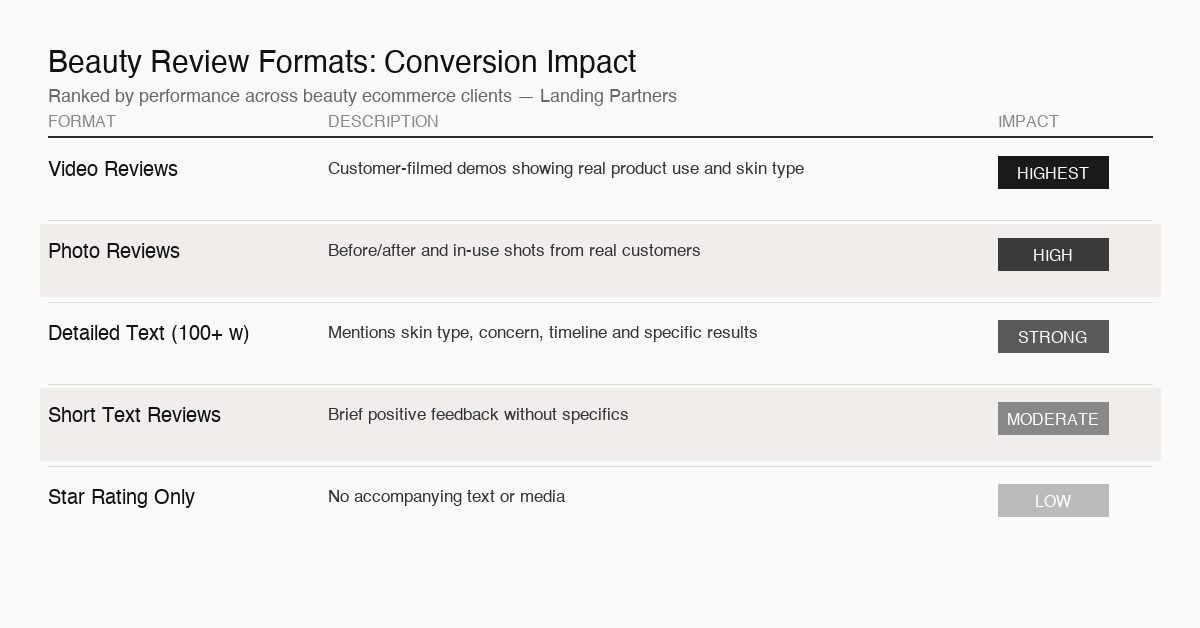
Not all reviews are equal. Format matters - and the ranking surprises most beauty brands.
Video reviews are the highest-conversion format for beauty, when they show the product in real use. A 15-second video of a customer applying a serum and describing their skin type does more for conversion than 20 text reviews. The barrier to getting video reviews is higher, but the return justifies the effort.
Photo reviews are the second-highest performing format. A before/after photo taken by the customer - not staged brand photography - is the most powerful single piece of social proof you can have. The key word is real: stock-quality photos in a review section do not perform.
Detailed text reviews of 100+ words, mentioning skin type, specific benefits, and timeline, outperform short text reviews significantly. A review that says 'cleared my congested pores in 3 weeks, I have combination skin and have tried everything' is worth more than ten reviews that say 'great product!'
Star-rating-only reviews have near-zero conversion impact on their own. Quantity of star ratings without text is vanity - it looks good in aggregate but does not answer the reader's actual question.
How to Display Reviews for Maximum Conversion
Collecting reviews is half the job. Where and how you display them is the other half - and this is where most beauty brands leave money on the table.
Placement on the product page
Reviews should appear above the fold on mobile - meaning within the first two scrolls of the product page. Most Shopify themes bury reviews at the bottom. Move them up. For a beauty product with 100+ reviews, reviews placed directly below the product description and before related products outperform bottom-page placement.
Skin-type filtering
If your review platform supports it, add skin type tags to reviews and surface a filter. A customer with dry skin should be able to instantly see reviews from other dry-skin customers. This is the single most impactful review display feature for beauty conversion - it makes social proof feel personally relevant.
Highlighted reviews
Pin one or two reviews at the top of your review section that best represent the product's core benefit. These should be long-form, specific, and ideally include a photo. The highlighted review is the first thing most visitors read - make it count.
Q&A section
A Q&A section below reviews captures objections before they lose you a sale. Common beauty questions - 'Does this work on sensitive skin?', 'Will this break me out?', 'How does it smell?' - can be answered pre-emptively. This reduces hesitation and decreases support volume simultaneously.
Not sure how to configure your review display for maximum conversion? Book a free call with Landing Partners - we audit product pages for beauty brands regularly and can tell you exactly what to prioritise.
Using Reviews Inside Klaviyo Flows
Review content should not stay on your product page. It is one of your most effective retention and re-engagement tools inside Klaviyo.
Post-purchase education flow: After a customer buys, include curated reviews from customers with similar skin types in the Week 3 and Week 5 emails. Seeing 'other customers with combination skin saw results after 4 weeks' during the waiting period reduces buyer regret and supports repeat purchase intent.
Winback campaigns: When a customer has not purchased in 90+ days, social proof reactivates them more effectively than discounts alone. A winback email featuring 3-4 recent reviews of the product they previously bought - especially if the reviews mention long-term results - reminds them why they bought in the first place.
Cross-sell via review matching: If a customer bought your serum and reviews from serum buyers consistently mention 'I pair this with the moisturiser', build that into a cross-sell email. Review-driven cross-sell recommendations feel organic rather than promotional.
Review-enhanced winback flows we run for beauty clients consistently outperform standard discount-only winback emails on both click rate and revenue per recipient. Social proof in the winback sequence is the most underused lever in beauty email marketing.
Turning Reviews Into Meta Ad Creative
Review content is some of the most effective raw material for Meta ads for skincare and beauty brands — but most beauty brands either do not use it, or use it in ways that risk policy violations.
The compliance principle: Do not use reviews that make medical claims - 'cured my eczema', 'eliminated my hormonal acne'. Focus on experience-based language: 'my skin feels softer', 'less visible pores after 3 weeks', 'my dry patches are almost gone'.
Screenshot ads: A well-designed graphic featuring a real customer review screenshot - with the customer's name, star rating, and 2-3 sentence text - performs consistently in the feed. Keep the design minimal: dark background, white text, the review, a product shot.
Video testimonial ads: A customer filming themselves in natural light describing their experience is your highest-performing creative format on Meta for beauty. Authenticity is the variable - shaky phone video in natural lighting outperforms polished studio content because it reads as real.
Carousel ads with reviews: A 3-5 card carousel where each card features one customer review, one skin type tag, and a product image. This format answers 'does this work for skin like mine?' directly in the ad - effective for cold traffic because it addresses objections before the click.
Policy checkpoint: Before running review-based ads, audit every review you plan to use for health claims, disease references, or before/after framing that implies medical treatment. What you cannot say in an ad, you cannot show in a screenshot of a review either.
Which Review Tool to Choose at Each Growth Stage
The tool matters less than most brands think. A straightforward review platform with a well-built Klaviyo collection flow will outperform an enterprise platform with no follow-up process.
That said, platforms differ in meaningful ways for beauty at different revenue stages.
Judge.me is the right choice for brands under €500K revenue. It is affordable, integrates cleanly with Shopify and Klaviyo, supports photo reviews, and covers the core use cases well. The Klaviyo integration allows you to trigger review requests directly from post-purchase flows.
Loox is photo-first. If your product is highly visual and you want to prioritise photo review collection, Loox's interface makes it easier for customers to submit images. Strong widget for displaying photo-based social proof on product pages. A good fit for €250K-€1M brands.
Okendo is built for Shopify and handles the features beauty brands need at scale: attribute tagging (skin type, concern), Q&A, media reviews, and deep Klaviyo integration. We recommend Okendo to beauty clients in Phase 2 and above (€500K+).
Yotpo is an enterprise platform with a built-in loyalty and SMS component. It makes sense for brands above €2M that want to consolidate reviews, loyalty, and SMS in one system. The integration complexity and cost do not justify it earlier.
Frequently Asked Questions
Reviews are not a nice-to-have in beauty ecommerce - they are the infrastructure your paid media runs on. Without strong review volume, strategic display, and a systematic collection process, every euro you spend driving traffic to your product pages works harder than it needs to.
Build the review foundation before you scale the ad spend. The beauty brands we see grow efficiently almost always have a review strategy that pre-dates their paid media investment.
Every brand's situation is different. The right review strategy depends on your price point, product category, and growth stage. If you want to know what makes sense for your specific brand - book a free call with Landing Partners.