SMS Marketing for Fashion Brands: How to Use Klaviyo SMS for Collection Drops, Flash Sales and VIP Access
Key Takeaways
- •SMS open rates for fashion brands reach 90%+ - dramatically outperforming email for time-sensitive campaigns
- •The 4 SMS use cases that work for fashion: collection drops, flash sales, back-in-stock alerts, and VIP early access
- •Build your SMS list separately from email - different opt-in mechanics, different tone, different frequency
- •In Klaviyo, SMS works best as a complement to email flows - not a replacement
- •RCS is replacing SMS in Europe through 2026 - brands that build SMS lists now are well-positioned for the upgrade
SMS was written off as spam. Then open rates hit 90%.
The fashion brands we work with that added Klaviyo SMS in 2025 and early 2026 didn't do it because they were chasing a trend. They did it because they had a specific problem: time-sensitive offers were reaching customers too late via email.
A collection drop at 10am. An email that gets opened at 3pm - after the best sizes are already gone. A flash sale that ends before half the list has seen it.
SMS fixes that. And in 2026, with RCS rolling out across European carriers, the channel is getting significantly more capable.
Here's what we've seen work - and what to avoid.
Why SMS Is Back for Fashion in 2026
The channel was oversaturated around 2020-2022. Brands sent too much, unsubscribe rates spiked, and the reputation of SMS as a marketing channel took a hit.
What changed:
Klaviyo's native SMS integration matured. You no longer need a separate tool. Klaviyo SMS sits in the same platform as your email flows, shares the same subscriber profiles, and lets you build conditional splits - send SMS if not opened email within 2 hours, for example.
SMS compliance in Europe got clearer. GDPR-aligned opt-in processes are now well-documented. The brands that are doing it right are building clean, fully consented lists.
Open rates haven't gone down. Across our fashion clients, SMS open rates remain above 90%. Email averages closer to 35-45% for well-maintained fashion lists. The gap matters most for time-sensitive sends.
Across our fashion client base, SMS open rates consistently average 90%+ - compared to 35-45% for email. For a collection drop or flash sale, that gap is the difference between selling out in 4 hours or 14.
The caveat: volume expectations are completely different. Email can be sent weekly or more. SMS needs to be sparse enough to feel like a privilege. Most fashion brands we work with send 4-8 SMS messages per month maximum.
SMS vs. Email: When Each Channel Wins
This is not a competition. The brands that use both channels well treat them as genuinely different tools.
Email wins for:
• Longer editorial content - new collection storytelling, lookbook launches
• Education and nurture - flow sequences that explain your brand
• Campaigns that can wait - newsletters, monthly offers, styling guides
• Re-engagement - win-back flows where multiple touchpoints over weeks are appropriate
SMS wins for:
• Time-sensitive launches - when hours matter
• High-urgency recovery - cart abandonment SMS sent 30 minutes after the email didn't get opened
• VIP access - exclusive early drop access that feels like a personal message
• Back-in-stock alerts - customers who waited want to know immediately
The hybrid approach is where we see the best results. A collection drop might run: teaser email 48h before, SMS 1h before launch, follow-up email with styled looks at 24h. Each touchpoint does what it does best.
Not sure how to structure SMS into your current Klaviyo flows? Book a free Klaviyo audit - we'll map out exactly which flows benefit from an SMS component.
The 4 SMS Use Cases That Work for Fashion
1. Collection drop notifications
The highest-performing use case we see. A short, direct SMS - 'New summer collection live. Be early: [link]' - sent 30-60 minutes before the email, or as a standalone if the drop is VIP-only.
The message must create urgency without feeling desperate. 'Limited pieces available' works for fashion. 'Act now' doesn't.
2. Flash sale announcements
A 24-48 hour sale works well as SMS-first. Email can follow up, but the SMS is what drives the first wave of traffic when the sale opens. For fashion brands with a high proportion of mobile buyers, this is where SMS pays for itself.
3. Back-in-stock alerts
A customer who signed up for a back-in-stock notification has high purchase intent. SMS converts better than email for this use case - the message is expected, it's personal, and the decision has already been made. We set these up as an automatic Klaviyo flow triggered by inventory restocking in Shopify.
4. VIP early access
Segment your top 10-15% of customers by purchase value or frequency, build a VIP SMS list, and give them early access to drops and sales. This drives repeat purchase while making your best customers feel recognised. Done well, it becomes a reason to stay subscribed.
Back-in-stock SMS messages have the highest conversion rate of any SMS use case we run for fashion brands - typically 15-25% within 24 hours for customers who opted into the specific product alert. The intent was already there; SMS just closes the loop.
How to Build a Fashion SMS List Without Cannibalising Your Email List
This is the question we get most often. The concern is real - if SMS becomes another opt-in on your popup, does it compete with email capture?
The answer is: only if you build it wrong.
Separate the opt-ins. Don't ask for both email and SMS in the same popup step. Capture email first. Then, in a post-purchase thank-you flow or a dedicated campaign, offer SMS as an upgrade - 'Join our VIP drop list for early access. Text YES to opt in.'
Position SMS as a VIP channel. The framing matters. Email is your newsletter. SMS is your insider list. Customers who join the SMS list should feel like they're getting something extra, not just another marketing channel.
Use Klaviyo's SMS opt-in flows. Klaviyo handles the double opt-in process for EU compliance automatically. Set it up once and let it run. The Klaviyo native keyword flow (customer texts a keyword to subscribe) works well as a low-friction opt-in from packaging inserts or organic social.
A realistic SMS list size for a fashion brand doing €500K+ in annual revenue: 500-2,000 subscribers is a strong starting point. You don't need scale to see ROI - you need engaged subscribers who opted in for the right reasons.
SMS Flow Structure in Klaviyo
Not every Klaviyo flow needs an SMS component. Here's how we think about it:
Flows that benefit from SMS:
• Welcome series - an SMS at step 1 with a personal welcome message works well, especially for VIP opt-in flows
• Cart abandonment - if email is unopened at 30-60 minutes, trigger an SMS. Not both at the same time
• Back-in-stock - SMS-first for this one
• Post-purchase - an SMS with shipping confirmation or delivery update builds trust without requiring an email open
Flows that don't need SMS:
• Win-back flows - too slow-moving for SMS tone. Email is the right channel for long nurture sequences
• Browse abandonment - purchase intent was lower. SMS can feel invasive here
• Newsletter-style campaigns - SMS should never feel like a newsletter. Keep it short, direct, and actionable
In Klaviyo, the most effective SMS setups use conditional splits: if the email in step 1 hasn't been opened within X hours, deliver the message via SMS instead. This avoids over-communicating while ensuring time-sensitive content reaches the subscriber.
Want to see how SMS fits into your current Klaviyo flow structure? Book a free call - we'll review your flows and identify where SMS adds the most value.
Frequency and Tone: How Much SMS Is Too Much?
The rule we use with our fashion clients: if you wouldn't send it as a push notification on someone's personal phone, don't send it as SMS.
That's not hyperbole. SMS lives on the same screen as messages from friends and family. The bar for interrupting that space is higher than email.
Frequency guidelines:
• Maximum 2 SMS per week, and only during active campaigns or drops
• Average 4-6 SMS per month across a typical fashion brand calendar
• July and August (summer sales), October-November (pre-BFCM), and January (winter sales) allow for slightly higher frequency
• Outside of high-intent periods: 2-4 SMS per month is the ceiling
Tone guidelines:
• Short. Under 160 characters if possible - one SMS message unit
• Direct. Start with what's happening, then the link. No long setup
• Personal. Write like a text, not a marketing email. 'New collection live. Go early: [link]' not 'We're thrilled to announce...'
• No discount dependency. Using SMS purely to push discounts trains your subscriber list to only buy on sale. Use it for access and news, not just promotions
SMS Benchmarks for Fashion Brands
Based on what we see across our fashion client base in 2026:
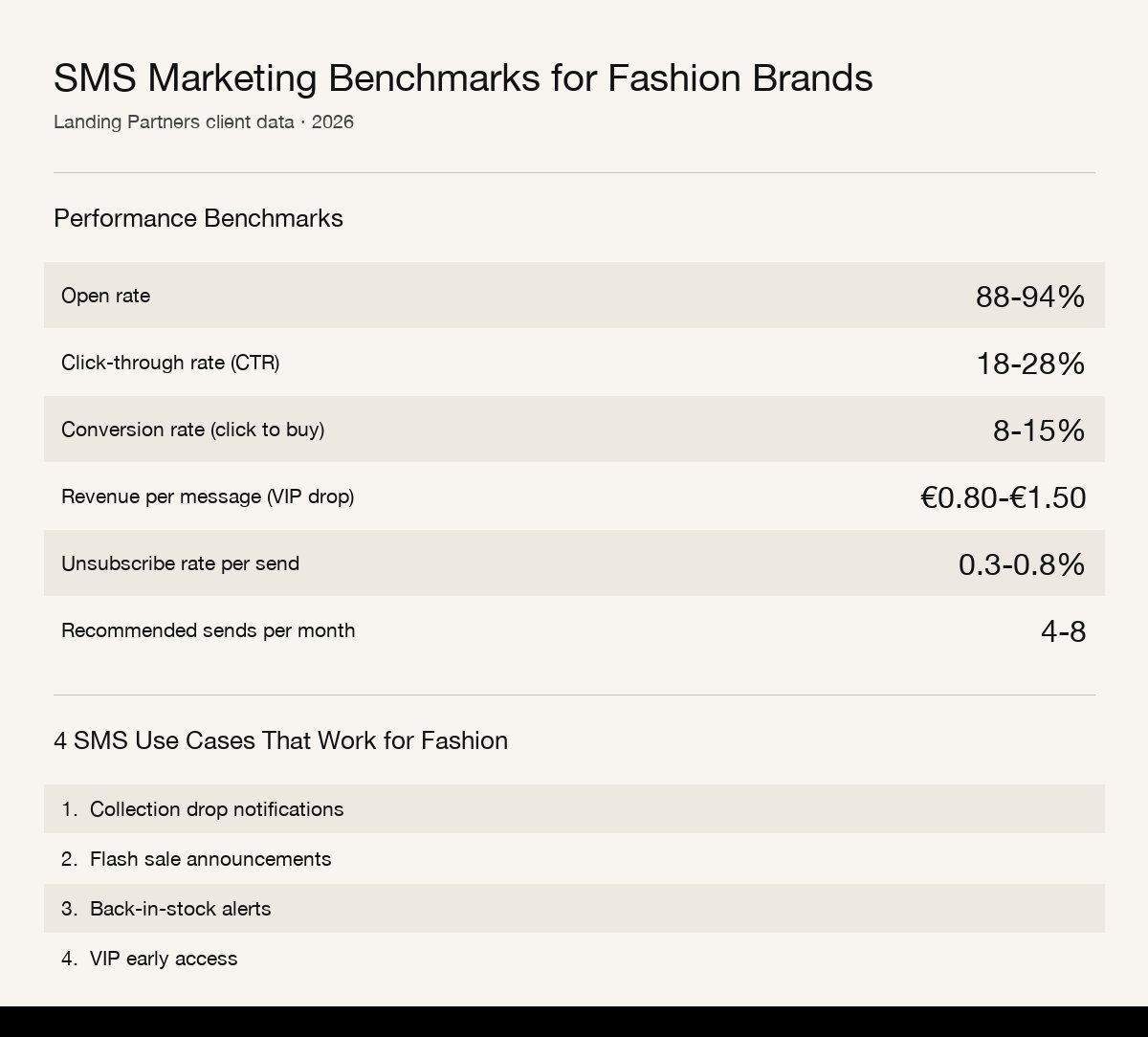
For fashion brands using SMS alongside email in Klaviyo, we see an average 12-18% revenue lift from SMS-only sends on collection drops - measured by direct SMS click-to-purchase within 24 hours. This makes SMS one of the highest-ROI channels per send for fashion brands that use it at the right frequency.
• Open rate: 88-94% (all SMS types)
• CTR: 18-28% (higher for back-in-stock and VIP drop sends)
• Conversion rate (click to purchase): 8-15% depending on use case
• Unsubscribe rate per send: 0.3-0.8% - rises sharply above 8 sends per month
• Revenue per SMS sent: VIP drops average €0.80-€1.50 per message sent; discount-only SMS typically €0.20-€0.40
**The key benchmark to track isn't open rate - it's unsubscribe rate over time.** If your SMS list is shrinking, you're sending too much or sending the wrong content. A healthy fashion SMS list should be growing each month.
RCS: What Fashion Brands Need to Know
RCS (Rich Communication Services) is replacing SMS across European mobile carriers. By late 2026, most Android devices in Belgium, the Netherlands, Germany, and the UK will support RCS natively through Google Messages.
What RCS adds that SMS doesn't have:
• Images and video in the message - no need for a link to a visual
• Read receipts and typing indicators
• Branded sender name instead of a phone number
• Interactive buttons inside the message
For fashion brands, RCS is significantly more interesting than SMS. A collection drop message with an actual product image and a 'Shop Now' button directly in the thread - without opening a browser - is a different category of engagement.
Klaviyo has been in beta with RCS functionality and is expected to roll this out more broadly through 2026. **Every subscriber who opts into your SMS program is automatically eligible for RCS when the channel activates for their device.**
The practical implication: the investment you make in SMS list building in 2026 is also an investment in your RCS reach. Don't wait for RCS to be fully live before starting.
Every brand's situation is different. How SMS fits into your retention strategy depends on your audience, your product type, and how your Klaviyo flows are currently structured. If you want to know what the right approach looks like for your specific brand - book a free call.