Loyalty Programs for Fashion Brands: How to Build Repeat Purchase Systems That Actually Work
Most fashion brands that launch a loyalty program end up with a points system that trained their customers to wait for the next reward email rather than buy at full price.
Loyalty done well is one of the strongest drivers of customer lifetime value - it turns occasional buyers into repeat customers and gives you audience data that makes your paid media sharper. Loyalty done wrong is an expensive discount machine.
Here is what we have seen across our client base, and how to build a system that actually increases repeat purchase rates.
Key Takeaways
- •Fashion loyalty works differently from retail loyalty because purchase frequency is lower and collections drive timing, not replenishment cycles.
- •Points programs work best for accessible price points. VIP access works best for premium brands.
- •The real value of loyalty is the data it generates - for Klaviyo segmentation and Meta audiences.
- •Repeat purchase rate benchmarks vary by subsector: 18-30% for women's fashion, 25-35% for casualwear and basics.
- •A loyalty program that costs money without ROI usually has the wrong trigger logic or is applied before retention fundamentals are in place.
Why Fashion Loyalty Is Different From Retail Loyalty
Fashion purchase behavior does not look like grocery or general retail. A customer does not buy a new dress every month. They shop seasonally, around collections, and often reactively - a campaign lands at the right moment, they like what they see, they buy.
This changes what loyalty can realistically do for a fashion brand.
The replenishment model does not apply. For beauty or supplements, loyalty programs can be built around 'you are running out soon' triggers. For fashion, there is no natural replenishment cycle. The triggers are editorial (new collection, campaign launch) and promotional (end of season sales).
Tenure loyalty is harder to build. If someone buys from you twice a year, their 'loyalty' looks different on paper than a customer who orders from an FMCG brand monthly. The benchmark for what counts as a loyal customer in fashion is lower - two to three purchases per year is genuinely strong.
Seasonal behavior means timing is everything. A loyalty email in April hits very differently than one in September. Fashion brands that ignore seasonal timing in their loyalty mechanics see lower engagement than those who align points expiry, VIP access, and rewards with collection moments — especially during BFCM, where loyalty mechanics can be a powerful differentiator against brands competing purely on discount.
Across our client base, a customer who makes a second purchase within 90 days of their first has a 45-60% chance of purchasing again. The first repeat purchase is the most important milestone to engineer.
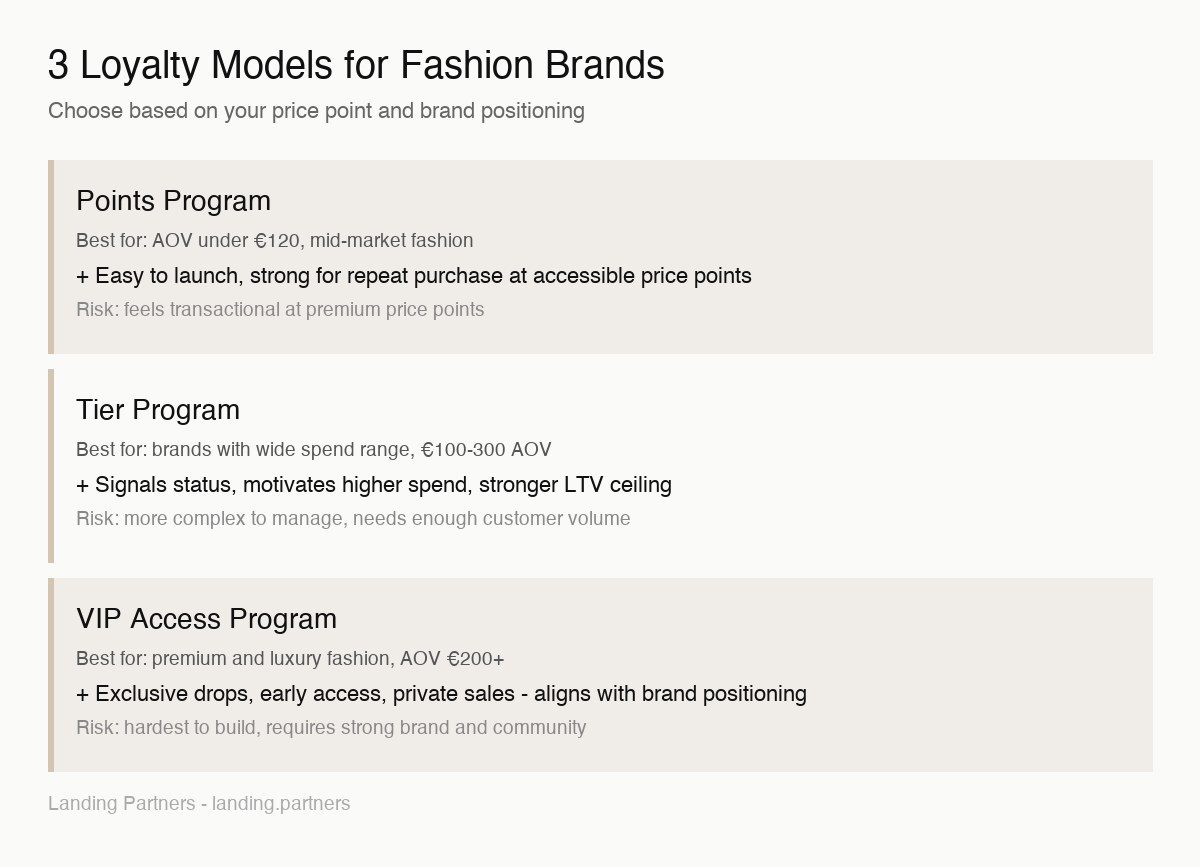
The 3 Loyalty Models for Fashion Brands
There is no single loyalty model that works for every fashion brand. The right choice depends on your price point, your brand positioning, and what your customers actually want.
Model 1: Points Programs
Points for every purchase, redeemable for discounts or free products. This is the most common and the easiest to set up.
It works well for accessible to mid-range fashion brands (AOV under €120), brands with moderate purchase frequency, and brands where a discount is an acceptable brand signal.
The risk: at premium or luxury price points, points programs can feel transactional. A customer paying €300 for a jacket does not want 150 points. They want something that feels exclusive.
Model 2: Tier Programs
Bronze, Silver, Gold - customers unlock higher tiers based on cumulative spend. Each tier comes with different benefits: early access, free shipping, dedicated support.
This works well for brands with a wide range of customer spend levels, and for brands that want to reward their best customers without creating a public discount ladder. The mechanics are more complex than points, but the ceiling for LTV is higher. Tier programs signal status to the customer, which aligns better with fashion's aspirational dynamic.
Model 3: VIP Access Programs
No points, no tiers - just a membership that unlocks exclusive access: early drops, limited editions, private sales, behind-the-scenes content.
This works best for premium and luxury fashion brands, brands with a strong community component, and brands where exclusivity is part of the product value. Access-based loyalty is the hardest to build but the most defensible. You cannot replicate it with a 10% discount.
Not sure which loyalty model fits your brand's price point and growth stage? Book a free growth call and we will tell you exactly where to start.
Connecting Loyalty to Klaviyo
The standalone loyalty tool is worth about 30% of what it could be. The other 70% comes from integrating it with your email marketing.
What good Klaviyo integration looks like.
When a customer hits a new tier or earns a reward, that event triggers a Klaviyo flow. Not a generic 'you have points' email - a flow that uses their loyalty status to shape the entire message.
A Tier 1 customer gets a welcome email series that explains their benefits and creates urgency around the next milestone. A Tier 3 customer gets early collection access emails before the general list. A points customer with an expiring reward gets a flow that connects the reward to an in-stock product they have browsed.
Segmentation built on loyalty data.
We use loyalty tier data to segment email lists in Klaviyo. VIP-tier customers get a different campaign frequency, different copy tone, and different offers than one-time buyers. This matters for revenue per recipient - VIP segments consistently outperform general sends by a significant margin.
The trigger logic that most brands miss.
Most loyalty setups send a static monthly 'here are your points' email. The best setups trigger emails based on behavior: a customer who has not purchased in 60 days but has enough points for a reward gets an expiry reminder flow. A customer who just crossed into a new tier gets a benefits activation email before the next collection drops.
Brands that connect loyalty events to Klaviyo flows see 20-35% higher repeat purchase rates from their loyalty segment compared to brands that manage loyalty separately from email.
Using Loyalty Data in Meta Ads
This is the part most fashion brands overlook entirely.
Your VIP customer list is your highest-value Lookalike seed. When you upload your top-tier loyalty customers as a Custom Audience in Meta and build a 1% Lookalike, you are finding people who look like your best customers - not just any buyers, but your best buyers.
How to set this up practically.
Export your top-tier loyalty segment (typically top 15-20% by lifetime spend) from your loyalty tool or Klaviyo. Upload as a Custom Audience in Meta. Run a Lookalike campaign from this seed alongside your standard Lookalike from all purchasers. Compare the ROAS.
In our experience, VIP-seeded Lookalikes consistently outperform general buyer Lookalikes - though the margin varies by brand and price point. The quality of the seed matters more than the size.
Retargeting loyalty non-converters.
A customer in your loyalty program who has not purchased in 90+ days is a warm audience. They know your brand. They chose to be in your program. Build a specific retargeting campaign for this segment with messaging around what they are missing - new collection access, expiring rewards, or a tier milestone they are close to.
If you want to see how loyalty data can sharpen your Meta performance, book a free audit. We will look at your current customer data and show you what is possible.
Repeat Purchase Rate Benchmarks by Fashion Subsector
Repeat purchase rate is the primary KPI for any loyalty program. Here is what we see across different fashion subsectors - based on our own client data, not industry averages.
Women's fashion (contemporary, €80-200 AOV): 18-30% repeat purchase rate within 12 months. This is the baseline most brands are working from.
Casualwear and basics (€40-90 AOV): 25-35%. Higher purchase frequency by nature - basics get repurchased more often than seasonal fashion.
Premium and luxury fashion (€200+ AOV): 12-20%. Lower frequency is expected - the economics of each transaction compensate. Two purchases per year at €350 AOV is strong.
Kidswear: 30-40%. Parents with growing children repurchase seasonally by necessity. Loyalty programs here can be built around growth milestones and size updates.
A 5-point improvement in repeat purchase rate - from 22% to 27% - can reduce your effective CAC by 15-20% at scale, because you are recouping your acquisition cost more efficiently across the customer lifecycle.
Which Loyalty Tool Fits Which Growth Phase
Phase 1 (under €250K revenue): don't start yet.
Do not start with a loyalty program. At this stage, your priority is list building and retention fundamentals - welcome flows, abandoned cart flows, and post-purchase sequences. A loyalty program adds complexity before you have the customer volume to make it work.
The exception: if your product has natural high repeat purchase behavior (basics, children's fashion), a simple points program can be live quickly and adds low-friction retention for a modest monthly cost.
Phase 2 (€250K-€1M revenue): start here.
This is where loyalty starts to make economic sense. You have enough customers to build meaningful segments. Smile.io is the easiest to implement, works well for entry to mid-market fashion, and has strong Klaviyo integration. LoyaltyLion is more customizable with better analytics - worth it if you have someone to actively manage the program.
Phase 3+ (€1M+ revenue): go deeper.
At this stage you need deeper data integration and more sophisticated program mechanics. Yotpo Loyalty bundles loyalty with reviews and SMS, which matters when you are scaling cross-channel retention. LoyaltyLion at scale justifies deeper custom trigger logic and multi-segment campaigns.
When a Loyalty Program Costs Money Without ROI
This is what we see most often.
Launched before retention fundamentals were in place. If your abandoned cart flow does not exist yet, your loyalty program will not save you. Fix the basics first.
Wrong trigger logic. A monthly 'your points balance' email is not a loyalty program - it is a newsletter you pay for. Loyalty ROI comes from event-based triggers at the moments that matter: tier upgrades, reward expiry, post-purchase milestones.
Applied to a brand where discounts erode margin. If your margin is under 50%, think carefully before offering 10% back in points. At scale, that is a significant cost. VIP access programs avoid this problem entirely.
Built without Klaviyo integration. A loyalty tool running in isolation is half a program. If your loyalty events do not feed into Klaviyo flows, you are leaving the highest-return communications unbuilt.
Too complex for the customer to understand. If a customer cannot easily answer 'what do I get if I buy twice?', the program will not drive behavior change.
Every brand's situation is different. Whether a loyalty program makes sense for your specific margin, price point, and growth stage is a conversation worth having. Book a free growth call and we will tell you exactly what the right approach looks like for your brand.