Case Study: How a Niche Fashion Brand Scaled Meta Ads from €5K to €50K Monthly Budget

Most fashion brands that want to scale on Meta think the solution is simple: spend more. Put in €5K, see it work, then push it to €20K. The problem is that almost never works.
Scaling Meta ads is not a linear process. The tactics that work at €5K fall apart at €15K - and what works at €15K needs to be rebuilt again at €30K. Each budget level requires a different structure, a different creative approach, and different ways to measure what's actually happening.
This is the case study of a niche streetwear brand that went from €5K to €50K monthly Meta ad spend over 14 months - without burning money in the process.
Key Takeaways
- •Scaling Meta ads requires rebuilding your approach at each budget level - the same setup doesn't work across ranges
- •Phase 1 (€5K-€10K): fix the funnel and creative fundamentals before touching budget
- •Phase 2 (€10K-€25K): systematic creative testing is the engine that enables scale
- •Phase 3 (€25K-€50K): audience expansion and campaign structure must evolve or performance collapses
- •The biggest mistake: increasing budget without first fixing what's holding back performance at the current level
The Starting Point: A Niche Brand With Potential but Plateauing Growth
The brand in this case study sells streetwear at an average order value of €95. They had been running Meta ads independently for about a year before we started working together, spending around €5K per month.
On paper, things looked acceptable. Their reported ROAS sat around 2.1x and traffic was consistent. They had a handful of creatives that had delivered results in the past.
But growth had stalled. Revenue was flat for three consecutive months. Increasing spend in previous attempts had always resulted in ROAS dropping immediately. They were stuck.
When we audited the account, we found three core issues:
• A single ad set structure with no separation between prospecting and retargeting
• All budget going to three creatives that were over a year old - no new content had been tested in months
• A product page that converted at around 1.2% on mobile - well below what you need to scale paid traffic profitably
The Problem: Why Just Increasing Budget Doesn't Work
There's a mechanical reason why pushing more budget into a broken Meta setup doesn't work. When you scale spend, Meta needs to find more people to show your ads to. If the only people converting are a narrow slice of your existing audience, Meta will start showing your ads to lower-quality signals - and CPMs rise while conversion rates drop.
The result is that your cost per purchase increases faster than your revenue, and ROAS collapses. We see this in almost every account that tries to scale without first fixing the underlying conversion mechanics.
For this brand, the issue wasn't audience size or brand appeal. The issue was that the ad account and the website couldn't support higher spend - not yet.
Before touching budget, we needed to rebuild from the bottom up.
Running Meta ads at your current budget but not seeing results when you try to scale? Book a free Meta audit - we'll show you exactly where the ceiling is and what's causing it.
Phase 1: Fixing the Foundation Before Scaling (€5K-€10K/month)
The first 6 weeks were not about increasing spend. They were about fixing what was already broken.
Website conversion rate
We identified four changes to the product pages that had a direct impact on conversion: clearer product photography on mobile, a size guide added inline to reduce purchase anxiety, a sticky add-to-cart button, and social proof moved higher on the page.
These are not complicated changes, but they matter at scale. Every extra percentage point of conversion rate on the product page has a compounding effect when you're spending €30K+ per month.
Account structure
We separated the account into a clean prospecting and retargeting structure. Prospecting campaigns went to cold audiences with broad targeting. Retargeting campaigns ran to anyone who had engaged with ads or visited the site in the past 30 days.
This separation matters because it lets you see - and control - what's happening at each part of the funnel. Without it, you're flying blind.
Creative refresh
We produced 8 new creative concepts across three formats: UGC-style videos, editorial static images, and direct-response carousels. Each concept tested a different message angle: product quality, brand story, social proof, and urgency.
Starting the new structure at €5K per month, we ran for 4 weeks before touching budget.
Phase 1 result: ROAS improved from 2.1x to 3.4x on the same €5K spend - before touching the budget at all. Product page mobile CVR went from 1.2% to 2.1%.
Phase 2: Systematic Creative Testing (€10K-€25K/month)
Once Phase 1 delivered a stable foundation - consistent ROAS, clean account structure, converting website - we had the data to start scaling.
But scaling budget without a creative testing system is how you end up running out of winning ads at the worst moment. Creative fatigue is the single most common reason Meta performance collapses at higher spend levels.
We set up a structured testing protocol:
• 2-3 new creative concepts into testing every 2 weeks
• Each concept gets a fixed test budget (€150-€200) and a 5-day window to prove itself
• Winners - cost per purchase below the target threshold - get moved to the main prospecting campaign
• Losers are killed immediately - no exceptions, no 'let it run a bit longer'
This created a pipeline. At any point in time, there were always 4-6 active winning creatives in rotation, with new concepts entering testing every fortnight.
What we tested in Phase 2
During this phase we ran 34 creative concepts across video and static formats. 11 became winners - a 32% hit rate, which is above average for fashion brands.
The highest-performing concept formats were UGC-style videos showing the product being worn in a realistic setting, and direct-response statics with a clear product shot and a specific offer. Editorial concepts - visually strong but without a clear hook - consistently underperformed.
Phase 2 creative testing result: 11 winning creatives from 34 concepts tested. Best-performing ad delivered a cost per purchase 41% below the campaign target, running profitably at €18K monthly spend.
Want us to build a creative testing framework for your brand? Book a free call - we'll walk through how we structure testing for your budget and category.
Phase 3: Structural Scaling with Audience Expansion (€25K-€50K/month)
At €25K monthly spend, the account hit the ceiling of its existing audience pool. The core prospecting campaign was showing signs of fatigue - CPMs rising, frequency increasing, cost per purchase creeping up.
This is a critical point in scaling. Most brands interpret this as 'Meta isn't working anymore' - but it's actually a structural signal that the campaign needs to expand, not that the platform is failing.
Lookalike expansion
We built a new prospecting layer using Lookalike audiences seeded from the brand's best customers - the top 20% by lifetime value. At higher spend, these broader audiences give the algorithm more room to find purchase intent signals.
International expansion
The brand had been running Belgium-only. At €25K, the domestic market alone couldn't absorb the spend profitably. We opened campaigns in two neighbouring markets where the brand's aesthetic and price point translated well.
Both new markets required adapted creative - language adjustments on text overlays, localised offer framing - but core video concepts transferred without major changes.
Campaign structure evolution
At €30K+, we moved to an Advantage+ Shopping Campaign for the prospecting layer, with the manual retargeting structure kept in place. The Advantage+ setup gave Meta more flexibility to optimise across a broader audience pool, while manual retargeting kept the warm audience conversion rate stable.
Budget was scaled in 20% increments - never more than that in a single step - with a minimum of 5 days between increases.
The Results: What Actually Changed
Over 14 months, the brand went from €5K to €50K monthly Meta ad spend. Here are the numbers that matter:
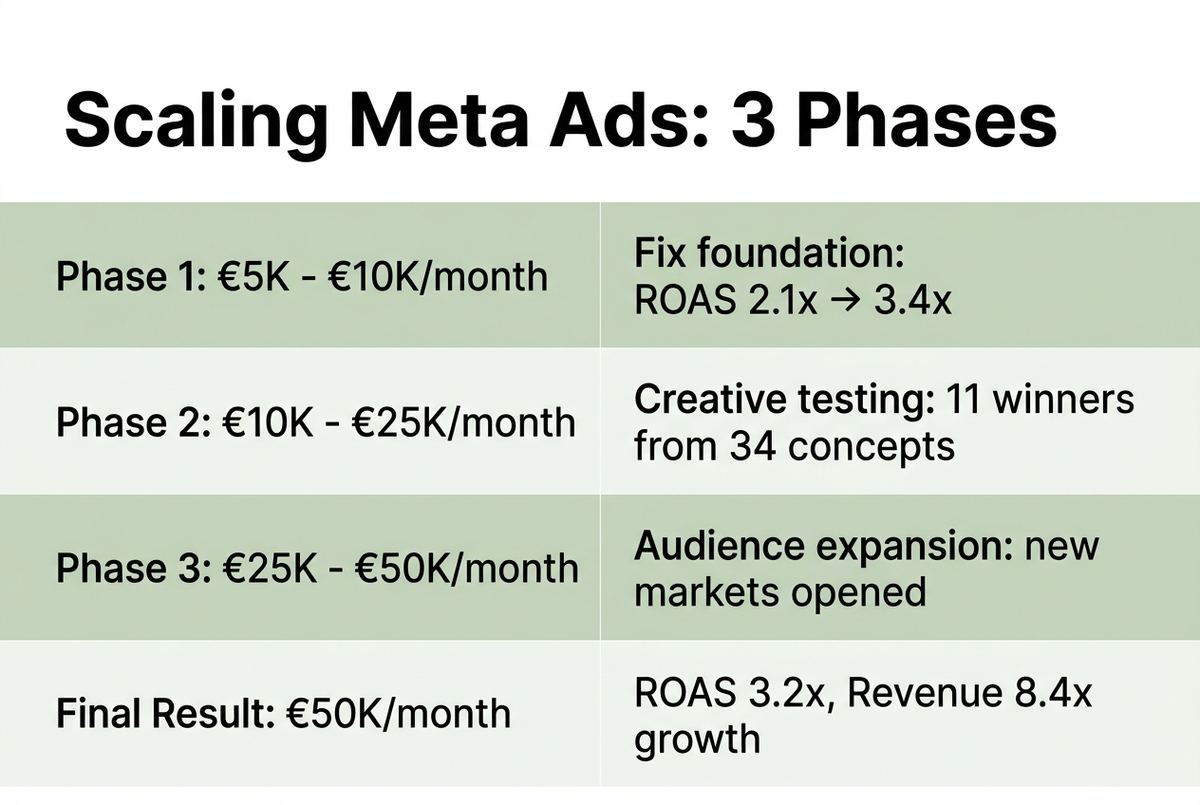
Final results: €50K monthly Meta spend at 3.2x ROAS. Revenue from Meta-attributed sales increased 8.4x over the period. Cost per purchase increased 18% while AOV increased 23% - driven by bundle adoption and upsell improvements.
What changed wasn't just the budget. What changed was:
• A website that could convert at scale
• A creative system that never ran dry
• A campaign structure that could handle higher spend without collapsing
• An audience expansion strategy that opened new markets at the right moment
Key Lessons from This Scale-Up
After 14 months and a 10x budget increase, here are the things that made the difference:
Fix before you scale
The single biggest risk in scaling Meta ads is pushing budget into a setup that has unresolved structural problems. Every problem that exists at €5K is amplified at €30K. Fix first, scale second.
Creative is the engine
At every budget level, the question is: do you have enough winning creatives to sustain this spend? Creative fatigue is not an if - it's a when. The only answer is a systematic testing pipeline that runs continuously.
Structure must evolve with budget
The campaign structure that works at €5K is not the right structure for €30K. Audience pools, campaign types, and bidding strategies all need to be reassessed as spend increases.
Scale in increments
Never scale Meta budget by more than 20% in a single step. Give the algorithm time to adjust. Impatience at scale is expensive.
As you scale, reported ROAS can be misleading. Track your Marketing Efficiency Ratio - total revenue divided by total ad spend - as the north star metric. It gives you a cleaner picture of what's actually happening across all channels.
Frequently Asked Questions
Every brand's scaling journey is different. What worked here - the phases, the timelines, the creative formats - reflects this brand's specific category, price point, and market. If you want to know what scaling looks like for your specific situation, book a free call and we'll give you an honest assessment of where you are and what it would take.