Women's health supplements are the fastest-growing category in the supplement market right now. Perimenopause formulas, hormonal balance products, PMS support, PCOS management and postpartum recovery brands are all hitting demand curves that most performance marketing playbooks were not built for.
The problem: Meta and TikTok have some of the most restrictive advertising policies in exactly this space. Any language that sounds like symptom relief, hormonal intervention or medical treatment gets rejected - often without a clear explanation of why.
The opportunity: most competitors are either being shut out by policy or running vague, ineffective creative that fails to convert. Brands that understand the compliance landscape and build a strategy around it have a real opening right now.
Here is what we see across the women's health supplement accounts we manage.
Why Women's Health is the Fastest-Growing Supplement Category
Three forces converged to create the current moment in women's health supplements.
First: a generation of women in their 40s and early 50s hitting perimenopause who are actively seeking alternatives to pharmaceutical hormone therapy. This demographic is educated, economically powerful and deeply skeptical of being underserved by the traditional healthcare system.
Second: the mainstream normalization of hormonal health conversations. Topics that were considered taboo five years ago - perimenopause, cycle syncing, PCOS, postpartum hormonal shifts - are now podcast subjects, Substack newsletter topics and active communities with millions of engaged members.
Third: growing DTC infrastructure. Shopify, Klaviyo and Meta make it feasible for small women's health brands to acquire and retain customers at scale without a retail distribution deal.
What this means commercially: the customer enters with high purchase intent. She has typically done significant research before clicking your ad. Her willingness to pay is above average for the supplement category. And if your product delivers on its promise, her repeat purchase behavior is exceptionally strong.
We see LTV for women's health supplement customers running meaningfully above general supplement averages in the accounts we manage. Daily-use habit formation, combined with high category involvement, drives repurchase rates that make the acquisition economics work even at higher initial CAC.
Across our client accounts: women's health supplement customers show 60-70% higher repurchase rates within 90 days compared to general supplement categories. The combination of daily-use routine, strong community reinforcement and results that compound over time drives this.
The Subcategory Breakdown: Each One Needs a Different Strategy
Women's health is not a single marketing strategy. Each subcategory has a different customer psychology, a different result timeline and different compliance constraints.
PMS and cycle support
Monthly cadence creates a natural replenishment rhythm. The customer knows exactly when she needs the product. Creative can reference cyclical patterns and routine without making symptom-specific claims. Focus on energy, mood and the concept of feeling like yourself during every phase of your cycle. Replenishment flows are predictable and straightforward to time.
Perimenopause and hormonal balance
The most complex category from an advertising compliance standpoint. The customer is typically 40-55, highly educated and actively researching. She responds to content that validates her experience and explains the mechanism without medical framing. The key messaging frame: quality of life. Sleep, energy, mental clarity, mood stability. Never symptom claims, never estrogen language.
PCOS management
Community-driven above all else. Women with PCOS are highly active online and rely on peer recommendations to a degree that is unusual even within the supplement category. Founder stories, real customer accounts and practitioner partnerships carry disproportionate weight. Clinical-looking creative underperforms significantly versus lived-experience content in our accounts.
Fertility support
Highest AOV in the women's health supplement category, and the most emotionally charged. Policy compliance is critical - any language suggesting your product increases fertility or treats infertility triggers immediate rejection. Focus on nutritional support framing: supporting the body's natural reproductive processes, not treating a condition.
Postpartum recovery
Genuinely underserved market. The postpartum customer is exhausted, time-poor and has no patience for vague or generic content. Specific and practical content converts well. Community support elements - new mother groups, routine-oriented check-in emails - drive retention for a cohort navigating major life transitions simultaneously.
Advertising women's health supplements on Meta and running into rejections? Book a free call - we will audit your creative and show you the compliant framework we use for health supplement accounts.
Meta Ads for Women's Health Supplements: What Works and What Gets Rejected
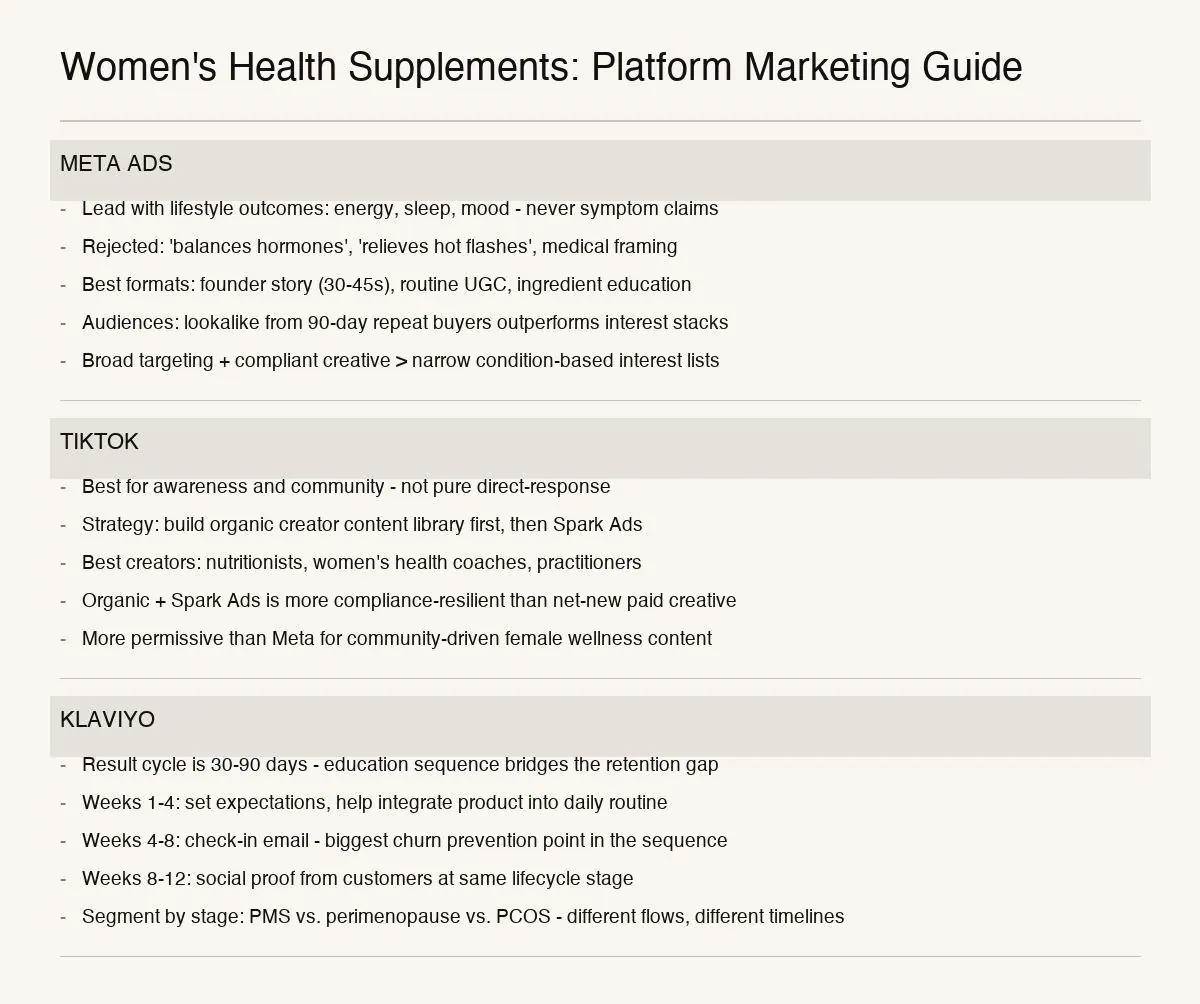
Meta has explicit policies restricting advertising that implies the treatment, cure or prevention of health conditions. For women's health specifically, three categories of language consistently trigger rejection:
Symptom-specific claims: 'reduces hot flashes', 'relieves PMS cramps', 'stops night sweats', 'reduces bloating during your cycle'
Hormonal intervention language: 'balances your hormones', 'regulates estrogen', 'restores hormonal balance', 'supports progesterone production'
Medical framing: 'clinically proven for PCOS', 'doctor-recommended for perimenopause', 'treats hormonal imbalance'
The compliant creative framework is benefit-led and lifestyle-anchored. The creative speaks to how the customer wants to feel - not what condition the product treats.
What works in women's health Meta creative
Energy and vitality: 'Wake up feeling like yourself again'
Sleep quality: 'Finally sleeping through the night consistently'
Routine and ritual: 'My morning non-negotiable for six months now'
Nutritional support: 'Supporting your body through hormonal transitions with targeted nutrition'
UGC testimonials referencing lifestyle outcomes - not symptom relief
Ingredient education: explaining what an adaptogen, magnesium glycinate or inositol does mechanically
Creative formats with the longest lifespan in women's health Meta accounts
Founder or practitioner intro video (30-45 seconds): authentic tone, explains why the product exists, who it is for and what the experience is like. Especially effective for perimenopause and PCOS brands where trust is the primary conversion driver. This format runs consistently for 90+ days in our accounts without creative fatigue.
Day-in-the-life routine content: shows the product as part of a broader wellness ritual. Lifestyle over product. Warmer lighting, morning context, casual framing. This format tends to have lower initial CTR but meaningfully better downstream conversion and lower return rates.
UGC testimonials with lifestyle framing: customer talking about how her daily experience has changed - what she notices about energy, sleep or focus. Never symptom claims. The most compliant version references feeling and routine rather than condition and treatment.
Ingredient education (15-30 seconds): short-form explainer on one key ingredient. Magnesium glycinate and its role in sleep quality. Vitex agnus-castus and cycle support. Ashwagandha and cortisol regulation. This format works best for warmer audiences already familiar with your brand.
From our experience managing health supplement accounts: benefit-led creative (energy, sleep, mood) gets approved 3-4x more consistently than symptom-led creative on Meta. The compliance investment upfront - rewriting brief templates, aligning creative teams on language - saves significant campaign delays and account risk downstream.
Audience strategy for women's health Meta
First-party data is your most valuable asset in this category. Build your lookalike audiences from your highest-LTV customers - specifically 90-day repeat purchasers. These audiences consistently outperform interest-based targeting in our women's health accounts.
For cold traffic: broad targeting with strong benefit-led creative outperforms narrow interest stacks. The algorithm finds the right audience faster when it has volume to work with, and women's health interest categories are both broad and noisy. Give it your best creative and let it optimize on conversion signal.
Exclude current purchasers and email subscribers from cold traffic campaigns. They should be handled through retention-focused campaigns with entirely different messaging.
TikTok for Women's Health Supplements
TikTok's culture around female wellness, hormonal health and 'what I take for perimenopause' content has normalized conversations that would flag immediately in a paid Meta context. The platform is genuinely more permissive for community-driven women's health content.
The distinction that matters: organic TikTok content has more latitude than paid TikTok Ads. A creator posting her personal perimenopause supplement routine organically sits in a different policy environment than a paid ad claiming the same things. Spark Ads (boosting existing organic content as paid) occupy a middle ground - the content authenticity helps, but the paid reach triggers standard ad review.
The most effective TikTok strategy for women's health supplements is a creator-first, Spark Ads second approach.
Build a content library with practitioner creators and real customers. Not sponsored posts with product mentions - genuine content about their experience, their routine, what they have noticed. Identify top-performing organic posts by view completion rate and comment quality. Boost these as Spark Ads to extend reach to qualified cold audiences.
This approach produces more authentic-feeling ads (because they are authentic), generates better comment sections which TikTok's algorithm reads as quality signals, and is significantly more compliance-resilient than net-new paid creative.
Creator profiles that work for women's health TikTok
Functional medicine practitioners and women's health coaches with TikTok presence are a particularly strong opportunity. Their audiences are actively seeking solutions and trust their recommendations at a level that macro-influencers rarely achieve in this category.
Nutritionists, registered dietitians, cycle syncing coaches and women's health physiotherapists all have audience profiles that index heavily toward women's health supplement buyers. A practitioner with 30,000 engaged followers often outperforms a macro-influencer with 500,000 general followers on commercial metrics - because the intent and trust level of the audience is categorically different.
Klaviyo Flows for Women's Health Supplements
The fundamental challenge in women's health Klaviyo is the result timeline. Many products in this category take 30-90 days to produce noticeable effects. That is a long time to maintain a customer relationship before she experiences the outcome you promised.
If you are not actively bridging that gap with education and expectation-setting, you will lose customers at day 20-30 who conclude it is not working - before it has had time to work.
The retention flow architecture for women's health supplements must do three things: set accurate expectations for when results appear, keep the customer engaged through the first 60 days, and create the habit and routine that makes replenishment automatic.
The welcome and education sequence (Days 1-30)
This is not a product education sequence. It is a customer journey sequence. What is she experiencing right now? What should she track in the first two weeks? What is a realistic indicator of progress at four weeks? Frame the content around her experience, not your product's mechanism.
Practical education that helps her integrate the product into her routine performs better than product-benefit reinforcement. If she is taking your magnesium glycinate formula, send her a short guide on sleep hygiene optimization that makes the supplement more effective. Demonstrate that you are invested in her outcome, not just her repeat purchase.
Check-in emails (Day 30-45)
Active engagement at the 30-45 day mark is one of the highest-leverage touchpoints in the women's health customer lifecycle. Ask a direct question: what has she noticed? What has changed? This serves multiple functions - it shows genuine care, surfaces testimonial content and catches disengaged customers before they lapse.
The response data from this email is among the most valuable customer insight you will collect. Reply patterns and click behavior reveal which customer segments are seeing results, which need additional education and which are at churn risk.
Want to see what a women's health Klaviyo retention flow looks like in practice? Book a free call - we will walk through the flow architecture for your specific product cycle and result timeline.
Results reinforcement (Day 60-90)
At 60-90 days, social proof from customers at the same lifecycle stage drives retention more effectively than product messaging. 'Here is what customers who stayed consistent through month two are reporting' normalizes the experience and anchors the expectation for customers who are at exactly that stage.
This is also the optimal window for subscription conversion or bundle offers. The customer has enough experience with the product to make an informed commitment decision.
Replenishment flow timing
Time replenishment triggers to product supply: 30-day supply triggers at day 22, 60-day supply at day 50. The replenishment email should reinforce her progress and the ongoing investment she has made - not just push a re-order. Frame it as continuing what is working, not starting a new purchase.
Segmentation for women's health
Segment by acquisition entry point and stated lifecycle stage where possible. A customer who came in for PMS support needs different communication than one navigating perimenopause. The educational content is different, the result timeline is different, and the community content she responds to is different.
If you use a quiz or intake form at signup - which we strongly recommend for women's health brands - use those responses to trigger sub-flows with relevant content rather than sending every subscriber the same sequence.
Women's health supplement accounts that implement lifecycle-stage segmentation in Klaviyo see 35-45% higher revenue per recipient versus non-segmented sends, based on our account comparisons. Tailored education content specifically drives click rates well above category averages.
Community as an Acquisition Channel
Women's health supplement customers are among the most community-reliant buyers in ecommerce. They research in private Facebook groups, Reddit communities, Substack newsletters and podcast communities before they ever click a paid ad.
This discovery journey often starts somewhere you cannot directly control. What you can do is be present where your customer is researching.
Podcast sponsorships remain one of the highest-quality acquisition channels for this category. Women's health podcasts covering perimenopause, fertility, hormonal health and female performance have audiences that are actively seeking solutions and trust host recommendations deeply. The conversion from podcast to purchase takes longer than paid social, but the resulting customers have significantly higher LTV and lower return rates.
Practitioner partnerships - nutritionists, naturopaths, women's health coaches, functional medicine practitioners - drive high-trust acquisition that paid media cannot replicate. A recommendation from a practitioner a customer already follows carries conversion weight that no ad creative can match. These partnerships can be structured as affiliate, gifting-based or content collaboration depending on the practitioner's preferences and regulatory constraints in their field.
Community presence: having a brand account that genuinely participates in relevant communities - answering questions without promotion, sharing educational content, being accessible - builds the organic awareness layer that makes paid media more efficient. A customer who has seen your brand in a trusted community context is significantly more likely to convert when she encounters your Meta ad.
Benchmarks: What to Actually Measure
Providing universal ROAS and CAC benchmarks for women's health supplements would be misleading. The variation by subcategory, price point, acquisition channel and result timeline is too significant to make cross-brand comparisons useful.
What we observe across our accounts in the women's health supplement space:
• Cold Meta traffic typically has a longer payback window than general supplements - 60-90 day customer payback is common and should be planned for
• Brands that combine Meta acquisition with podcast and practitioner referral see meaningfully higher 90-day retention rates
• Subscription conversion at checkout is above supplement category average for perimenopause and PMS products - the daily-use habit is strong once established
MER (total revenue divided by total ad spend) is the right primary metric for women's health supplement brands, not channel-specific ROAS. The attribution complexity across podcast, organic and paid channels makes last-click ROAS an unreliable decision input.
Every brand's situation is different. The right targets for your women's health supplement brand depend on your product cycle length, price point, subscription mechanics and acquisition channel mix. If you want to know what the right numbers look like for your specific situation - book a free call with us.