Gut Health and Probiotic Brand Marketing: Meta Ads, Klaviyo and the Education Strategy for the Fastest-Growing Supplement Category

Gut health is the fastest-growing supplement category of 2026. It is also the hardest to advertise.
Probiotics, prebiotics, synbiotics and digestive enzymes attract enormous consumer interest - but Meta flags microbiome claims, results take 4-8 weeks to appear, and most brands lose customers during that gap before the product has a chance to work. We see this pattern in nearly every gut health account we audit.
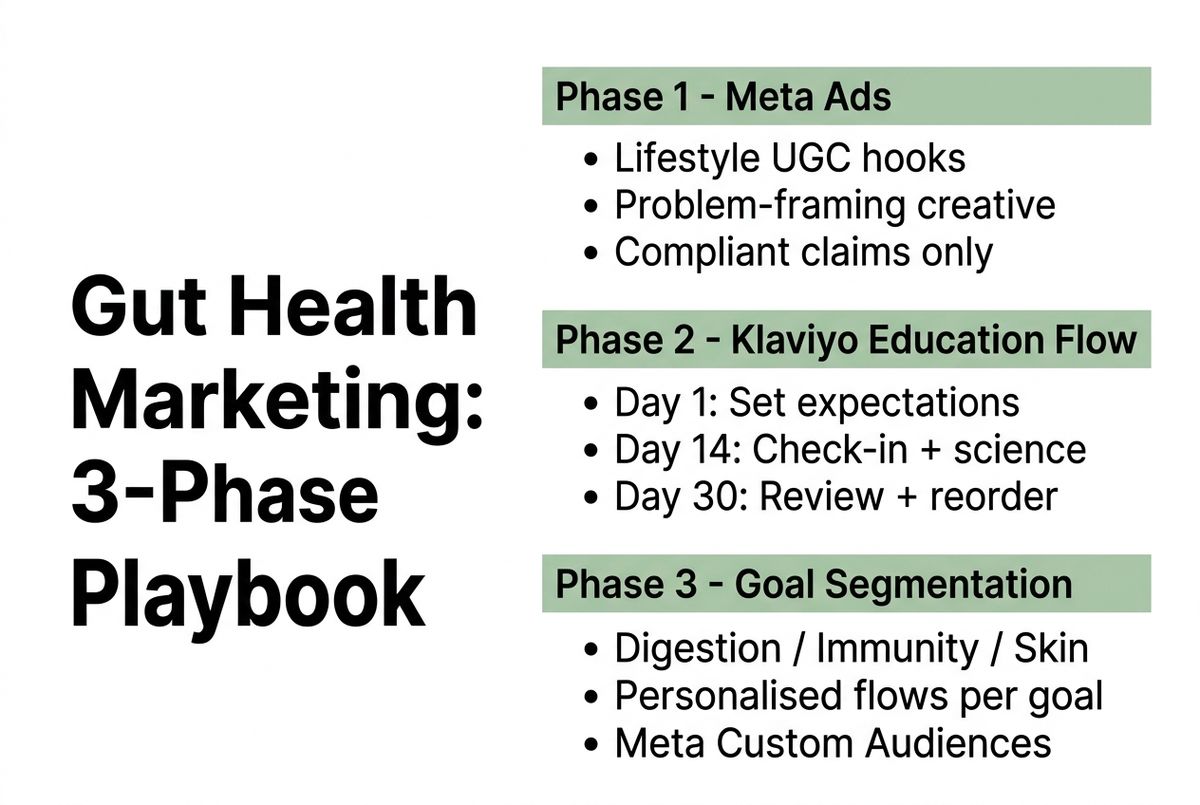
We work with health supplement brands across gut health, sports nutrition and women's wellness. This article is the playbook we use internally: how to build compliant Meta campaigns that convert, the Klaviyo education flow that keeps customers through the results window, and the segmentation strategy that lifts email revenue without making a single medical claim.
Key Takeaways
- •Gut health is Meta's most restricted supplement category - claims about the microbiome, digestion and immunity require careful framing to avoid ad rejections.
- •Lifestyle creative outperforms ingredient-heavy creative for cold audiences. Save the science for the education flow.
- •The results window (4-8 weeks) is your biggest churn risk. A Klaviyo education flow built around that window is the most important retention tool you have.
- •Segmentation by health goal (digestion, immunity, mental health, skin) dramatically improves email revenue per recipient.
- •ROAS benchmarks for gut health are lower than sports nutrition in the short term - but repeat purchase rates are high for brands that execute retention correctly.
Why Gut Health Is the Hardest Supplement Category to Advertise
Every supplement category has advertising friction. Gut health sits at a uniquely difficult intersection.
On one side: enormous consumer demand. Searches for probiotics, gut health and microbiome content are growing at double digits year-on-year. The category has been validated by mainstream media, podcast hosts and wellness culture. The consumer is already interested.
On the other side: Meta's ad policies treat references to the gut, microbiome, digestion or immune function as potential health claims - and health claims require careful framing. 'Improves digestion' is flagged. 'Supports digestive health' usually passes. The line between the two is thin, inconsistently enforced and changes without notice.
Add to that: results take time. A customer who buys on Monday won't feel anything for 2-4 weeks. By the time the probiotic starts working, most brands have already lost them to inertia. The education gap between purchase and result is the biggest LTV killer in this category.
We have seen gut health accounts flagged for language like 'supports healthy digestion' while nearly identical phrasing sailed through on a sports nutrition account the same week. Policy enforcement is not consistent - and understanding what triggers review versus rejection is a skill in itself.
None of this makes gut health unworkable. It makes it a category where the brands with the right strategy have a genuine edge. Most competitors are either getting ads disapproved or running generic creative that doesn't convert. If you get this right, you are running in a field that has thinned itself out.
The Gut Health Subcategories and Why They Matter for Your Marketing Strategy
Gut health is not one thing. Probiotics, prebiotics, synbiotics, digestive enzymes, postbiotics and digestive blends each carry different consumer expectations, different results timelines and different creative angles.
Probiotics are the most searched and most competitive. The consumer is broadly familiar with the concept but often confused about strains, CFU counts and what 'actually works'. Creative that simplifies the choice and reduces confusion converts well.
Prebiotics are less searched but growing fast as microbiome science becomes more mainstream. The 'feed the good bacteria' hook is intuitive and compliant - it describes mechanism without making a medical claim.
Synbiotics (pre and probiotic combined) benefit from a 'why take two when one does both' positioning. Clear comparison creative performs well here, especially in warm audiences.
Digestive enzymes have the most direct complaint-to-solution connection: bloating, discomfort after meals, slow digestion. This makes them the easiest subcategory to write compliant creative for - you are describing a specific moment (after eating) rather than a systemic health outcome.
Postbiotics are emerging. Consumer awareness is still low, which means education-first creative - not benefit-first - works better at cold audience level. The consumer doesn't know what a postbiotic is yet, so your job is to explain before you sell.
Across our gut health clients, digestive enzymes consistently show the lowest CAC in cold audience Meta campaigns. The direct complaint-to-solution framing reduces the information gap at first click - the consumer already knows they have the problem.
Understanding which subcategory you are in determines your entire creative strategy. A probiotic brand and a digestive enzyme brand face fundamentally different marketing mechanics, even if both sit in 'gut health'.
Meta Ads for Gut Health: What Works, What Gets Flagged and How to Navigate the Policy
The core rule for gut health Meta ads: describe the experience, not the mechanism.
Meta's health and wellness policies do not prohibit selling gut health supplements. They prohibit health claims that imply medical benefit, diagnosis or treatment. The distinction sounds simple. In practice, it requires constant discipline at the creative level.
What generally passes review:
- References to digestive comfort: 'feel lighter after meals', 'support your daily routine'
- Lifestyle positioning: 'made for people who take their health seriously'
- Ingredient transparency: '10 billion CFU, 5 researched strains'
- Social proof framing: 'over 12,000 five-star reviews'
What consistently triggers flags or rejection:
- Any reference to the immune system: 'supports immunity', 'immune-boosting'
- Specific microbiome claims: 'rebuilds your gut microbiome', 'rebalances gut flora'
- Digestive disease language: 'IBS', 'leaky gut', 'Crohn's' - even when buried in customer testimonials
- Before/after framing applied to health conditions
The safest frame for a gut health supplement ad: you are selling a daily wellness habit, not a medical intervention. The creative should look and sound like a lifestyle brand, not a pharmacy.
Not sure how to structure your gut health ad campaigns without triggering policy rejections? Book a free call - we will look at your current setup and tell you exactly what to fix.
Creative Formats That Convert for Gut Health Brands on Meta and TikTok
We test across three creative categories for gut health clients: lifestyle UGC, educational content and ingredient transparency. Each has a role depending on audience temperature.
Lifestyle UGC performs best at cold audience level. The format: a real person, a real kitchen, a morning routine. No green screen, no white lab coat. The implicit message is 'this fits into normal life', which reduces the perceived effort barrier for someone who has never considered taking a gut health supplement.
Educational breakdowns work well in warm audiences and for retargeting. 'Here's why your probiotic isn't working' performs strongly for brands that have already built some awareness. This format can reference more specific information - strains, CFUs, timing - because the viewer already has some context.
Ingredient transparency creative - a close-up of the label, ingredient callouts, certification visuals - performs particularly well for an audience that has been burned by low-quality products before. For brands with a strong quality story (third-party testing, no fillers, transparent sourcing), this format is consistently underused.
On video length: for gut health cold audiences, 15-second hooks that drive to a landing page outperform longer educational videos. Save the 60-second explanation for retargeting. The cold audience is not ready to watch a lecture - they need a reason to click.
In our gut health accounts, lifestyle UGC with a problem-framing hook - 'tired of bloating after every meal?' - consistently generates the highest thumb-stop rate at cold audience level. Problem-framing outperforms benefit-first hooks across every gut health subcategory we have tested.
Klaviyo for Gut Health: The Education Flow That Keeps Customers Through the Results Window
The biggest LTV risk for a gut health brand is the gap between purchase and first noticeable result. Most customers will feel nothing for 2-4 weeks. Some need 6-8. Without the right communication during that period, churn happens silently - the customer just doesn't reorder.
The Klaviyo education flow is the most important retention tool a gut health brand has. Not a discount. Not a reactivation campaign. An education flow that sets expectations and gives the customer a reason to stay consistent.
A gut health welcome and education flow we build for clients typically follows this logic:
Day 1: Welcome and set the timeline. Be explicit. 'Most people notice a shift in 2-4 weeks. Some feel a difference from day 1. Some need 6-8 weeks. This is normal - the microbiome takes time.' This single email dramatically reduces customer service contacts and early churn.
Day 5: How to take it correctly. Timing, food pairings, hydration. Simple and practical. This is the email customers save and refer back to.
Day 14: Two-week check-in. Ask how they're feeling. Link to the FAQ. Reinforce consistency. This is also a good moment for a light cross-sell if you have a complementary product - digestive enzymes alongside a probiotic, or a prebiotic fibre.
Day 30: Results check-in and review request. By now most customers have experienced something. This is the moment to capture a review and introduce the next step - subscription upgrade, larger supply, complementary product.
Day 45: The science behind your product. This email goes deeper: which strains, what the research shows, what CFU count means in practice. For a customer who has already experienced positive results, this email builds conviction and loyalty. For a customer who hasn't seen results yet, it provides a rational basis for continuing.
Want us to review your current Klaviyo setup? If you are not running an education flow for your gut health brand, you are losing customers during the results window. Book a free Klaviyo audit here.
Goal-Based Segmentation: How to Build Klaviyo Segments That Match Why People Actually Bought
Not every gut health customer has the same goal. Bloating relief, immune support, mental clarity, skin health, weight management - these are all reasons people buy probiotics, and they respond to different messaging.
The most effective segmentation we run for gut health clients is goal-based, captured at the point of purchase via a short post-purchase quiz. Three to four questions is enough: what is your primary health goal, are you currently taking other supplements, how long have you been dealing with this concern?
Once you have that data in Klaviyo, you can:
- Route new customers into goal-specific welcome flows (the bloating customer gets different content than the immunity customer)
- Personalise the Day 14 and Day 30 check-in emails to reference their specific goal
- Build Meta Custom Audiences by goal segment for hyper-relevant retargeting
- Cross-sell based on goal: the immunity customer gets a vitamin D recommendation; the digestion customer gets the digestive enzyme upgrade
The impact on email revenue per recipient is significant. Goal-segmented flows consistently outperform single-flow setups for gut health clients because the messaging matches why the customer actually bought - not what's easiest to write.
The Role of Scientific Evidence: When It Builds Trust and When It Backfires
Gut health customers are increasingly sophisticated. They read ingredient labels, check strain research and call out brands that use generic 'Lactobacillus blend' without specifics. For the right audience, science-led content builds trust faster than any lifestyle influencer.
But science-led content can work against you if deployed at the wrong stage.
For cold audiences on Meta and TikTok, scientific complexity is a friction point. A cold audience doesn't know your brand and is not ready to evaluate your clinical evidence. Lead with strain-level data in the first touch and you lose them.
For warm audiences, retained customers and email subscribers, scientific content is powerful. An email that explains why a specific Lactobacillus strain has 30 years of clinical research behind it is a confidence-builder for a customer who is already committed to the product.
The practical rule: science in the email flow, lifestyle in the cold ad. The same information - sequenced differently based on the customer's readiness to receive it.
Benchmarks: ROAS, Repeat Purchase and Email Revenue for Gut Health Supplement Brands
We work with gut health supplement brands at different stages. Benchmarks vary significantly by price point, supply duration (30-day vs. 90-day supply) and whether the brand has an active subscription model. That said, here is what we observe across our clients:
Short-term ROAS is typically lower than sports nutrition brands. Gut health requires more education before first purchase. The first 60-90 days of running ads rarely look as profitable as the long-term picture - which is why brands that optimise for short-term return often kill their gut health campaigns prematurely.
Repeat purchase potential is high for brands that execute the retention strategy correctly. Customers who get through the first 30 days without churning have significantly higher 12-month LTV than in most supplement categories. The habit is sticky once formed.
Email revenue contribution is substantial for gut health brands running education flows. Because the relationship between brand and customer is ongoing - results take time, follow-through matters - email engagement stays high longer than in categories where the product delivers immediate results.
We do not publish specific ROAS targets because they depend on your AOV, your margin and your price point. The brands we scale to profitability are the ones who treat first-purchase economics as customer acquisition investment, not a short-term return target.
Every brand's situation is different. The right Meta structure, Klaviyo setup and segmentation logic for a gut health brand depends on your category, your price point, your retention history and where you are in the growth curve. If you want to know what the right approach looks like for your specific brand - book a free call and we will show you.