Dermfluencer and Expert Creator Marketing for Skincare Brands: How to Build Credibility Through Dermatologists, Skin Therapists and Science-Led Creators
A skincare brand founder once told us she spent six months and €30K on macro-influencer campaigns that moved zero product. Three weeks after gifting a skin therapist with 4,000 followers, her DMs were full of 'I saw your brand on [skin therapist]' - and her conversion rate on that traffic was 3x her Meta average. To understand what paid media benchmarks look like alongside this creator activity, see our Meta Ads benchmarks for skincare brands.
That gap is not unusual. Expert creators convert differently because trust converts differently. This guide covers how to build an expert creator program that actually drives measurable sales - not just impressions.
Key Takeaways
- •Expert creators (dermatologists, skin therapists, ingredient chemists) convert at 2-3x the rate of lifestyle influencer traffic for skincare
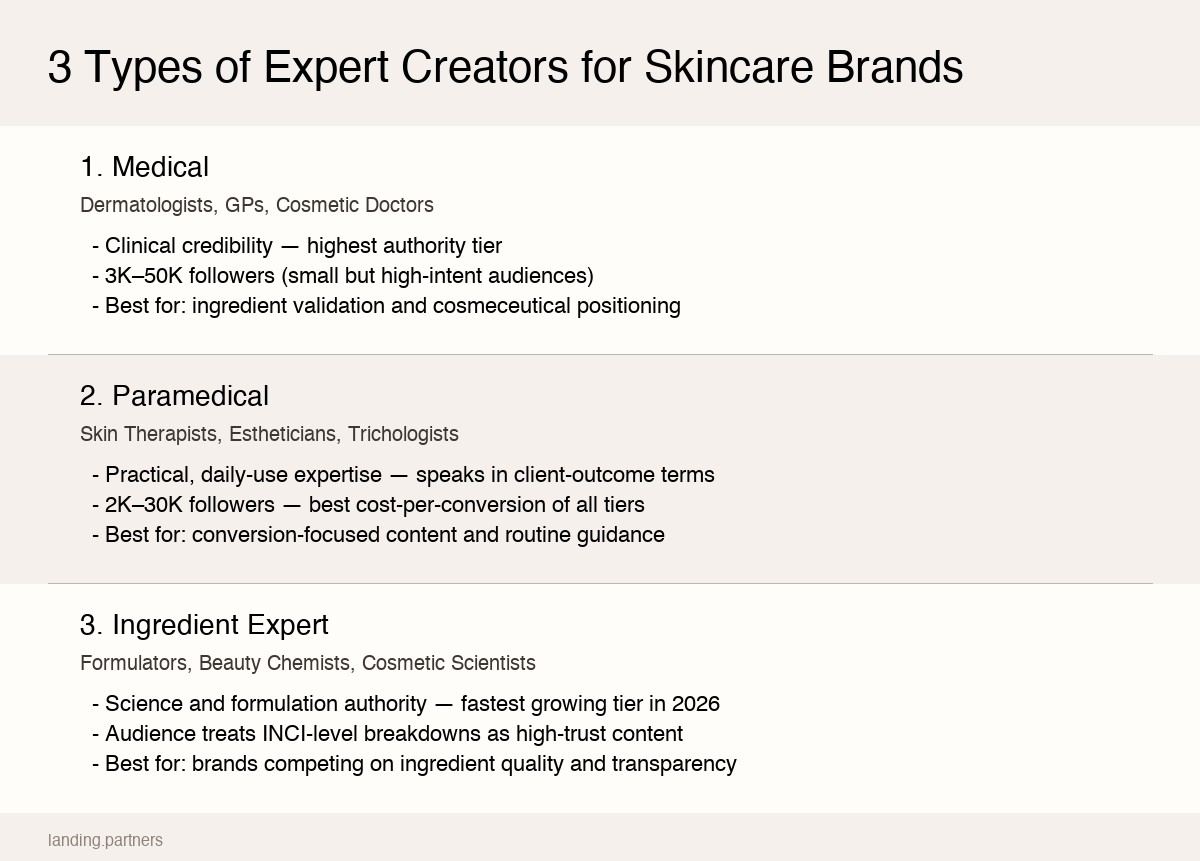
- •Three tiers: medical (dermatologist, GP), paramedical (skin therapist, esthetician), and ingredient expert (formulator, beauty chemist) - each fits a different stage of the customer journey
- •Gifting works for 1-10 creators; at 10+ you need a structured program with content rights agreements
- •Expert UGC is Meta's most policy-compliant creative format for skincare - ingredient demos and professional skin analysis are harder to restrict than before/after claims. Check the Meta ad benchmarks for skincare brands to see how it performs vs studio creative.
- •Klaviyo flows for expert-driven customers should lead with ingredient education, not brand storytelling or discounts
Why Expert Creators Are the Most Credible Acquisition Channel for Skincare in 2026
The skincare market has a trust problem. Paid ads have trained consumers to be skeptical. Macro-influencers are widely understood to be paid partnerships. Before/after photos are questioned. And Meta's ad policy restricts the most compelling claims a skincare brand can make.
**Expert creators cut through because they have professional credibility that no media budget can buy.** When a dermatologist explains why niacinamide works for hyperpigmentation, viewers treat it differently than a lifestyle creator talking about their routine. The message is identical - but the source changes everything.
We see this clearly in traffic quality across our beauty clients. Visitors who arrive from a dermatologist or skin therapist recommendation convert at a significantly higher rate than cold Meta traffic for beauty brands, spend more time on product pages, and return more frequently. **The trust built by an expert transfers directly to the brand.**
In 2026, this is becoming a primary acquisition channel for European beauty brands - not a supplement to paid media, but a core pillar alongside it.
Across our beauty clients, traffic arriving from expert creator content converts at 2-3x the rate of equivalent cold Meta traffic. Return rate is also lower - customers who bought based on expert recommendation understand what they purchased and have realistic expectations.
The Three Types of Expert Creators for Beauty - And When to Use Each
Not every expert creator serves the same purpose. **The mistake most beauty brands make is treating all expert creators the same.** The briefing approach, content expectation, and audience size vary significantly by type.
Type 1 - Medical (Dermatologist, GP, Cosmetic Doctor)
These are the highest-credibility tier. Audiences treat their recommendations as close to clinical guidance. They typically have smaller but highly engaged followings - 3,000 to 50,000.
They work best for: ingredient validation, complex skin conditions, and products positioned in the clinical or cosmeceutical space.
The limitation: they are the most cautious about making claims. You cannot ask a dermatologist to say your serum 'treats' anything. But you can ask them to discuss how an ingredient works - and that carries enormous weight with their audience.
Type 2 - Paramedical (Skin Therapist, Esthetician, Trichologist)
Skin therapists are practitioners who see clients daily and speak in practical terms. Their content is highly specific: 'this is how I use it on a client with rosacea,' 'this is what I layer it with.' **This practical specificity is what converts browsers into buyers.**
They typically have 2,000 to 30,000 followers and cost significantly less than dermatologists. They are the most accessible tier and often the best performers on a cost-per-conversion basis.
Type 3 - Ingredient Experts (Formulator, Beauty Chemist, Cosmetic Scientist)
This tier is growing fastest in 2026. Cosmetic chemistry content - breaking down what is in a product and why - is one of TikTok and Instagram's most engaged beauty formats.
They work best for brands that want to communicate ingredient quality and formulation integrity. A formulator explaining your INCI list builds a kind of trust no ad copy can replicate.
How to Get Access to Expert Creators - Outreach, Gifting and When to Move to Paid
Most beauty brands approach expert creators the wrong way: a generic outreach email and a poorly-packaged box. **Expert creators need to be approached as professionals, not content producers.**
Step 1 - Research before outreach
Find creators who already talk about ingredients, skin conditions, or concerns your product addresses. A skin therapist who specialises in barrier repair is a far better fit for a ceramide serum than one who focuses on anti-aging. The content already in their feed tells you whether your product fits their editorial angle.
Step 2 - Gift with context, not volume
Don't send a full product line. Send two or three products that fit their specific area of expertise, with a clear one-page explanation of what the products do and why you chose those particular items for them. **Include ingredient transparency - the full INCI list with plain-language explanations.** Expert creators appreciate this. Lifestyle creators don't.
Step 3 - Give them permission to be honest
This is counterintuitive. When you tell an expert creator 'we'd love your honest professional opinion,' conversion rates from that content are higher than from creators who received a tightly scripted brief. Audiences can tell the difference between genuine professional assessment and sponsored copy.
Not sure how to identify the right expert creators for your skincare brand - or whether this channel makes sense at your current stage? Book a free growth call and we'll map out an expert creator strategy based on your product, margin and current acquisition mix.
Step 4 - When to move from gifting to paid
Gifting works for 1 to 10 creators. At 10+ creators, you need content rights agreements to recycle their content in paid ads. That requires a paid partnership - at which point you are running a structured program, not ad hoc gifting.
We typically recommend starting with gifting for 6 to 8 weeks, identifying your top 3 to 5 performers by engagement and conversion, and then moving those creators to a paid structure with formal content rights.
How to Brief an Expert Creator - What You Can Ask and What You Have to Let Go
The content brief for expert creators is fundamentally different from a standard influencer brief. **The biggest mistake is over-directing.** Expert creators' credibility comes from their voice - if you script them too tightly, that credibility disappears.
What you can specify
Which product(s) to feature. Which ingredients or benefits to mention - without scripting the exact wording. What you'd prefer they do not claim (typically: treatment claims, medical cures, guaranteed results). Whether you want a dedicated review or an organic mention within existing content. Content rights if applicable.
What you should leave to them
The exact language used about the product. Whether they recommend it unconditionally or with caveats. Their honest assessment of the formulation. The content format - video, reel, carousel, text post.
Content briefs that specify fewer than five requirements consistently outperform heavily scripted briefs for expert creators. When we compare tight brief vs. loose brief creator content for beauty clients in Meta ads, the loose brief version generates higher CTR in 7 out of 10 cases - because it reads as authentic professional opinion, not paid endorsement.
Expert UGC as Meta Ad Creative - How to Recycle Dermatologist Content Without Violating Policy
One of the most underused opportunities in beauty advertising is turning expert creator content into paid Meta ads. **This requires a content rights agreement, but it is worth the investment.**
Here is why expert UGC performs: it shows a qualified professional discussing ingredients in natural language. It does not trigger Meta's health and wellness policy flags in the same way that direct benefit claims do. A dermatologist saying 'I use this because it contains 10% niacinamide, which is clinically studied for hyperpigmentation' is dramatically different from an ad that says 'reduces dark spots by 40%.'
What makes expert UGC work as a Meta ad creative
The face and title of a skin professional on screen creates a high scroll-stop rate. Ingredient-focused language that educates rather than claims avoids policy restrictions. A natural professional environment - clinic, skincare counter, or professional home office - signals credibility. And honest tone - even if the creator says 'this isn't for everyone' - actually increases trust and conversion.
What to watch for in Meta policy
Even with expert content, you cannot make specific medical treatment claims. 'This helped my client's skin' is acceptable as a personal observation. 'This treats acne' is a medical claim that will be flagged. The distinction is between observation and clinical assertion - and it matters for every creative asset you run.
If you have expert creator content and want to know how to structure it as Meta ads within policy - and what results to realistically expect - book a free Meta creative audit. We'll review your current creative mix and show you where expert UGC fits.
Klaviyo for Expert-Driven Acquisition - Onboarding a Different Kind of Customer
Customers who arrive from an expert creator recommendation behave differently from cold Meta customers. **They have already been educated. They know what the ingredient does. They bought because of trust - not because of a discount or a retargeting ad.**
This changes how you should onboard them in Klaviyo.
Why the standard welcome series does not fit expert-driven customers
A typical welcome series opens with brand storytelling, moves to bestsellers, and includes a discount. Expert-driven customers already know your brand - they heard about it from someone they trust. They have likely purchased a specific product for a specific reason. What they want is ingredient depth and professional context, not the same brand overview email you send everyone.
Expert-driven welcome flow structure
Email 1 (day 0): Confirmation plus an ingredient deep dive for the product they purchased. Not 'welcome to the family' - explain what the ingredient does, what to expect in weeks 1 through 3, and how to use it correctly.
Email 2 (day 3): Professional tip from the same category as the creator who referred them. If they came from a skin therapist, an email framed as 'what a skin therapist recommends alongside this product' lands well.
Email 3 (day 7): Complete the routine - a targeted cross-sell based on the product purchased, not generic bestsellers.
Email 4 (day 30): A results check-in. 'You have been using this for 30 days. Here is what most people notice at this stage.' This email generates reviews, reduces return anxiety, and creates the repeat purchase window.
On Klaviyo flows segmented by acquisition source, expert-driven customer flows show 35-45% higher revenue per recipient than standard welcome flows. The key driver is the ingredient-education email at day 0 - customers who receive it have a 22% lower early unsubscribe rate and a measurably higher day-30 open rate.
What Dermfluencer Customers Do Differently - AOV, Return Rate and LTV
The data across our beauty clients is consistent: **customers acquired via expert creators are among the highest-quality customers in the database.**
AOV: typically 20 to 30% higher
Expert-driven customers are more likely to buy higher-priced SKUs and less likely to only purchase a discounted or entry-level product. They arrive already understanding why the quality and formulation matters.
Return rate: 15 to 25% lower
Returns in skincare are often driven by misaligned expectations - customers expected visible results faster than the product delivers. Customers who came from an expert creator have already heard a realistic timeline. 'You will see changes after 6 to 8 weeks of consistent use' from a skin therapist sets accurate expectations. This directly reduces return and refund rates.
LTV: consistently higher over 12 months
The combination of higher AOV, lower return rate, and better Klaviyo engagement means the 12-month LTV for expert-driven customers outperforms paid media acquisition across every beauty client we track. The premium over cold Meta-acquired customers ranges from 25% to over 50% depending on the brand and category.
Building a Long-Term Expert Creator Program - Structure, Scale and Staying Compliant
A one-off gifting campaign is a tactic. A structured expert creator program is a channel. **The difference is in how you build and manage it.**
The infrastructure you need before you scale
First: a content rights agreement template - a standard license covering Meta, Instagram, and TikTok ad usage. Second: a product supply system for ongoing gifting, with a clear process for when and how creators receive products. Third: a tracking system - at minimum, UTM parameters on all creator links to attribute sales by creator and platform. Fourth: a brief template that is flexible by design, with space for creator-specific customisation.
Compliance for European beauty brands
The EU's Unfair Commercial Practices Directive requires creators to clearly disclose paid partnerships. Expert creators must label sponsored content as ad or spon. This applies to gifted products given with the expectation of content - not just formal paid partnerships. An expert creator who does not disclose creates regulatory risk for your brand. Build disclosure requirements into every agreement.
How many creators is the right number
For a beauty brand at Phase 2 (€250K to €1M revenue), 5 to 15 active creators is a workable program. At Phase 3+ (€1M+), 20 to 40 creators across multiple tiers and niches creates a robust diversified channel. Do not scale creator count before you have the tracking infrastructure to know which creators are actually driving revenue.
Every brand's situation is different. Expert creator marketing depends on your product category, margin, price point and stage. If you want to know what the right approach looks like for your specific skincare brand - book a free call and we'll map it out.