How to Lower Customer Acquisition Costs for Fashion Brands

For most fashion brands we audit, customer acquisition cost has gone up. Not because their ads got worse. Not because their product changed. Meta CPM is higher, audiences are more saturated, and the easy wins from 2021 are gone.
The instinct is to spend more. That instinct is wrong.
More spend into a broken acquisition model compounds the problem. The brands that are actually lowering their CAC in 2026 are doing something different: they are building organic channels that make their paid media cheaper over time. It is a flywheel, not a quick fix - but the math is compelling.
Key Takeaways
- •CAC for fashion brands is structurally rising due to higher Meta CPM and saturated lookalike audiences
- •More paid spend does not fix a rising CAC - it amplifies the problem
- •The brands lowering CAC in 2026 are building email lists, organic content, and creator channels alongside paid media
- •A larger Klaviyo list directly reduces Meta spend needs - fewer cold conversions required
- •Blended CAC (all channels combined) is the only number that matters - not your reported Meta ROAS
- •The flywheel takes 3-6 months to show in your numbers, but the impact compounds
Why CAC Is Rising for Fashion Brands in 2026
The structural drivers are not going away. Meta's cost-per-thousand impressions for fashion has risen significantly over the past 24 months. Privacy changes have reduced signal quality, which means the algorithm needs more spend to find buyers. And fashion audiences - especially in Belgium, the Netherlands, and the UK - are genuinely saturated for brands that have been running the same lookalike strategy for years.
The three forces pushing CAC up:
First, lookalike audiences have deteriorated. The 1-3% lookalike that worked well in 2022 is now competing with every other fashion brand targeting the same modelled profile. The CPM on those audiences has increased as competition for the same segment intensifies.
Second, creative fatigue hits faster. The average fashion brand we work with needs to refresh creatives every 3-5 weeks at scale. Every refresh cycle costs time and money. Brands without a proper creative pipeline are always playing catch-up.
Third, last-click attribution flatters Meta. The reported ROAS in Ads Manager looks fine. But blended revenue (total revenue divided by total ad spend) tells a different story. We consistently see a gap of 30-50% between reported and blended ROAS for fashion clients.
Across our fashion client base, brands spending 100% of their marketing budget on paid media have a blended CAC 40-65% higher than brands that also invest in owned channels - even when Meta ROAS looks similar on both. See our fashion brand advertising budget guide for how to allocate across channels.
Blended CAC vs. Paid CAC - The Only Number That Matters
Before you try to lower CAC, you need to measure the right thing. Most brands are measuring paid CAC - the cost to acquire a customer via a specific paid channel. This number is useful but incomplete.
How to calculate blended CAC:
Blended CAC = Total marketing spend (all channels) divided by total new customers acquired (all channels) in the same period.
This includes your Meta spend, your Google spend, any influencer or creator fees, your email platform cost, and your agency fees. All of it. Divided by every new customer you brought in - whether they found you via Meta, Google, organic search, word of mouth, or a creator post.
When you look at it this way, the picture changes. A brand spending €30K per month on Meta and acquiring 300 new customers has a reported Meta CAC of €100. But if they also spent €5K on an agency, €2K on Klaviyo, and €3K on content production, their real blended CAC is €133. That 33% gap matters for unit economics.
Not sure what your blended CAC actually is? We run free growth audits that break down your real acquisition costs across all channels. Book a free call and we will calculate it with you.
The 4 Organic Channels That Lower CAC for Fashion Brands
These are not theoretical. These are the channels we see actually moving blended CAC for fashion clients, ordered by impact and speed of return.
1. Email list growth (Klaviyo)
A larger, more engaged Klaviyo list directly reduces your reliance on cold paid acquisition. Every sale from an email flow is a sale you did not need to pay Meta for. More importantly: a high-quality Klaviyo list feeds better Meta Custom Audiences for suppression (exclude existing customers from acquisition campaigns) and for lookalike building (model new audiences on your best buyers).
We have seen fashion brands reduce their Meta spend by 15-20% simply by improving their Klaviyo suppression setup - stopping the algorithm from wasting budget re-acquiring existing customers.
Fashion brands with an email list above 10,000 engaged subscribers (35%+ open rate) spend an average of 18% less on paid media per new customer acquired, compared to brands with a smaller or less engaged list. The list pays for itself in reduced CAC.
2. Organic social content (Reels and TikTok)
Organic Reels and TikTok content does two things for CAC. First, it creates a warm audience - people who have watched your content are significantly cheaper to convert via paid retargeting than cold audiences. Second, high-performing organic posts can be boosted as Spark Ads (TikTok) or promoted posts (Meta), often at lower CPM than cold traffic campaigns.
The catch: organic content only lowers CAC if it actually performs. Generic brand content does not. What works for fashion: styling content, behind-the-scenes collection stories, product close-ups with personality. Content that would get engagement without the ad budget behind it.
3. Creator and affiliate programs
A commission-based creator program is, in unit economics terms, a variable CAC. You pay a percentage of revenue when a sale happens, not a fixed CPM. For many fashion brands in the €500K-€2M revenue range, this is significantly cheaper than cold paid acquisition - especially for first-time buyers.
The typical commission structure for fashion affiliates sits at 8-15% of first-order revenue. At a €120 average order value, that is €10-18 per acquired customer. Compare that to a blended Meta CAC of €40-80 for many mid-tier fashion brands. The economics are compelling.
4. SEO and blog content
Organic search traffic converts. A fashion brand ranking for "buy women's linen trousers Belgium" or "men's tailored casual shirt online" gets buyers who have already made most of their purchase decision. The CAC for an organic search conversion is effectively the cost of producing the content - which, spread over time, is very low.
Blog content compounds. An article written today can drive traffic for 3-5 years. Paid ads stop the moment you stop paying.
If you are spending more than €10K per month on Meta and your email list is below 5,000 subscribers, you have a structural problem. The fix is not to spend more on Meta. Book a free audit and we will show you where the CAC bleed is.
How the Flywheel Actually Works
The reason most fashion brands do not invest in organic channels is that they do not see immediate return. Meta spend converts today. A blog post takes 6 months to rank. A Klaviyo list takes time to build. A creator program takes months to recruit and test.
This is the wrong time horizon. The flywheel works like this:
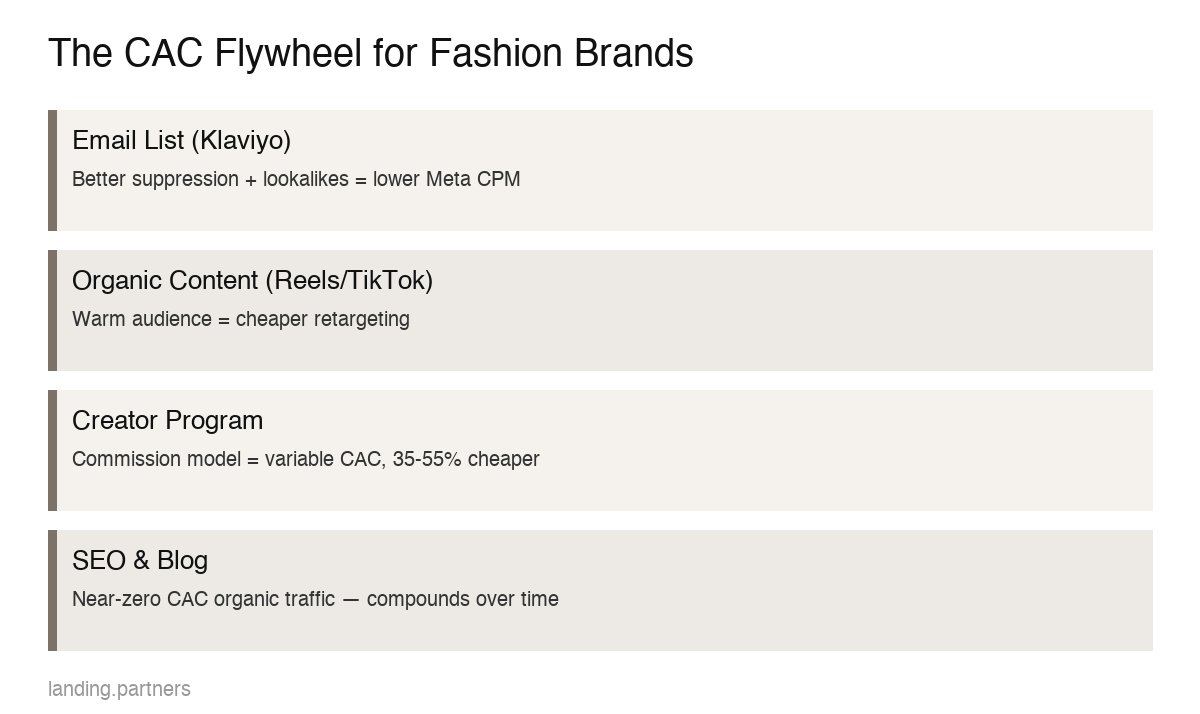
Month 1-3: Investment phase
You start building the list. You produce organic content consistently. You set up a basic creator program. Your blended CAC does not improve - it might get slightly worse as you add costs. This is normal and expected.
Month 3-6: First signals
Your Klaviyo list starts generating flow revenue. Your warm Meta audiences (from organic video views) start showing lower CPM. Your first creator-driven sales come in. Blended CAC starts to flatten.
Month 6-12: Compounding effect
A larger list means better Meta suppression and lookalikes. Consistent organic content means a bigger warm pool for retargeting. Creator sales are running on commission. Blog traffic starts arriving. Blended CAC starts to visibly decline. Your Meta spend can stay flat or grow more slowly while revenue accelerates.
Fashion brands we have worked with for 12+ months, that built all four organic channels alongside paid media, show a blended CAC reduction of 20-35% compared to their starting point - even as their revenue scaled by 40-80% in the same period. The flywheel compounds.
The Email List as a CAC Reducer - The Specifics
Because the email list has the fastest and most direct impact on blended CAC, it deserves specific attention.
The mechanism is threefold. First, every sale from a Klaviyo flow is a sale with a near-zero acquisition cost. Welcome flows, abandoned cart flows, and post-purchase cross-sell flows all drive revenue from contacts you already own. Second, suppressing existing customers from Meta acquisition campaigns reduces wasted spend significantly - we typically see 8-15% of a fashion brand's Meta audience being existing customers who should be excluded. Third, a clean list of buyers is your best lookalike seed audience. Meta's algorithm models new people most similar to your existing buyers - and if your seed audience is high-quality, the lookalike performs better.
What good list-building looks like for fashion brands:
The highest-converting opt-in mechanisms we see for fashion are exit-intent pop-ups with a style-related incentive (not just a generic discount), back-in-stock waitlists (buyers who want a specific product are high-intent), and launch waitlists for new collections. Generic 10% discount pop-ups attract bargain hunters who buy once and unsubscribe. Style quizzes attract engaged potential buyers who want help.
For a luxury or premium fashion brand: never offer a percentage discount on a pop-up. It cheapens the brand. Offer early access to new collections instead. The opt-in rate is lower but the subscriber quality is higher - and that is what actually lowers CAC.
Organic Social: When It Helps and When It Does Not
Organic content only lowers CAC if it creates an audience. A brand posting beautiful imagery that gets 50 likes and 1,200 impressions is not building a warm audience. The threshold for meaningful impact on Meta retargeting is roughly 10,000+ video views per month - below that, the custom audience is too small to make a material difference to CPM.
The content that creates audiences for fashion brands in 2026: short-form video. Specifically, content that shows the product being worn, styled, or described by a real person. Educational styling content ("three ways to wear this piece") and behind-the-scenes collection stories consistently outperform static brand imagery for warm audience building.
If you are not generating meaningful video views organically, you have two options: invest in the content capability to get there, or use paid Spark Ads/promoted posts to seed the audience artificially while you build organic traction. The second option costs more but creates the retargeting pool faster.
Want to know which of the four organic channels will move your CAC fastest given your current situation? Book a call and we will prioritise the right starting point for your brand. Book a free growth call
Creator Programs: The Variable CAC Model
Commission-based creator programs are structurally attractive for fashion brands because they convert a fixed cost (CPM) into a variable cost (commission on sale). You pay when a customer is acquired, not before.
The practical setup for a fashion brand starting a creator program:
Recruitment: Micro-creators (10,000-100,000 followers) with high engagement rates in fashion niches typically outperform macro-influencers for commission-based programs. They have an audience that trusts them, and the commission model incentivises them to actually sell, not just post.
Commission structure: 10-15% of first-order revenue is the standard range for fashion. Some brands offer a flat fee per sale instead - typically €10-20 per confirmed new customer. Both work; commission percentage is easier to explain to creators.
Attribution: Use unique discount codes or UTM-tagged landing pages per creator. Do not rely on platform affiliate tracking alone - it undercounts. And be careful not to double-count creator-attributed sales that also appear in your Meta attribution window.
Content briefing: Give creators a brief with product positioning and key messages, but leave room for their own voice. Creator content that sounds like branded ad copy does not convert in a commission model - their audience follows them for authenticity, not polished production.
For fashion brands that run active creator programs alongside paid media, the average cost per new customer via creator (commission-based) is 35-55% lower than via cold Meta acquisition - based on our client data. The difference is most pronounced for brands with a mid-range AOV of €80-€150.
SEO: The Slowest Channel With the Lowest Long-Term CAC
SEO has the longest ramp time of the four organic channels, but the most durable impact on CAC. An article that ranks for a relevant query drives organic traffic indefinitely. A Meta ad stops the moment you pause the budget.
For fashion brands, the most valuable SEO categories are:
Product-level queries ("linen blazer women Belgium", "sustainable streetwear brand") - these drive high-intent buyers directly to product or category pages. These are won with product page optimisation and collection page copy, not blog articles.
Informational queries ("how to style a trench coat", "what to wear to a garden party") - these drive top-of-funnel traffic that can be converted via email capture. Blog content wins here.
Brand queries (your own brand name) - make sure you own these. Branded search is almost free acquisition because the intent is already high. Every brand should rank first for their own name.
The realistic SEO timeline for fashion brands: 4-6 months to see initial traffic movement from new content, 9-12 months for meaningful volume. This is why SEO should be started early, not when you desperately need cheaper acquisition. The brands that invested in SEO content in 2024-2025 are benefiting now. The brands starting today will benefit in 2027.
What the Numbers Look Like at Scale
To make this concrete: consider a fashion brand at €1.5M annual revenue, spending €25K per month on paid media (primarily Meta), acquiring approximately 400-500 new customers per month at a blended CAC of €55-65.
After 12 months of building the flywheel alongside paid media - investing approximately €3-5K per month in content, creator program management, and Klaviyo optimisation - the typical outcomes we see:
Klaviyo now drives 12-18% of total revenue from flows, reducing the number of paid acquisitions needed. Meta suppression of existing customers saves 8-12% of wasted acquisition spend. Creator programs bring in 15-20% of new customers at 35-45% lower CAC. Organic content warms the audience, reducing retargeting CPM by 15-25%. Blog content contributes a small but growing stream of near-zero-CAC organic conversions.
Net result: blended CAC drops from €60 to €42-48 over 12 months, while revenue grows. The paid media spend stays roughly flat or grows slowly. The difference is that the same €25K now goes further because the ecosystem around it is more efficient.
Frequently Asked Questions
Every brand's CAC situation is different. The right mix of organic channels depends on your current revenue stage, your margin, your product type, and how saturated your existing paid audiences are. If you want to know what the right approach looks like for your specific brand - book a free growth call and we will audit your current acquisition model.