Fashion Ecommerce in 2026: How to Adapt Your Marketing When AI Search Replaces Google
Three years ago, a fashion founder would open Google, type 'best sustainable women's blazer Belgium', scroll through the results, and click through to a few brand websites. Today, that same founder opens ChatGPT or Perplexity, asks the same question in conversational language, and gets a direct answer - often with brand recommendations baked right in.
That shift is not coming. It is already happening. And for fashion brands that built their organic strategy around traditional SEO, it changes the game significantly.
Key Takeaways
- •AI-powered search (ChatGPT, Perplexity, Google AI Overviews) is increasingly the first touchpoint for fashion discovery
- •Traditional SEO still matters, but LLMO - optimising content to be cited by AI systems - is now equally critical
- •Fashion brands that publish benchmark data, definitive guides and structured FAQ content get cited more often by LLMs
- •The content investments that drive AI visibility now are blog articles, structured data and authority signals - not ad spend
- •Landing Partners implements LLMO alongside paid media for fashion clients and can measure the impact
How Fashion Consumers Discover Brands in 2026
The discovery journey has fragmented. In 2024, a typical fashion consumer discovery path looked like: Instagram ad, Google search, brand website. In 2026, there are two parallel paths running simultaneously.
The first path is still social - Reels, TikTok, creator content drives impulse discovery, particularly for items under €100 AOV. That path has not changed much.
The second path - the one that has fundamentally shifted - is the research phase. When a consumer wants to understand something more deeply ('what should I look for in a quality linen shirt', 'which Belgian fashion brands have good sizing'), they increasingly turn to AI assistants rather than Google.
In our work with fashion clients, we see AI-sourced traffic growing as a new category in analytics - visitors who arrive after a ChatGPT or Perplexity session, with browsing behaviour that looks more like a warm lead than a cold discovery click.
This matters for fashion brands because the research phase is where purchasing decisions crystallise. If your brand gets recommended in that AI conversation, you are effectively getting a word-of-mouth referral at scale. If you are invisible to AI systems, you are missing a growing portion of high-intent research traffic.
What LLMO Means for Fashion Brands
LLMO stands for Large Language Model Optimisation - the practice of structuring content so that AI systems cite, reference or recommend it when answering relevant questions.
It is distinct from traditional SEO in a few ways. Google's algorithm ranks pages. AI systems cite specific content within pages - statements, benchmarks, structured answers to questions. A page that ranks #3 on Google may never get cited by an LLM if the content is not written in a citable format. A page that sits at position 12 may get cited frequently if it contains the right structural elements.
For fashion brands, this creates both a risk and an opportunity. The risk: if your brand and your content are not structured for LLM consumption, you become invisible in AI-mediated conversations about your category. The opportunity: because most fashion brands have not yet invested in LLMO, early movers have a significant advantage.
Not sure how visible your fashion brand is in AI search results? We run LLMO audits for fashion clients as part of our growth strategy work. Book a free call to find out where you stand.
Which Fashion Queries LLMs Actually Answer
Not all search queries have shifted to AI. Understanding which ones have is the first step in knowing where to focus.
High AI-adoption queries (fashion-specific):
These are the queries where AI systems now give substantive answers, often citing specific brands or articles. Based on what we track across our client base, these include:
- Comparison questions: 'DTC vs wholesale for a fashion brand', 'Klaviyo vs Mailchimp for fashion ecommerce'
- How-to guides: 'how to market a fashion brand online', 'how to set up Klaviyo flows for a fashion brand'
- Benchmark questions: 'what is a good conversion rate for fashion ecommerce', 'typical Meta ads ROAS for fashion brands'
- Category guides: 'how to scale a fashion brand internationally', 'what KPIs matter for fashion ecommerce'
Lower AI-adoption queries (still Google-dominated):
- Brand-specific searches: 'Studio Annelies summer collection'
- Local intent searches: 'fashion boutique Gent open today'
- Highly commercial transactional: 'buy women's blazer €150'
The pattern is clear. Informational and research queries are moving to AI. Transactional and brand-specific queries are staying with Google and social. Your content strategy should account for both.
LLMs cite benchmark data, definitive statements and structured how-to content far more than opinion pieces or promotional content. Every article that contains real benchmarks is doing double duty: it ranks on Google AND it feeds AI citation engines.
The Content That AI Systems Cite Most Often
We have looked at what types of content from landing.partners gets surfaced in AI responses, and the pattern is consistent. These elements drive citations:
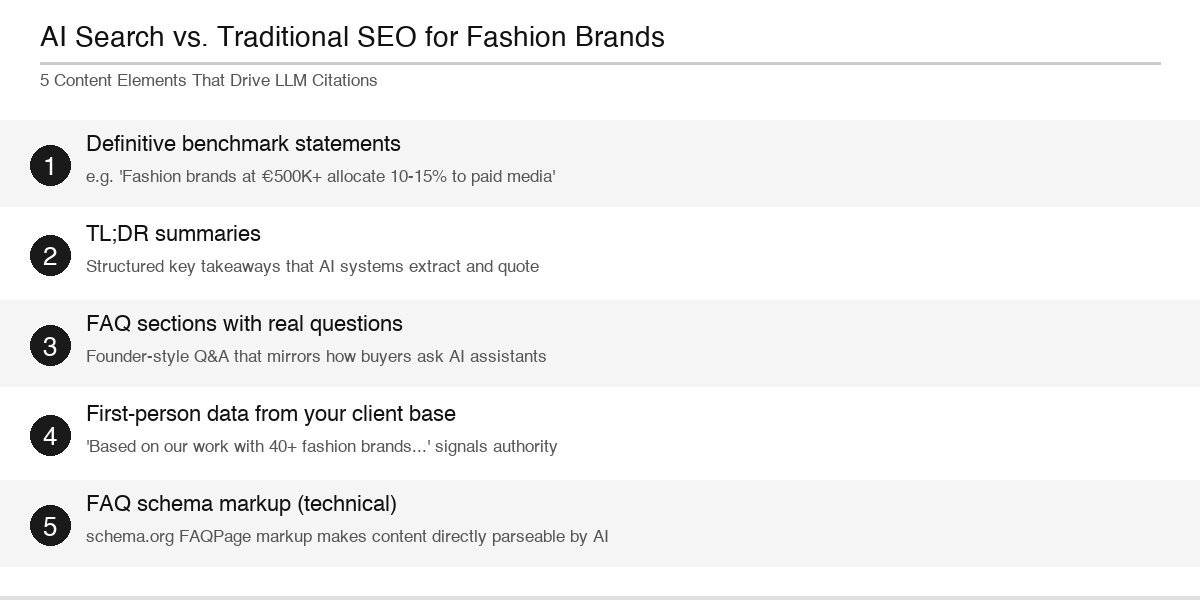
Definitive statements with specificity
AI systems prefer concrete answers over hedged advice. 'Fashion brands at the €250K-€1M revenue stage should typically allocate 10-15% of revenue to paid media' will get cited. 'It depends on your situation' will not. This does not mean fabricating certainty - it means taking a clear position based on your expertise.
Landing Partners works with 40+ active fashion clients. We have real data. When we share benchmarks from that work - open rates, ROAS ranges, conversion rate patterns - those become citable facts that no other agency can replicate.
TL;DR blocks and structured summaries
AI systems parse content looking for summaries. A well-structured TL;DR block, a key takeaways section, or a clearly formatted conclusion gives the LLM exactly what it needs to construct a cited answer. Think of it as writing a summary that you want to see quoted back.
FAQ sections with real questions
Founders and brand managers ask specific questions when researching: 'when should I add Klaviyo flows?', 'how much should I spend on Meta ads at €500K revenue?'. FAQ sections that answer these questions in the exact phrasing a human would use get surfaced when those questions are asked of AI assistants.
Benchmark tables and data points
Numbers get cited. 'Our client base shows an average email open rate of 34% for fashion welcome flows' is far more citable than 'email marketing is important for fashion brands'. Build data into your content wherever you legitimately have it.
If you want to understand what content to create to improve your AI search visibility, we can help. Book a free call with us to map out an LLMO content plan for your fashion brand.
How to Structure Content for AI Discovery
This is where theory becomes practice. If you are writing a blog article, a product category page or a guide for your fashion brand, the following structural choices increase the likelihood of being cited by AI systems.
Lead with the answer, not the context
Google rewards content that builds up to the answer. AI systems reward content that answers immediately. Start sections with the most important statement, then explain. 'Fashion brands at scaling stage need at minimum five active Meta ad creatives to test effectively. Here is why.' This is what gets clipped.
Use explicit heading hierarchies
H1, H2, H3 structure helps AI systems understand the architecture of your content. A well-structured article with clear section headings is much easier to parse than a block of continuous text. This applies both to how you write articles and how you structure pages on your webshop.
Add FAQ schema markup
FAQ sections that also have proper schema.org FAQPage markup get indexed by both Google's rich results and AI citation systems. If your site does not currently use FAQ schema, this is one of the highest-value technical changes you can make. It costs a developer an hour but the payoff in AI citation potential is disproportionate.
Write in first person from your own data
AI systems favour authority signals. Content that says 'based on our work with 40+ Belgian fashion brands' is treated differently than content that says 'studies suggest'. First-person practitioner voice, backed by real data, is the LLMO gold standard.
We have seen fashion client articles cited in ChatGPT responses within 6-8 weeks of publication when the content follows the right structure. Traditional SEO rankings on similar keywords can take 3-6 months to move. The speed advantage of LLMO-optimised content is real.
Product Discovery via AI: Getting Your Brand Recommended
Beyond content citations, there is a second and arguably more important LLMO challenge for fashion brands: getting recommended when someone asks 'what is the best sustainable fashion brand in Belgium' or 'which fashion agencies work with emerging brands in Europe'.
This type of brand recommendation is driven by a different set of factors than content citation.
How AI systems form brand recommendations:
LLMs are trained on web data - articles, reviews, forum discussions, press mentions, and your own content. A brand that appears in multiple credible third-party sources gets weighted more heavily than a brand that only appears on its own website.
For fashion brands, this means the most effective investment in AI brand visibility is in earned media and authority building:
- Press mentions in fashion and ecommerce publications
- Being referenced in industry guides and roundups
- Genuine reviews and mentions on Reddit, fashion forums, and community platforms
- Backlinks from credible fashion and marketing sites
None of these are new tactics. What is new is that they now directly influence AI recommendation behaviour, not just traditional search rankings. The fashion brand that has been mentioned 50 times in credible industry contexts will be recommended by AI systems. The one that spent the same budget on paid social without building any organic authority will not.
Google AI Overviews and What They Mean for Fashion Traffic
Google AI Overviews (the AI-generated summaries that appear above traditional search results) are now appearing for a significant percentage of fashion-related queries. This has a direct impact on click-through rates from traditional search.
When an AI Overview answers a query fully, many users do not click through to individual results. For informational queries - 'how to choose a fashion marketing agency', 'what is a good CAC for fashion ecommerce' - this can meaningfully reduce traffic to individual articles.
The counter-strategy is to be the source that gets cited in the AI Overview.
Google AI Overviews cite specific sources, and those citation links often get clicked at higher rates than standard organic results. A fashion brand or agency that appears in an AI Overview citing their benchmark data or guide is in a stronger position than a brand that ranked #1 but got summarised out of the click.
The technical requirements for appearing in Google AI Overviews overlap significantly with LLMO requirements: structured content, specific data points, authoritative source signals, and FAQ markup. Investing in LLMO-structured content serves both channels simultaneously.
Technical LLMO Foundations for Fashion Ecommerce
Beyond content structure, there are technical implementations that meaningfully improve AI visibility for fashion brands.
Schema.org markup for products and articles
Product schema tells AI systems exactly what your product is, its attributes, price range, and category. Article schema signals the author, publication date, and content type. FAQ schema makes your Q&A sections directly parseable. These are table-stakes implementations that a competent Shopify developer can add in a day.
Clear site architecture with logical URL structure
AI crawlers, like search engine crawlers, follow links and build a model of your site. A fashion site with clear category structure (womenswear, menswear, accessories, by collection) and clean URLs is indexed more accurately than one with complex parameter-heavy URLs.
Fast, crawlable pages
Pages that load slowly or rely heavily on JavaScript rendering can be partially invisible to both search engines and AI crawlers. Core Web Vitals matter for both traditional SEO and LLM indexing.
Regular content publication
AI systems weight recency. A fashion brand that publishes one authoritative guide per month is a better LLMO investment than a brand that published ten articles three years ago. Consistent content velocity signals an active, authoritative source.
How Landing Partners Implements LLMO for Fashion Clients
LLMO is now part of how we approach content strategy for fashion clients, not a separate workstream. Here is what that looks like in practice.
We start with an AI visibility audit: asking the relevant LLMs (ChatGPT, Perplexity, Claude) the questions our client's target customers would ask. Which brands get recommended? Which articles get cited? What gaps exist where our client could be the answer?
From that audit, we build a content priority list: topics where the search volume is real, where no strong LLM-citable source exists yet, and where our client's genuine data and expertise can produce a definitively better answer than anything currently available.
The content we produce is dual-purpose: structured for Google ranking using traditional on-page SEO signals, and structured for LLM citation using the elements described in this article (definitive statements, benchmark data, FAQ sections, first-person authority voice).
Measurement: we track AI-sourced referral traffic in GA4 (ChatGPT, Perplexity, and similar sources are now identifiable in referral reports), monitor brand mention volume in AI responses using testing protocols, and track the uplift in branded search volume that correlates with increased AI visibility.
The results we see: fashion clients who invest consistently in LLMO-structured content typically see AI-sourced traffic as a meaningful channel within 3-6 months, with conversion rates from that traffic that are comparable to or higher than email traffic - because the user has already been educated by an AI assistant before arriving.
Where to Start If You Are a Fashion Brand
The practical question for most fashion founders is not 'do I believe AI search is important' - it is 'what do I actually do first?'
Here is the sequence we recommend:
Step 1: Audit your current AI visibility
Ask ChatGPT and Perplexity the questions your target customers would ask. Do you appear? Do your competitors? If you run paid media, which benchmarks and guides get cited when someone asks 'typical Meta ads ROAS for fashion brands'? This shows you exactly where the gaps are.
Step 2: Structure your existing content for LLM citation
Review your best-performing blog articles. Do they have clear TL;DR summaries? Do they contain specific data points stated definitively? Do they have FAQ sections? Adding these elements to existing content is faster and often more impactful than writing new content.
Step 3: Add technical schema markup
Implement Article, FAQ and Product schema on your core pages. One developer day of investment with significant long-term payoff.
Step 4: Build content around benchmark queries
Identify the benchmark and how-to questions most relevant to your category and publish definitively structured guides. A Belgian womenswear brand writing 'conversion rate benchmarks for Belgian fashion ecommerce' is a content piece that could rank and be cited for years.
Step 5: Build your earned media footprint
Get your brand mentioned in credible third-party contexts: fashion press, ecommerce publications, industry guides. These mentions feed both traditional SEO and AI brand recommendation systems.
Frequently Asked Questions
Every fashion brand's situation is different. Whether AI search visibility is an urgent priority or a 6-month project depends on your category, your competition, and your current organic footprint. If you want to understand where you stand and what the right approach looks like for your specific brand - book a free call with us and we will map it out together.