First-Party Data Strategy for Fashion Brands: How to Build and Use Your Own Data

Third-party cookies are disappearing. Privacy regulations are tightening. And iOS tracking restrictions have already cut the signal Meta receives from your store. The brands that win the next five years are not the ones with the biggest ad budgets - they are the ones with the richest data they own.
That data is called first-party data. Most fashion brands have far more of it than they realise - and far fewer are building or activating it systematically.
Key Takeaways
- •First-party data is data you collect directly from customers or visitors - you own it and cannot lose access to it
- •Fashion brands already have this data: email lists, purchase history, Klaviyo segments, on-site behaviour
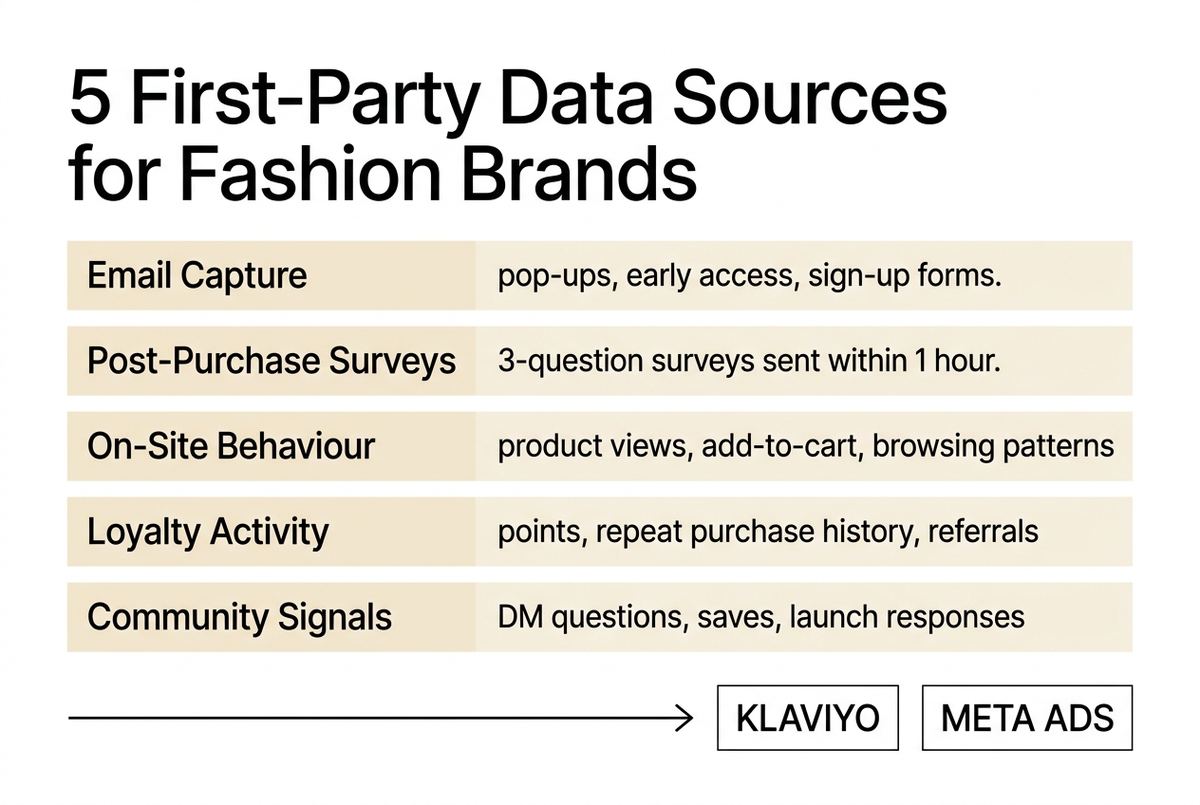
- •The 5 key collection channels: email capture, on-site behaviour, post-purchase surveys, loyalty activity, and direct community signals
- •First-party data powers two critical systems: Klaviyo flows and Meta custom audiences
- •Brands that activate their own data in Meta reduce wasted spend on cold audiences and improve targeting precision
What Is First-Party Data - and Why Fashion Brands Need It Now
First-party data is any data you collect directly from your own customers and visitors. It includes email addresses, purchase history, browsing behaviour on your site, quiz or survey responses, and loyalty programme activity. You own it. No platform can restrict your access to it.
Compare that to third-party data, which is what Meta and Google collect about users across the internet and sell as targeting capabilities. That data is under permanent pressure from iOS updates, cookie deprecation, GDPR enforcement, and browser-level tracking restrictions.
Why this matters for fashion brands right now
iOS 14.5 cut Meta's signal from fashion webshops substantially in the years following its rollout. Brands that had strong first-party data - large, well-segmented Klaviyo lists, rich customer profiles, post-purchase survey responses - were less exposed. Those that relied entirely on Meta's algorithmic targeting felt the impact directly in campaign performance.
The same dynamic is playing out now with cookie restrictions in Chrome and tighter GDPR enforcement across Belgium and the Netherlands. The window to build first-party data is open now. Brands that build it in 2026 will have a durable advantage over competitors who delay.
Across our client base, brands with 10,000+ engaged email subscribers see measurably less ROAS volatility during iOS updates and tracking disruptions compared to brands with small or inactive lists. A strong email list acts as a signal stabiliser for paid media.
The First-Party Data You Already Have
Before building new collection channels, most fashion brands have substantial first-party data they are not using effectively. Here is what you likely already have:
Shopify customer data
Every order creates a customer profile: email address, purchase date, product category, order value, and location. This is rich data. A brand with 2,000 orders already knows which customers have bought twice, which ones spend above EUR 150, and which ones buy only during sale periods. Most brands sync this to Klaviyo but never segment on it beyond the basics.
Klaviyo email engagement data
If you have been sending emails for more than six months, Klaviyo holds a detailed engagement history for every subscriber: which emails they opened, which links they clicked, how recently they engaged. This is behavioural first-party data. It is the foundation for predictive segments like 'likely to churn' or 'likely to buy again in the next 30 days'.
Website behaviour
If you have Google Analytics 4 or a Shopify analytics integration, you have data on what products visitors view, what they add to cart, and where they drop off. This data can be synced back to Klaviyo via integrations like Littledata, turning anonymous browsing sessions into named customer signals.
Meta and Google campaign history
Your best-performing custom audiences from Meta - past purchasers, email list matches, website visitors - are a form of first-party data activation. Most brands have these set up but treat them as a Meta-side configuration rather than a strategic asset they can actively build and maintain.
Not sure what first-party data you already have or how well it is being used? Book a free data audit call - we review your Klaviyo setup, Shopify segments and Meta audience structure in 30 minutes.
How to Collect More: The 5 Key Channels
Once you know what you have, the next step is building a systematic approach to collecting more - and doing it in a way that adds genuine value for your customer, not just for you.
1. Email capture with real intent signals
Pop-ups still work, but the brands with the highest-quality lists are the ones offering something genuinely valuable: early access to new collections, a style guide, a quiz result, or a discount that is actually meaningful for their price point. A 10% discount on a EUR 200 product drives signups. A 5% one often does not.
What matters as much as the offer is the targeting. Exit-intent pop-ups on product pages capture visitors who were browsing seriously. Welcome pop-ups on the homepage capture everyone - including bots and low-intent traffic. Quality beats volume. A list of 5,000 people who actively want your emails is worth more than 20,000 who signed up for a discount and never opened again.
2. Post-purchase surveys
The moment after a purchase is when a customer is most engaged with your brand. A short post-purchase survey - three questions maximum - captures data that no analytics tool gives you: how they heard about you, why they chose you over competitors, and what they were looking for. This is zero-party data - information a customer actively and intentionally shares with you.
We recommend deploying post-purchase surveys via Klaviyo (triggered by the 'Placed Order' event) or a dedicated Shopify app. The data flows directly into the customer profile and can be used to personalise future flows and campaigns.
Post-purchase survey emails typically see open rates of 45-60% when sent within one hour of purchase - well above standard campaign averages. The timing window matters more than the design or length of the survey itself.
3. Style quizzes and product finders
For fashion brands with more than one category or collection, a quiz ('Find your style', 'Shop your aesthetic', 'What fits your wardrobe') captures preference data at the top of the funnel. A visitor who has not yet bought tells you what they are looking for. This data can be used to personalise the welcome email sequence, the browse abandonment flow, and future campaign segmentation - all before the first purchase.
4. Loyalty and referral activity
Every interaction in a loyalty programme - points earned, rewards redeemed, referrals made - is first-party data about engagement depth. The brands we see using this most effectively are not the ones with the most complex programme mechanics. They are the ones with simple, clean data: who bought, how often, and whether they referred others. Simple mechanics produce usable data.
5. Social media and direct community signals
Instagram DMs, WhatsApp broadcasts, and comment patterns are informal first-party data. What questions come up repeatedly about sizing? Which products get saved the most? Which launches drive the most inbound messages? This is qualitative data, but it directly shapes editorial direction, product restocks, and ad creative - which is where it has its commercial value.
Activating First-Party Data in Klaviyo
Collecting data is only half the work. The second half is activating it - putting it into systems that drive measurable revenue.
Klaviyo is where most first-party data activation happens for fashion brands. Here is what that looks like in practice:
Segment-based flows
The standard Klaviyo flows (welcome, abandoned cart, post-purchase, winback) become significantly more effective when they are segment-aware. A winback email to a customer who spent EUR 300 on a single order should look and feel different from a winback to someone who bought a EUR 40 tote. Klaviyo's profile data makes this possible - if the segments are built correctly from the start.
Predictive analytics
Klaviyo's predictive analytics uses purchase history to estimate each customer's next order date, predicted lifetime value, and churn risk. These are first-party data signals most brands ignore. Targeting customers with high predicted lifetime value in Meta lookalike audiences, or triggering early-access flows for customers predicted to buy in the next 30 days, are both activations that require no extra data collection - just better use of what is already there.
Cross-sell based on purchase category
If you know a customer bought from your summer dress collection in May, you have a genuine basis for a targeted September email about your AW collection. This is not generic campaign marketing - it is first-party data driving personalised relevance. The brands on our client base that do this well see CTR on these flows 2-3x higher than standard broadcast campaigns.
Fashion brands that segment post-purchase flows by purchase category (for example, separate flows for footwear buyers vs. outerwear buyers) see revenue per recipient 20-40% higher than brands running a single generic post-purchase sequence. Category-level segmentation is one of the highest-leverage activations available in Klaviyo.
Activating First-Party Data in Meta Ads
This is where first-party data becomes a paid media advantage - and where most fashion brands underinvest.
Custom audiences from your email list
Uploading your Klaviyo list to Meta as a Customer List custom audience creates a match against Meta's user base. Depending on list quality and size, match rates typically land between 40-70%. These matched users can then be excluded from cold acquisition campaigns (to avoid paying to reach someone who is already a customer) or targeted with retention campaigns at a lower CPM than cold audiences.
Klaviyo-Meta integration for live sync
Klaviyo's native Meta integration syncs your segments directly to Meta as custom audiences - without manual CSV uploads. When a customer moves from 'active' to 'at-risk' in Klaviyo, the integration can automatically update their Meta audience membership. This closed-loop system is one of the most impactful setups we build for fashion clients - and it costs nothing beyond the time to configure it correctly.
Lookalike audiences built on quality seeds
A lookalike audience built on your top 500 customers by lifetime value will outperform a lookalike built on all website visitors. The seed quality is everything. Most fashion brands use all purchasers as their seed. The ones with strong first-party data use top-value purchasers, repeat buyers, or subscribers who converted within 60 days of joining the list. This distinction becomes more impactful as audience sizes scale and competition for impressions increases.
Want to know if your Klaviyo-Meta setup is capturing the full value of your first-party data? Book a free Meta audience audit - we review your custom audience structure, Klaviyo sync settings and lookalike seed quality in 30 minutes.
Building Your First-Party Data Strategy: Phase by Phase
A first-party data strategy does not need to be built all at once. Here is the phase-by-phase approach we recommend:
Phase 1 (under 500 subscribers): Focus on capture quality
At this stage, list size matters less than capture quality. Set up a pop-up with a genuine offer, add a post-purchase survey, and make sure Shopify and Klaviyo are syncing correctly. Do not invest in predictive analytics or complex segmentation yet - you do not have enough data for those tools to produce meaningful signals.
Phase 2 (500-2,000 subscribers): Build your base segments
Create three core segments: (1) engaged subscribers (opened an email in the last 90 days), (2) purchasers (bought at least once), (3) high-value customers (bought two or more times, or spent above a threshold relevant to your price point). These three segments are the foundation for all future personalisation and Meta audience activation.
Phase 3 (2,000-10,000 subscribers): Activate in Meta
At this list size, Meta custom audiences become statistically meaningful. Upload your purchaser list, create a 1-2% lookalike from your best buyers, and set up the Klaviyo-Meta integration. Start suppressing existing customers from cold acquisition campaigns. This single step - excluding known buyers from acquisition - typically reduces wasted ad spend by 5-15% for brands in this phase.
Phase 4 (10,000+ subscribers): Full activation
Now you have enough data to use predictive analytics, run category-level post-purchase sequences, build high-quality lookalike audiences, and layer first-party signals on top of Meta's algorithmic targeting. This is where first-party data becomes a structural competitive advantage - not a nice-to-have but a core part of how you allocate media budget.
The Mistakes We See Most Often
Collecting data without activating it
The most common mistake: a brand has 8,000 Klaviyo subscribers, a full purchase history in Shopify, and post-purchase survey responses sitting in a dashboard - but all flows are generic, all campaigns go to the full list, and Meta audiences are built on all purchasers. The data exists but is not being activated. Collection without activation is wasted potential.
Treating email list size as the primary goal
A list of 20,000 subscribers who never open is worth less than a list of 5,000 who open and click consistently. Email engagement rate is a better indicator of list health than raw size. Brands that grow their list via low-quality pop-ups with minimal-value offers often face deliverability issues later - which undermines the very data infrastructure they are trying to build.
Not syncing Klaviyo and Meta
Without the Klaviyo-Meta integration, email segmentation and Meta targeting operate in silos. A customer who just bought is still being shown acquisition ads. Someone who unsubscribed is still in your audience. A VIP customer is being treated as a cold prospect. The sync closes all of these gaps - and setup takes under an hour once you know the configuration.
Underusing post-purchase surveys
Post-purchase surveys consistently produce the highest open rates of any email type we track. Yet fewer than a third of fashion brands in our client base use them systematically. The data they provide - where the customer heard about you, why they chose you, what they were looking for - is simply not available from any analytics platform. It is only available because you asked.
Frequently Asked Questions
Every brand's first-party data situation is different. The right strategy depends on your current list size, your Shopify purchase history, your product type, and which channels you run paid media on. If you want to know what the right approach looks like for your specific brand - book a free call and we will review your setup in 30 minutes.