Google Ads for Supplement Brands: Performance Max, Shopping Campaigns and How to Navigate Health Advertising Policies

Most supplement brands we talk to have the same blind spot: they've built their entire acquisition model on Meta, and Google Ads is either an afterthought or completely absent from their stack.
That's understandable. Meta is visual, emotional, and fast. Google feels complicated - policies, feed requirements, bidding strategies. And for health products, there's an extra layer: what can you actually say in an ad?
But here's what we see across our supplement clients: Google Ads often becomes their highest-efficiency repeat-purchase channel once it's set up correctly. The people searching for your brand or your product category on Google are already past the awareness phase. They have intent. That changes everything.
Key Takeaways
- •Google Ads captures purchase intent that Meta cannot - people actively searching for supplements are much closer to buying
- •Google's health advertising policies are strict but fully navigable once you understand which claim types trigger flags
- •Performance Max works for supplement brands when structured by product category with proper audience signals
- •Branded search is the most underutilised Google channel for supplement brands with an existing customer base
- •Google and Meta serve different moments in the funnel - running both is more effective than choosing one
Why Supplement Brands Underestimate Google
The default assumption in supplement marketing is that Meta is the primary acquisition channel and everything else is secondary. We understand why that perception exists. Meta is where most supplement brands see their first results: you target an interest audience, you run a benefit-driven video, conversions come in.
But Meta is interruption-based. You're reaching someone who wasn't looking for your product. The conversion relies on stopping them mid-scroll and building enough trust in 15 seconds to get a purchase decision.
Google Search is the opposite. Someone types 'best magnesium supplement for sleep' or 'vitamin D3 K2 buy' - they already have intent. The hard part of the sale is already done.
Across our supplement client base, branded search campaigns consistently deliver the lowest cost-per-acquisition of any paid channel - often 3 to 5 times more efficient than cold Meta traffic.
The reason supplement brands avoid Google isn't lack of opportunity. It's policy complexity. Google's healthcare and pharmaceutical advertising rules create genuine friction - especially if you're used to the relative permissiveness of Meta's health category.
Understanding those rules is the unlock. Once you know what's allowed, what's flagged, and what's genuinely off-limits, running supplement campaigns on Google becomes systematically manageable.
Google's Health Advertising Policy for Supplements in 2026
Google doesn't treat all supplements the same way. There are three distinct tiers in terms of policy friction, and understanding which tier your products fall into determines your entire campaign strategy.
Tier 1: General wellness supplements (low friction)
Products like multivitamins, protein powders, omega-3, and general wellness supplements face the fewest restrictions. You can advertise the nutritional content, the category benefits ('supports energy', 'contributes to normal immune function'), and the lifestyle use case ('for active people', 'ideal for plant-based diets').
The critical rule: all health claims must comply with EU/EFSA regulations if you're running in European markets. This means sticking to approved nutrient function claims from the EFSA register - not general benefit statements that imply disease treatment.
Tier 2: Targeted wellness supplements (moderate friction)
Products positioned for specific health concerns - sleep support, stress, joint health, digestive health - face stricter scrutiny. These categories trigger more automated policy reviews, and certain claim types will get your ads disapproved or your account flagged.
What's allowed: 'contains magnesium, which contributes to normal muscle function', 'with ashwagandha, traditionally used in Ayurvedic practice'.
What gets flagged: implying treatment of a specific condition, using before/after framing that suggests disease reversal, making efficacy claims without EFSA approval.
Tier 3: Pharmaceutical-adjacent supplements (high friction)
Products that overlap with pharmaceutical categories - high-dose melatonin, hormonal support supplements, weight loss products - face the most restrictive policies. In some markets, certain products in this tier require Google certification to advertise at all.
The practical implication: review your ad copy through the lens of EFSA approved claims before any campaign goes live. Google's automated systems flag specific vocabulary patterns - words like 'cure', 'treat', 'heal', 'reverse', 'clinically proven' are automatic triggers, even in organic-sounding copy.
Not sure which tier your supplement products fall into - or whether your current ad copy is compliant? Book a free Google Ads review and we'll assess your account against current policy requirements.
Google Shopping for Supplement Brands: Product Feed Optimisation
Shopping campaigns - whether standalone or inside Performance Max - live and die by product feed quality. For supplement brands, a generic Shopify-to-Google feed is rarely sufficient. The optimisation is in the attributes.
Product titles
Google uses your product title as the primary signal for query matching in Shopping. The default title from your Shopify store is often written for brand voice, not search intent. Optimise titles to include the supplement type and key ingredient, the format (capsules, powder, gummies), the quantity or supply duration, and the use case where EFSA-compliant.
A poorly optimised title: 'Moon Blend - Our Premium Recovery Formula'.
An optimised title: 'Magnesium Glycinate Capsules 400mg - 60 caps - Muscle and Sleep Support'.
Product title optimisation alone has increased Shopping impression share by 40 to 60% for supplement clients we've audited - without changing bids, budgets, or campaign structure.
Custom labels for bid segmentation
Use custom labels to segment your product feed by margin, price point, and customer purchase frequency. A €15 single-serve supplement pack and an €89 three-month supply bundle should not share the same campaign with the same bidding strategy.
Common label structures we use: margin tier (high / medium / standard), product category (vitamins / minerals / proteins / herbals), subscription eligibility (yes / no). This allows different ROAS targets per product group rather than blending a €12 product and an €89 product under a single campaign target.
Additional attributes that build trust in the feed
Google surfaces additional attributes in Shopping results. For supplement brands, include: lab tested or third-party tested certifications (if accurate), organic or vegan certification where applicable, and key ingredient dosage in the description. These details directly improve click-through rate on Shopping placements.
Performance Max for Supplement Brands: Structure and Setup
Performance Max (PMax) is now Google's default campaign type for ecommerce. For supplement brands, it works - but the setup choices matter significantly more than in a standard Shopping campaign.
Asset group structure by product category
Do not put all your supplement products in a single asset group. Group by product category and audience intent. Sports nutrition (protein, pre-workout, creatine) goes in one group with fitness and gym audience signals. General wellness (multivitamins, omega-3, probiotics) gets health-conscious adult audience signals. Sleep and stress products (magnesium, ashwagandha, adaptogens) are separate with wellbeing and sleep audience signals. Beauty supplements (collagen, biotin, hyaluronic acid) get skincare and beauty audience signals.
Each asset group gets its own creative assets, headlines, and descriptions. The angle for a protein powder audience is completely different from the angle for someone looking for sleep support.
Audience signals that shorten the learning phase
PMax uses audience signals to accelerate the learning phase - you're not targeting, you're giving Google a starting point. For supplement brands, combine customer match lists from your email database (existing buyers by product category), similar segments to your highest-LTV customer cohort, interest signals from Google's health and wellness categories, and URL signals from your product and blog pages.
Running Performance Max without proper audience signals often means a 6 to 8 week learning phase that spends inefficiently. Customer match data from day one dramatically shortens that window.
Managing budget allocation across channels
PMax has full discretion over budget allocation across Search, Shopping, Display, YouTube, Gmail, and Discover. For supplement brands in the early stages, this can lead to significant spend on Display inventory before Shopping has been properly optimised.
The solution: run a separate Standard Shopping campaign alongside PMax with campaign priority set to High. This ensures your best-performing Shopping products get direct budget before PMax redistributes across channels.
We structure PMax setups from day one with segmented asset groups and customer match data. If your current PMax is spending on Display with weak Shopping results, there's almost certainly a structural fix available. Talk to us about your Google setup.
Branded Search: The Most Underutilised Google Channel for Supplement Brands
If you have a supplement brand with any meaningful organic customer base - people who've bought before, who follow you on social, who've seen your Meta ads - branded search is almost certainly driving purchase intent that you're not capturing efficiently.
When an existing customer finishes their protein powder and types your brand name into Google, what happens? In most cases, your organic listing appears, but so do competitor ads. If you're not bidding on your own brand terms, you're paying Meta to acquire customers who then get poached at the point of repurchase.
For supplement brands with a monthly active customer base, branded search campaigns typically achieve a ROAS of 10x to 20x - the most efficient spend in the entire paid media stack.
**Branded search campaigns should be the first Google campaign any supplement brand launches**, before Shopping, before PMax. The investment is minimal - €5 to €20 per day depending on your brand volume. The returns are immediate, and you're protecting revenue you've already earned through other channels.
The setup is straightforward: one campaign, exact and phrase match on brand name and brand plus product variations ('[your brand] magnesium', '[your brand] protein powder'), maximise conversion value bidding once you have 30 or more conversions in 30 days.
YouTube Ads for Supplement Brands: Education First, Conversion Later
YouTube is the highest-consideration channel in Google's ecosystem for supplement brands - and it's often completely absent from supplement marketing stacks.
For supplements that require education - why this ingredient matters, how it works, what differentiates this formula - YouTube is the best channel to build the trust that turns a first-time visitor into a committed buyer.
What works for supplement YouTube ads
**Ingredient education content:** a 60 to 90 second video explaining what a specific ingredient does, why dosage matters, and how your product delivers it. No medical claims - frame it as 'here's what the research shows' rather than 'this will do X to your body'.
**Routine content:** how to incorporate supplements into a daily routine. Particularly effective for multi-product brands where the cross-sell opportunity is significant.
**Founder or formulator content:** the person who created the formula explaining why. This type of content builds genuine brand trust in a category where customers are understandably cautious.
YouTube ad policy for supplements
YouTube applies Google's healthcare policy to video ads. The same claim rules apply: no disease treatment claims, no before/after that implies medical outcomes, EFSA-compliant language for European markets.
The added nuance: YouTube automated systems flag specific visual elements, not just text. Before/after images of skin conditions or weight loss visuals in the video itself - not only the copy - can trigger disapproval.
ROAS and CPC Benchmarks for Supplement Brands on Google
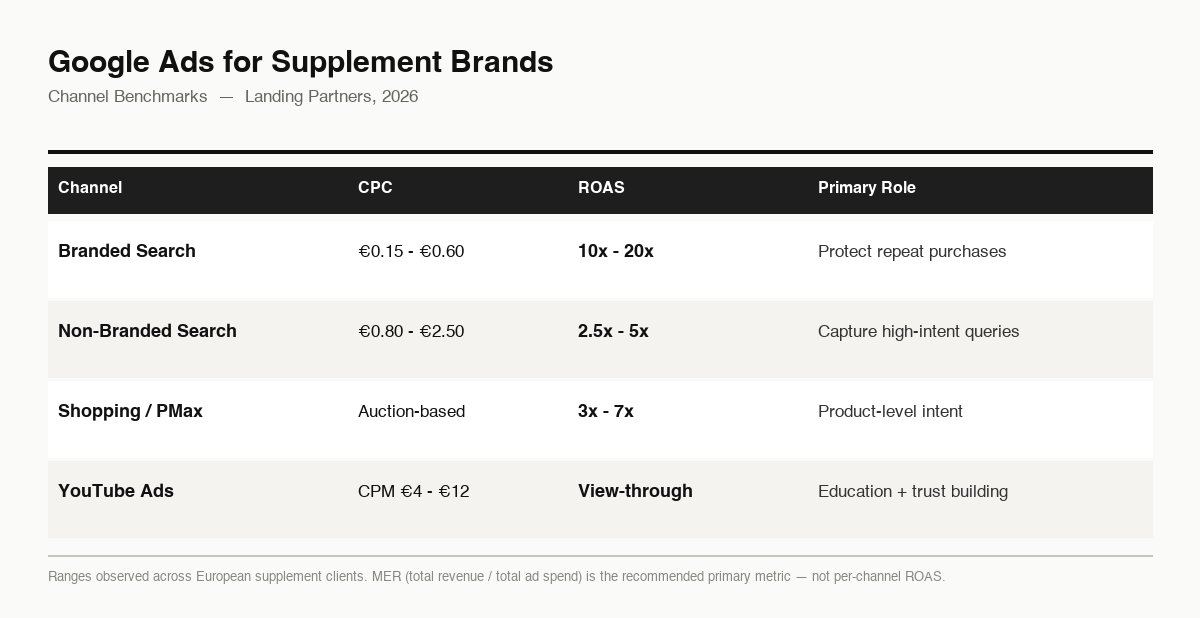
These are the ranges we observe across supplement clients in European markets. Every brand operates in a different competitive landscape with different margins and product AOV - use these as directional reference points, not fixed targets.
Branded search
CPC: €0.15 to €0.60 (low competition on own brand terms). ROAS: 10x to 20x (high intent, existing brand affinity).
Non-branded search (generic supplement queries)
CPC: €0.80 to €2.50 (varies by category - weight loss terms are highest). ROAS: 2.5x to 5x (dependent on landing page quality and offer).
Shopping and Performance Max
ROAS: 3x to 7x for general wellness and sports nutrition. ROAS: 2x to 4x for targeted wellness and premium-priced products (higher AOV requires more touchpoints before conversion).
YouTube in-stream ads
CPM: €4 to €12 in health and wellness targeting segments. YouTube's impact is often best measured in branded search lift rather than direct ROAS, since it drives awareness that converts later on Search.
Google and Meta: Building the Complete Supplement Acquisition Funnel
The question we hear most often from supplement founders is: 'should I focus on Meta or Google?' It's the wrong question.
Meta and Google serve fundamentally different moments in the customer journey. Trying to replace one with the other misunderstands what each channel actually does.
**Meta creates demand.** Someone wasn't looking for a sleep supplement. Your ad appears while they're scrolling. The video explains why they need better sleep and how magnesium supports it. They click, they browse, they may not buy immediately.
**Google captures demand.** Three days later, they search 'magnesium sleep supplement'. Your Shopping ad appears. This is the lowest-friction purchase moment in the funnel.
The ROAS Google reports for that conversion will look excellent. But the conversion was enabled by the Meta touchpoint. Attribution systems that give Google full credit for this sale are misleading you about where to invest.
**The correct frame:** use MER (total revenue divided by total ad spend across all channels) as your primary metric. Don't make budget decisions based on last-click attribution in either platform's reporting.
The operational structure that works for growing supplement brands: Meta for cold prospecting and warm retargeting - use it for awareness, benefit-driven creative, and consideration. Google Search for branded terms and high-intent non-branded queries ('buy magnesium glycinate', 'best vitamin D supplement'). Google Shopping or PMax for product-level intent capture with an optimised feed. YouTube for education and trust-building for considered purchases. Klaviyo for post-purchase flows, replenishment, and win-back - the retention layer that improves the economics of every acquisition channel.
Every supplement brand's situation is different. The right Google Ads structure depends on your margin, product range, existing customer base, and growth stage. If you want to know what the right approach looks like for your specific brand, book a free call with our team.