Case Study: How a Niche Fashion Brand Scaled Meta Ads from €5K to €50K Monthly Budget

Key Takeaways
- •A contemporary women's fashion brand scaled Meta from €5K to €50K/month in 9 months without a ROAS collapse.
- •The bottleneck was never budget - it was creative. We needed a consistent production pipeline before we could scale spend.
- •Phase 1 was about proving the model. Phase 2 was about creative infrastructure. Phase 3 was about systematic expansion.
- •We maintained a blended ROAS of 3.2x throughout the entire scale - by protecting the profitable structure at each new level.
- •The biggest lesson: scaling Meta spend is a creative problem, not a media buying problem.
Scaling Meta ads from €5K to €50K monthly is not a linear process. It is not just a matter of increasing the daily budget and watching results improve proportionally.
For every fashion brand we work with that wants to scale, the conversation usually follows the same arc: we demonstrate a profitable structure at lower spend, build confidence, and then face the real challenge - how do you add a zero to your budget without destroying the efficiency you built?
This is the story of one brand where we figured it out. A niche women's fashion brand, contemporary price point at around €150 AOV, strong organic presence but barely any paid media experience. Nine months later, they were spending €50K per month on Meta and growing.
Here is exactly how we did it.
The Brand: Context and Starting Point
The brand sells women's fashion in the contemporary segment - elevated basics, easy-to-wear pieces, the kind of label that builds a loyal following through aesthetics and community rather than price competition.
When we started together, they were doing around €15K per month in total online revenue. They had a Shopify store with a solid conversion rate for their price point, an engaged Instagram following built organically over three years, and almost no paid media history.
Their Meta setup was minimal: a pixel that had been firing for months but collecting messy data, a few boosted posts that had gone nowhere, and a lingering belief that 'Meta doesn't work for our brand.'
What we found in the audit:
The store was ready. The organic content was strong. The product photography was editorial quality. The problem was not the brand - the problem was the paid infrastructure, which was essentially non-existent.
Starting budget: €5,000 per month. Starting ROAS: not measurable (no clean data). Target: build a scalable paid engine.
Phase 1: Building the Foundation (€5K-€10K/month)
The first month was not about scaling. It was about getting clean data and proving the model.
We rebuilt the pixel setup from scratch: server-side tracking via Conversions API, correct event mapping, and a clean 180-day purchase audience. We set up a straightforward campaign structure - one prospecting campaign, one retargeting campaign - and kept everything simple deliberately.
Creative strategy in Phase 1:
We pulled 12 creatives from their existing organic content: editorial photos, short Reels, a few product flat lays. We tested them in a dynamic creative setup to let the algorithm find winners without burning budget on manual A/B tests.
Three weeks in, two creatives were pulling clear purchase data at a ROAS of 3.5x on prospecting. One was a Reel showing the product being worn, styled three different ways - the kind of 'how to wear it' content the brand already posted organically. The other was a simple static product image with a direct price-and-feel headline.
After 30 days at €5K spend: ROAS 3.2x on prospecting, 5.1x on retargeting. Clean data. Two proven creative concepts. Ready to scale.
At this point, most brands want to immediately jump budget. We deliberately held at €5K for a second month to stress-test the structure across more of the catalogue and confirm that the winning creatives held their performance over time.
They did. Month two ended at 3.4x blended ROAS.
Not sure if your Meta setup is actually ready to scale? Book a free Meta audit - we'll tell you exactly what's holding you back before you add more budget.
Phase 2: The Creative Infrastructure (€10K-€25K/month)
This is the phase that determines whether a scale-up works or falls apart. The biggest risk when increasing Meta budget is not audience saturation - it is creative fatigue.
At €5K/month, two winning creatives can carry you. At €25K/month, you need a production pipeline.
What we built:
We set up a monthly UGC production process with three micro-creators in the brand's niche. Each creator produced two short videos per month: one 'styling' format and one 'honest review' format. That gave us 6 new UGC assets per month alongside the brand's own organic content.
We also introduced Advantage+ Shopping campaigns alongside the existing manual structure - not to replace it, but to run in parallel as a second prospecting engine.
Budget moved to €10K in month three, €15K in month four, €20K in month five. Each increment waited two weeks before the next increase to let the algorithm stabilise.
By the end of Phase 2 (month six), we had 19 active creatives in rotation. The top five accounted for 68% of purchases. UGC formats consistently outperformed branded editorial by about 30% on purchase volume - but the branded content drove higher AOV. We ran both deliberately.
The creative fatigue protocol we implemented:
When a creative's CTR drops more than 30% week-over-week, we flag it for replacement within 10 days. This sounds simple but requires someone actively monitoring it. The moment you let fatigued creatives run, efficiency drops and budget is wasted.
At €25K/month, we were spending roughly €3,500 per month on creative production (UGC creators plus editing). That is 14% of ad spend on creative - and it was the best investment of the entire scale.
Phase 3: Systematic Budget Expansion (€25K-€50K/month)
The jump from €25K to €50K is where most brands either unlock serious scale or start seeing ROAS erosion. The difference is usually in how you structure the expansion.
We did not simply double the budget on existing campaigns. Instead, we opened new prospecting layers:
A broad prospecting campaign targeting lookalike audiences based on the 180-day purchaser list - no interest targeting, just the lookalike signal and creative quality doing the work.
A catalogue-based dynamic product ad campaign targeting website visitors who had not purchased within 14 days.
A new campaign targeting a specific product category (their summer drop) with dedicated creatives built around the drop narrative.
Budget allocation at €50K/month:
Roughly 70% of budget into prospecting (split across three campaign types), 20% into warm retargeting, and 10% into retention campaigns targeting past purchasers with new arrivals. This distribution reflects this brand's specific funnel dynamics - it is not a universal template.
Month nine results at €50K/month: blended ROAS 3.1x, revenue at €155K for the month (up from €15K twelve months earlier). Creative refresh cadence: 8-10 new assets per month. Active creatives in rotation: 24.
The ROAS held within 0.3 points of where we started. That consistency across a 10x budget increase only happened because we built the creative infrastructure before we scaled the budget.
We've done this for multiple fashion brands at different price points and in different markets. If you want to know whether your brand is ready for a similar scale - book a free strategy call.
The Numbers: Before and After
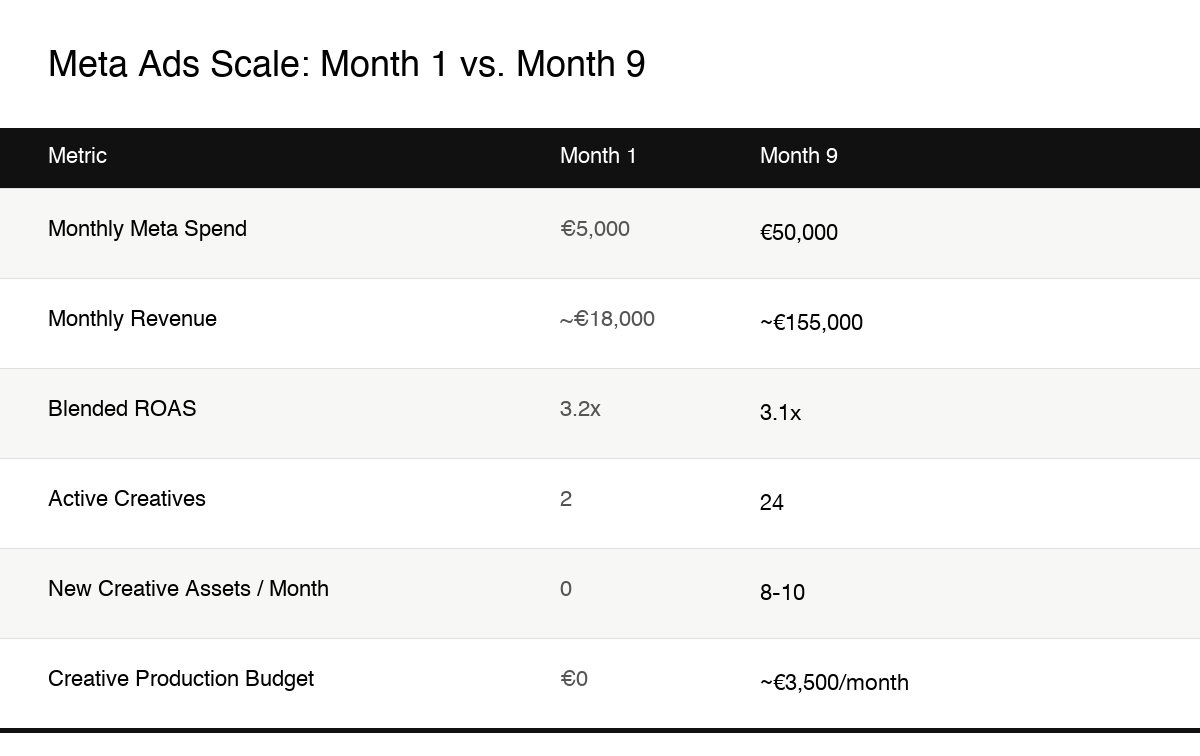
Month 1 vs. Month 9:
Monthly Meta spend: €5,000 to €50,000.
Monthly online revenue: ~€18,000 to ~€155,000.
Blended ROAS: 3.2x to 3.1x (held throughout).
Active creatives in rotation: 2 to 24.
Monthly new creative assets: 0 (reused organic) to 8-10 (dedicated production).
Creative production budget: €0 to ~€3,500/month.
What changed most: not the campaign structure, not the targeting strategy - the creative output. Every time we hit a ceiling at a new budget level, the answer was more creative, not more budget.
Key Lessons from This Scale-Up
1. Creative is the rate-limiting factor
You cannot scale Meta spend without scaling creative production. This seems obvious but most brands underestimate what 'scaling creative' actually requires - not just more assets, but a system for production, testing, rotation and replacement.
2. Incremental budget increases protect efficiency
We never increased budget more than 20-25% in a single step. Each increase waited for the algorithm to restabilise before the next one. Patience at each plateau is what kept the ROAS intact.
3. UGC and branded content serve different roles
For this brand, UGC drove higher purchase volume; branded editorial drove higher AOV. Running both gave us the best of both metrics. The mistake would have been choosing one over the other.
4. Structure before scale
We spent two full months proving the model at €5K before touching the budget. That patience paid off in nine months of consistent scaling. Brands that skip this step usually regret it at month four.
5. MER over ROAS as the primary metric
As we scaled, we tracked Marketing Efficiency Ratio (total revenue / total ad spend) rather than Meta's reported ROAS. ROAS is easy to manipulate by adjusting attribution windows. MER is harder to game. It told us the truth about whether the business was growing or just the reported numbers.
Every brand's Meta scale looks different. The timeline, the creative mix, the budget pacing - it all depends on your price point, your margin, and how much organic leverage you're starting with. If you want to map out what a realistic scale looks like for your brand, book a free call here.