AI Personalisation for Fashion Ecommerce: Product Recommendations, Dynamic Email Content and On-Site Experiences That Convert

Most fashion brands are leaving money on the table with generic product recommendations that show the same five bestsellers to every visitor. AI personalisation in 2026 is not about futuristic technology - it is about using the data your store already collects to serve the right product, email content, and ad to each person at the right moment.
Key Takeaways
- •AI personalisation for fashion is not one tool - it is a layer across your webshop, email flows, and paid ads that makes each touchpoint more relevant
- •Klaviyo's predictive analytics and dynamic content blocks are the email personalisation tools our fashion clients use most - but they only become meaningful once you have 1,000+ active subscribers
- •On-site, genuine style-based recommendations outperform generic 'recently viewed' blocks - but most brands start with behaviour-based tools and upgrade as they scale
- •Meta Dynamic Ads and Advantage+ Creative handle ad-level personalisation at scale - the prerequisite is a clean, complete product catalogue
- •Tool selection depends on your revenue phase: Klaviyo for email (any phase), Rebuy for on-site quick wins (Phase 1-2), Nosto for on-site at scale (Phase 3+)
The brands that win at personalisation are not the ones with the most sophisticated technology. They are the ones who match the right product to the right person, consistently, across every channel.
What AI Personalisation Actually Means for Fashion Brands in 2026
AI personalisation is not a single feature - it is a layer of relevance across three separate channels: your webshop, your email flows, and your paid ads. Each channel has its own tools, its own data inputs, and its own benchmarks.
In fashion, the challenge is more complex than in other categories. A customer who buys a midi dress and a customer who buys oversized streetwear pieces are both 'clothing buyers' - but serving them the same recommendations misses everything that matters about their style. Real personalisation in fashion means understanding not just what people bought, but what collection, style direction, and price point they belong to.
In 2026, the tools to do this are mature and accessible to brands that are past the early-stage threshold. The prerequisite is data - transaction history, browse behaviour, and email engagement - and the patience to build it before layering personalisation on top.
On-Site Personalisation: Product Recommendations That Match Your Customer's Style
On-site personalisation covers everything that changes on your webshop based on who is visiting. The most common implementations are:
• Recently viewed - the simplest, lowest-effort implementation. Shows what the visitor browsed. Almost every Shopify theme includes this built in.
• 'Complete the look' - pairs items that work together stylistically. This requires either manual curation or a tool that understands product relationships.
• 'You might also like' - based on purchase and browse history across all shoppers. This is where the quality gap between tools is largest.
• Collection-based recommendations - surfaces products from the same collection or style direction the customer has shown interest in.
The biggest mistake we see: brands turning on 'you might also like' blocks and pointing them at their overall bestsellers, regardless of who is viewing the page. For a brand with a wide catalogue - multiple collections at different price points, different aesthetics - this is worse than useless. The visitor from the premium tailoring collection does not want to see the same items as the visitor browsing the casual basics range.
We've seen brands increase add-to-cart rate by 15-25% after switching from global bestseller recommendations to collection-coherent recommendations on product pages. The lift is highest for brands with multiple distinct style directions.
Which tool for which phase?
For Phase 1-2 brands (below €1M revenue), Rebuy is the most practical entry point. It integrates natively with Shopify, is straightforward to configure, and does not require a significant technical investment. The personalisation is primarily behaviour-based rather than style-based, but it delivers visible results quickly.
For Phase 3+ brands (above €1M revenue) with a substantial transaction history, Nosto offers more sophisticated style-matching logic. It requires more setup and ongoing management, but the quality of recommendations improves meaningfully once you have enough data to train the models.
LimeSpot sits between the two - reasonable personalisation at a lower price point than Nosto, with a simpler implementation. It works well for brands in the €500K-€1.5M range that want more than Rebuy but are not ready for Nosto's investment.
Not sure which on-site personalisation tool fits your current stage? Book a free call - we'll walk through your catalogue size, traffic volume and revenue phase to give you a specific recommendation.
Email Personalisation in Klaviyo: Dynamic Blocks, Predictive Sending and AI Segments
Klaviyo has become the standard email platform for fashion brands at scale, and its personalisation features are a core reason why. But - and this is important - email personalisation only moves the needle once you have at least 1,000 active subscribers. Before that, the data is too thin for the AI features to perform meaningfully.
The three Klaviyo features our fashion clients use most for personalisation:
1. Dynamic content blocks
These allow you to show different product images, text, or offers within the same email based on subscriber properties. A brand with both a women's and a men's line can send one email that shows relevant products to each segment automatically. A brand with premium and accessible price points can tailor the featured products without sending separate campaigns.
2. Predictive sending
Klaviyo's predictive send-time optimisation sends each email when a specific subscriber is most likely to open. For fashion brands with an international customer base or a wide demographic spread, this can lift open rates by 8-12 percentage points compared to fixed send times. It requires at least 12 months of subscriber activity to perform well.
3. AI segmentation and predictive analytics
Klaviyo can predict which subscribers are at risk of churning (Predicted Churn Risk), which are likely to buy again soon (Expected Date of Next Order), and what a subscriber's predicted lifetime value is. These segments become the basis for targeted win-back flows, VIP sequences, and reactivation campaigns.
Across our fashion clients who have Klaviyo flows set up with dynamic content personalisation, we see 20-35% higher click-through rates on personalised emails compared to non-segmented campaigns. The caveat: this requires a clean list and well-structured subscriber properties.
One rule we follow consistently: evaluate email personalisation by flow-specific metrics, not total email revenue. Klaviyo's attribution window is broad - a purchase that happens within 5 days of an email gets credited, even if the customer would have bought anyway. The metric that tells you whether personalisation is working is revenue per recipient on specific flows, not overall email revenue percentage.
If you're running Klaviyo but haven't set up dynamic content blocks or predictive segments yet, you're likely leaving meaningful revenue on the table. Book a free Klaviyo audit - we'll show you exactly where the gaps are.
Meta Dynamic Ads and Advantage+ Creative: AI Personalisation at the Ad Level
Meta's personalisation capabilities work differently from on-site and email tools - they personalise the ad creative and product shown to each person, based on their catalogue browsing and purchase history.
Dynamic Ads (Catalogue Ads)
If you have a Shopify store with a clean product feed connected to Meta, Dynamic Ads show each person the specific products they have viewed or similar items based on their behaviour. For fashion brands with large catalogues, this is one of the highest-ROAS placements available - because the product is already matched to the viewer's interest.
The prerequisite is a clean, structured product catalogue. Common failures: missing product images for some variants, inconsistent category tagging, outdated inventory data in the feed. A bad catalogue produces bad Dynamic Ads - the personalisation logic can only work with the data it receives.
Advantage+ Creative
Advantage+ Creative automatically tests different versions of your ad creative - swapping headlines, descriptions, image crops, and ad formats - and serves the version that each person is most likely to engage with. It is not personalisation in the style-matching sense, but it is personalisation at the creative level.
We use Advantage+ Creative as a default on most fashion brand accounts because it removes the guesswork from creative testing. The caveat: you need to supply high-quality source assets. The AI enhances good creative - it does not fix weak creative.
In our Meta accounts for fashion clients, Dynamic Ads consistently perform 30-50% better on ROAS compared to static catalogue-free ads when the product catalogue is clean and up to date. This gap widens during sale periods when inventory changes rapidly.
Style-Based vs. Behaviour-Based Recommendations: Where Fashion Brands Go Wrong
Most personalisation tools start with behaviour-based logic: 'people who viewed X also viewed Y', 'people who bought X also bought Y'. This works well in categories where products are functionally related - skincare, supplements, home goods.
Fashion is different. A customer might view a silk blouse and a denim jacket in the same session, but that does not mean they are stylistically compatible. Behaviour-based logic groups customers by what they interact with, not by their actual aesthetic preferences.
Style-based personalisation goes one level deeper: it tries to understand the style direction a customer belongs to and recommends products from that same direction. This is harder to implement because it requires product tagging that goes beyond standard categories - 'minimalist', 'maximalist', 'streetwear', 'tailored', 'bohemian' - and a tool that can use those tags in its recommendation logic.
Our observation across fashion clients: brands that invest in proper product tagging and style-coherent recommendation logic see meaningfully better results than those relying purely on behaviour data. The investment is in the taxonomy and tagging work, not necessarily in a more expensive tool.
Tools Comparison: Klaviyo, Nosto, LimeSpot, Rebuy
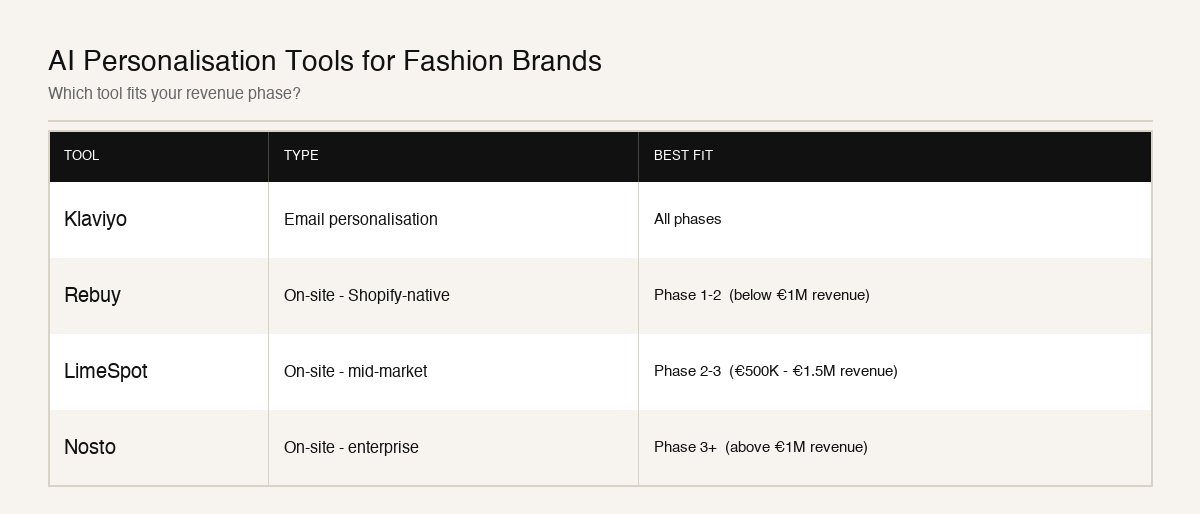
A practical comparison for fashion brands based on what we see in client accounts:
Klaviyo (email personalisation)
Relevant for all phases. The email personalisation layer transforms Klaviyo from a sending tool into an actual retention engine. Dynamic content blocks and predictive segments are available on all paid plans. The limitation: all personalisation is within the email channel only.
Rebuy (on-site, Shopify-native)
Best fit for Phase 1-2 brands. Native Shopify integration, fast to set up, reliable for behaviour-based recommendations. Works well for brands with a single clear aesthetic and a compact catalogue. Less effective for brands with multiple distinct style directions.
LimeSpot (on-site, mid-market)
Good fit for brands in the €500K-€1.5M range. Offers more recommendation logic options than Rebuy, with more flexibility in placement and styling. Does not reach Nosto's depth of style-matching but is a meaningful upgrade for growing brands.
Nosto (on-site, enterprise)
Best fit for Phase 3+ brands with large catalogues and substantial traffic. Nosto's strength is in understanding product relationships and customer style profiles at scale. Requires dedicated onboarding and ongoing optimisation. The results justify the investment at the right stage - but it is overkill below €1M revenue.
The Results We See Across Our Fashion Clients
Across the fashion brands we work with, personalisation consistently delivers measurable impact - but the size of the impact depends on where in the funnel it is implemented and how much transaction data the brand has.
On-site personalisation at the product page level (switching from global bestsellers to collection-coherent recommendations) typically lifts CVR on those pages by 10-20%. The brands that see the largest lifts are those with wide catalogues and multiple distinct audiences.
Email personalisation in Klaviyo (dynamic content by segment) lifts click rates on personalised flows versus unsegmented sends. The most reliable metric to track: revenue per recipient on flows where personalisation is active, compared to flows without it.
Meta Dynamic Ads, when the catalogue is clean, consistently outperform static broad ads on ROAS - particularly for retargeting and reactivation. The gap is most pronounced in periods where the brand's catalogue is changing rapidly, such as sales and seasonal transitions.
The common thread: personalisation amplifies the quality of your underlying data and product catalogue. If your product tagging is inconsistent, your Klaviyo subscriber properties are incomplete, or your Meta catalogue has missing assets, personalisation tools will underdeliver - not because the tools are weak, but because the input data is weak.
Every brand's personalisation potential is different - it depends on your catalogue structure, traffic volume, subscriber list quality, and revenue phase. Book a free call to find out where the highest-leverage personalisation opportunities are for your specific brand.
Frequently Asked Questions
Every brand's personalisation setup is different. What tools make sense, which features to activate first, and what results to expect - these all depend on your catalogue, your traffic volume, your revenue phase, and your existing data infrastructure. If you want to know what the right approach looks like for your specific brand, book a free call.