Ashwagandha Brand Marketing: How to Sell the World's Most Discussed Adaptogen When the Market Is Already Saturated

Ashwagandha is everywhere. It is the most searched supplement on TikTok after magnesium, the market is approaching $1 billion globally, and hundreds of brands are selling essentially the same capsule with the same claims. If you are running an ashwagandha brand in 2026, you already know the paradox: it is easy to sell, and nearly impossible to scale.
The demand is real. The problem is positioning.
This is the guide we wish existed when we started working with adaptogen supplement clients. What follows is the differentiation strategy, the paid media playbook, and the Klaviyo approach that we see actually working for ashwagandha brands in a commoditised market.
Key Takeaways
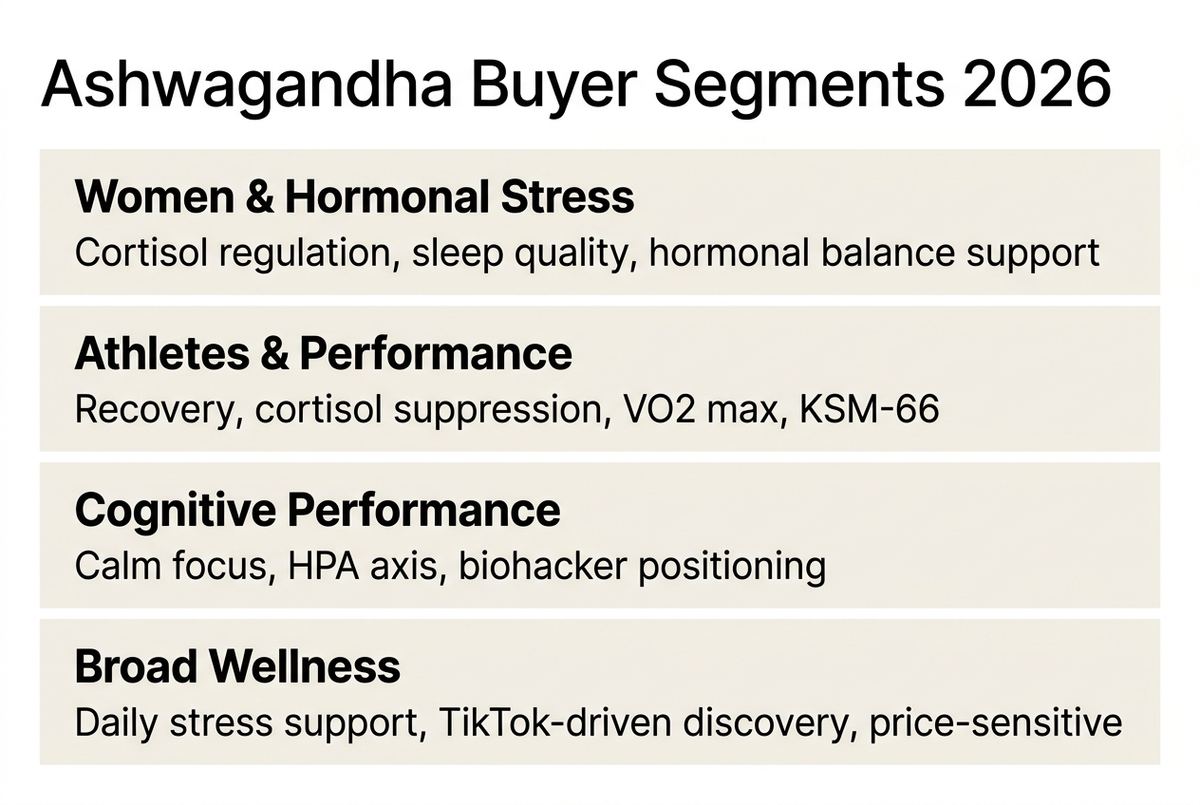
- •Ashwagandha has four distinct buyer segments - each needs a different hook, creative, and Klaviyo sequence
- •KSM-66 and Sensoril branding are the single most effective quality signals in a saturated market
- •Results take 2-4 weeks - your Klaviyo education flow is the difference between a refund and a repeat buyer
- •Subscription conversion is the unit-economics lever that makes ashwagandha brands profitable at scale
- •Meta Ads for adaptogens require careful vocabulary - cortisol and stress framing works, disease-state framing gets flagged
The Ashwagandha Market in 2026: Saturated, But Not Closed
The global ashwagandha market crossed $800 million in 2025 and is on track for $1 billion by 2027. Demand is not the problem. The problem is that the market has commoditised faster than almost any other supplement category.
Walk into any health food store or open any DTC supplement discovery app and you find the same product: ashwagandha root extract, 600mg per capsule, stress and sleep claims, a clean label, and a price between €25 and €45 for 60 capsules. Hundreds of brands. Nearly identical positioning.
Across our supplement client base, we see ashwagandha as the category with the highest initial conversion rate and the highest 90-day churn. Easy to buy, easy to abandon.
What this means strategically: the entry barrier is low, but the retention barrier is high. Brands that win do not win on acquisition alone. They win because they build education systems that keep buyers convinced during the 2-4 weeks before results become noticeable.
There is still genuine opportunity - but only for brands that can differentiate on three things: ingredient quality signals, audience targeting precision, and post-purchase education. If you are doing none of those three, you are competing on price. And on price, you will lose.
The Four Ashwagandha Buyer Segments in 2026
Before you write a single ad or set up a single Klaviyo flow, you need to decide which buyer you are talking to. Ashwagandha has four meaningfully different segments in 2026, and each one responds to a completely different message.
Segment 1 - Women with hormonal stress or perimenopause symptoms
This is the fastest-growing ashwagandha segment in Europe, driven partly by the broader perimenopause conversation that has exploded on social media since 2024. These buyers are not looking for a generic stress supplement. They are looking for cortisol regulation, hormonal balance support, and sleep quality specifically tied to hormonal changes.
What works: female-forward creative, before-and-after testimonials about sleep and mood, hormone-adjacent language (without medical claims). Klaviyo sequences that acknowledge the specific pattern of hormonal stress - it peaks at certain times of the month, certain times of life.
Segment 2 - Athletes and performance-focused buyers
This segment uses ashwagandha for cortisol suppression, recovery acceleration, and endurance. They are familiar with supplement science, they read ingredient labels, and they respond to clinical citations. KSM-66 branding is particularly powerful here because it has the most human clinical trial data of any ashwagandha extract.
What works: performance context (training, recovery, VO2 max), ingredient quality signals, before-and-after in an athletic context. Shorter education sequences - these buyers already understand what adaptogens do.
Segment 3 - Cognitive performance and biohackers
The calm-focus positioning. This segment overlaps with nootropics buyers and is concentrated in the 25-40 male demographic. They want stress resilience without sedation, and they are sceptical of wellness language. Clinical language, peer-reviewed references, and ingredient specificity work better than lifestyle imagery.
In our adaptogen accounts, the cognitive-focus angle consistently produces the highest AOV - often 15-20% above the average order - because these buyers stack ashwagandha with other performance supplements and buy larger quantities.
Segment 4 - The broad wellness consumer
The largest segment by volume, the hardest to convert at a margin that works. These buyers discovered ashwagandha through TikTok, know vaguely that it is for stress, and will buy the cheapest option that looks trustworthy. This segment is where the commodity trap lives. You can build awareness here, but your retention economics will be difficult unless you upsell into a more specific use case.
Our general recommendation: build your core brand around segments 1-3, use broad wellness creative as a prospecting layer that feeds into more specific landing pages and email journeys.
Not sure which segment is your primary audience? Book a free call - we'll map your current customer base and tell you exactly where your positioning needs to go.
Ingredient Branding as Your Single Biggest Differentiator
In a commoditised supplement market, ingredient quality signals are the fastest path to differentiation. For ashwagandha, this means one thing: standardised extract branding.
Three branded extracts dominate the clinical research landscape:
KSM-66 is the most studied ashwagandha extract, with the largest volume of human clinical trials. It uses a root-only extraction process (no leaves, which some research suggests can introduce withanolide alkaloids at higher concentrations). It is the default choice for performance and cortisol-focused positioning.
Sensoril uses a full-spectrum root and leaf extract at a lower dose (125-250mg vs KSM-66's 300-600mg). It has strong data specifically for anxiety and sleep. Better for stress and recovery positioning.
Shoden is the highest-withanolide-concentration extract on the market, at 35% withanolides versus KSM-66's 5%. Newer clinical data, premium positioning, smaller brand recognition - but growing fast in the biohacker segment.
Based on our A/B testing across supplement accounts, ads that name the extract (KSM-66, Sensoril) in the headline or first five seconds of video consistently produce a 20-30% lower CPM in cold audiences compared to generic ashwagandha messaging. The ingredient name acts as a quality filter - it attracts informed buyers and repels bargain hunters.
The practical implication: if your product uses a branded extract, make it the headline. Not an afterthought in the fine print. Put it front and centre in your Meta Ads, your product page hero, and your email subject lines.
If your product uses generic ashwagandha root extract, you have a positioning decision to make. Generic extract is not inherently inferior, but you cannot use ingredient branding as a differentiator. In that case, your differentiation has to come from formulation context (what you combine ashwagandha with), specific use-case positioning, or brand story.
Meta Ads for Ashwagandha: The Vocabulary That Works
Meta Ads for adaptogens require careful creative strategy. The platform's health and wellness advertising policies flag content that implies medical conditions or treatment. For ashwagandha, this creates a specific challenge: the most compelling use cases (stress, anxiety, cortisol) sit close to the edge of what Meta allows.
Here is the vocabulary framework we use with ashwagandha clients:
Safe language (consistently approved):
- Daily stress support
- Calm and focused
- Support your body's response to stress
- Cortisol management (generally approved, not guaranteed)
- Sleep quality
- Recovery and resilience
- Adaptogen for modern life
Flagged language (use with caution or avoid):
- Anxiety treatment or relief
- Clinical anxiety disorder language
- Adrenal fatigue (flagged as a health condition)
- Specific disease name claims
The cortisol angle is particularly effective because it is both scientifically accurate (ashwagandha has strong human trial data on cortisol reduction) and sufficiently mechanism-focused to stay below Meta's health condition threshold. We frame it as: "ashwagandha supports your body's cortisol response" rather than "treats high cortisol."
Creative formats that convert by segment:
For women and hormonal stress: female UGC with before-and-after energy and sleep narrative. First hook: "I've been taking ashwagandha for 6 weeks and here's what actually changed." Relatability over authority.
For athletes: founder or athlete direct-to-camera, clinical language, ingredient spotlight. First hook: "Here's why KSM-66 specifically - and not generic ashwagandha - is what elite recovery requires."
For biohackers and cognitive performance: educational carousel or video with mechanism explanation. First hook: "Ashwagandha doesn't work the way most people think. Here's the actual mechanism."
Running Meta Ads for supplements and unsure what's getting flagged and why? Book a free audit - we'll review your account and flag the specific creative or copy elements causing policy issues.
TikTok for Ashwagandha: The Adaptogen Community Is Ready
TikTok is the channel that built the ashwagandha category for the mass market. The #ashwagandha hashtag has over 2 billion views. The wellness and supplement community on TikTok is highly engaged and actively looking for recommendations.
The challenge for brands is standing out in a content environment where thousands of creators are already posting ashwagandha content - most of it organic and unbranded.
What works on TikTok for ashwagandha brands:
Spark Ads from creators who have already built credibility in the stress, sleep, or performance space. The ideal creator for ashwagandha is not a generic wellness influencer - it is someone whose audience trusts them specifically on stress management, hormonal health, or athletic performance. The creator's authority in the specific use case matters more than their follower count.
The women's hormonal health community on TikTok is particularly strong right now. Creators who discuss cortisol, perimenopause, and stress physiology are generating high-engagement content that ashwagandha brands can activate through Spark Ads at relatively low CPM.
The cognitive performance and biohacker community is smaller but has higher AOV and higher intent. Content that breaks down mechanism (how ashwagandha affects the HPA axis, cortisol half-life, etc.) performs well in this community even when it sounds technical.
In our TikTok supplement accounts, Spark Ads from niche-authority creators (10K-100K followers in a specific use-case community) consistently outperform Spark Ads from large general wellness creators on cost per acquisition - often by 40-60%.
What does not work: generic lifestyle content without a specific use case. "Here's why I take ashwagandha every morning" from a general wellness creator in a sea of identical content produces high CPM and poor conversion. The market is too saturated for undifferentiated aspiration.
Klaviyo for Ashwagandha: The Education Flow That Holds Buyers Through the Wait
This is where most ashwagandha brands lose. The product works - but results take 2-4 weeks of consistent use before they become noticeable. Most buyers who do not feel anything in the first 3-5 days quietly stop taking the product and request a refund or simply do not reorder.
The Klaviyo education flow is not optional for an ashwagandha brand. It is the single most important retention mechanism you have.
The post-purchase sequence we build for ashwagandha clients:
Day 1 - Welcome + expectation setting: "Your ashwagandha just arrived. Here's what the first two weeks look like." Set the expectation clearly: adaptogens are not like painkillers. They work by gradually regulating your stress response system. Most people notice the first changes in sleep quality around day 10-14.
Day 3-4 - Early check-in: "Three days in - here's what to track." Give them a simple self-monitoring framework. Not "do you feel less stressed?" (too vague) but "how is your sleep onset? Are you waking at 3am less? Are you noticing any change in your afternoon energy dip?" Specific observable signals they can actually notice.
Day 7 - Mechanism education: "Why ashwagandha works the way it does - and why week two is when things start shifting." Explain the HPA axis in simple terms. The more a buyer understands the mechanism, the more patient they are during the waiting period.
Day 14 - Moment of truth: "It's been two weeks. Here's what our customers notice most at this point." Social proof from real buyers at the 2-week mark. This is the most critical email in the sequence - it bridges the gap between the waiting period and the visible results window.
Day 21 - Results reinforcement + subscription prompt: "You should be feeling the difference by now. Here's how to lock it in." This is where you introduce the subscription offer. The buyer who has reached day 21 and is experiencing results is your most receptive subscriber acquisition moment.
In our ashwagandha accounts, the 21-day post-purchase email generates subscription conversion rates of 18-25% among buyers who have opened the education sequence. Among buyers who received no post-purchase education, subscription conversion at day 21 is under 5%.
Subscription Strategy: The Unit Economics Lever
Ashwagandha is a daily supplement with a 60-90 day supply per bottle. The repurchase cycle is built into the product. The question is whether you capture that repurchase as a subscription or compete for it each cycle as a one-time purchase.
The economics are significant. A one-time buyer who repurchases twice has roughly the same lifetime value as a subscriber who stays active for six months. But acquiring that same buyer three times costs three times the CAC. Subscription is the mechanism that fixes the unit economics.
The challenge specific to ashwagandha: the 90-day churn window we mentioned. Many buyers subscribe, experience results, and then stop taking the product when they feel better - not understanding that the benefit is maintained by continued use, not built up permanently.
The Klaviyo flows that address this: month 2 and month 3 education emails that explain the maintenance mechanism. "Ashwagandha is not a one-time fix. Here's why consistent use is what sustains the cortisol regulation you've built." Frame subscription not as a commercial upsell but as the medically correct usage pattern.
Subscription offer timing: We recommend introducing the subscription offer at the day-21 mark (when results are first visible) rather than at checkout or in the immediate post-purchase. A buyer who has not yet experienced results is being asked to commit to something unproven. A buyer at day 21 who feels the difference is being asked to protect something they value.
For the subscription offer itself: free shipping plus a modest discount (10-15%) is sufficient incentive. Large discounts signal desperation and undermine the premium positioning that ingredient branding builds.
Want help building the Klaviyo sequence and subscription funnel for your ashwagandha brand? Book a free call - we'll map out the exact flow structure for your product and audience.
Benchmark: What the Numbers Look Like for Ashwagandha Brands
Based on our work with adaptogen supplement clients, here are the performance ranges we see for ashwagandha brands that have positioned correctly versus those competing on generic wellness messaging.
Meta Ads (prospecting):
- ROAS for generic ashwagandha creative: 1.5-2.5x (difficult to scale profitably)
- ROAS for ingredient-branded, segment-specific creative: 2.5-4.5x
- The ROAS gap is driven almost entirely by lower CPM (ingredient branding attracts higher-intent audiences) and higher conversion rate on landing (specific use-case landing pages convert at 2-3x the rate of generic product pages)
Email and retention:
- 30-day repurchase rate without education sequence: 8-12%
- 30-day repurchase rate with full education sequence: 22-30%
- Subscription conversion at 21 days (with education): 18-25%
- Average subscription duration for ashwagandha: 4-6 months before churn
Churn triggers to watch: The three most common churn moments are day 3-5 (no early results noticed), day 45-60 (subscription 2nd renewal), and day 90 (third renewal). Each needs its own Klaviyo touchpoint.
These numbers are directional, not universal. They depend heavily on price point, ingredient quality, target segment, and the quality of your creative and landing page. Every brand's situation is different.
Frequently Asked Questions
Every ashwagandha brand's situation is different. The right positioning, the segment to lead with, and the Klaviyo sequence structure all depend on your specific product, price point, and existing customer data. If you want to know what the right approach looks like for your specific brand - book a free call and we'll give you a concrete direction in 30 minutes.