Fashion Brand on Amazon Europe: How to Sell on Amazon.de, Amazon.fr and Amazon.nl Without Cannibalising Your DTC Channel

Should your fashion brand be on Amazon? We get this question every month from founders who are watching their DTC growth plateau and looking for a new revenue lever.
The honest answer is: sometimes yes, often no, and always with a clear-eyed view of what you're trading away.
Amazon Europe - specifically Amazon.de, Amazon.fr and Amazon.nl - is the most discussed and least understood distribution channel for fashion DTC brands in 2026. The fear is real: brand dilution, price erosion, cannibalisation. But so is the opportunity: 35%+ of all fashion searches in Germany now start on Amazon, not Google.
At Landing Partners, we work with Belgian and Dutch fashion brands that are actively navigating this decision. Here's what we've learned.
Key Takeaways
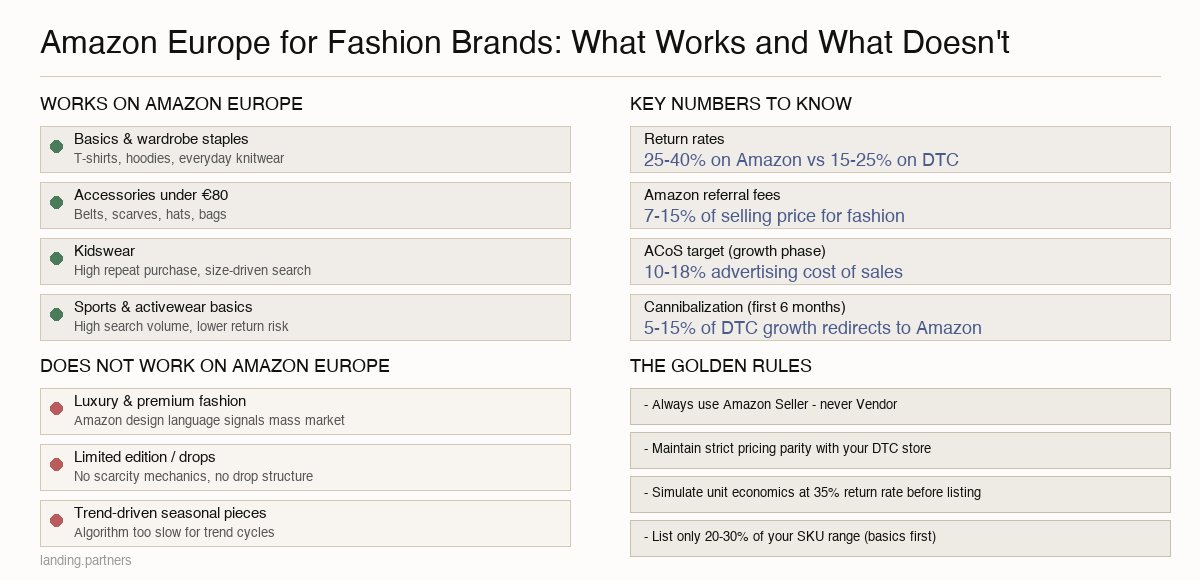
- •Amazon Europe works for fashion basics, accessories, and kidswear - not for luxury, limited editions, or highly seasonal drops
- •Amazon Seller (not Vendor) is the right model for DTC fashion brands that want to maintain pricing control
- •Pricing parity is the single most important rule: if Amazon undercuts your DTC store, you lose on both channels
- •Amazon Ads for fashion require a fundamentally different approach than Meta - intent-based, not interruption-based
- •Return rates on Amazon for fashion are 20-40% higher than DTC - factor this into your unit economics before you list
The Big Amazon Question for Fashion DTC: When Does It Strengthen Your Brand and When Does It Hurt?
Amazon is not a neutral channel. It is a marketplace that commoditises products by design. The algorithm rewards listings with the most reviews, the lowest price, and the fastest delivery. None of these defaults favour a brand-first fashion business.
**The brands that succeed on Amazon Europe are the ones that use it as a discovery channel, not a brand channel.** They list specific SKUs - their basics, their bestsellers, their entry-level accessories - and drive those first-time buyers back to their own store for everything else.
The brands that fail on Amazon are the ones that try to replicate their full DTC range. They end up competing with their own listings, with grey-market resellers, and with Amazon's own fashion label - all at once.
Here is what we tell every client who asks: Amazon is a traffic source with a fulfilment problem attached. Treat it as acquisition, not as your brand home.
Not sure whether Amazon is the right move for your brand? Book a free growth call and we'll tell you based on your specific category, price point, and margin structure.
Which Fashion Subcategories Work on Amazon Europe (and Which Don't)
This is the most important filter before you invest a single hour in Amazon setup.
Subcategories that work on Amazon Europe:
**Basics and wardrobe staples** - plain t-shirts, hoodies, straight-leg denim, everyday knitwear. These are search-driven purchases where the buyer knows what they want and is optimising on fit, quality signal, and price. Amazon excels here because the purchase intent is already formed.
**Accessories** - belts, scarves, hats, bags under €80. Lower price points reduce return risk, and accessories have lower size-fit dependency than clothing. A bag that photographs well sells on Amazon. A blazer that needs to fit perfectly does not.
**Kidswear** - one of the strongest performing fashion subcategories on Amazon Europe. Parents search by age, size, and occasion. The repeat purchase cycle is fast (kids grow out of clothes every 3-6 months). And the demographic is already on Amazon buying everything else.
**Sports and activewear basics** - gym wear, yoga leggings, running tops. High search volume, relatively low return rates if sizing is accurate, strong subscription potential for basics.
Subcategories that do not work on Amazon Europe:
**Luxury and premium fashion** - If your average order value is €200+, Amazon undermines your positioning before a customer even sees your product. The Amazon design language signals mass market. A €280 jacket listed next to a €45 lookalike trains buyers to see your product as overpriced.
**Limited edition and collection drops** - Amazon's fulfilment model and listing structure are not built for scarcity. There is no countdown timer, no drop mechanic, no waitlist. If your business model is built on drops, Amazon actively works against you.
**Highly seasonal, trend-driven pieces** - Fashion trend cycles move faster than Amazon's catalogue can absorb them. By the time a trend-driven item is fully indexed and reviewed, it is often past peak. You end up with a listing that declines just as the algorithm is starting to push it.
Based on our client work across Belgium and the Netherlands: fashion brands that list only basics and accessories on Amazon see 70-80% lower return rates than those that list their full collection range.
Pricing Strategy for Amazon Alongside DTC: How to Maintain Parity and Protect Your Margins
Pricing is where most fashion brands make their first and most costly mistake on Amazon.
**The rule is simple: never list a product cheaper on Amazon than on your own store.** Amazon will not enforce this for you - they will happily rank cheaper third-party listings above yours. But if you list your own product lower on Amazon, you are training your DTC audience to price-check you and training your repeat buyers to leave your ecosystem.
Pricing parity means your Amazon listing price equals your DTC price - before any promotional codes or member discounts your DTC store might offer.
This is harder than it sounds. Amazon charges a referral fee of 7-15% on fashion items plus FBA fees if you use their fulfilment. On a €60 t-shirt, you might be paying €9-12 in Amazon fees before your margin. If your DTC margin on the same product is 65%, your Amazon margin might be 45%.
**The correct framing is: Amazon is a paid acquisition channel with embedded fulfilment costs.** You pay 20% of your margin (roughly) to reach buyers who would not have found you organically. That is a legitimate trade if your LTV model works. It is a death spiral if you then sell to those same buyers at a discount.
Practical rules for pricing parity:
• Set your Amazon price equal to your DTC full-price listing
• Never run Amazon-specific promotions on items also in your DTC store
• If Amazon third-party resellers are undercutting you, you have a grey market problem - address that before scaling Amazon
• Factor FBA fees and referral fees into your product-level CAC calculation
Working out whether Amazon makes unit-economic sense for your specific product range? Book a free call - we'll run the numbers with you.
Amazon Seller vs. Amazon Vendor: Which Model Fits Fashion DTC Brands
If you are a DTC fashion brand considering Amazon, this decision matters more than most founders realise.
**Amazon Seller (third-party marketplace):** You list your products, set your own prices, manage your own inventory, and receive payment directly from Amazon minus their fees. You control the listing, the pricing, and the fulfilment (via FBA or your own warehouse). Amazon is the platform; you are the merchant.
**Amazon Vendor (first-party wholesale):** Amazon buys your products wholesale, sets the price, and sells them directly. You lose control of pricing, promotions, and listing content. Amazon can discount your products whenever they choose. For fashion brands with brand equity and pricing strategy, this is almost always the wrong model.
**We recommend Amazon Seller for all DTC fashion brands.** Here is why:
Pricing control is non-negotiable in fashion. A Vendor relationship means Amazon can list your €120 jacket at €89 during a sale period, and you cannot stop them. That damages your DTC positioning and trains wholesale buyers to expect lower prices.
Listing control matters for fashion. Product images, size guides, A+ content, and keyword strategy are what drive conversion on Amazon. As a Seller, you control all of this. As a Vendor, Amazon controls it - and their defaults are generic.
The data access difference is significant. Seller Central gives you detailed performance data. Vendor Central's analytics are less granular and locked behind paid tiers.
Our recommendation across all DTC fashion clients: Amazon Seller via FBA is the only model that preserves the brand control you need to maintain pricing parity and listing quality.
SEO on Amazon for Fashion: How to Rank on Amazon.de, Amazon.fr and Amazon.nl
Amazon SEO is fundamentally different from Google SEO. The algorithm rewards conversion rate, review velocity, and click-through rate - not just keyword relevance. In fashion, this creates a specific challenge: new listings have no reviews and poor conversion data, which means they rank poorly regardless of keyword quality.
**Building a ranking strategy for Amazon fashion listings requires a different approach than your regular SEO work.**
Product titles for fashion on Amazon Europe:
The title is the single most important ranking element. For fashion on Amazon.de, Amazon.fr and Amazon.nl, the title should follow this format: [Brand] + [Primary product type] + [Key attribute] + [Size/colour range if relevant]
Example for Amazon.de: "Maison Example Damen Merino Pullover Slim-Fit - Herbst/Winter 2026 - Größen XS-XL"
The primary keyword (Merino Pullover Damen in this case) should appear within the first 80 characters. Amazon truncates titles in search results at around 80 characters depending on device.
Bullet points and A+ Content:
Bullet points are the first place customers read after the title and images. In fashion, the top 3 bullet points should address: material and care (what is it made of), fit and sizing (how does it fit - true to size, relaxed, oversized), and use case (when would someone wear this - work, casual, special occasion).
A+ Content (available to brand-registered Sellers) lets you add comparison modules, lifestyle imagery, and brand story sections. For fashion brands with strong visual identity, A+ Content can lift conversion by 3-10% - it is worth implementing before you scale spend.
Amazon Ads for fashion - the intent difference:
Amazon Sponsored Products work on search intent, not interest targeting. Unlike Meta Ads where you interrupt someone scrolling, Amazon Ads appear when someone searches "merino wool sweater women XL". The buyer intent is already present.
This means your Amazon Ads strategy should be keyword-first, not audience-first. Start with exact match on your core product keywords, layer in phrase match for broader discovery, and use product targeting to appear on competitor listings.
Budget split: Amazon Ads should typically run at 8-15% of your Amazon revenue target as an ACoS (Advertising Cost of Sales) ceiling for fashion in the growth phase.
Returns on Amazon for Fashion: The Number That Can Kill Your Margin
Fashion has the highest return rates of any ecommerce category. Amazon fashion has even higher return rates than fashion DTC. This is the number most brands do not factor in before listing.
**On DTC stores, we see fashion return rates of 15-25% depending on category.** On Amazon, the same products typically generate 25-40% return rates. The reasons are structural:
Amazon's free returns policy sets a zero-friction return expectation. Customers order three sizes and return two. On your DTC store, a €5.95 return label creates at least minor friction. On Amazon, there is none.
The customer demographic on Amazon skews toward price-conscious shoppers, not brand-loyal buyers. These shoppers are more likely to return if the product does not exceed expectations.
Amazon's sizing standardisation does not match fashion's nuance. A brand that has trained its DTC audience on "runs small - size up" has no mechanism to communicate this effectively on Amazon at scale.
Which return rates make Amazon unviable:
If your DTC return rate is already 30%+ and your Amazon return rate is 45%, and your product gross margin is below 60%, Amazon will not be profitable at any sustainable scale. The math simply does not work once you factor in FBA fees, referral fees, and return processing costs.
**Practical rule: before listing on Amazon, simulate your unit economics at a 35% return rate.** If the product is still profitable, list it. If it is not, either improve your margin first or do not list on Amazon.
Return rates are the silent margin killer on Amazon fashion. We've seen brands with healthy DTC economics discover their Amazon P&L is negative when they properly model in return costs, FBA fees, and the labour cost of re-processing returns.
Benchmark: Amazon vs. DTC Channel Economics for Fashion Brands
For brands that run both channels well, here is what the economics typically look like across our client base:
Amazon channel characteristics:
- Lower AOV (typically 15-25% lower than DTC) because Amazon buyers are more price-sensitive
- Higher first-order volume (more traffic, broader reach) but lower repeat purchase rate
- Amazon buyers rarely become DTC buyers organically - the purchase attribution stays with Amazon
- Cannibalization ratio: for brands where Amazon is their first channel, DTC usually grows independently; for brands adding Amazon to an existing DTC base, expect 5-15% of DTC growth to be redirected to Amazon in the first 6 months
DTC channel characteristics:
- Higher margin per order (no referral fees, no FBA fees)
- Full data ownership - you own the customer email, purchase history, and behavioural data
- Stronger brand experience - you control the post-purchase journey (packaging, unboxing, follow-up email via Klaviyo)
- Lower initial reach but higher LTV potential
The hybrid model that works:
The fashion brands in our client base that run both channels successfully treat Amazon as their top-of-funnel acquisition channel for basics, and their DTC store as their brand-building and retention channel. They deliberately list only 20-30% of their SKU range on Amazon - specifically the products with the most search volume and lowest return risk.
They do not run Amazon Prime Day promotions. They do not discount on Amazon. And they actively invest in their post-purchase Klaviyo flows to convert DTC first-time buyers into repeat customers before Amazon can intercept them.
Frequently Asked Questions
Every brand's Amazon strategy depends on its product range, margin structure, and stage of DTC maturity. What works for a kidswear brand at phase 2 revenue looks completely different from what works for a luxury accessories brand at phase 4. If you want to know what the right approach looks like for your specific situation - book a free call and we'll map it out with you.