How to Build a Fashion Brand on Instagram in 2026: What Still Works

Key Takeaways
- •Instagram is still the highest-intent discovery platform for fashion - but the brands winning there have fundamentally changed how they use it.
- •Reels drive reach; carousels drive saves and engagement; Stories convert existing audiences. Each format has a different job.
- •Growth in 2026 is not about posting frequency - it's about content quality and strategic collaboration.
- •Instagram and paid advertising work together. Your organic presence affects your Meta ad performance more than most brands realise.
- •The brands growing fastest on Instagram treat it as a brand-building tool, not a direct response channel.
Fashion discovery still happens on Instagram. That part hasn't changed.
What has changed is how it happens. The feed-first, chronological approach that worked in 2019 is gone. Today, Instagram is a discovery engine - driven by Reels, search, and algorithmic recommendations. For fashion brands, that's actually good news.
The visual nature of fashion is a natural fit for how Instagram works in 2026. A well-shot Reel of a new collection, a carousel showing different styling options, a Story series behind a drop - this is exactly what the platform surfaces to new audiences.
We work with fashion brands across Belgium, the Netherlands, and internationally. The ones growing their Instagram following and - more importantly - converting that following into customers share a clear set of behaviours. This article documents what those behaviours are.
Why Instagram Still Matters for Fashion Brands in 2026
There's a persistent conversation in fashion marketing about whether Instagram is 'over'. It isn't.
Based on our work with fashion clients across Europe, Instagram remains the primary discovery channel for new fashion customers aged 18-35 - ahead of TikTok, Pinterest, and organic search. The platform's user base has shifted younger and more global, but the intent is still there: people come to Instagram specifically to find new brands, discover styling ideas, and follow the aesthetics they aspire to.
Based on our work with fashion clients across Europe, Instagram remains the #1 discovery channel for new fashion customers aged 18-35. The platform's shopping intent is higher than any other social channel we track.
What has changed is the competitive density. Every brand is on Instagram now. Standing out requires understanding how the platform actually works in 2026 - not how it worked three years ago.
What the Instagram Algorithm Actually Rewards
The algorithm in 2026 rewards content that does one of two things: holds attention, or generates meaningful interaction. Everything else is secondary.
Hold time is the primary signal
When someone watches your Reel to the end, pauses on your carousel, or lingers on a Story - that hold time signals to the algorithm that the content is worth distributing further. This is why quality matters more than frequency.
A single Reel that holds attention for 15 seconds will outperform five mediocre posts. We see this consistently across the accounts we manage.
Saves and shares outweigh likes
Likes are passive. Saves and shares indicate that someone found the content genuinely useful or inspiring enough to return to it or share it with someone else. The algorithm weights them accordingly.
For fashion brands, this means content that inspires - styling guides, outfit combinations, 'how to wear this' formats - tends to have higher downstream impact than purely aesthetic posts.
Consistency matters, but volume doesn't
The algorithm does reward consistent posting - it learns your cadence and adjusts distribution accordingly. But 3 high-quality posts per week will consistently outperform 7 mediocre ones. We've seen brands burn out their creative team trying to hit arbitrary posting targets while engagement declines.
Find a pace you can sustain at real quality, and hold it.
Not sure whether your Instagram content is actually driving results for your brand? Book a free call with our team and we'll review what the data shows.
Content Formats That Work for Fashion in 2026
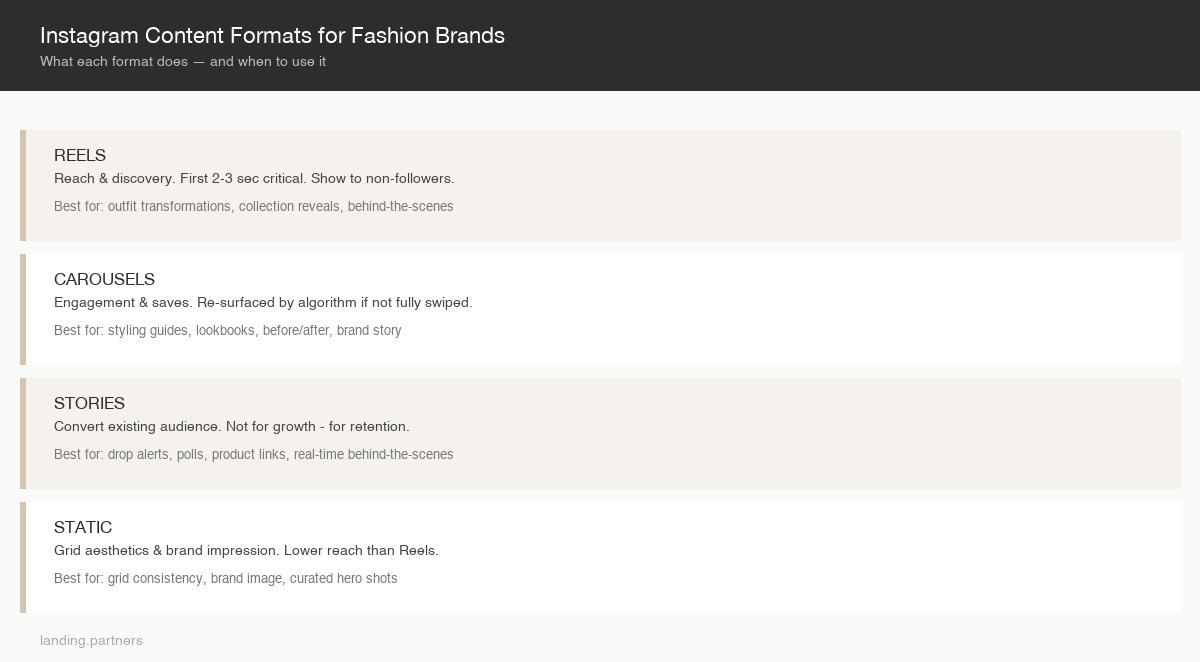
Each format serves a different purpose. The brands that understand this build a content mix that uses each one correctly - instead of posting everything in the same way and wondering why results vary.
Reels: reach and discovery
Reels are the reach engine. They get shown to people who don't yet follow you. The first 2-3 seconds are everything - if you don't capture attention immediately, the algorithm moves on.
What works for fashion Reels: outfit transformations with fast cuts, collection reveals with strong music, behind-the-scenes of production or photoshoots, and 'this or that' format with two contrasting looks. What doesn't work: slow starts, logo animations, or static images repurposed as video.
Carousels: engagement and saves
Carousels generate the highest save rates of any format on Instagram. They also get re-surfaced - Instagram shows a carousel again to users who didn't swipe through fully on first view.
For fashion, carousels work best as styling guides ('5 ways to wear this piece'), collection lookbooks with 8-10 images from the same shoot, before/after transformation formats, or brand story content.
Stories: conversion of existing audience
Stories don't grow your audience. They convert the one you already have. Think of Stories as your CRM - it's where you communicate with people who already care about your brand.
Use Stories for: drop announcements, limited stock alerts, polls and questions, behind-the-scenes real-time content, and direct links to product pages.
Static posts: brand image and grid aesthetics
Static images still matter for the grid - the first impression when someone visits your profile. But they drive significantly less reach than Reels or carousels. Use them sparingly and make sure they hold up the visual standard of your brand.
How to Build Your Instagram Audience Without Paying for Followers
Paid followers are worthless. A following of 10,000 engaged people who wear your aesthetic is worth exponentially more than 100,000 inactive accounts.
**The fastest legitimate growth mechanism in 2026 is collaboration.**
Collabs with creators in your price segment
Instagram's Collab feature lets two accounts co-post a single piece of content. The post shows in both feeds and both follower counts see it. For fashion brands, this means finding creators or complementary brands in your segment and creating something together.
This isn't influencer marketing in the traditional sense - you're not paying for a post that disappears. You're co-creating content that lives on both profiles.
The key is segment alignment. A €250 premium denim brand collaborating with a creator who posts streetwear at €60 AOV will see low conversion even if the reach numbers look good.
Consistent keyword strategy in captions
Instagram search in 2026 works more like Google than it used to. Keywords in captions and alt text affect where your content shows up in search results.
This isn't about stuffing 30 hashtags into a post. It's about writing captions that include the words people actually search for when looking for what you sell: the fabric, the style name, the occasion, the price category, the market or city if relevant.
Engagement in the first hour after posting
The algorithm judges how a post performs in its first hour and uses that to determine wider distribution. Brands that actively respond to comments, use interactive elements (polls, questions), and post at times when their audience is online see significantly better reach.
Across the fashion accounts we manage, posts that receive 10+ comments in the first 30 minutes reach on average 40-60% more accounts than posts with similar quality but low early engagement.
Giveaways and community activations (used carefully)
Giveaways drive fast follower growth but attract low-quality followers if structured badly. If you run one, tie the entry mechanism to something that signals real interest: 'follow + tag someone you'd wear this with' will attract better followers than 'follow + like.' Limit giveaways to once per quarter at most - too many trains your audience to only engage when there's something free.
Instagram and Paid Advertising: The Connection Most Brands Miss
Your Instagram presence directly affects the performance of your Meta paid campaigns. This is one of the most underappreciated dynamics in fashion marketing.
**When someone clicks on your Meta ad and lands on your Instagram profile, the profile quality determines whether they follow, visit your website, or leave immediately.**
But there's a more important connection. Meta's algorithm uses social proof - likes, comments, shares, save rates - to inform how it distributes paid ads. An ad creative that has been organically saved and shared many times will generally cost less to run as a paid ad than one that hasn't.
This means your organic Instagram content is also a testing ground for paid creative. Post organically. See what resonates. The content with the highest save rates and shares is worth putting budget behind.
We use this approach with multiple clients: build a library of organic content, identify the top performers by save rate and share rate, then deploy those as Meta ads. The results are consistently stronger than ads produced exclusively for paid channels.
Dark posts vs. organic amplification
Some brands run Meta ads exclusively as 'dark posts' - content that only runs as ads and never appears on the organic feed. There are legitimate reasons for this, but it means losing the social proof feedback loop described above.
The stronger approach for most fashion brands is a hybrid: post organically, let content prove itself, then boost with paid. For time-sensitive campaigns (a drop, a sale), dark posts make more sense because you need speed.
For fashion brands managing both organic Instagram and Meta paid campaigns, we consistently see lower CPM and higher CTR on ads that were first tested as organic posts, compared to ads created exclusively for paid distribution.
What Not to Do: The Mistakes We See Most Often
The mistakes that hold fashion brands back on Instagram in 2026 are almost always the same.
Posting every day with declining quality
Frequency for its own sake is the most common mistake. We see brands posting daily, watching engagement per post decline, and interpreting that as an algorithm problem. It's usually a quality problem. The algorithm shows your content to a subset of your followers first. If that subset doesn't engage, it stops distributing. Posting more doesn't fix this.
Treating Instagram as a product catalogue
Every post is a flat product image with a price in the caption. No context. No story. No reason to care. Fashion is aspirational - the product is the end point, not the starting point. Show the lifestyle, the context, the person wearing it. The product page handles the product details.
Ignoring the profile as a landing page
When someone discovers you through a Reel, the next thing they do is visit your profile. If the bio is unclear, the link doesn't work, and the grid looks inconsistent, they leave. **Your profile bio should tell a new visitor exactly who you are, who you're for, and where to go in under five seconds.**
Neglecting captions
Captions are where your brand voice lives. A caption with intentional voice - one that tells a story, prompts a reaction, or asks a question - consistently outperforms a price tag or a string of hashtags. You don't need to write an essay, but captions deserve attention.
If you're unsure which approach fits your brand's stage and resources, book a free strategy call - we'll review your account and give you a specific plan.
How to Measure Instagram Performance (The Metrics That Actually Matter)
Follower count is not a performance metric. Here's what is.
Reach and impressions growth (monthly)
Are you reaching more people month over month? This is the primary growth signal. If your reach is flat or declining while you're posting consistently, the content is underperforming.
Save rate by format
Saves per 1,000 impressions, broken out by format (Reel vs. carousel vs. static). This tells you which content types your audience finds genuinely useful or inspiring. High save rate = content worth amplifying with paid.
Profile visits from Reels
When a Reel is performing well in discovery, track how many of those viewers visit your profile. This is the conversion rate from discovery to 'interested.' If it's low, the content is attracting the wrong audience.
Website clicks from Instagram
How many clicks to your site does Instagram generate per month? This is the downstream commercial signal. Growing follower count without growing website clicks usually means the audience isn't commercially relevant.
Story views per follower
Your Story reach as a % of your follower count tells you how engaged your existing audience is. This number is typically lower than brands expect. If it's declining, you're losing attention with your existing followers - which matters more than total reach.
Every brand's situation is different. Instagram performance depends on your audience, your content quality, and how Instagram fits into your overall channel mix. If you want to know what the right approach looks like for your specific brand - book a free call with our team.