Influencer Marketing for Fashion Brands: Micro vs. Macro and How to Measure ROI

Key Takeaways
- •Micro-influencers (5K-100K) generate stronger engagement and better cost-per-result for most fashion brands - bigger is not always better
- •ROI from influencer marketing is mostly unmeasurable in isolation - the honest frame is brand equity plus content asset generation, not direct ROAS. The content your influencers create also feeds directly into paid media — see how we structure that in our Meta ads creative playbook.
- •Gifting without a brief is wasted spend. A proper brief is what separates brands that get results from those that get pretty photos nobody sees
- •The best use of influencer content for fashion brands right now is Spark Ads - repurposing influencer content as paid ads consistently outperforms brand-produced assets
- •Budget guidance: build 10-20 micro-influencer relationships before spending on a single macro partnership
Most fashion founders come to us with the same question: should we be working with influencers? And if so - micro or macro?
The honest answer is that it depends less on the tier and more on what you are trying to achieve. We have worked with brands that built entire top-of-funnel strategies around micro-influencer content and saw consistent growth. We have also seen brands spend €10K on one macro partnership and get nothing measurable back.
This article breaks down how we think about influencer marketing at Landing Partners - including the one metric most brands are tracking that tells them almost nothing.
Micro vs. Macro: What the Labels Actually Mean
The industry tends to use three tiers:
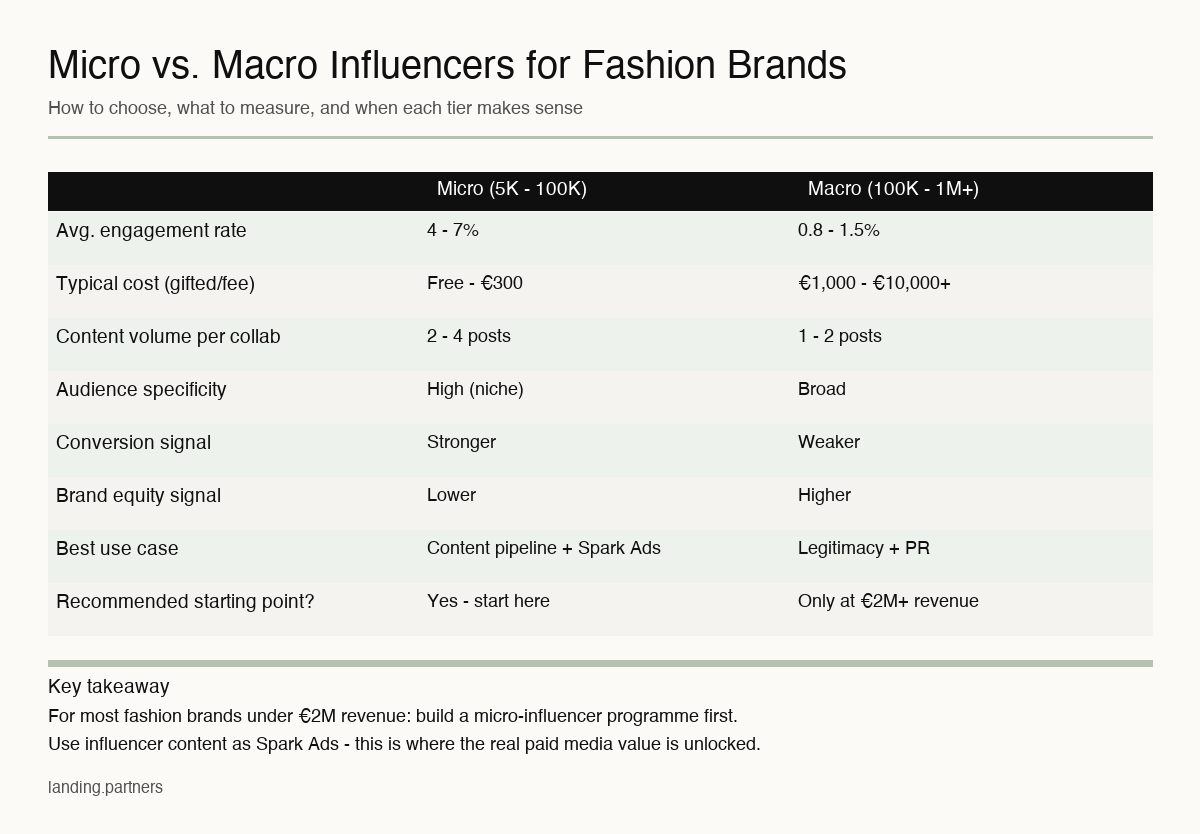
Micro-influencers: 5K - 100K followers. Niche audiences, high engagement rates, usually open to gifting or small fees.
Macro-influencers: 100K - 1M followers. Broader reach, stronger brand equity signal, higher fees - typically €1,000 to €10,000+ per post depending on niche and engagement.
Mega or celebrity: 1M+ followers. Mass reach, very low engagement rate relative to follower count, costs that are only justified at significant scale.
For most fashion brands in our client base - brands doing €250K to €5M in revenue - micro-influencers deliver better cost-per-result. The engagement rates are typically 3-8% versus 0.5-2% for macro accounts. The audience is more specific to the aesthetic and price point. And the cost is a fraction.
That said, macro partnerships serve a different purpose. They are not primarily conversion tools — the actual purchase rate from influencer content is far lower than Meta or Google. See our fashion ecommerce conversion rate benchmarks for how influencer-sourced traffic compares. They are brand equity signals. A post from a well-known fashion figure legitimises the brand in a way that 20 micro posts do not. The question is whether you need that legitimisation right now, and whether you can afford it.
Across fashion accounts we work with: micro-influencer collaborations (5K-100K) consistently outperform macro on cost-per-content-piece and engagement rate. The average engagement rate we see on gifted micro posts is 4-7%, versus 0.8-1.5% for paid macro posts in the same fashion niche.
The ROI Trap - Why Most Fashion Brands Measure This Wrong
Here is the uncomfortable truth: influencer marketing ROI is mostly unmeasurable in any precise sense.
Brands try to track it with discount codes, UTM links, or by looking at traffic spikes after a post. These all give partial signals, but none of them capture the full picture.
Someone sees an influencer post on Tuesday, does not click, searches the brand on Google on Thursday, and converts on Friday via a Meta retargeting ad. Your discount code attribution gives that sale to Meta. Your influencer gets zero credit.
The opposite happens too: a macro partnership drives 200 direct link clicks and 5 conversions. The ROAS looks terrible. But the post also generated 40,000 impressions on an audience that perfectly matches the brand's customer profile. Some of those people will search the brand next month. None of that shows up in your UTM report.
We are not saying influencer marketing is unmeasurable. We are saying the correct lens is not direct ROAS. The right frame is: what is this generating in terms of brand equity, content assets, and upper-funnel exposure?
If you need every marketing euro to be directly attributed to a sale, influencer marketing will always look inefficient compared to paid media. That comparison is not fair - they are doing different jobs in the funnel.
Not sure how to build an attribution model that accounts for influencer and paid media working together? Book a free call and we will walk you through how we structure this for our clients.
How to Find the Right Influencers for Your Brand
The most common mistake we see: brands searching by follower count and aesthetic match alone. Both are necessary but neither is sufficient.
What we look at before recommending an influencer:
Audience quality, not just size. Request a media kit or use a tool like Modash to check audience demographics. Follower count means nothing if 40% of the audience is in a country where the brand does not ship.
Engagement rate relative to tier. For micro, we expect 3%+. For macro, 1%+ is reasonable. Below those thresholds, the account has likely bought followers or has an audience that has tuned out.
Content tone alignment. A minimalist Scandinavian aesthetic influencer posting for a maximalist streetwear brand will always look off. The audience senses the mismatch immediately.
Previous brand collaborations. Look at the last 10-15 posts. How many are paid partnerships? If most content is sponsored, the audience has learned to ignore the recommendations.
Comments, not just likes. Look at what people are saying in the comments on non-sponsored posts. That is your proxy for community quality.
When we audit influencer programmes for new clients, we regularly find that 30-40% of the influencers they were working with had audience demographics that did not match the brand's customer profile. The posts generated vanity metrics - impressions, saves, likes - but reached the wrong people.
How to Brief an Influencer (Most Brands Get This Backwards)
Most brands send a gifted product with a short note and hope for the best. This is the least efficient way to run an influencer programme.
A good brief does three things: it tells the influencer what the campaign is for, gives them enough context to create something authentic, and makes clear what you need technically - format, tag, link, key message.
Here is the structure we use for clients:
Campaign context: What is this drop or collection about? What is the story you want to tell? One paragraph maximum.
Key message: The one thing you want their audience to take away. Not three things - one. 'This is the piece for transitional dressing' is a key message. 'We are a sustainable brand from Belgium with a focus on quality' is not.
Content direction: What you want to see - not a script, but a direction. 'We would love to see this styled on a Sunday morning' invites creativity. 'Please post a full outfit with our jacket' produces content that looks like an ad.
Technical requirements: Format (Reel, static, Story), tags, link in bio duration, required disclosures.
One thing we always include in briefs for clients running Spark Ads: a note that the brand may use the content in paid advertising. This needs to be agreed upfront. Good influencer content running as Spark Ads on TikTok or boosted posts on Meta regularly outperforms brand-produced creative.
We help brands set up influencer programmes that feed directly into their paid media creative pipeline. If you want to know how to structure this for your brand - book a free call.
Spark Ads and the Paid Amplification Play
The most effective use of influencer marketing for fashion brands right now is not organic reach - it is using influencer content as raw material for paid ads.
Spark Ads on TikTok allow you to boost an influencer's post from their own account. The content runs as an ad but retains the influencer's handle, profile picture, and engagement. It looks native. Audiences respond to it differently than branded ads.
The equivalent on Meta is the partnership ad format, where you can run an influencer's post as a Meta ad from their handle. When tracking paid results, the same Meta Ads benchmarks for fashion brands — ROAS, CPM and CTR by budget stage — apply to boosted influencer content.
In both cases, the performance is consistently better than brand-produced creative for middle-of-funnel and top-of-funnel audiences. We see this across accounts. The content looks real because it is real.
For this to work, you need three things: an influencer who creates quality content, a brief that results in something you would actually want to run as an ad, and upfront agreement to boost rights.
In accounts where we run influencer content as Spark Ads alongside brand-produced Meta creative, the influencer-origin content regularly achieves 20-40% lower CPM and higher click-through rates - particularly on new audience acquisition campaigns.
Building an Influencer Programme That Scales
Running one-off gifting campaigns is not a programme. A programme is a repeatable system that generates content, builds relationships over time, and feeds consistently into your creative pipeline. For brands ready to take the next step, a creator commerce programme can turn your best influencer relationships into a structured affiliate revenue channel. The content those creators produce can also feed directly into your Meta ad creative strategy as UGC.
Here is what a functional micro-influencer programme looks like for a fashion brand at €500K+ revenue:
Tier 1 - Gifted micro-influencers (5K-30K): 15-25 active relationships. Gifting only, new products each drop. Expected output: 2-3 posts per drop. Purpose: consistent reach into niche communities, content generation for repurposing.
Tier 2 - Paid micro/mid-tier (30K-150K): 3-5 relationships per season. Small fee (€200-€800) plus gifting. Expected output: Reel plus Story set. Purpose: slightly larger reach, stronger brand association, Spark Ad material.
Tier 3 - Strategic macro (150K+): 1-2 per year maximum at this stage. Budget €2,000-€8,000 per partnership. Purpose: brand equity and PR signal, not conversion.
The ratio shifts as the brand scales. At €2M+ revenue, you can start to justify more Tier 3 investment. Below that, the MER impact of macro partnerships is hard to defend.
Track content output, not just reach. A gifted micro-influencer who produces 3 reusable content pieces is worth more to you than a macro post that generates 50K impressions and zero assets you can use.
What to Measure (And What to Ignore)
Metrics worth tracking:
Content output and quality. How many usable pieces did this collaboration produce? Did you get Spark Ad rights?
Engagement rate on collaboration posts. Not as proof of ROI - as a signal of audience quality and content fit.
Traffic spikes post-collaboration. Not directly attributable, but a consistent spike pattern across multiple partnerships is a real signal.
Branded search volume. Over time (3-6 months), consistent influencer activity should move branded search. This is trackable via Google Search Console.
Direct code redemptions. Helpful as a floor metric - do not use it as the ceiling of influencer value.
Metrics to deprioritise:
Raw impressions from influencer posts. Impressions are not reach into buying intent. A million impressions from an audience that will never buy your brand is noise.
Follower growth attributed to influencer posts. Not a business metric. A campaign that drives 500 new followers and zero qualified traffic is a failure dressed up as a success.
Story views in isolation. Highly variable and influenced by account-level algorithm factors - not a reliable quality signal on their own.
Frequently Asked Questions
Every brand's influencer strategy is different. The right mix of micro vs. macro, gifting vs. paid, and organic vs. Spark Ads depends on your margin, price point, and current growth stage. If you want to know what the right approach looks like for your specific brand - book a free call.