How to Reduce Cart Abandonment in Fashion Ecommerce (76% Leave - Here's What to Do)
Key Takeaways
- •76% cart abandonment is the industry average - but the causes differ brand by brand
- •Most abandonment is not a cart problem. It's a trust, price, or friction problem earlier in the funnel
- •The highest-impact fixes are almost never on the cart page itself
- •Abandoned cart emails recover 5-10% of abandoned carts - but only if your flow is set up correctly
- •Fix your store first. Throwing paid traffic at a leaky funnel makes the leak worse

76%. That's roughly how many people who add something to their cart in a fashion webshop leave without buying.
If you're running paid ads and your cart abandonment rate is around that number, you're not doing anything wrong - that's the baseline. The question is whether you understand *why* your specific visitors are leaving, and whether you're doing anything about it.
We audit a lot of fashion webshops. The cart abandonment issues we find are rarely on the cart page. They're upstream.
Why Fashion Has Such High Cart Abandonment
Fashion buying is inherently high-consideration. You're asking someone to commit money to a product they can't try on, from a brand they may not fully trust yet, at a price point where a mistake costs real money.
The comparison behaviour in fashion is also intense. A shopper might add to cart on three different sites before deciding. Your cart is often a wishlist, not a purchase intent signal.
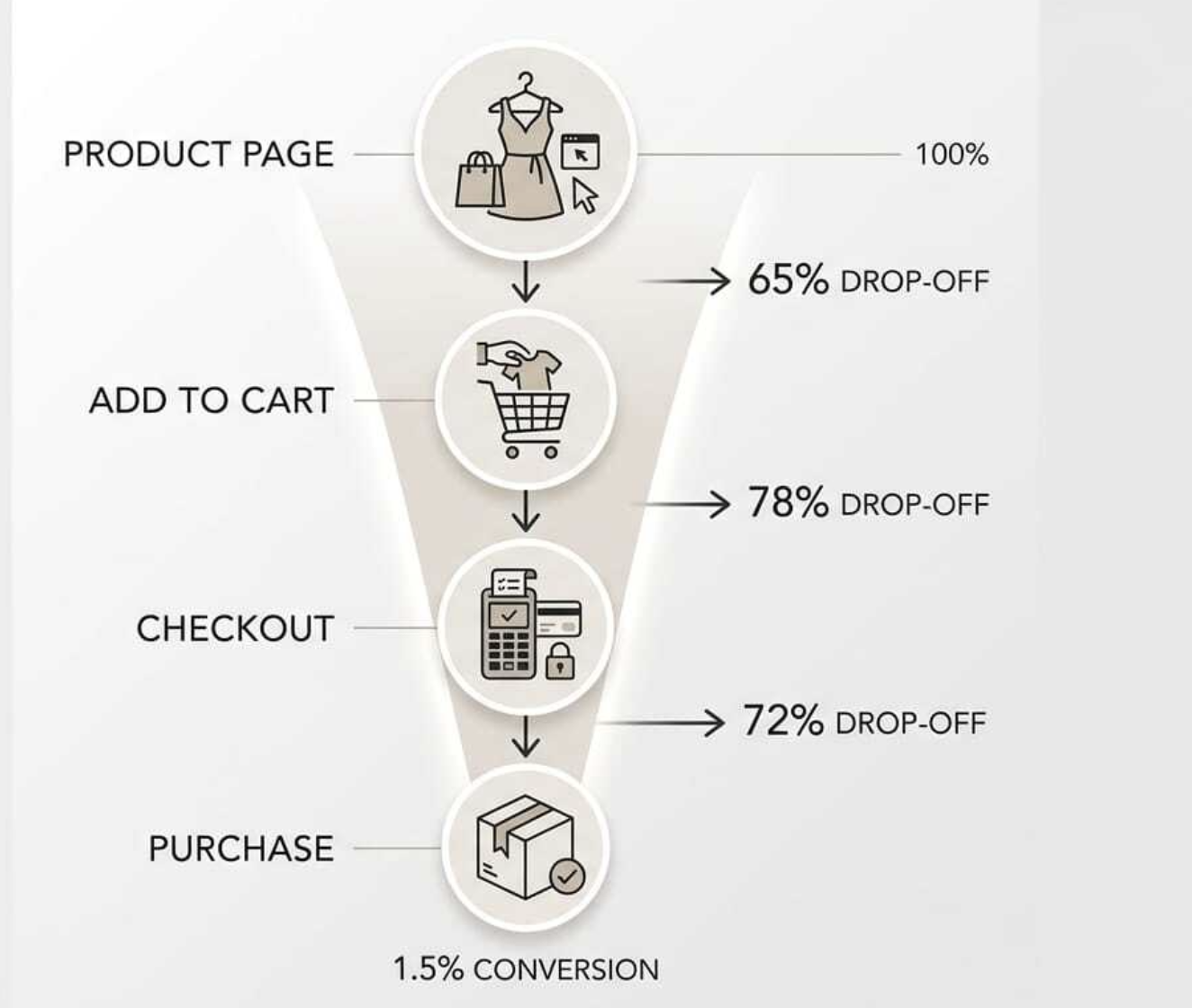
Based on our audits across 40+ fashion brands: 60-70% of cart abandonment happens before the checkout page is ever opened. It's a product-page and trust problem, not a checkout problem.
The three most common root causes we see
First: **unclear product information**. Sizing that doesn't explain itself, materials described in vague terms, no indication of fit relative to body type. The visitor cannot answer 'will this fit me?' with confidence.
Second: **price without context**. A €180 shirt with no story, no quality cues, no social proof. The price looks expensive because nothing around it justifies it.
Third: **trust deficit at first purchase**. Reviews are missing or thin. The return policy is buried. Payment options are limited or the icons are missing. The store looks unfamiliar.
None of these are fixed by a cart abandonment email.
What Actually Moves the Needle
1. Fix the product page before you touch the cart
We almost always start here. The product page is where purchase intent forms or dies. Key elements we look at:
Sizing guide that's actually useful (not just a generic EU/UK conversion table)
Model height and what size they're wearing
Material and care instructions that justify the price
Reviews that mention fit, quality, and delivery - not just 'great product!'
Clear return policy visible on the product page - not just in the footer
If your product page doesn't answer 'will this fit me, is this worth the price, and can I return it easily' - you're losing buyers before they even get to cart.
Not sure where your store is losing buyers? Book a free webshop audit - we identify the highest-impact changes in your specific store.
2. Streamline the checkout process
We look at checkout friction second. Fashion buyers on mobile (which is the majority - typically 65-75% of traffic) have even less patience for a clunky checkout.
What we fix most often:
Guest checkout as the default path - don't force account creation
Autofill for address fields - essential on mobile
Apple Pay / Google Pay as primary options above the fold
Progress indicator so buyers know how many steps are left
Shipping cost visible before checkout starts - price surprises at step 3 kill conversions
In our experience, mandatory account creation at checkout is one of the single biggest conversion killers in fashion ecommerce. Removing this requirement alone has recovered meaningful conversion rate on several audits.
3. Abandoned cart email flow
With product page and checkout fixed, the abandoned cart email becomes meaningful. Without those fixes, you're emailing people who left because your store didn't answer their questions - and a discount won't fix that.
What a well-configured cart abandonment flow looks like in Klaviyo:
Email 1: 1 hour after abandonment. Product reminder, no discount. Clean, high-quality image of what they left behind.
Email 2: 24 hours. Add social proof - reviews, brand credibility, return policy reminder.
Email 3: 72 hours. Optional discount for price-sensitive segments. Not for everyone.
We typically see 5-10% recovery rate on cart abandonment emails when the flow is set up well and the store itself is solid. If you're below 3%, the problem is usually the store - not the email timing.
4. Exit-intent and on-site recovery
Exit-intent popups have a mixed reputation, but done right they work in fashion. The key is relevance: don't show a generic 10% off popup to everyone. Show it to first-time visitors who have been on a product page for more than 30 seconds and are about to leave.
The offer can be a discount, but it can also be: 'Save this for later' (builds your list), free shipping threshold reminder, or a 'Still unsure about sizing?' prompt that links to the size guide.
The Mistake We See Most Often
Brands spend money on abandoned cart ads - retargeting people who added to cart - before fixing the underlying reasons those people left.
If 70% of your abandonment is happening because your product pages don't build enough trust, retargeting those visitors with the same product image won't fix it. You're paying to re-expose them to the same experience that didn't convert the first time.
We've seen brands cut abandoned cart ad spend by 30% after fixing their product pages, and see *better* recovery rates because the re-engaged visitors now land on a page that actually converts.
Fix the store. Then close the loop with email and retargeting.
Running paid traffic into a store with high abandonment? Book a free call - we'll show you where the budget is leaking.
What a Realistic Recovery Looks Like
We work with fashion brands across a range of price points and categories. Here's what we typically see after systematically fixing cart abandonment:
Short-term (first 30 days): Checkout fixes and cart email setup have the fastest impact. You'll typically see a meaningful improvement in checkout conversion rate and a measurable cart recovery rate within the first month.
Medium-term (60-90 days): Product page improvements take longer to show up in the data because they affect the full funnel. You'll see it in time-on-page, product page conversion rate, and - eventually - your blended MER.
The total impact depends on your starting point. A brand with a well-optimised store and 76% abandonment is in a different position than a brand with 88% abandonment and fundamental trust issues.
There's no universal recovery benchmark we'd apply across the board. What matters is: are you improving your own baseline, and are the right fixes in place?
A Checklist for Fashion Brands
Product pages answer: will this fit me, is this worth the money, can I return it?
Reviews present and specific - not just star ratings
Return policy visible on product page (not just footer)
Guest checkout available as primary path
Apple Pay / Google Pay enabled
No surprise shipping costs at checkout
Abandoned cart email flow: 3 emails, 1h / 24h / 72h
Cart recovery rate tracked separately from email open rates
Retargeting only running after store issues are fixed
Frequently Asked Questions
FAQ: Cart Abandonment in Fashion Ecommerce
Every store's abandonment profile is different. The right fix depends on your price point, product type, and where exactly you're losing buyers. If you want a clear picture of what to fix first in your specific store, that's exactly what we do in a free webshop audit. Book a call - no commitment, just a concrete set of priorities.