How to Scale Meta Ad Creative with AI: A Fashion Brand's Practical Guide
If you're running Meta Ads for a fashion brand in 2026, you've probably noticed something: the algorithm rewards volume. More creative variants mean more learning signals, lower CPMs, and faster identification of what converts. The brands winning on Meta today aren't the ones with the best single ad - they're the ones who can test 20 variants a week without burning their production budget.
That's exactly where AI creative tools enter the picture. But fashion is a category that demands visual quality, brand consistency, and emotional resonance - things that generic AI tools can easily get wrong. This guide covers what actually works, based on what we see across our fashion client base.
Key Takeaways
- •Creative volume is the new competitive advantage on Meta - AI makes that achievable without scaling your production costs
- •AI tools work best for generating variants and testing hooks - not for replacing hero content or brand-defining visuals
- •Fashion-specific challenges (style consistency, model representation, seasonal imagery) limit what AI can do autonomously
- •The winning workflow combines AI-assisted production with human creative direction - not one replacing the other
- •Advantage+ Creative uses Meta's own AI to optimise your assets - what you feed it matters as much as the tool itself
Why Creative Volume Is Now a Competitive Advantage
Meta's algorithm has shifted. Five years ago, a well-structured campaign with good targeting could outperform a competitor with mediocre creative. Today, that gap has narrowed significantly. Meta's own targeting has become so automated - through Advantage+ audiences and broad targeting defaults - that the creative itself is increasingly the primary differentiator.
What that means practically: the brand that can test more creative variants, learn faster, and iterate more often wins. Our Meta ads creative playbook explains what to test first. Not through luck, but through volume.
Across our fashion client base, brands running 15+ active creative variants consistently achieve 20-35% lower CPMs than brands running 3-5 variants in similar categories.
The problem is that traditional creative production doesn't scale linearly. Shooting one lookbook is expensive. Shooting 15 different creative angles with 20 variants each is not a realistic ask for most fashion brands. AI changes that equation - not by replacing the creative, but by making variation and iteration affordable.
What "creative volume" actually means for fashion
Volume doesn't mean flooding Meta with random content. It means:
Having 3-5 distinct hooks tested against the same core creative concept.
Generating multiple format variants from a single shoot (square, vertical, landscape).
Testing different text overlays, opening seconds, and product focus without re-shooting.
Producing seasonal variants of evergreen content without re-investing in full production.
AI makes each of these steps cheaper and faster. The creative direction and brand standards still come from your team.
What AI Creative Tools Can and Cannot Do for Fashion
Before integrating AI into your pipeline, it helps to be honest about the limitations - especially for fashion, where visual quality isn't negotiable.
What works well
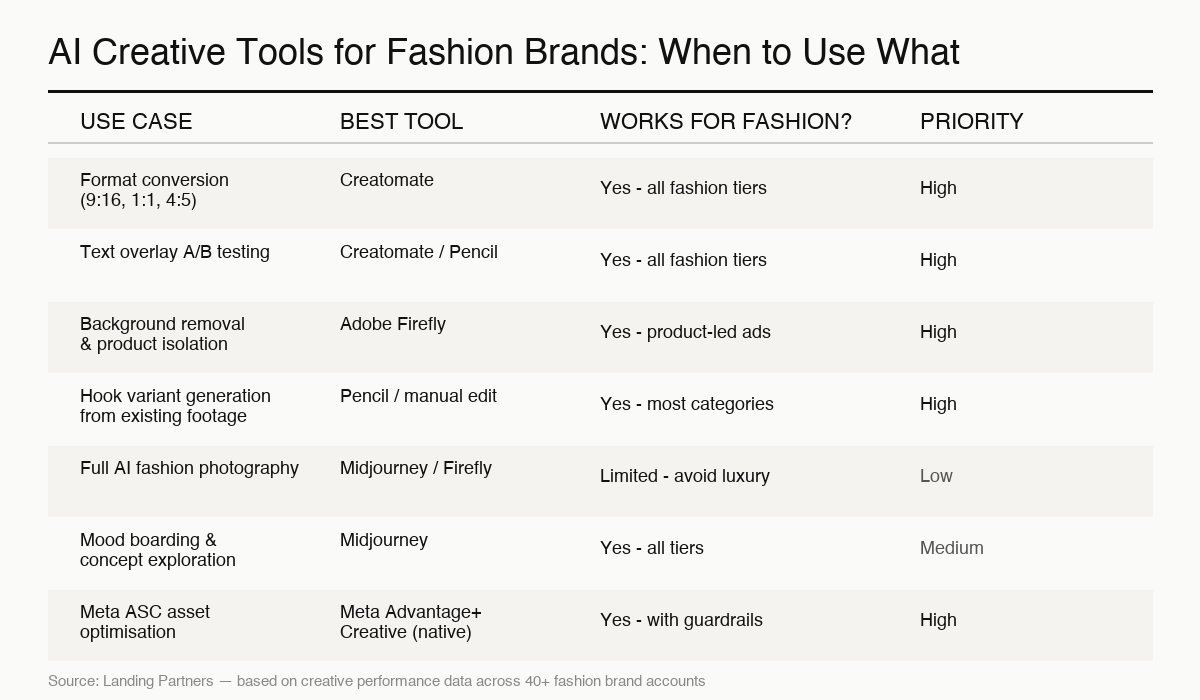
Format conversion: Taking a 16:9 video and generating a 9:16 or 1:1 variant is now largely automated. Tools like Creatomate handle this cleanly without visible quality loss.
Text overlay variation: Testing different headlines, benefit statements, and CTAs on the same visual is something AI handles well. This is low-risk and often high-impact.
Background removal and product isolation: AI-assisted background cleanup has reached a quality level that works for most fashion product shots. Not for luxury editorial, but for product-led ads - yes.
Hook variation from existing footage: Cutting the first 3 seconds differently, testing different opening frames from the same raw content - this is where AI editing tools add significant value.
When we give fashion clients 5 different hook variants from the same core video, we typically find a 40-70% performance difference between the weakest and strongest hook - from identical underlying footage.
What doesn't work well yet
Full AI-generated fashion photography: The results are still inconsistent for consumer-ready fashion ads. Fabric texture, garment fit, and model proportions often look slightly off in ways that erode trust. For luxury fashion, this is a hard no. For contemporary and streetwear, it depends heavily on the tool and the category.
Style consistency across a catalogue: AI tends to generate images that look like adjacent brands rather than your specific brand. Maintaining a coherent visual identity across 20 AI-generated variants is difficult without significant human curation.
Seasonal storytelling: A summer campaign needs to feel like summer - not just in product, but in light, location, and mood. AI struggles to inject the kind of atmospheric coherence that makes fashion creative work.
Not sure how to build a creative testing framework that actually learns? Book a free creative strategy call - we'll audit your current approach and show you where AI fits for your brand specifically.
The Creative Pipeline: How Top Fashion Brands Integrate AI
The brands getting the best results aren't using AI as a shortcut - they're using it as a production multiplier at specific points in the workflow.
Step 1: Human-led concept and hero creative
Your hero creative - the cornerstone concept, the brand-defining visual, the campaign narrative - should still be human-led. This is where brand identity lives, and it's where creative direction matters most. AI doesn't replace the shoot. It multiplies the output of the shoot.
Step 2: AI-assisted variant generation
After you have your hero content, AI enters the workflow. From one shoot, you can generate:
Multiple aspect ratios for placement optimisation (Reels, Stories, Feed, Advantage+ placements)
Format variants with different text overlays for A/B testing
Product-isolated versions for catalogue and shopping ad formats
Re-edited openers with different first-frame choices to test hook performance
Step 3: Tool-specific production
Different tools serve different parts of the workflow. Here's what we use and recommend per use case:
Creatomate - best for automated format conversion, video resizing, and adding dynamic text overlays to existing video. Integrates with Meta's ad API for bulk production.
Adobe Firefly - best for background extension, product isolation, and seasonal background changes on product photography. Fashion-specific: works well for product-led ads, less well for lifestyle.
Pencil - AI-native ad creative platform that analyses your existing creative performance and generates new variants based on what's worked. Has native Meta integration. Better suited to performance-focused brands than editorial-quality campaigns.
Midjourney - genuinely useful for mood boarding, concept exploration, and generating reference imagery for your creative team. As a final ad asset: still limited for fashion specifically.
The most effective AI creative workflows we've seen involve AI generating the variants and humans curating and approving before launch - never fully autonomous AI-to-ad workflows for fashion.
Step 4: Structured testing launch
AI-generated variants need to be tested with the same rigour as manually produced creative. That means clean A/B structure, single variable testing, and enough budget per variant to generate meaningful signal. We recommend a minimum of €50-100 per variant per test before drawing conclusions.
Advantage+ Creative: Meta's Own AI and What It Means for Fashion
Alongside third-party tools, Meta itself is inserting AI into the creative layer through Advantage+ Creative. This is something every fashion brand running Advantage+ Shopping campaigns or broad campaigns needs to understand.
Advantage+ Creative automatically applies enhancements to your ads: brightness adjustments, text additions, background variations, music additions for video, and aspect ratio cropping. By default, it's often opted in - many brands don't realise it's running.
What Meta's AI actually does to your creative
The enhancements range from harmless (cropping a 1:1 to 4:5) to potentially brand-damaging (adding generic text overlays that conflict with your visual identity, or music that doesn't match your brand tone). For fashion brands with a specific aesthetic - especially luxury or premium contemporary - the default Advantage+ Creative settings often need to be managed.
Our standard setup: allow aspect ratio adjustments and brightness corrections. Disable text additions and music if your brand has specific audio or copy standards. Review the "creative enhancements" settings per campaign, not just at account level.
What you feed Meta's AI matters
Advantage+ Creative performs better when you give it high-quality, diverse input assets. The AI is optimising from what you provide - if you give it three nearly identical static images, the system has limited room to work. If you give it video, still images, and product catalogue assets across multiple formats, the system can find the right combination per user and placement.
Want to know if your current creative asset library is set up for Advantage+ to perform? Book a free Meta audit - we'll review your ASC setup and creative inputs.
UGC vs. AI-Generated Creative: When to Use Which
One of the most common questions we get from fashion brands: should we be investing in AI creative production or UGC? The honest answer is that they serve different purposes in the funnel.
UGC strengths for fashion
UGC - genuine customer or creator content - provides authenticity signals that AI-generated content cannot replicate. Real people in real clothes in real settings convert differently than even very good AI-generated imagery. Especially for brands where social proof is a key conversion driver (streetwear, DTC contemporary), UGC performs well in cold traffic at the awareness and consideration stages.
UGC also has a built-in hook that AI content lacks: it looks like organic social content. When it appears in a feed, it doesn't read as advertising in the same way as a polished branded visual.
AI-generated creative strengths for fashion
AI creative excels at scale, consistency, and iteration speed. Where UGC is constrained by what creators actually film, AI can generate infinite variants of a core concept. This makes it better for:
Retargeting campaigns where the audience already knows the brand and trust is established
Product-led ads where the primary objective is to show the garment clearly
Seasonal variants where you need to update the visual context without re-shooting
Format variants where the underlying creative is strong but you need multiple aspect ratios
The combination that works
The best-performing creative strategy we see combines both: UGC for top-of-funnel authenticity and discovery, AI-assisted variants for mid-funnel efficiency and retargeting scale. Not one or the other.
Brand Identity at Scale: The Real Risk of AI Creative for Fashion
The risk that most fashion brands don't talk about: using AI creative at volume can erode brand identity if the curation process breaks down.
When you're producing 50 creative variants a month, not all of them will look like your brand. Some will look like adjacent brands. Some will look generic. If enough of those reach your audience, the cumulative effect is a diluted brand impression - even if individual ads perform well on ROAS.
**The solution isn't to produce less - it's to build a curation layer into the workflow.**
Every AI-generated asset should pass a brand identity check before launch: does this look like our brand? Does the model representation match our casting standards? Does the colour palette, lighting, and composition align with our visual identity guidelines?
This doesn't require a full creative director review of every variant - it requires a documented visual identity checklist that anyone on the team can apply.
Fashion brands that document their visual identity standards before scaling AI creative output maintain significantly more consistent brand metrics (awareness recall, purchase intent) than brands that use AI without structured brand guardrails.
A/B Testing with AI Variants: How to Find the Winning Formula
AI creative tools make it easier to generate variants. But the learning only happens if you test them correctly.
Structure your tests cleanly
One variable per test. If you're testing different hooks, use the same body and CTA. If you're testing different CTAs, keep the hook identical. When multiple variables change simultaneously, you can't identify what drove the performance difference.
Give each variant enough budget to signal
A variant with €20 in spend and 3 conversions tells you nothing statistically. For fashion, we recommend a minimum of €50-100 per variant before making decisions, and €200+ before declaring a winner in competitive categories.
Test in sequence, not simultaneously
Running 20 variants simultaneously splits your budget so thin that each variant gets insufficient signal. Prioritise 3-5 variants per test, identify the winner, then test the winner against new challengers.
What to test first with AI variants
Based on what we see move performance most for fashion clients:
First 3 seconds (hook): the single highest-leverage test. A different opening frame or different text on screen in the first 3 seconds can change thumb-stop rate by 30-50%.
Format ratio: 9:16 vs. 1:1 vs. 4:5 often shows surprising performance differences by placement.
CTA text: "Shop the collection" vs. "See all looks" vs. "Get yours" - small copy changes, real performance differences.
What We See Across Fashion Clients Using AI Creative
From our work with fashion brands integrating AI into their creative pipeline in 2026:
Creative output volume increases 3-5x without proportional cost increases, when AI is properly integrated into the post-production step.
CPM tends to improve as more variant diversity allows Meta's algorithm to optimise placement matching more precisely.
Creative lifespan extends: AI-generated seasonal variants and hook refreshes prevent ad fatigue without requiring a full new shoot.
The biggest failure mode: brands that go fully autonomous with AI creative without human curation. Outputs become visually inconsistent, brand identity degrades, and CPM savings are offset by lower conversion rates.
Our recommendation for fashion brands: start with AI in the variant and format conversion step. Use it to multiply the output of your existing shoots before investing in AI-generated imagery from scratch.
Frequently Asked Questions
Every brand's situation is different. The right AI creative approach depends on your production budget, brand tier, and current creative volume. If you want to know what the right workflow looks like for your specific brand - book a free call and we'll walk through your current setup.