Creative Strategy for Fashion Ads: How to Brief a Creative Team and What to Test First
Creative is the number one lever in fashion ads. Not your budget. Not your targeting structure. Not your bidding strategy. The creative. Our Meta ad creative playbook for fashion brands shows you exactly what that looks like in practice.
We manage ad accounts for 40+ fashion brands across Europe. When we audit an underperforming account, the problem is almost never the campaign setup. It is almost always the creative. Yet it is the thing most brands spend the least time thinking about systematically.
This article covers how we approach creative strategy at Landing Partners - how we brief creative teams, how we structure testing, and how we know when a creative has run its course.
Key Takeaways
- •Creative is the most important variable in fashion ad performance - we see this consistently across 40+ client accounts
- •A winning fashion ad has three components: a hook that stops the scroll, a body that earns consideration, and a CTA that converts
- •Test concept first, then format, then production level - in that order. See our Meta Ads creative playbook for the exact test matrix we use.
- •You need a minimum of 8-12 active creatives per campaign to maintain performance over time
- •UGC works for fashion - but only when it fits the brand's price point and visual identity
- •Creative fatigue in fashion hits faster than in other sectors - plan for it from the start. Our Meta ads creative playbook covers how to build a bank of winning concepts.
Why Creative Is the Most Underestimated Element in Fashion Ads
Fashion is a visual category. The product is the creative. You are not selling a SaaS subscription or a mattress with a comparison table - you are selling how something looks, feels, and what it says about the person wearing it. That makes creative both the biggest opportunity and the biggest risk.
Brands that succeed with fashion ads do not just make beautiful content. They make content that performs - and there is a difference. A lookbook shot can be stunning and convert terribly. A short iPhone video from a real customer can outperform a five-thousand euro studio shoot. We have seen both, many times.
The core issue is that most fashion brands approach creative intuitively - 'this looks good, let us run it.' High-performing brands approach creative systematically - hypothesis, test, learn, iterate. That is the mindset shift this article is about.
Based on our work across 40+ fashion brand accounts: when we diagnose underperformance, the creative is the primary root cause in approximately 7 out of 10 cases. Budget and targeting structure are rarely the limiting factor.
The Anatomy of a Winning Fashion Ad
Every effective fashion ad has three parts: the hook, the body, and the close. All three need to work. Miss one and the ad fails.
The hook (first 2-3 seconds). This is the only part of the ad the algorithm gives you for free. The user has not chosen to watch - the ad appeared in their feed. Your hook has one job: stop the scroll.
Hooks that work in fashion: unexpected product reveals, transformation cuts, social proof statements, price anchors, seasonal urgency, movement-forward clips. Hooks that consistently fail: slow brand logo openers, ambient lifestyle intro shots without visual tension, text overlays with no contrast.
The body (the earn). Once you have stopped the scroll, you need to earn the click. This is where you build desire. Show the product from multiple angles. Use motion. Demonstrate fit, texture, how it moves. Pair with copy that validates the choice ('the jacket that sold out twice') or addresses an objection ('runs true to size - detailed fit guide on the page').
The close (CTA). Clear, direct, relevant. 'Shop now' works. 'See the full collection' works. 'Learn more' does not - in fashion, the decision is emotional and visual, not informational. End on your strongest frame.
Not sure if your current creative is limiting your ad performance? Book a free creative audit - we will review your top-spending ads and tell you exactly what to fix.
How to Write a Creative Brief That Actually Works
The brief is where most fashion brands lose. They either do not have one ('just make it look like our brand') or they have one so vague it gives the creative team nothing to work with. A good fashion creative brief answers six questions.
• 1. What product are we featuring? Specific SKU, collection, or category - not 'our brand.'
• 2. Who is this for? Not demographic data - a real person. 'A 28-year-old woman in Amsterdam who follows fashion accounts and shops for occasions like...' Be specific.
• 3. What is the single message? One thing. Not three. If the brief has three messages, the creative will have three messages, and it will convert like none of them.
• 4. What hook are we testing? Give the creative team 2-3 hook options based on your hypothesis. They choose the execution; you define the concept to test.
• 5. What do we already know? Share performance data from previous creatives. What worked, what did not, and your hypothesis on why.
• 6. What feeling are we selling? Fashion is identity. 'This jacket makes me feel like I have my life together' is more useful creative direction than 'show the jacket from multiple angles.'
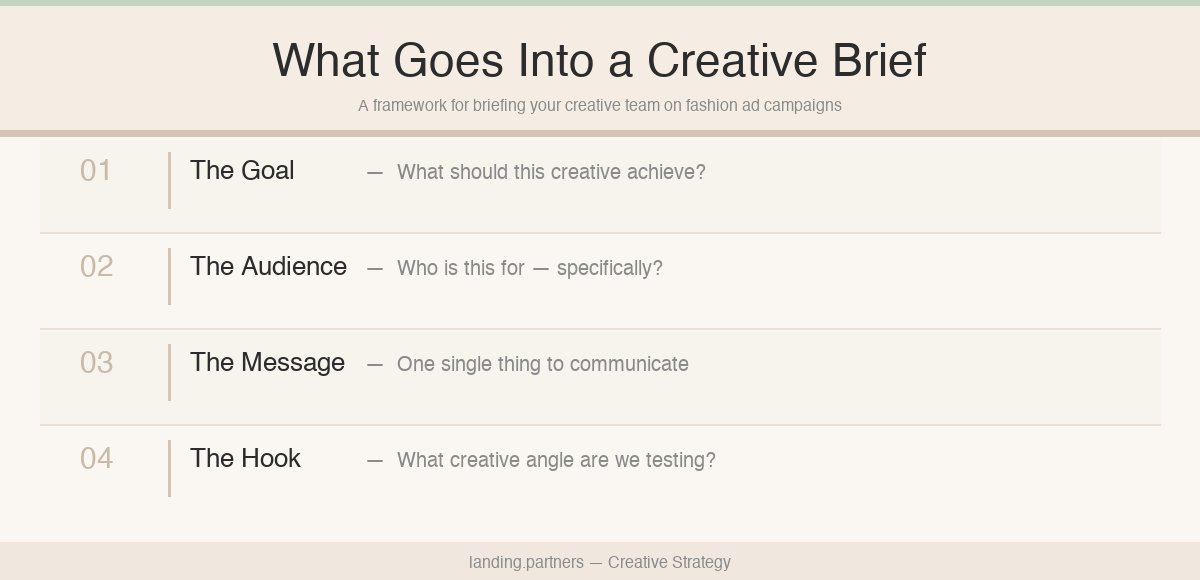
Brands that brief with a single clear message outperform brands with multi-message briefs. Across our client accounts, single-message ads generate stronger click-through rates and lower cost-per-purchase than 'showcase everything' formats - even with a smaller product surface area in the visual.
Creative Testing Framework: What to Test First
The most common mistake in creative testing is testing the wrong variable. Brands change the background color when the problem is the hook. They test two different products when the brief is the issue. Testing without a framework burns budget without generating insight.
We test in three layers, in order:
Layer 1: Concept. The core hypothesis. 'Transformation story' vs. 'product reveal' vs. 'social proof.' This is the highest-leverage test. If the concept is wrong, execution cannot save it. Run concept tests with minimal production investment - you do not need a polished video to know if a concept resonates.
Layer 2: Format. Once you know which concept wins, test formats - static vs. video, carousel vs. single image, long-form vs. short-form. Format affects reach and cost as much as it affects conversion, so test with real budget.
Layer 3: Production level. This is last, not first. Only invest in high-production content after the concept and format are validated. We have seen fashion brands spend thousands on a studio shoot for a concept we could have invalidated with a low-cost UGC test first.
For budget allocation across tests: we typically recommend a 70/30 split between proven creative (consistent performers) and new tests. The test budget should be structured to generate a clear winner within 7-10 days - running tests at minimal daily spend will not generate enough signal to decide confidently.
Not sure what to test next in your creative strategy? Book a free growth call - we will walk through your account and map out a 30-day creative testing plan.
How Many Creatives Do You Need Per Campaign?
Less than you think to start. More than you think to sustain.
For a new campaign: 6-8 concepts in test, 2-3 proven performers running concurrently. You are not trying to find 20 creatives that work - you are trying to find 3-5 that outperform your current control ad.
For sustained performance at scale: the number goes up. At significant monthly spend levels, we typically see brands needing 12-18 active creatives to maintain healthy ROAS without creative fatigue dragging performance down.
The bigger issue is refresh rate. Fashion has a shorter creative shelf life than other categories. A seasonal collection has a natural lifespan - after the season passes, those creatives lose relevance regardless of how well they once converted. Evergreen creatives (product quality, returns, fit guides) last longer. Trend-specific creatives can burn out in weeks.
Treat creative production as an ongoing operating cost, not a one-time investment. The brands that sustain paid media performance have a production cadence, not a production project.
UGC for Fashion: When It Works, When It Does Not
User-generated content works for fashion. We have seen UGC creatives outperform studio content on CTR and cost-per-purchase across multiple accounts. But the blanket advice to 'use more UGC' misses important nuances.
UGC works when: the brand is contemporary or accessible (typically under €150 AOV), the product benefits from real-world context, the creator's aesthetic aligns closely with the brand identity, and the hook is strong enough to compete with editorial content in the same feed.
UGC does not work when: the brand is positioned at luxury price points (rough aesthetic undercuts premium positioning), the product requires controlled visual presentation for accuracy, or the creator's content looks clearly like paid advertising - which removes the authenticity signal entirely.
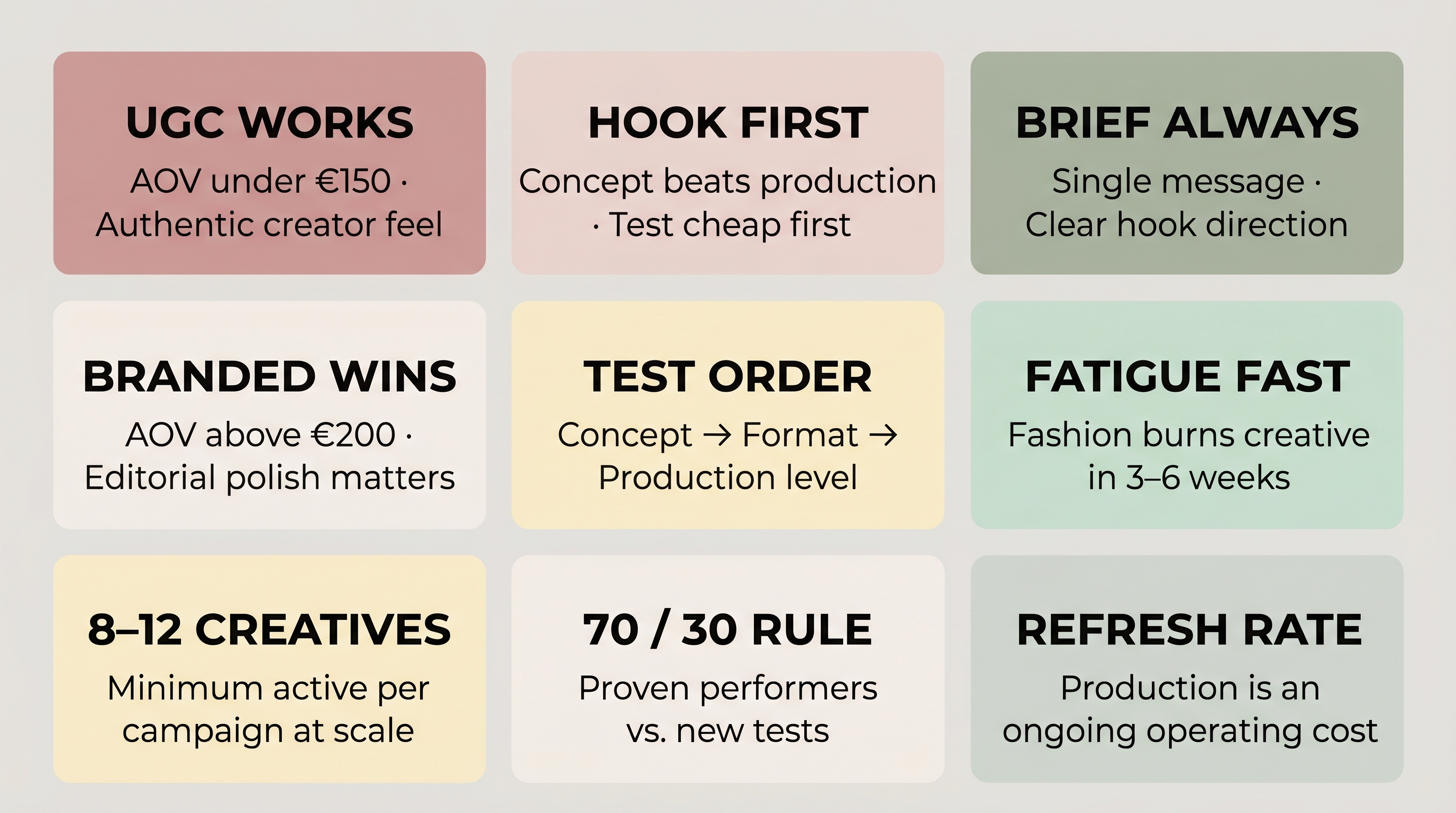
From our client accounts: UGC as a creative format performs best for brands with AOV under €120 and strong mobile traffic share. For brands with AOV above €200, branded editorial content typically outperforms UGC on purchase conversion - even when UGC generates higher top-of-funnel engagement.
When you commission UGC for fashion: brief the creator the same way you would brief an internal creative team. Give them the hook concept, the single message, and the visual direction. 'Be yourself' is not a brief. It is a creative liability.
How to Recognize and Handle Creative Fatigue
Creative fatigue is when a previously strong creative starts declining in performance - not because the targeting changed, but because the same audience has seen it too many times.
In fashion, fatigue hits faster than in other categories. Consumers are highly tuned to trends and novelty. A creative that ran strong for six weeks in another sector might plateau after three weeks in fashion. Seasonal content accelerates this further.
Signals of creative fatigue: CTR drops 20% or more vs. the creative's peak performance, CPM rises while reach stays flat, frequency climbs above 3 for cold audiences, and conversion rate drops disproportionately to traffic volume.
What to do when you detect fatigue: do not kill the creative immediately - test a variant first. Change the hook, change the first frame, change the opening caption. Often the concept is still valid and a fresh execution extends the life by 4-6 weeks.
If the concept itself has fatigued, archive it and rotate to the next proven performer while new tests build up. Never turn off all creative simultaneously while waiting for new assets. That is how accounts stall.
Frequently Asked Questions
Every brand's creative situation is different. What works at a €100 AOV streetwear brand will not work at a €400 AOV women's fashion brand. If you want to know what the right creative strategy looks like for your specific brand - book a free call with our team.