The Fashion Brand's Meta Ads Creative Playbook: What We Test, What Works, What Fails
Most fashion brands lose in Meta in the first 3 seconds of a scroll - and no amount of audience optimisation rescues a creative that fails to stop the thumb. But creative alone doesn't win either. Solid campaign structure and smart targeting are the foundation. Without them, even your best creative underperforms.
Key Takeaways
- •Creative is a primary performance variable in fashion Meta Ads - but it only works when structure and targeting are solid. The three have to work together.
- •There is no single set of formats that works for every brand. The 5 formats below are strong starting points - but finding what resonates with your specific audience is the real goal.
- •Your hook has 3 seconds. Fashion ads that win stop the scroll with movement, direct address, or a question the viewer is already asking themselves. And the same creative logic that wins cold traffic needs a different angle for retargeting fashion shoppers who already visited your site.
- •UGC outperforms branded content for trust and lower price points. Branded content wins for luxury and editorial brand positioning. For beauty and skincare, the rules shift — see our Meta ad creative benchmarks for skincare brands.
- •Creative fatigue in fashion hits faster than most sectors - track frequency and have fresh assets ready before you need them.
- •Test hooks first, then body format, then CTA. One variable at a time. Everything else is noise.
We've been running Meta Ads for fashion brands since 2019. Across 40+ active clients - from emerging Belgian womenswear labels to established European lifestyle brands - we've seen a consistent pattern: the brands that win in Meta are the ones that get all three pillars right at once - a well-structured account, smart targeting, and strong creative. Spend the most without the other two and you're accelerating waste. Nail the creative but ignore campaign structure and you leave performance on the table. This guide focuses on creative because it's the pillar most brands underinvest in - but never in isolation from the rest.
This guide is the framework we use internally. What we test, what we've seen work, and what consistently fails.
Why Creative and Structure Both Matter
Five years ago, Meta Ads success was largely about audience precision. Tight targeting could compensate for weaker creative. That balance has shifted.
Since iOS 14 and Meta's shift toward broad targeting by default, the algorithm does more of the audience finding. What determines whether it finds the right people is increasingly the creative itself - Meta reads engagement signals to decide who sees your ad next. Strong creatives attract the right viewers. Weak creatives attract broad, low-intent traffic.
But this doesn't make targeting and budget allocation irrelevant. Solid account structure and smart targeting are still the foundation. Without a well-organised campaign hierarchy, the right bid strategy, and a clear funnel logic, even strong creatives underperform. The shift is that creative used to be one input among many. Now it's the variable that most often explains the difference between two accounts with identical budgets and similar structure. The ceiling is higher when all three are working together.
This is especially true in fashion, where the product is visual, the purchase is emotional, and the competition for attention is intense. A fashion ad isn't just competing with other fashion ads. It's competing with a friend's holiday photos, a viral clip, and a breaking news story - all in the same feed.
We've seen fashion brands with identical budgets and identical audience settings produce wildly different ROAS - the gap traced back almost entirely to creative quality. Spend amplifies what's already working. It doesn't rescue what isn't.
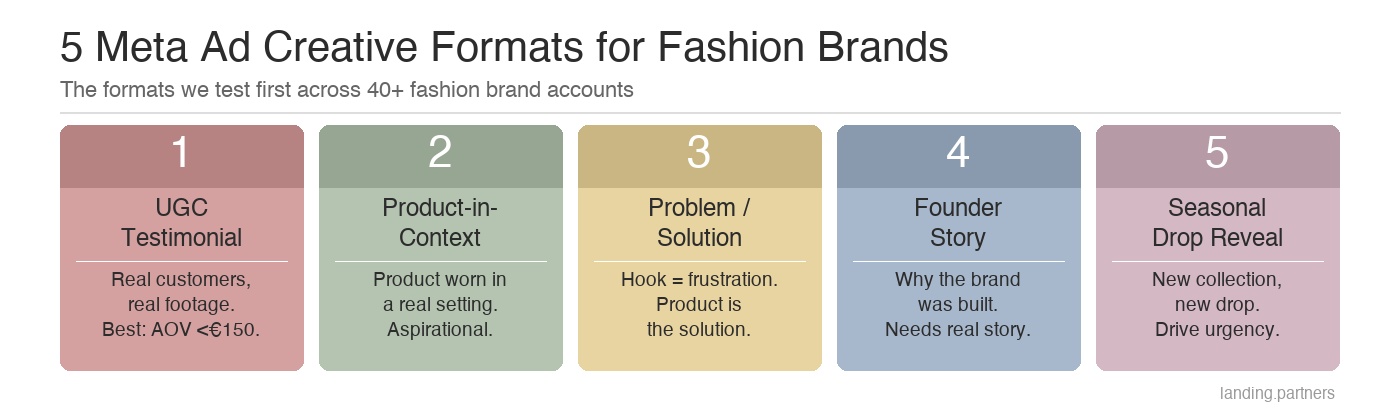
5 Creative Formats Worth Testing First
There are no formats that work for every brand. Different audiences respond to different approaches - and finding what resonates with your specific customer is the real goal of creative testing. That said, these five formats consistently give strong starting signal across a wide range of brand types and price points. They're where we begin, not where we stop.
In our client base, these five format types account for the majority of first-test winners in new client onboarding. They're not universal - but they're the most reliable entry points across fashion brand types we work with.
1. UGC Testimonial
Real customers, real footage, real reactions. "I ordered this in two colours" performs better than most polished campaigns we've produced for the same brand. Why? Because fashion purchases are trust decisions. Seeing a real person wear the product in their actual environment reduces the perceived risk of buying from a brand the viewer doesn't know yet.
UGC consistently performs best in cold acquisition for mid-market brands (€50-€150 AOV). At luxury price points (€200+), high production value is part of the product promise - UGC can actively undermine the positioning.
2. Product-in-Context Lifestyle
High-quality imagery or video of the product being worn in a real setting - not a studio, not a hanger. Rooftop terrace. Sunday market. Cobblestone street. The product lives in the customer's world.
This format works across price points and performs best when the styling is aspirational but believable. Unreachable aspirational images stop working in fashion ads faster than you'd expect. The viewer needs to see themselves in the content, not just admire someone else.
3. Problem/Solution Frame
"You wear the same 3 outfits because nothing else feels right." Hook identifies a real frustration, body offers the solution, product is the vehicle. This format performs particularly well in cold acquisition - when the viewer doesn't know the brand yet and needs a reason to care beyond aesthetics.
The key: the problem must be specific. Generic problems ("tired of your wardrobe?") underperform versus precise ones ("still looking for a linen shirt that actually breathes"). Precision signals that you understand the customer, not just the product category.
4. Founder Story
The founder explains why they built the brand. This format works when the brand has a genuine origin story - and fails when it doesn't. Authenticity is not scriptable. We've seen founder story ads generate the lowest CPM and highest comment engagement of any format for brands where the founder has a real story to tell.
It's particularly effective for new-to-market brands where "who are these people?" is the first question a potential buyer asks themselves before clicking.
5. Seasonal Drop Reveal
New collection, new drop, limited run. Fashion buyers are conditioned to act on newness. A well-executed seasonal reveal - whether it's a 15-second edit of new pieces or a single striking image of the hero product - can drive strong short-term performance around key seasonal moments.
The risk: this format requires constant fresh asset production. Brands that rely on it without a systematic content pipeline run out of content at the worst possible moment.
Not sure which format fits your brand? We run creative strategy sessions for fashion brands that want to stop guessing and start testing with a real framework. Book a free creative audit
Hook Formulas for Fashion: The First 3 Seconds
Creative quality matters from the very first frame. The hook - the opening frame, sentence, or visual - determines whether a viewer pauses or swipes past. Without a strong hook, none of the rest of the creative has a chance to work - but a strong hook on a weak offer still won't convert. Both have to land. Most fashion brands underinvest in hook testing, then wonder why their ads plateau after two weeks.
These are the hook patterns we test when starting with a new client:
Direct address: "If you're still paying full price for linen sets, read this." Speaks directly to a specific buyer. Immediate relevance. No preamble. The viewer knows in half a second whether this is for them.

Contrast or unexpected visual: Jump cuts, unexpected colour pairings, or unusual settings create pattern interrupts that pause the scroll before the viewer consciously decides to watch. Movement in the first frame outperforms static opens in most of our video tests.
Bold, proof-backed claim: "We've shipped 40,000 orders and this is still our best-seller." Concrete proof outperforms vague brand statements at every price point we've tested. Numbers create credibility even before the viewer knows who you are.
Question the viewer is already asking: "Why does every summer dress feel the same?" If you name a frustration the buyer already has, they stop scrolling to find out if you have an answer. This is the highest-performing hook type for cold audiences in our experience.
The hook drives the CTR. The rest of the ad determines whether that click converts. Don't neglect either, but prioritise the hook - it's the gate everything else passes through.
UGC vs. Branded Content: When to Use Which
This is one of the most common questions we get from fashion brands starting to scale their Meta spend. The answer isn't "one is better" - both have a role, and the right ratio depends on your brand.
UGC wins on trust and authenticity. It performs better in cold acquisition for mid-market brands. It handles "is this real? can I trust this brand?" objections better than any polished campaign. And the production cost is significantly lower.
Branded content wins on perception and positioning. For brands at luxury price points (€200+ AOV), high production value signals quality - it's part of the product promise. A shaky handheld video communicates the wrong positioning when your average order is €350. For editorial brands with a strong aesthetic identity, UGC can actively undermine brand equity.
The practical rule we use: test UGC first if you're at a contemporary price point and still establishing trust with new audiences. Lead with branded content if brand prestige is part of the product value.
A third format - creator content - sits between the two. Fashion creators who produce high-quality content independently can deliver the authenticity of UGC with better production control and brand alignment. This is the format growing fastest across our client base in 2025.
Not sure what the right creative mix looks like for your brand's price point and growth stage? Book a free call and we'll map it out.
Seasonal Creative Strategy: Plan Assets Before You Need Them
Fashion has a built-in creative calendar - and most brands manage it reactively instead of proactively. Our creative brief framework for fashion ads explains how to plan it properly. The campaigns that win in Q4 are built in September. The campaigns that drive January sales are briefed in November. If you start producing content when you need it, you're already too late.
We work with clients to plan creative assets 4-6 weeks ahead of each seasonal peak. The creative strategy also shifts by season, not just the offer:
For SS drops and new collections: focus on newness, styling inspiration, and "this just arrived" urgency. The buyer is primed to refresh their wardrobe - speak to that.
For BFCM and sale periods: shift to value signals. "The price you've been waiting for" and last-chance urgency outperform aspirational lifestyle content in high-discount moments. The buyer is in deal mode, not inspiration mode.
For gifting seasons (December, Valentine's Day, Mother's Day): gift-framing, packaging, and delivery assurance are key creative elements. The buyer is purchasing for someone else - the creative needs to acknowledge that context.
One important note: this varies significantly by brand type. Kidswear brands see their strongest seasonal peak in September (back-to-school), not Q4. Jewellery brands experience AOV spikes around fashion weeks in addition to gifting seasons. There is no single seasonal creative calendar that works for all fashion brands - and applying the wrong one wastes budget at your most important moments.
How to Recognise Creative Fatigue Before It Kills Your Results
Creative fatigue is the silent ROAS killer. An ad delivering strong results today can be invisible noise in three weeks - not because the targeting changed, but because the audience has seen it too many times.
Fashion brands are especially vulnerable because their target audiences are often relatively narrow. A niche womenswear brand with a defined customer profile has a smaller addressable audience than a broad consumer goods brand — and beauty and skincare brands on Meta face this even more acutely, with strict ad policy restrictions on top. Frequency builds fast. If you're not monitoring frequency, you're flying blind.
The warning signs we watch for:
• CTR dropping week-on-week without budget or audience changes
• Cost per result increasing while spend stays flat
• Frequency above 3-4 in a 7-day window for cold audiences
• Comment sentiment shifting to "I keep seeing this everywhere"
The fix isn't always a full creative overhaul. Sometimes a fresh hook on the same offer, or a new product focus within the same format, is enough to reset performance. We always maintain a creative backlog - at least 2-3 unpublished assets per format - so we're never scrambling when fatigue hits. Reactive creative production is one of the most expensive habits a fashion brand can have.
Testing Framework: How to Learn Fast Without Burning Budget
Account structure sets the ceiling. Creative determines whether you reach it. In our client base, the accounts that improve the fastest combine both: a clean campaign hierarchy with clear funnel logic, and a structured creative testing rhythm running on top of it.
The biggest creative testing mistake we see: testing too many variables at once.
If you change the hook, the body format, the product positioning, and the CTA simultaneously, you learn nothing. You have a winner or a loser, but no idea what made the difference. Next time you're back to guessing.
Our framework: one variable at a time, starting with the hook.
Phase 1 - Hook testing: Run 3-5 versions of the same ad with different opening hooks. Same product, same offer, same body. The hook with the highest CTR moves forward. This tells you what language, framing, or visual approach resonates with your audience.
Phase 2 - Format testing: Take the winning hook. Test it across different formats - static vs. video, UGC vs. branded, carousel vs. single image. The format determines how the hook is delivered; test until you have a clear signal.
Phase 3 - Body and CTA: Once hook and format are confirmed, test body copy length, product focus, and call to action. "Shop the drop" vs. "Get yours before it sells out" can produce measurable differences at scale.
On testing budget: don't run test ad sets on €2/day and expect meaningful signal within a week. The right daily budget depends on your CPM and audience size - you need enough impression volume to generate conclusions within 5-7 days. Running too low just extends the timeline without improving the data.
The goal of testing isn't to find one perfect ad. It's to build a picture of what resonates with your specific audience - a picture that makes every future campaign smarter and every budget more efficient.
For brands monitoring their LTV and CAC alongside Meta, the creative investments that drive repeat purchase (UGC, tutorial formats, styling content) tend to have the strongest downstream LTV impact. For brands also running Google Shopping campaigns alongside Meta Ads, the same principle applies — feed creative and product title variations are your primary performance variables there too.
Frequently Asked Questions
Every brand's creative situation is different. What works for a high-end womenswear brand at €250 AOV is not what works for a streetwear brand at €75 AOV. The formats, the hook style, the UGC ratio, the testing cadence — and the creative logic shifts again when you move into retargeting — all of it depends on your specific audience, price point, and where you are in your growth journey. If you want to know what a structured creative strategy looks like for your brand specifically - book a free call and we'll map it out.