Fashion Drop Marketing: How to Build Hype and Drive Maximum Sales Around a New Collection Launch
Key Takeaways
- •The drop model only works when the pre-drop phase builds real waitlist demand - most brands skip this step and wonder why launch day falls flat.
- •Your Klaviyo waitlist sequence and countdown flows need to start at least 3-4 weeks before drop day - not 3 days.
- •Meta Ads for a drop are a two-phase play: awareness and anticipation pre-drop, conversion on launch day. Spreading the same budget evenly across both phases is a waste.
- •Organic social and influencer preview content should be seeded 2-3 weeks out - not posted the day before.
- •Post-drop stock management is where brand equity is won or lost. How you handle unsold pieces says as much about your brand as the launch itself.
- •We've seen drops generate 3-5x more revenue in a single 48-hour window than a standard new arrival launch - but only with the full pre-drop infrastructure in place.
Most fashion brands have tried a drop that underperformed. Almost always, the problem was a 3-day pre-drop instead of a 3-week pre-drop. The drop model is not difficult - but it requires a specific sequence, and that sequence has to start weeks before launch day.
This is the complete collection drop marketing playbook we use for fashion clients - from waitlist building through to post-drop stock management.
Drop Model vs. Traditional Collection Model: What Fits Your Brand?
Not every fashion brand needs a drop strategy. Before building the machine, it's worth asking whether the drop model fits your product, your customer, and your commercial goals.
The traditional collection model releases a seasonal range - spring/summer or autumn/winter - and spreads marketing spend across 6-10 weeks. Products stay on the site until they sell through or go on sale. It works well for brands with a broad catalogue, a clear seasonal rhythm, and a customer base that browses rather than hunts.
The drop model works differently. A limited quantity of product launches on a specific date and time. Scarcity is structural, not manufactured. The brand builds anticipation for weeks before launch day, then concentrates all marketing energy into a short conversion window.
When drops work best:
Drops generate disproportionate results for brands that have a community - even a small one - that follows the brand actively. Streetwear brands, contemporary women's fashion with a strong aesthetic identity, and accessory brands with collectible appeal are natural fits. If people already seek out your content, the drop model amplifies that behaviour.
Drops are harder to execute for brands with broad SKU ranges, long product cycles, or customers who need extended consideration before purchasing.
Not sure whether the drop model fits your brand's stage and commercial goals? Book a free call - we'll tell you exactly where you are and what makes sense for your situation.
The 3 Phases of a Successful Fashion Drop
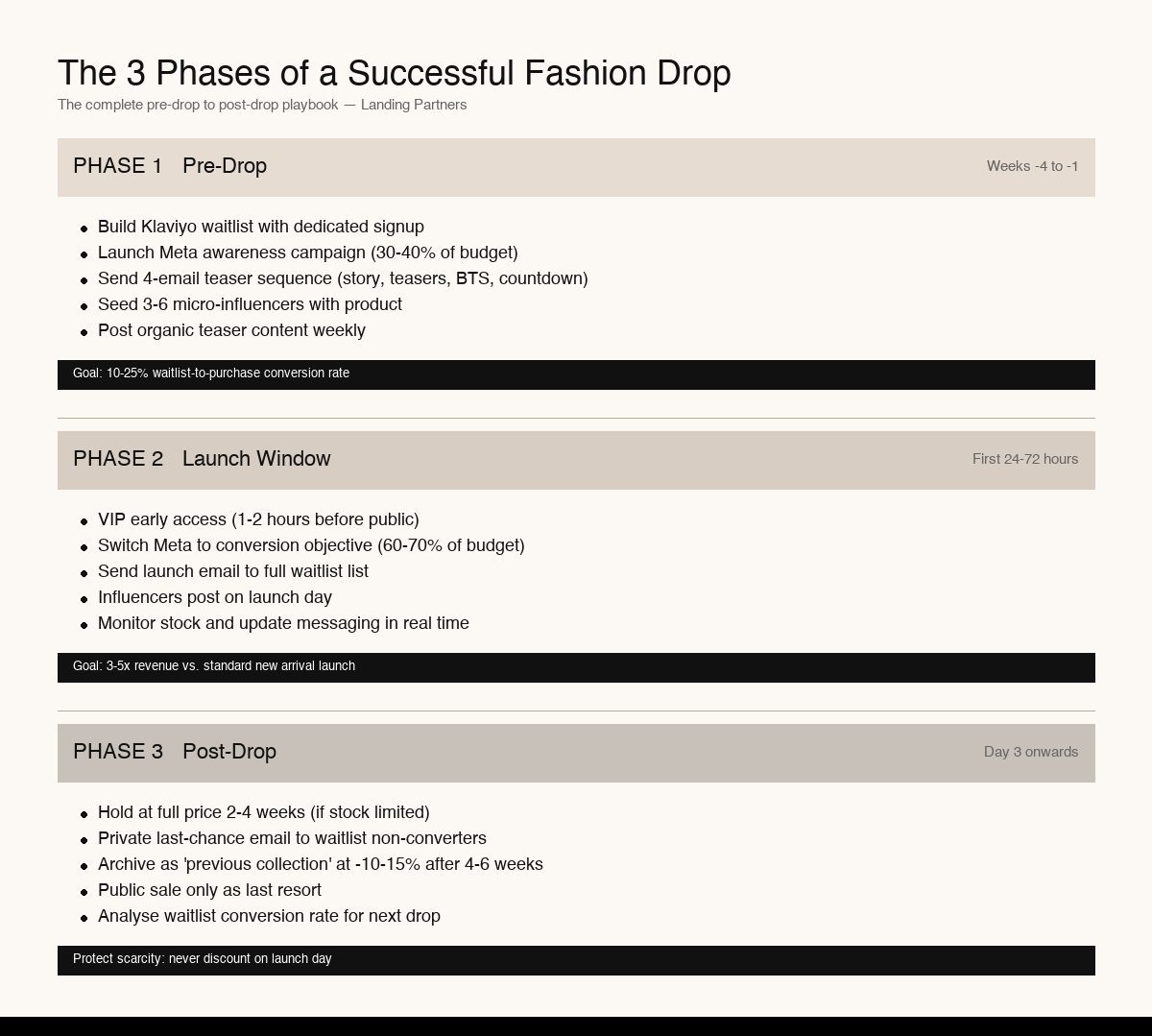
Every drop we've run or consulted on follows the same three-phase structure. The ratio of effort across phases is counterintuitive: most brands underinvest in Phase 1, over-concentrate on Phase 2, and then improvise Phase 3.
Phase 1: Pre-Drop (weeks -4 to -1) - build demand before you need it
This is where drops are won or lost. If you haven't built genuine anticipation before launch day, no amount of launch-day spend will save you. Phase 1 covers teaser content, waitlist building, Klaviyo pre-drop flows, Meta awareness campaigns, and influencer seeding. The goal isn't to sell yet - it's to create the feeling that something is coming that you don't want to miss.
Phase 2: Launch Day and Window (first 24-72 hours) - convert demand you built
This is the short, intense window where all Phase 1 work pays off. Email drops, Meta campaign switches to conversion objective, organic content goes live, influencers post. The window is deliberately short - typically 24 to 72 hours - before you signal that stock is limited or availability narrows.
Phase 3: Post-Drop (day 3 onwards) - manage what's left without diluting the brand
This phase is the one most brands don't plan for. How you handle remaining stock after the launch window determines whether your next drop generates more or less anticipation.
Based on our experience across fashion clients: a well-orchestrated drop with a 4-week pre-drop phase generates 3-5x more revenue in the first 48 hours compared to a standard new-arrival launch without pre-drop infrastructure.
Pre-Drop Klaviyo Strategy: Waitlists, Countdown Flows and Teaser Emails
The pre-drop Klaviyo strategy has two objectives: (1) grow a waitlist of people who have actively opted in to know when the drop goes live, and (2) warm those people up across 3-4 weeks so that launch-day open rates exceed 50%.
Step 1: Build the waitlist
Create a dedicated waitlist signup - a landing page, a popup on the coming-soon product page, or a Klaviyo form embedded in your site. The CTA should be specific: 'Be the first to know when [collection name] drops.' Add subscribers to a dedicated Klaviyo list or segment tagged 'waitlist - [drop name]'. This keeps launch-day sends separate from your regular subscriber list and lets you track the conversion rate of waitlist subscribers independently.
Step 2: The pre-drop email sequence (4 weeks out)
Week 4: 'Something is coming' - brand story behind the collection, no product photos. Establishes the narrative.
Week 3: First teaser content - one or two product shots with minimal context. Subject line: 'A first look.'
Week 2: Behind the scenes - creative process, materials, design details. This is where you build the story that makes people care.
Week 1: Final countdown - product details revealed, drop date and time confirmed, early access for VIP subscribers.
Each email should have one job. Don't try to sell in the pre-drop phase - that's what launch day is for.
Step 3: VIP early access as a retention lever
Build a VIP segment from your top purchasers and give them 1-2 hours of early access before the public drop. This isn't just a loyalty gesture - it's a conversion strategy. VIP early access creates urgency for the broader audience ('VIPs already have access - the public drop opens in 2 hours') and rewards your highest-LTV customers with access rather than discount.
In the drops we've managed for fashion clients, the VIP early-access window (1-2 hours before public) consistently converts at 2-3x the rate of the general launch window - without any additional paid spend.
Meta Ads for a Collection Drop: The Two-Phase Campaign Structure
Meta campaign structure for a drop is fundamentally different from always-on advertising. You're running two distinct phases with different objectives - not one campaign spread across the whole drop period.
Phase 1 Meta campaign: Awareness and anticipation (weeks -4 to -1)
Run a reach or awareness objective campaign targeting your existing customer lookalikes and warm interest audiences. Creative should mirror the teaser approach: lifestyle, mood, behind-the-scenes. No direct product CTAs yet. Budget: 30-40% of your total drop budget. This is building the audience you'll retarget on launch day.
A critical detail: turn off your conversion campaign during the pre-drop phase. Running conversion ads before the product is available trains the algorithm on no-conversion signals. You want the algorithm fresh and warm when the product goes live.
Phase 2 Meta campaign: Launch conversion (launch day onwards)
On launch day, switch to conversion objective and retarget everyone who engaged with pre-drop content - website visitors, video viewers, social engagers. This audience is warm because you spent 3-4 weeks building it. Budget: 60-70% of total drop budget. Concentrate spend in the first 48 hours. Creative shifts from mood/teaser to product - direct product shots, the full collection view, and social proof from early VIP purchases.
Want to build a Meta campaign structure for your next drop? Book a free call - we'll map out the exact campaign setup for your budget and collection.
Organic Social and Influencer Preview: Timing Is Everything
The mistake most fashion brands make with drops is treating organic social as a launch-day tool. By then, you're competing with every other brand posting that day. The advantage in drops comes from seeding content before launch.
Influencer preview strategy
Send product to 3-6 micro-influencers (10K-100K followers) 2-3 weeks before launch. Brief them on the drop date - give them creative freedom on content format but align on timing: nothing goes live before a specific pre-drop teaser window. The goal is influencer content appearing in the 5-10 days before launch day, not on launch day itself. This creates the feeling of organic buzz building before you've officially marketed the drop.
Organic content calendar for a drop
Week 4: Story-driven posts - the idea behind the collection, inspiration, process
Week 3: Teaser visuals - partial reveals, flat lays, material close-ups
Week 2: Behind-the-scenes - fitting room content, atelier shots, founder voice
Week 1: Countdown content - 'X days to go,' early access reminder, time and date confirmation
Launch day: Full reveal - lookbook content, purchase link live, real-time stock updates
Landing Page and Product Page Setup: What Must Be Ready
Technical failures on launch day kill drops faster than any marketing mistake. We've seen fashion brands lose 20-30% of their launch-day conversion potential because the product page wasn't optimised - or because the site slowed under traffic load.
Product page with full image set - minimum 6-8 product images, at least one on model
Size guide that doesn't require leaving the product page
Clear stock messaging - 'limited stock available' or a real-time inventory indicator
Mobile-optimised checkout - tested on at least three different phones before launch day
Klaviyo waitlist conversion flow active - anyone who can't buy gets an immediate back-in-stock notification
What to avoid on launch day:
Don't run a discount on launch day. Drops are built on perceived value and scarcity. A launch-day discount contradicts both. If conversion is lower than expected on day one, investigate the funnel before reaching for a markdown.
Fashion brands that run a same-day discount on drop day typically see a 30-40% reduction in waitlist-subscriber AOV compared to drops that hold pricing for the full launch window.
Post-Drop: Clearing Remaining Stock Without Damaging Your Brand
The post-drop phase is where brand equity is quietly won or lost. If you discount too fast or too aggressively, you train your next-drop audience to wait for the markdown. If you hold too long, you tie up cash flow.
The options, in order of brand impact:
Hold at full price for 2-4 weeks. If demand was real and stock is limited, this is almost always the right move. Scarcity has ongoing value - don't rush it.
Private offer to waitlist non-converters. Send a last-chance email to waitlist subscribers who didn't purchase on launch day. This is private - not publicly marketed as a sale. It extends the conversion window without publicly discounting.
Archive as 'previous collection' at -10 to -15%. After 4-6 weeks, moving remaining pieces to a clearly marked previous-collection section with a modest markdown is brand-safe. You're not running a sale - you're archiving.
Sale as a last resort. If the drop significantly overestimated demand, a public sale is sometimes unavoidable. The key is not making it the default. One overcalculated drop, one disciplined markdown. Two or more in a row, and your audience learns to wait.
Frequently Asked Questions
Fashion drops are one of the highest-leverage commercial strategies available to a fashion brand - but the leverage is entirely in the pre-drop execution. The brands we see underperform on drops almost always have the same diagnosis: they started too late and treated the drop as a one-day marketing push rather than a 4-week demand-building sequence.
Every brand's drop situation is different. The right pre-drop timeline, the right Meta budget split, the right post-drop strategy - they all depend on your margin, list size, and collection positioning. If you want to know what the right approach looks like for your specific brand, book a free call.