Fashion Ecommerce Trends for 2026: What We're Seeing Across Our Client Base

Every year, the same brands scale. And every year, different brands get left behind. In 2026, the gap between the two is widening faster than we've seen in five years of running paid media for fashion brands across Europe.
The difference is not budget. It is not the platform. And it is not luck. It is whether or not the brand has spotted and acted on the shifts happening underneath the surface - in how customers buy, how algorithms work and how the smartest operators are responding.
Here is what we are seeing across our client base right now.
Key Takeaways
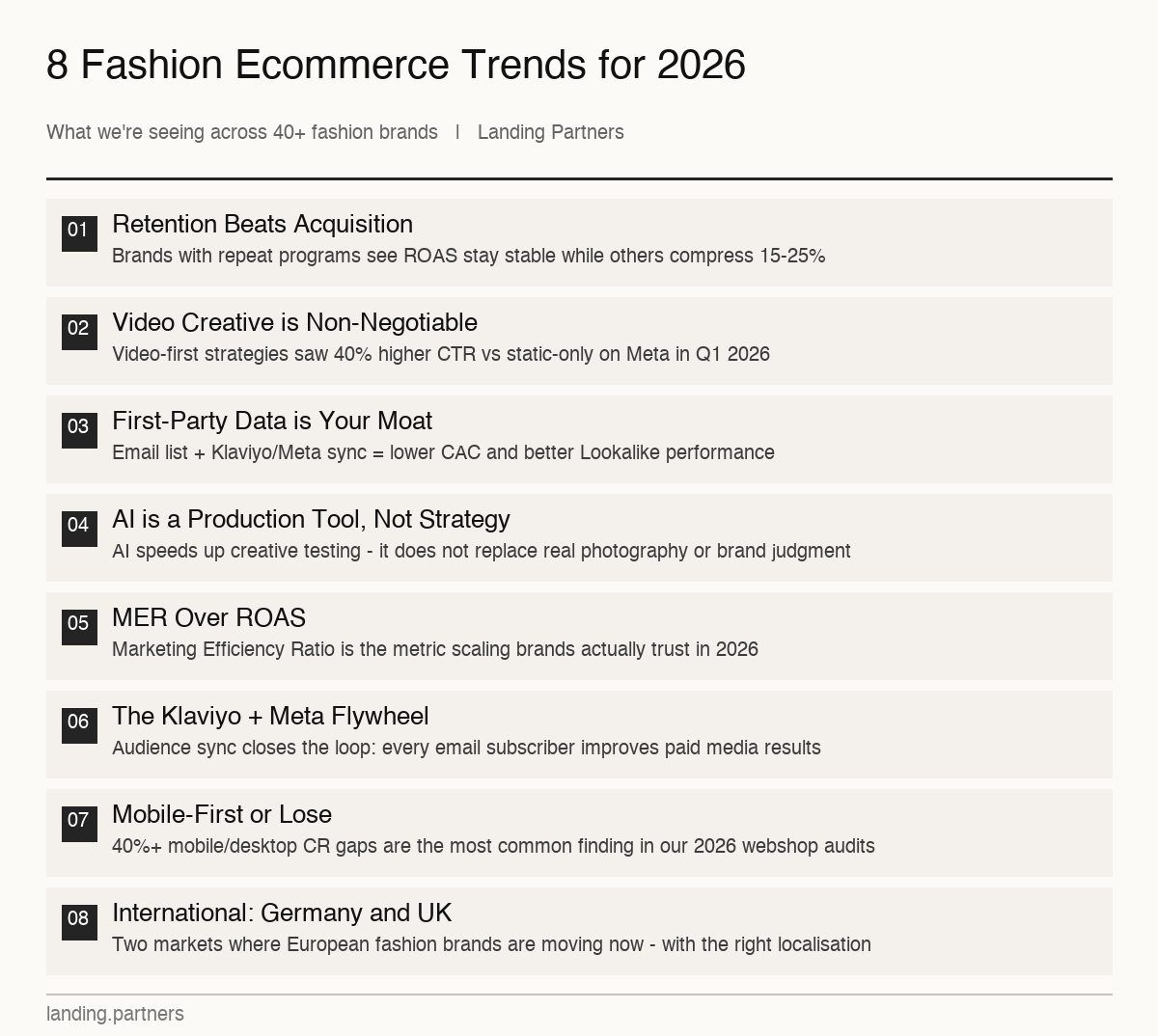
- •Retention is the new acquisition: brands spending proportionally more on keeping customers are outperforming on every paid media metric.
- •Video-first creative is now table stakes on Meta and TikTok - static-only is losing ground.
- •First-party data is the competitive moat. Brands with large, engaged email lists are winning on paid media.
- •AI is a production tool, not a strategy. The brands using it well move faster - not differently.
- •ROAS is unreliable. MER is what the serious operators are using to make scaling decisions.
- •The Klaviyo + Meta flywheel is becoming standard for the brands hitting consistent results.
- •Mobile CR gaps are costing brands significant revenue - and most don't know it.
- •Germany and the UK are the two international markets worth moving on in 2026.
Trend 1: Retention Beats Acquisition at Scale
The brands scaling fastest in 2026 are not the ones spending the most on new customer acquisition. They are the ones spending proportionally more on keeping the customers they already have.
We saw this pattern accelerate significantly across our client base this year. Brands that invested in Klaviyo flows, post-purchase sequences and VIP segments in 2024 are seeing lower effective CAC in 2026 - not because acquisition got cheaper, but because repeat buyers reduce the pressure on paid media.
The math is straightforward. A brand with a 30% repeat purchase rate needs to acquire 30% fewer new customers to maintain the same revenue. And repeat buyers convert at 3 to 5 times the rate of cold traffic, which means every email you send to an existing customer is worth significantly more than a Meta impression served to a stranger.
Across our clients, brands with a structured retention program saw 2026 ROAS stay stable or improve - while brands without one saw it compress by 15-25% as acquisition costs rose.
If you are spending more than 80% of your marketing budget on acquisition, 2026 is the year to rebalance. Even a basic Klaviyo welcome series and abandoned cart flow changes the economics of your paid media immediately.
Wondering how your retention stack compares? Book a free retention audit - we'll show you exactly where your repeat revenue is leaking.
Trend 2: Video Creative is No Longer Optional
In 2024, you could still run a successful Meta campaign with strong static ads. In 2026, that window is closing fast.
**Video - specifically short-form video - now drives the majority of fashion ad performance** across both Meta and TikTok for the brands we manage. This is not because static ads stopped working entirely. It is because video raises the ceiling on performance, and the brands investing in it are pulling ahead.
The formats working in 2026 for fashion:
• Authentic product demonstrations - real people wearing the clothes in real situations
• Before/after styling content - showing the transformation, not just the product
• Founder-led content - the face behind the brand converting better than polished campaigns
• UGC repurposed as ads - raw, authentic, short
On Meta, our fashion clients running video-first creative strategies in Q1 2026 saw on average 40% higher click-through rates compared to those running static-only creative.
The production barrier is lower than it looks. The best performing videos for fashion brands in 2026 are not expensive productions. They are shot on iPhones by the brand team or by customers. The signal that converts is authenticity, not production value.
Trend 3: First-Party Data is the New Competitive Advantage
iOS updates, cookie deprecation and signal loss on Meta have been discussed for years. In 2026, the gap between brands that built their first-party data strategy and those that did not is now visible in real numbers.
The brands winning on paid media in 2026 share one trait: they have large, engaged email lists that feed Meta's Advantage+ audiences with high-quality first-party data. The brands struggling are the ones that relied entirely on Meta's native targeting and never built their own database.
Building a first-party data moat is not complicated - but it does require consistency. It needs three things:
• A strong email capture mechanism on your website (popup, welcome discount, quiz, waitlist)
• A Klaviyo program that keeps subscribers engaged and segmented
• Regular Custom Audience syncs from Klaviyo to Meta
The compounding effect is significant. Every engaged email subscriber you add today becomes a future targeting signal for paid media, a potential repeat buyer and a source of zero-party data about your customer base.
Not sure how to build your first-party data strategy? Book a free call - we will map out the data infrastructure behind your competitors' paid media performance.
Trend 4: AI is a Production Tool, Not a Strategy
Every fashion founder we speak to is asking about AI. And the honest answer is: AI is changing how marketing gets produced, but it is not changing what good marketing looks like.
The brands using AI well in 2026 are using it to:
• Produce more creative variations faster for testing
• Write copy variants for A/B tests across email and ads
• Analyse large datasets (GSC data, Klaviyo reports) faster than before
• Generate concept imagery for mood boarding before a shoot
The brands getting it wrong are:
• Using AI-generated copy as final creative without human review
• Treating AI as a replacement for strategy and creative thinking
• Generating AI images for fashion product ads and wondering why conversion rates are low
Fashion is a visual, trust-dependent category. Shoppers need to feel the brand before they buy. AI-generated imagery has not yet solved this for premium fashion. Real photography, real people and real stories still convert better - and the delta is larger than most brands expect.
Among our clients that tested AI-generated ad imagery in 2025-2026, none saw it outperform real photography for fashion product ads. AI works well for lifestyle context - not for the product itself.
Trend 5: Attribution is Getting Harder - Smarter Brands Are Adapting
ROAS as a metric is increasingly unreliable in 2026. The fashion brands making good media investment decisions are using MER (Marketing Efficiency Ratio) as their primary benchmark, not platform-reported ROAS.
Why ROAS is unreliable in 2026:
• Meta's attribution window can be set wide or narrow - different windows give very different numbers
• Modelled conversions replace real signals where tracking is limited by privacy restrictions
• Last-click attribution ignores the full customer journey across multiple touchpoints
• Campaign-level ROAS does not reflect total business health
The right question is not 'what did Meta report?' - it is 'what happened to total revenue when we increased spend?'
MER = Total revenue divided by total marketing spend. It is simple, honest and the number we use with every client to make scaling decisions. If MER improves when you increase spend, you scale. If it does not, you do not. ROAS cannot tell you that.
Trend 6: The Klaviyo + Meta Flywheel is Becoming Standard
The brands that have figured out the Klaviyo/Meta integration are running a fundamentally different playbook. Instead of treating email and paid media as separate channels, they are using each to amplify the other.
How this works in practice:
• Klaviyo segments (engaged subscribers, active buyers, VIPs) feed directly into Meta Custom Audiences
• Meta's Lookalike Audiences built from email buyers consistently outperform interest-based targeting
• Klaviyo flows are triggered by Meta ad engagement data (view-content, add-to-cart events)
• Meta retargeting re-engages email subscribers who clicked but did not convert
The result is a closed loop where every email subscriber makes your paid media better - and every paid media click improves your email list quality.
This integration requires setup. But once it is running, it compounds. Brands with a mature Klaviyo/Meta flywheel see CAC decrease over time as audiences improve with better data.
Trend 7: Mobile-First or Lose
**75% of fashion ecommerce traffic is mobile. Most fashion webshops are still not built for it.**
In 2026, mobile CR gaps are one of the most consistent findings in our webshop audits. The pattern is always the same: the brand's desktop conversion rate is acceptable, but mobile is 30 to 50% lower. This means every paid media euro spent on mobile traffic is working much harder than it needs to.
The mobile issues we see most often in 2026 audits:
• Product images that require pinching to see meaningful detail
• Size selectors that are too small to tap accurately on a phone
• Checkout flows with too many friction points on a small screen
• Page load times above 3 seconds on mobile connections
Each of these costs conversion rate points. And because most fashion traffic is mobile, fixing mobile CRO has a higher ROI than almost any other investment you can make right now.
Not sure what your actual mobile vs desktop CVR gap looks like? Our fashion ecommerce CVR benchmarks break it down by traffic source, device and price segment — so you know exactly where your numbers should sit.
In our 2026 webshop audits, brands with a mobile/desktop CR gap of more than 40% are systematically overspending on paid media to compensate for low conversion - often without realising it.
Think your mobile CR might be costing you? Book a free webshop audit - we'll identify the exact mobile conversion blockers in your funnel.
Trend 8: International Expansion is a 2026 Growth Lever
For Belgian and Dutch fashion brands, 2026 is the year to look seriously at Germany. If you run ads in Belgium specifically, our guide on digital marketing for fashion brands in Belgium covers the bilingual targeting setup in detail. The German fashion ecommerce market is large, growing and still relatively underserved by European specialty brands. The brands that have made the move with proper localisation are seeing strong early traction.
What proper localisation means for Germany:
• German-language ad creative and landing pages - not machine translated, properly localised
• Payment methods German shoppers expect: PayPal, SEPA direct debit, invoice payment (Kauf auf Rechnung)
• Return policy that meets German consumer expectations (30-plus day returns are standard)
• Creative that speaks to German brand values: quality, longevity and material transparency
The brands that fail in Germany assume the Belgian/Dutch playbook transfers directly. It does not. Consumer behaviour, brand discovery patterns and purchase triggers are meaningfully different across the border.
The UK is the other market where European fashion brands are moving in 2026. Post-Brexit complexity has reduced competitive pressure from EU brands entering the UK, which creates a window for those willing to handle the logistics and localisation properly.
Frequently Asked Questions
Every brand's situation is different. The 2026 trends we are seeing play out differently depending on your stage, price point and market. If you want to know what the right priorities look like for your specific brand - book a free strategy call.