Fashion Webshop Conversion Rate Benchmarks: What's a Good CVR for Fashion Ecommerce?

Your fashion webshop converts at 0.8%. Is that good? The honest answer: it depends — and anyone who tells you otherwise is guessing.
We audit webshops from fashion brands at every stage, every price point, and every market. What we've found is that conversion rate is the metric most brands misread — and the fix often starts earlier than the checkout page. Before tweaking your funnel, make sure your creative briefs for fashion ads are setting the right expectations at the top of the funnel. They compare themselves to averages that don't apply to their situation, chase a number that doesn't exist universally, and miss the real question: is your store selling to people who are ready to buy?
This article breaks down what we actually see in our client data — CVR by traffic source, device, price segment, and brand type. No made-up benchmarks. Just what 40+ fashion brands have taught us.
Key Takeaways
- •CVR in fashion ranges from 0.5% to 4%+ depending on price point, traffic source, and brand type — there is no single healthy benchmark. Retargeting is one of the fastest levers: see how our retargeting strategy for fashion ecommerce increases CVR from paid traffic.
- •Luxury brands at high AOV convert lower by volume but higher by value; fast fashion converts by volume — comparing them makes no sense
- •Email traffic converts 3-5x higher than paid social traffic in fashion — this is why email list building is a strategic priority
- •Mobile accounts for 70-80% of fashion traffic but desktop still converts better — fixing mobile UX is the highest-leverage CRO move for fashion brands
- •The most important question is not 'what is my CVR?' — it is 'does my store sell organically, without ads?'
The Question We Always Ask First
Before we look at any CVR number, we ask one thing: does your store convert organic and direct traffic?
If someone types your brand name into Google, lands on your site, and buys — your store works. If they need heavy retargeting, big discounts, and three reminder emails to convert — the problem is not your ad spend. Paid acquisition amplifies what's already there. It does not fix a store that doesn't sell. If you're questioning how to allocate your fashion brand advertising budget across channels, that's a separate — and equally important — question.
We've audited brands spending €30K/month on Meta ads with a 0.6% CVR on paid traffic — and a 3.2% CVR on direct traffic. The store works. The paid funnel does not. That's a creative and landing page problem, not a CVR problem.
Fix the store first. Our 12 CRO changes for fashion ecommerce show exactly where to start. Then scale spend.
Not sure if your store is ready to scale? Book a free webshop analysis — we'll tell you exactly where the conversion drop is happening before you spend another euro on ads.
Does your store sell organically? If visitors from word-of-mouth, direct or branded search convert - you likely have a traffic quality problem, not a store problem. Fix the store first, then scale spend.
CVR Benchmarks by Price Segment
This is where most benchmark articles get it wrong. They quote a single number — "fashion ecommerce converts at 1.5-2.5%" — and move on. That number is meaningless without context.
Here is what we see across our client base, broken down by price point:
Luxury and high-end fashion (AOV €200+): CVR typically sits between 0.5% and 1.5%. Lower volume, higher intent per visitor. Customers browse multiple times before buying. The browse-to-buy journey is longer. A 0.8% CVR here can represent excellent performance — because each conversion is worth €200-500.
Contemporary fashion (AOV €80-200): CVR typically between 1.5% and 3%. This is the widest segment. The store needs to do real selling work — product photography, social proof, clear sizing. Brands in this segment often have the most untapped CRO opportunity.
Accessible and fast fashion (AOV under €80): CVR can reach 3-5%+. Lower price point means lower purchase friction. Impulse buying is more common. But margin pressure means you need volume — and volume means paid traffic, which converts lower than organic.
The real benchmark is your own baseline. If you're at 1.2% this month and 1.8% next month after fixing your product page, that's progress. Comparing to a competitor you know nothing about is noise.
CVR by Traffic Source: The Numbers That Actually Guide Our Work
This is one of the most useful breakdowns we track. Different traffic sources bring different intent — and intent drives conversion.
Across our client base, here is the rough hierarchy:
Direct traffic (branded search, return visitors) converts highest — typically 3-5% for healthy brands. These are people who know you and came looking for you.
Email traffic (from Klaviyo flows and campaigns) converts 2-4x higher than paid social. We consistently see 2-5% CVR from email traffic across our fashion clients. This is why email list building is not optional — it is the highest-ROI asset you can build. Specifically, flow traffic (welcome series, abandoned cart, post-purchase) converts better than campaign traffic, because flow emails target high-intent moments.
Organic search converts well — typically 1.5-3% — because searchers have specific intent. Someone searching "black midi dress Belgium" is ready to buy.
Paid social (Meta, TikTok) converts lowest — often 0.5-1.5% for cold traffic, 1-2.5% for retargeting. This is normal. Paid social is an interruption medium. You are reaching people who were not thinking about your brand. The job of paid social is to generate intent, not capture it.
What this means practically: if your paid social CVR is 0.7% and you're worried — check what your email and direct traffic converts at. If those are healthy, your store works. Your paid funnel may need creative or landing page work.
Want to know your actual CVR by traffic source and where you're leaking? Request a free analysis — we'll pull the numbers from your GA4 and tell you where to focus.
CVR by Device: The Mobile Problem Every Fashion Brand Has
Fashion is a mobile-first category. Across our clients, 70-80% of traffic comes from mobile devices. But here is what almost every brand has in common: mobile converts lower than desktop, sometimes by a factor of 2x.
Desktop CVR is typically 1.5-3x higher than mobile CVR for the same brand. Why?
Fashion buying involves careful consideration — sizing, fabric, how something looks from multiple angles. On a small screen with slow load times and a clunky checkout, friction compounds. A size chart that requires zooming. A checkout that doesn't autofill. Product images that don't zoom properly.
The gap between mobile traffic share and mobile conversion rate is the single biggest CRO opportunity for most fashion brands we work with. See our fashion webshop audit checklist for a complete walkthrough of what to fix. Closing the mobile gap by even 30% often has a bigger impact on revenue than any paid media optimization.
70-80% of fashion traffic is mobile - but desktop still converts 1.5-3x better. Closing even 30% of that gap typically has more impact on revenue than any paid media optimisation.
Priority fixes for mobile CVR in fashion: fast-loading images (WebP, properly sized), sticky add-to-cart button, one-tap payment options (Apple Pay, Google Pay), clear size guide accessible from the product page without leaving, and a checkout that remembers returning customers.
Even when your mobile experience is solid, shoppers who add to cart and don't complete checkout are a separate recovery opportunity. Our guide to reducing cart abandonment in fashion ecommerce covers Klaviyo flows, exit-intent triggers and UX fixes that recover 5–10% of lost carts.
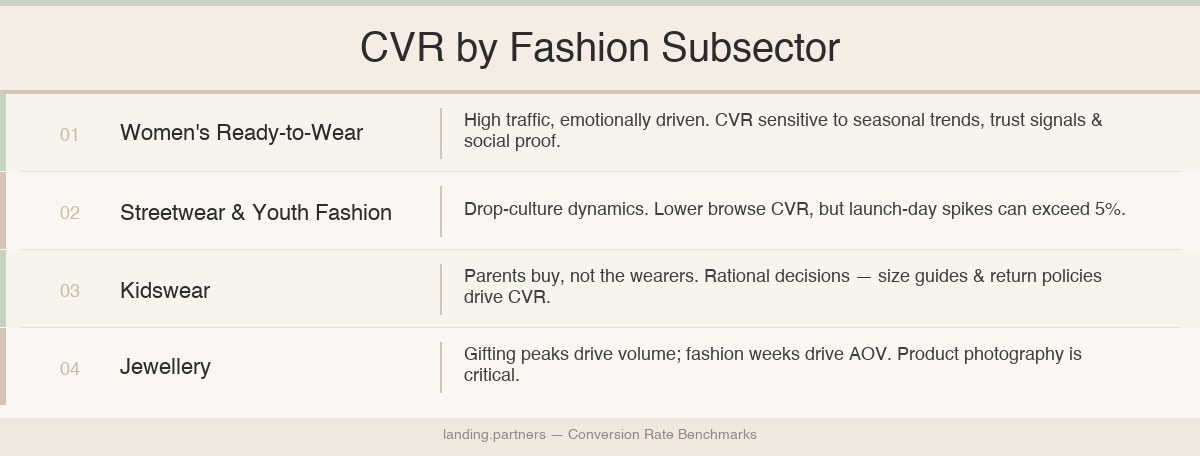
CVR by Fashion Subsector: Why Kidswear and Jewellery Need Separate Benchmarks
Even within "fashion", subsectors behave differently.
Women's ready-to-wear: High traffic, competitive market, emotionally driven purchase. CVR is sensitive to photography quality, model diversity, and social proof. Seasonal drops matter. January and July sales periods spike CVR significantly.
Streetwear and youth fashion: Drop-culture dynamics. Lower "browse" CVR, but launch-day CVR spikes hard. Email and SMS for launch notification are essential. If you don't have those channels built, you're leaving conversion on the table.
Kidswear: Parents are the buyer, not the wearer. Purchase decisions are rational and size/quality-driven, not impulse-driven. CVR is more stable across the year but spikes in September (back-to-school) and December — often more than BFCM for this segment. Social proof from other parents converts well here.
Jewellery: Gifting dynamics create two peaks - gifting seasons (Valentine's, Mother's Day, December) drive volume; fashion weeks drive AOV. CVR on gifting traffic is higher than fashion browsing traffic — the intent is clearer. Product video showing the piece worn is the highest-impact CRO element we've tested for jewellery brands.
What Above-Average Performers Do Differently
After working with brands that convert at 2-3x the rate of similar brands in the same segment, patterns emerge.
1. They treat product pages as sales pages. Not just image galleries. Real copy that answers objections: how does it fit, what is the fabric, what do I pair it with. The product description does selling work.
2. They have meaningful social proof at the point of decision. Not just a star rating. Photos from real customers wearing the product. Reviews that answer sizing questions. "True to size — I'm a 36 and ordered a 36" is worth more than 50 generic five-star reviews.
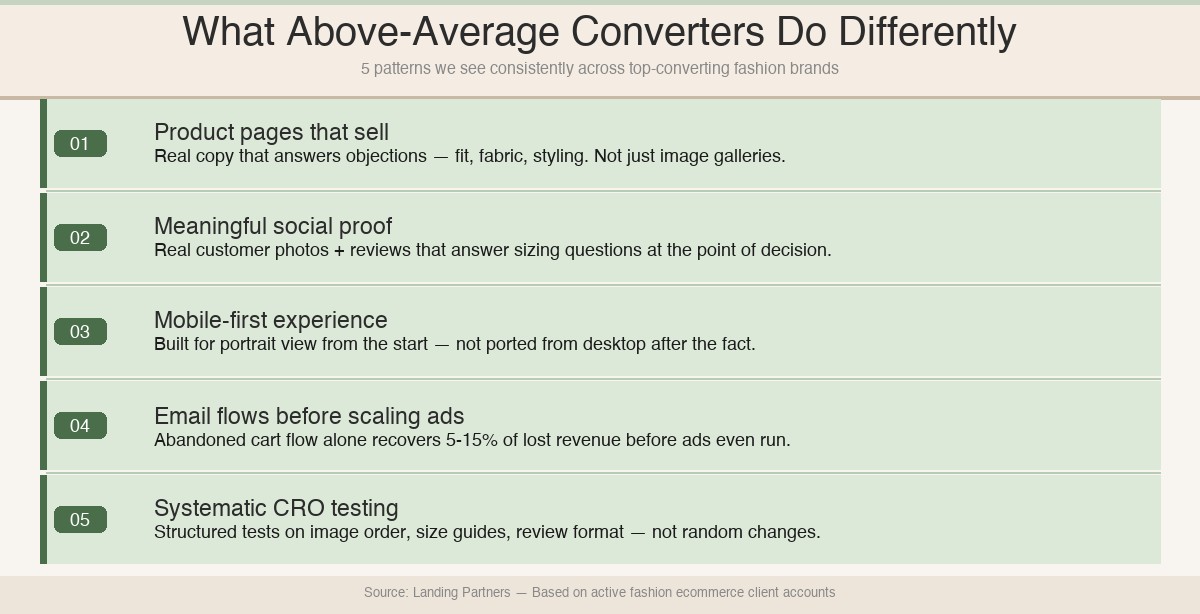
3. Their mobile experience is built first, not ported from desktop. Product images are optimized for portrait view. The add-to-cart is always visible. Payment is one tap.
4. They have a high-converting email flow in place before scaling ads. The abandoned cart flow alone recovers 5-15% of abandoned sessions for well-optimized fashion brands. That's CVR improvement without touching the webshop.
5. They test systematically. Not random changes. Structured tests — product image order, size guide placement, review format — with clear hypotheses.
If you're not sure which of these applies to your brand, a free webshop audit is the fastest way to find out. Book a free session with our team.
How to Measure and Interpret Your CVR Correctly
A few practical points on measurement, because CVR is easy to misread.
Always segment by traffic source in GA4. Your blended CVR is almost meaningless. A brand with 80% paid traffic will show a lower blended CVR than one with 80% organic — even if the stores are equally good.
Watch for sale periods inflating CVR. A brand that runs a 30% discount in January will show a CVR spike that disappears in February. That's not store improvement — that's price elasticity.
Track CVR trends over 30/60/90 days, not week-over-week. Fashion has natural volatility — a new collection launch, a viral post, a Meta outage. Short windows mislead.
Use the CVR by landing page report. If your collection pages convert at 0.4% but your product pages convert at 2%, the problem is your category page experience. If your homepage converts at 0.3%, people are landing and not knowing where to go.
And the most important frame: CVR is a symptom, not a root cause. Low CVR tells you something is broken. It does not tell you what. The diagnostic work — traffic quality, landing page relevance, store UX, offer clarity — is what tells you where to fix.
FAQ
Every brand's situation is different. Your CVR depends on your price point, your traffic mix, your product category, and the quality of your webshop experience. If you want to know what the right benchmarks look like for your specific brand - and where your biggest conversion opportunity is - book a free webshop analysis with our team. We will pull your actual numbers and tell you exactly where to focus.