
If someone types 'women's leather jacket size M' or 'online clothing store free shipping' into Google, they're not browsing - they're buying. That intent is what makes Google Ads fundamentally different from Meta for fashion brands. But that intent advantage comes with real complexity: feed management, campaign structure choices, a confusing push toward Performance Max, and attribution numbers that rarely reflect reality.. For more on this, see Google Ads for beauty and skincare brands.
We've run Google Ads for fashion clients across multiple markets. What we see consistently: brands either underuse Google (leaving demand unmet) or misuse it (burning budget on traffic that would have converted anyway). Our fashion brand advertising budget guide covers how to split spend across channels by revenue stage. This guide covers what actually drives sales.
Google Shopping vs Meta: Two Different Jobs
Meta interrupts. Google responds. These aren't better or worse - they're complementary. A potential customer discovers your brand through a Meta ad, browses your site, leaves. Three days later, they search for your product on Google. A Shopping ad appears. They click and buy.
Without Meta, there's no discovery. Without Google, you lose the conversion. The brands that understand this treat Google not as an alternative to Meta, but as the downstream capture mechanism for the demand Meta (and content, and email) creates.
Fashion is a visual category. Shopping ads - which show product images, price and brand name - are far more effective for fashion than standard text search ads. When someone searches 'blue linen shirt men', a Shopping ad with a good product image outperforms a text ad almost every time. The visual format also means feed quality is the real creative work in Google Shopping.
Across our fashion client accounts, Google Shopping typically drives 60-75% of Google Ad revenue - significantly outperforming text search campaigns for most product categories.
The Product Feed Is Your Creative
The most underinvested area in Google Shopping — whether for fashion brands or beauty — is the product feed. Most brands connect Shopify, let the default sync run, and wonder why Shopping performance is mediocre.
Your product feed is what Google uses to match your products to search queries. The title, description, category, images and attributes you provide directly determine which searches trigger your ads - and how well they convert.
Three feed changes that consistently move performance for our fashion clients:
First, title optimization. Default Shopify titles like 'Blue Shirt - Style 4821' tell Google almost nothing. Strong Shopping titles follow a formula: Brand + Category + Key Attributes. 'Brand Name Women's Linen Shirt - Light Blue - Size XS-XL' gives Google the signals it needs to match your products to the right queries.
Second, image quality. Shopping shows your product image at a small size in a competitive grid. Images with clean white or light backgrounds outperform lifestyle shots in most fashion Shopping contexts. Test both - the data usually shows one format wins by 20-30% on CTR.
Third, attribute completeness. Color, size, gender, material, age group - every attribute you fill in improves match quality and reduces irrelevant clicks. Incomplete attributes waste budget on poor-fit traffic.
Not sure if your feed is what's limiting your Google Shopping performance? Book a free Google Ads audit - we'll review your feed and campaign structure and tell you exactly where the leaks are.
Standard Shopping vs Performance Max: What We Actually See
Google has been aggressively pushing fashion brands toward Performance Max (PMax). The pitch: one campaign type that optimizes across all Google surfaces automatically. The reality for fashion is more complicated.
Performance Max works by distributing budget across Search, Shopping, Display, YouTube, Gmail and Discover. Without guidance, it tends to over-index on high-intent audiences - your remarketing pools, your brand searchers - because these convert easily and make the reported ROAS look strong.
The problem: that ROAS is largely fictitious. You're paying Google to show ads to people who were going to buy anyway. Real incremental growth comes from acquiring new customers, and unmanaged PMax is not efficient at that.
What we typically recommend for fashion brands:
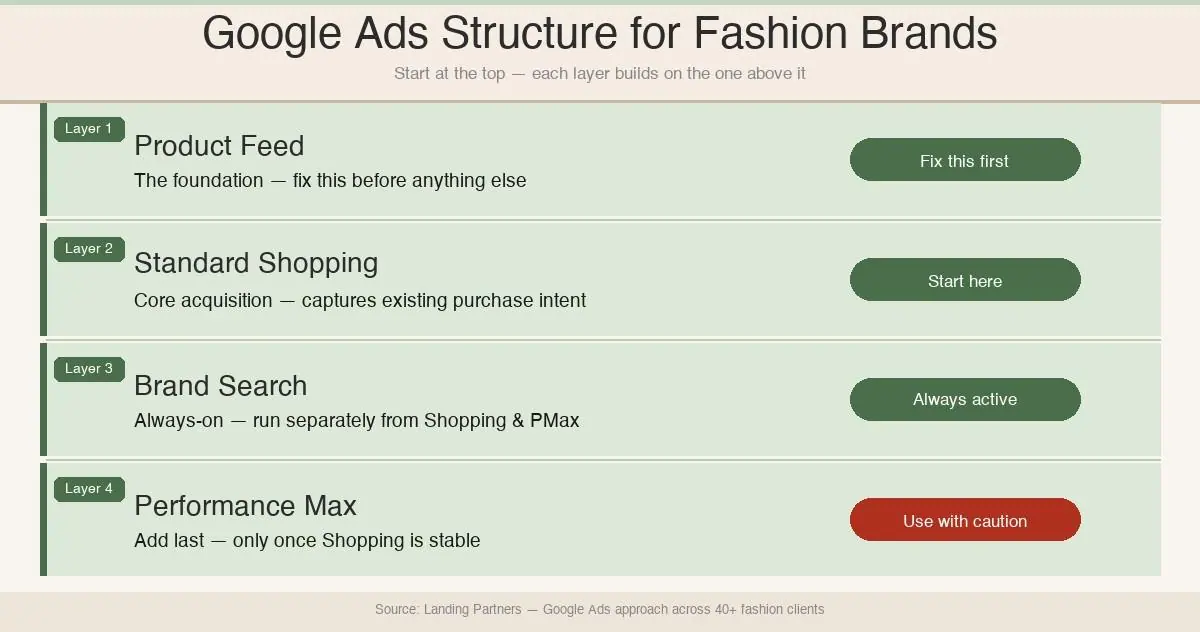
Run Standard Shopping as your primary campaign. This gives you control over search term visibility, negative keyword management, and collection/product-level bidding. You can see exactly which queries are driving which products - and cut waste.
Run a separate PMax campaign, but with clear guardrails: brand exclusions (so it doesn't poach your brand search campaigns), tight audience signals, and asset groups organized by collection or product type. Treat PMax as a supplement to Standard Shopping, not a replacement.
In accounts we've audited where brands ran PMax as their only campaign, we consistently see reported ROAS of 4-8x - but MER (marketing efficiency ratio) improvements that are far smaller. The gap reveals how much PMax revenue was already going to happen without the ads.
Brand Search Campaigns: Non-Negotiable
If your brand has any name recognition, competitors are bidding on your brand terms. A customer who searches your brand name should see your ad first - not a competitor's.
Brand search campaigns are typically the highest-ROAS campaigns in any fashion account - and the most defensible. The cost is low (you're bidding on your own name), the intent is high (they searched for you specifically), and the alternative is losing that customer to a brand bidding on your terms.
Set up a dedicated brand search campaign with your brand name, common misspellings and key brand + product combinations. Keep it separate from prospecting campaigns so you can control budget and bidding independently. Even at modest spend, it's almost always the best-returning campaign in the account.
Attribution: Why Google's Reported ROAS Misleads You
This is where most fashion brands get into trouble. Google reports ROAS based on its own attribution model - typically last-click or data-driven attribution with a 30-day click window. This inflates the numbers.
Here's what's actually happening: a customer sees a Meta ad on Monday, clicks an email on Wednesday, then searches your brand name on Friday and clicks a Shopping ad before buying. Google attributes the full sale to the Shopping click. Meta attributes it too (under its 7-day click window). Both claim 100% credit for the same sale.
The only metric that cuts through attribution confusion is MER - Marketing Efficiency Ratio. Calculate it as: total revenue divided by total ad spend across all channels. If you spent €10,000 on ads (Meta + Google + TikTok) and generated €40,000 in revenue, your MER is 4x.
MER doesn't lie. It doesn't care which channel claims the conversion. It tells you whether your total marketing spend is generating growth. Use it as the primary decision metric for scaling or cutting Google budgets.
When we calculate MER for fashion clients running both Meta and Google, the blended number is consistently lower than either channel's self-reported ROAS. For most accounts, Meta reporting 3.5x ROAS and Google reporting 5x ROAS translates to a real MER of 2.5-3x. That's still a healthy business - but it's the actual number to build decisions on.
Want to know your real MER and whether your Google Ads are driving incremental growth? Book a free analysis - we'll pull the numbers across your channels and show you the real picture.
Budget Framework by Revenue Stage
Google Ads for fashion works best as a downstream capture mechanism, not a primary growth driver. This has real implications for how much to spend and when.
Phase 1 (under €250K revenue): focus entirely on Meta and email first. Google Shopping without a base of brand awareness and a proven converting store generates expensive, low-quality traffic. Get your store converting organically, get your Meta ads profitable, build your email list - then add Google.
Phase 2 (€250K-€1M revenue): Google Shopping makes sense as a complement to Meta. A starting budget of 20-30% of your Meta spend is a reasonable starting point. A brand spending €8,000/month on Meta might allocate €1,500-2,500/month to Google Shopping to capture demand Meta has seeded. Scale based on MER improvement.
Phase 3+ (€1M+ revenue): Google becomes a meaningful part of the channel mix, particularly for brands with strong organic search presence and a well-known brand name. PMax, YouTube, and non-brand search campaigns become viable at scale. The right allocation depends on category - higher-AOV fashion tends to see stronger Google Shopping returns than lower-priced categories where the intent signal is less brand-specific.
The 3 Biggest Google Ads Mistakes Fashion Brands Make
Mistake 1: Launching Performance Max without brand exclusions. Without exclusions, PMax cannibalizes your brand search campaigns, inflates ROAS on remarketing, and makes it look like Google is performing better than it is. Always exclude your brand terms from PMax and run a separate brand search campaign.
Mistake 2: Ignoring feed quality. Fashion brands spend hours on Meta creative and almost no time on Shopping feed optimization. The feed is the creative. Weak titles, incomplete attributes and low-quality images cap your Shopping performance regardless of budget or bidding strategy.
Mistake 3: Using Google ROAS to make scaling decisions. If Google reports 6x ROAS and your MER is 2.5x, scaling Google budget based on the 6x number will not grow your business the way you expect. Always evaluate Google's contribution through the lens of blended MER, not channel-level ROAS alone.
Every brand's situation is different. Whether Google Ads makes sense for your fashion brand - and at what budget - depends on your revenue stage, your Meta performance, your brand awareness, and your product category. If you want to know what the right approach looks like for your specific situation, book a free call and we'll walk through it together.