Meta Ads for Fashion Brands: Benchmarks, ROAS Targets and What We've Learned from 40+ Clients
Key Takeaways
- •Meta ROAS benchmarks for fashion vary significantly by price point - a streetwear brand at €80 AOV and a high-end label at €350 AOV cannot use the same targets.
- •MER (total revenue / total ad spend) is more reliable than Meta-reported ROAS for evaluating true Meta performance.
- •The biggest Meta mistakes fashion brands make: testing with too little budget, stopping what works, and treating ROAS as the only metric. For the creative side, see our Meta ads creative playbook.
- •Fashion brands need at least 3 months of consistent data before drawing conclusions about Meta performance.
- •Creative quality is one of the most important variables in Meta ads - and one where the right agency or partner should actively coach you to get it right.
Most fashion brands judge their Meta performance wrong. They look at ROAS, panic when it drops, and make decisions that undo months of work. Here's what we actually see across 40+ fashion clients - and what the numbers actually mean.
Why Fashion Is Different on Meta
Fashion is one of the hardest verticals to advertise on Meta. Not because Meta doesn't work - it does, consistently, for fashion brands at every scale. But because fashion has a unique set of dynamics that make the numbers look different from most other industries.
Three things make fashion specific on Meta.
The product is visual and emotional. A fashion ad either stops the scroll or doesn't. There is no middle ground. Creative quality determines everything - more than targeting, more than bidding strategy, more than campaign structure. We've seen accounts with brilliant structure underperform because the creative wasn't right. We've also seen simple, well-structured campaigns outperform everything when the creative hit.
Fashion has hard seasons. You're not advertising a product that sells consistently year-round. You're advertising a collection that's relevant for a window. This creates pressure to front-load investment when the creative is fresh and the collection is new - and to pull back when momentum drops.
CPMs are high. Fashion audiences are competitive. You're targeting overlapping audiences with hundreds of other brands, including global players with massive budgets. This is baked into your numbers.
Fashion is one of the hardest verticals on Meta - not because it doesn't work, but because creative quality determines everything. More than targeting. More than campaign structure.
What ROAS Actually Measures - And Why We Don't Lead With It
Before we get to benchmarks, we need to be honest about ROAS.
ROAS is a manipulatable metric. Attribution windows can be set wide or narrow. Campaign objectives can be optimized to maximize reported conversions. An agency can make ROAS look good if they want to. And Meta itself sometimes attributes too much (through modelled conversions) and sometimes too little (through privacy and signal loss). You don't fully control what it measures.
We don't use Meta ROAS as our primary metric for fashion brands. We use MER.
MER = total revenue / total ad spend. It's simple, manipulation-resistant, and reflects the reality of your business. If your MER improves over time and revenue grows, your ads are working. When you see benchmarks below, read them as MER ranges, not as Meta-reported ROAS targets.
MER is what we track for every fashion client we work with. If you want to know what a healthy MER looks like for your specific brand - and where yours stands - book a free intro call. 30 minutes, and you'll leave with a clear picture.
We don't use Meta ROAS as our primary metric for fashion brands. We use MER. MER = total revenue ÷ total ad spend. Simple, manipulation-resistant, and reflects the reality of your business.
Meta Benchmarks for Fashion Brands: What We See Across Our Client Base
Based on our work with 40+ fashion brands throughout Europe and the US, here are the MER ranges we work with per brand type. One important caveat: a high number is not automatically good, and a low number is not automatically bad. The right benchmark depends on your price point, margin structure, and growth stage.
Accessible fashion (AOV €60-120) - streetwear, contemporary basics
MER target range: 3-6x

Typical Meta spend at scaling stage: €300-1,500/day — see our advertising budget guide for how to allocate by revenue stage
What we see: tighter margins mean lower MER targets. A 4x MER for a €80 AOV streetwear brand is healthy. A 4x MER for a €300 label is a problem.
Contemporary women's fashion (AOV €120-250)
MER target range: 6-15x
Typical Meta spend at scaling stage: €100-600/day — and how this fits into your growth stage
What we see: widest variance of any segment. Brands with strong creative and clear positioning hit 12-15x. Brands still finding their proposition sit at 6-8x.
High-end and designer fashion (AOV €250-500+)
MER target range: 15-35x
Typical Meta spend at scaling stage: €100-400/day
What we see: numbers look impressive, but high MER reflects high margin and lower volume. You cannot scale these accounts the same way you scale a streetwear brand.
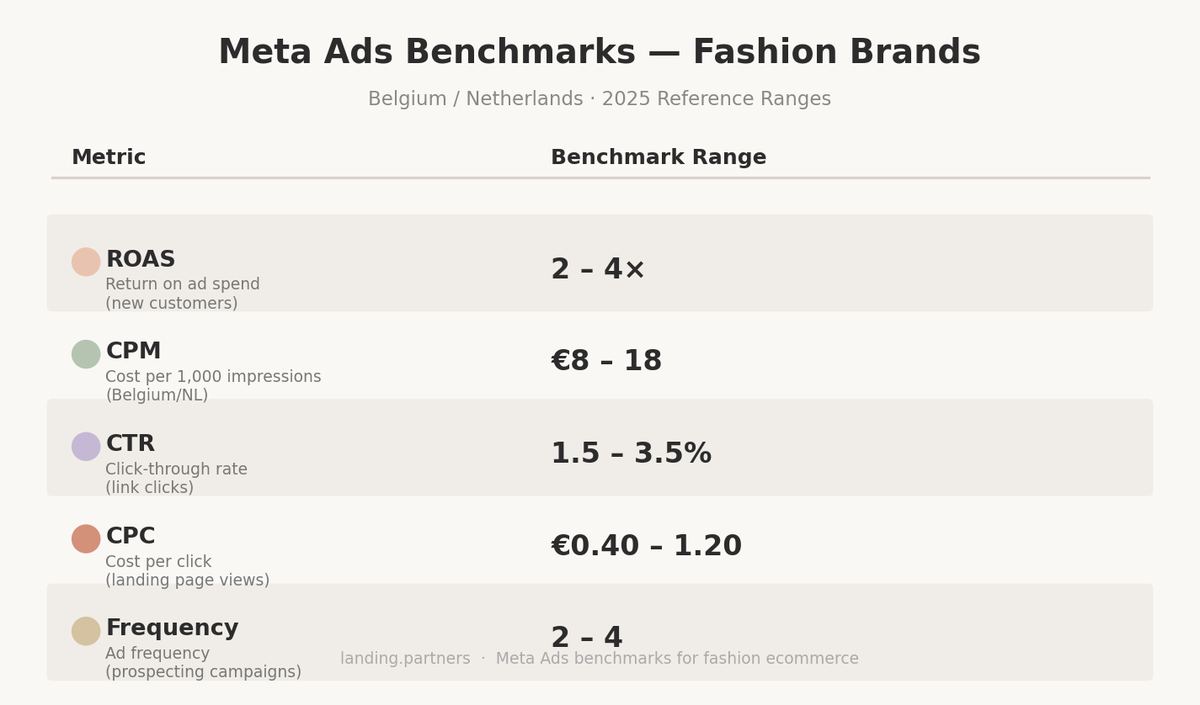
The implication: if you're comparing your numbers to a competitor or benchmark you read online, make sure you're comparing the right type of brand. A 5x MER from a luxury label and a 5x MER from a basics brand are very different situations.
How Meta Performance Evolves Over Time
One of the most common mistakes we see: brands judge Meta too early.
Months 1-3 - the learning phase. Meta's algorithm needs data. You're building audiences, identifying which creatives work, and establishing baseline performance. Numbers will be inconsistent. Some weeks will look great, others won't. This is normal. Do not make structural decisions based on month-one data.
Months 3-6 - stabilization. If you've been consistent with budget and creative testing, you start to see reliable patterns. Your best-performing audiences are established. You know which creative angles convert. This is when you should start drawing real conclusions.
Months 6-12 - scaling decisions. Now you have enough data to know what works for your brand specifically. This is when we start scaling aggressively on what performs and cutting what doesn't. MER should improve in this phase as budget allocation sharpens.
Year 2+ - optimization and efficiency. At this point, the primary challenge shifts from 'getting Meta to work' to 'maintaining performance as creative fatigue sets in and audiences saturate.' This requires a consistent creative pipeline.
If you're judging your Meta results in month one, you're doing it wrong. Patience here is a financial discipline - not a virtue.
The 3 Biggest Mistakes Fashion Brands Make on Meta
Based on auditing hundreds of fashion accounts, the same mistakes come up again and again.
Mistake 1: Testing with too little budget. Meta's algorithm needs a minimum amount of spend to learn effectively. Running campaigns at €20-30/day means the algorithm can't gather enough conversion data to optimize. The result is inconsistent performance that doesn't represent what Meta can actually do for your brand. Our recommendation: allocate at least €50-100/day per active campaign during testing. Below that, your data is unreliable.
Mistake 2: Stopping what works. We see this constantly. A creative performs well for 3-4 weeks, then someone gets bored or makes a judgment call that 'it's been running too long.' They stop it. Performance drops. Creative fatigue is real, but it's often called too early. A creative performing above your MER target should keep running until the metrics actually drop - not until you're personally tired of seeing it. Your customer is not seeing it as many times as you think.
Mistake 3: Treating Meta ROAS as the only signal. If your Meta ROAS drops but your total revenue and MER hold steady, you don't have a problem. You might have attribution shift (iOS changes, pixel gaps) or a channel mix shift. Looking at Meta ROAS in isolation will lead to wrong decisions. Always triangulate: Meta ROAS + MER + total revenue trend. All three together tell you what's actually happening.
Inconsistent Meta performance is almost always fixable - but you need to know what you're actually looking at. Book a free Meta audit - we'll show you exactly what's happening in your account.
Creative Framework: What Works for Fashion on Meta
Creative is the variable we spend the most time on with fashion clients — it's where the biggest performance differences happen. Our Meta ad creative playbook for fashion brands covers the exact hooks, formats and testing approach we use.
What consistently works:
Product in context, not white background - fashion is aspiration, show the lifestyle
Real people wearing the product - movement, texture, fit all matter
First-frame impact - the first 2-3 seconds determine everything
Seasonal hooks tied to the collection narrative
Clear product visibility - the viewer should understand what they're looking at in one second
What rarely works for fashion in direct response:
Overly produced brand films (they work for awareness, not conversion)
Generic 'Shop Now' CTAs without a specific hook
Carousels as the primary format (useful for retargeting, rarely a top performer for cold audiences)
Creative is where most fashion brands leave the most performance on the table. If you're not sure what to test next - or why your current creative is underperforming - book a free Creative Coaching session. We'll review your ads and give you a concrete direction.
Budget Guidelines by Growth Phase
We use our own phase definitions for fashion brands. These are starting points - not limits.
Phase 1 (0-€250K annual revenue): €20-60/day. Focus on proving the channel works, not scaling. Test 2-3 creatives maximum.
Phase 2 (€250K-€1M annual revenue): €60-200/day. Systematic creative testing. Scale what works, cut what doesn't.
Phase 3 (€1M-€2M annual revenue): €200-800/day. Meta becomes a serious growth driver. You need 2-3 new creatives per month minimum and a clear Advantage+ Shopping Campaign structure alongside your prospecting campaigns.
Phase 4 (€2M+ annual revenue): €800+/day. At this scale, Meta alone is not enough. Channel diversification — including Google Shopping campaigns — and international strategy become critical.
Frequently Asked Questions
Every fashion brand's Meta situation is different. The right benchmarks, budget, and creative approach depend on your price point, margin, stage, and audience. If you run beauty or skincare products alongside fashion, benchmarks differ — our Meta ads guide for skincare brands covers what to expect.
Want to know what realistic performance looks like for your brand? Book a free Meta ads analysis - we'll tell you exactly what we'd change in your account.