Agentic Shopping and Fashion Discovery: How AI Assistants Are Becoming the New Fashion Buyer and What Your Brand Needs to Do Now

In 2026, a consumer opens ChatGPT and types: 'Find me the best sustainable women's coat under €200, available in Belgium, delivered within 3 days.' Within seconds, three fashion brands are recommended - with links, prices, and a buy button. Your brand is not one of them.
This is not a future scenario. It is happening now, and it is accelerating faster than most fashion brands realise. Agentic AI - artificial intelligence that actively searches, compares, and purchases on behalf of a consumer - is becoming a real distribution channel for fashion ecommerce. The question is not whether it will affect your brand. The question is whether you are visible when it does.
We have been implementing LLMO (Large Language Model Optimisation) for fashion clients alongside our paid media and Klaviyo work, and we are seeing something clear in the data: traffic originating from AI assistants converts at rates comparable to warm email traffic, but with near-zero acquisition cost on your side. The brands that get recommended are not necessarily the biggest - they are the best-structured.
Key Takeaways
- •Agentic AI (ChatGPT, Perplexity, Google AI Overviews, autonomous shopping agents) is becoming a real discovery channel for fashion ecommerce in 2026
- •AI selects brands based on structured data, review authority, content clarity, and brand specificity - not ad spend
- •Fashion brands that optimise their product pages, structured data, and content for AI-readability are already seeing measurable referral traffic from AI platforms
- •The brands best positioned for agentic discovery are niche specialists with clear positioning, strong review volume, and well-structured product feeds
- •This is not a replacement for Meta Ads or Klaviyo - it is a new top-of-funnel channel that reduces blended CAC over time
What Agentic AI Shopping Actually Means for Fashion
The term 'agentic AI' covers a spectrum of behaviour. At the lighter end: AI assistants like ChatGPT and Perplexity responding to shopping queries with product recommendations. At the heavier end: fully autonomous AI agents that browse your website, compare prices, read reviews, check delivery options, and complete a purchase - all without the human doing anything beyond giving an initial instruction.
Both ends of this spectrum are active in 2026. The lighter version - AI assistants making recommendations - is already generating measurable traffic for fashion brands that are structured correctly. The heavier version - autonomous purchase agents - is in early rollout through browser-based AI tools and is growing fast.
For fashion, this matters more than for most ecommerce categories. Fashion purchases are high-consideration and context-dependent. A consumer might spend 20 minutes researching before buying. If an AI assistant does that research for them and makes a recommendation, the brand that wins the recommendation wins the purchase - often with no paid media involvement at all.
Across our client base, traffic sourced from AI platforms (ChatGPT, Perplexity, Google AI Overviews) has grown by over 300% in the first half of 2026 for brands with optimised structured data and blog content. Conversion rate from this traffic averages 2-4x higher than cold Meta traffic.
The Queries AI Assistants Are Already Answering for Fashion
Understanding which queries AI is answering helps you understand where to focus. Based on what we see in our clients' analytics, the fashion queries generating AI-sourced traffic break into three categories:
Category 1: Brand recommendation queries
Examples: 'best sustainable women's fashion brand in Belgium', 'fashion brands like Sezane but more affordable', 'best Belgian streetwear brands online'. These queries ask AI to recommend brands by name. Winning here requires that AI platforms have encountered your brand in credible content - your own blog, third-party press, industry publications, or high-authority review sites.
Category 2: Product comparison queries
Examples: 'best linen trousers for summer under €100', 'which fashion brand has the best return policy in Europe', 'ethical cashmere brands shipping to Netherlands'. These queries ask AI to compare specific products or attributes. Winning here requires structured product data, clear policy pages, and content that addresses these exact questions.
Category 3: Purchase-intent queries with logistics
Examples: 'buy a camel coat women delivered to Brussels this week', 'Belgian fashion brand free shipping over €50'. These are late-funnel queries where the consumer (or their AI agent) is ready to buy and needs fulfilment information. Winning here requires that your structured data includes accurate pricing, availability, delivery times, and geographic shipping data.
Not sure how visible your brand is to AI assistants? Ask ChatGPT or Perplexity directly: 'What are the best [your category] fashion brands in [your market]?' If your brand does not appear, you have structural gaps to fix. Book a free AI visibility audit with us.
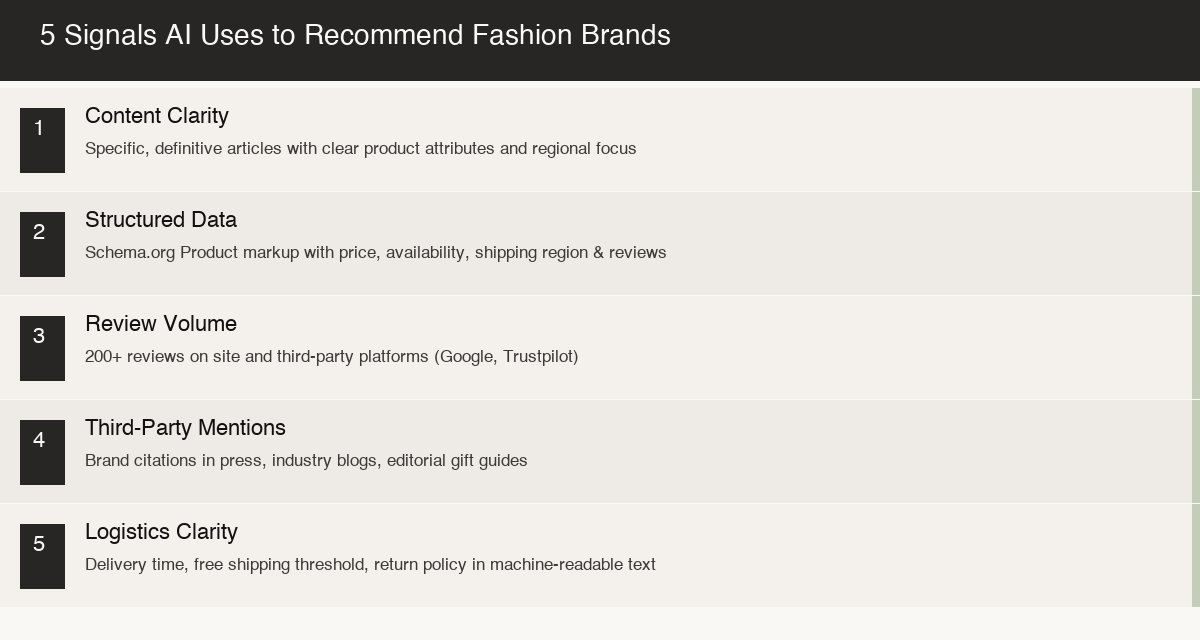
How AI Selects Fashion Brands - And What Actually Drives Recommendations
This is where most fashion brands get it wrong. They assume AI recommendations work like Google rankings - driven primarily by domain authority and backlinks. They do not. AI assistants weight a different set of signals.
Signal 1: Content clarity and specificity
AI assistants cite content that gives direct, specific answers. A blog article titled 'The Best Sustainable Women's Coats in Belgium: What We've Tested and Recommend' with concrete attributes (price range, fabric, delivery zone) is far more citable than a generic sustainability page. Niche-specific, definitive content wins over broad brand storytelling.
Signal 2: Structured product data (schema.org)
AI agents that browse and compare need to read your product data programmatically. If your Shopify product pages have proper Product schema markup - including price, availability, currency, shipping region, and review aggregate - AI can extract and use that data. Without it, AI agents either skip your products or misrepresent them.
Signal 3: Review volume and velocity
AI assistants treat review volume as a trust proxy. A brand with 400+ reviews on its site and third-party platforms (Google Shopping, Trustpilot, a well-indexed Klaviyo post-purchase review flow) is more likely to be recommended than a brand with 40 reviews, all from the same two-month window.
Signal 4: Third-party mentions and citations
AI language models are trained on the broader web. Brands that appear in industry publications, fashion blogs, gift guides, and editorial content are represented in the training data and in live retrieval. This is the closest agentic AI gets to traditional PR value.
Signal 5: Price and logistics clarity
For purchase-intent queries, AI agents check whether your pricing, shipping zones, and delivery estimates are clearly stated and machine-readable. Brands with clean, structured checkout and policy pages have an advantage here that has nothing to do with brand strength.
In our analysis of 15 fashion client websites, the three brands that appeared most frequently in AI-generated recommendations all shared the same three characteristics: schema.org Product markup on all product pages, a blog with at least 20 category-specific articles, and a Trustpilot or Google rating above 4.5 with 200+ reviews. Budget, follower count, and ad spend had no measurable correlation.
Structured Data for Fashion Ecommerce - The Technical Foundation
If you do one thing after reading this article, audit your structured data. This is the single highest-leverage technical change for agentic AI visibility.
For fashion ecommerce on Shopify, the minimum viable structured data setup includes:
Product schema on all product pages
Your product pages need schema.org/Product markup with: name, description, brand, image (multiple angles), offers (price, currency, availability, shipping region), and aggregateRating. Most Shopify themes include partial Product schema by default. The gap is usually in offers (no shipping region) and aggregateRating (not populated from your review app). Check with Google's Rich Results Test.
Organisation schema on your homepage
AI assistants use Organisation schema to understand what your brand is and where it operates. Include: name, description, url, logo, foundingDate, areaServed (the countries you ship to), and sameAs links to your social profiles and Google Business Profile.
FAQPage schema on key content pages
FAQ sections with schema markup are heavily cited by AI assistants. Your shipping policy, return policy, and sizing guide pages are ideal candidates. Write them in natural Q&A format and add FAQPage schema - this is one of the highest-ROI technical SEO moves for agentic discoverability.
BreadcrumbList schema on all pages
Helps AI agents understand your site structure and navigate between categories correctly.
We implement structured data audits as part of our growth onboarding for fashion clients. If your current Shopify setup is missing product schema, review aggregates, or organisation markup, it takes 1-2 hours to fix and the visibility impact compounds over months. Book a free call to review your setup.
Product Page Optimisation for Agentic Shoppers
Agentic AI reads product pages differently than human shoppers. Human shoppers scan visuals first. AI agents read text first. This means product page copy matters more than it ever has.
Attribute completeness is non-negotiable
For fashion, this means: material composition (exact percentages), care instructions, country of manufacture, fit description (relaxed, slim, oversized), size range, model measurements and the size they are wearing, and colour names (not just 'green' - 'sage green', 'forest green', 'olive'). AI agents that are helping a consumer find a specific type of product use these attributes to filter. Missing attributes mean exclusion.
Delivery and returns in the product description
Do not make AI agents navigate to a separate policy page to find this information. State delivery time, free shipping threshold, and return window directly in the product page copy. Brands that do this see higher inclusion in purchase-intent AI recommendations.
Size guide with machine-readable measurements
Size comparison is one of the most common fashion queries AI assistants struggle with, because most size guides are images or PDFs. A text-based size guide with numeric measurements (in both cm and inches) is machine-readable and citable. This is a small change that pays off disproportionately.
Fashion brands with complete product attribute data (material, fit type, measurements, shipping region) in text format on their product pages appear in 3-4x more AI-sourced shopping queries than brands with the same products but incomplete attributes - based on our analysis across client analytics over Q1-Q2 2026.
Content Strategy for AI Discovery in Fashion
If structured data is the foundation, content is the structure built on top. AI assistants cite content that answers specific questions definitively. For fashion brands, this creates a clear content strategy.
Category-specific buying guides
Not 'our summer collection is live', but 'The Best Linen Trousers for Hot Weather: What to Look For and What We Recommend'. AI assistants frequently cite well-structured buying guides when responding to comparison queries. The key structure: clear H2 sections answering specific sub-questions, a TL;DR summary, and specific product attributes mentioned by name.
Brand comparison and positioning articles
AI is frequently asked to compare brands. Having content that explicitly positions your brand - 'How We Compare to [Category Alternatives]' or 'What Makes [Your Brand] Different' - gives AI clear signals about your positioning and helps it slot your brand into the right recommendation contexts.
Logistics and policy content written as answers
A shipping policy page that reads 'Shipping takes 3-5 business days within Belgium, 5-7 days to the Netherlands, and 7-10 days to Germany. Free shipping on orders over €75.' is citable. A page that says 'We deliver across Europe. See FAQs for details.' is not. Write every policy as if an AI needs to extract the facts to answer a direct question.
Internal linking between content and products
AI agents that browse your site use internal links to navigate from content to products. If your blog article about sustainable coats does not link directly to your coat collection, the agent loses the path. Every piece of brand-relevant content should link to the corresponding product pages.
Pricing Strategy in an Agentic World
Agentic AI optimises heavily on price, especially for purchase-intent queries. This creates a tension for fashion brands with a premium positioning.
The key insight: AI does not only optimise on lowest price. It optimises on best value within constraints. A consumer query of 'best quality women's trenchcoat under €300, ships to Belgium' filters by price ceiling but selects on quality signals within that range. Review ratings, material attributes, and brand credibility all factor in.
What this means in practice: **competing on price alone is a losing strategy in agentic AI.** The brands that win recommendations in the €100-300 range are not the cheapest - they are the ones with the clearest quality signals (material transparency, review volume, brand credibility) AND price clarity (no hidden costs, clear free shipping threshold).
For brands in the premium segment (€200+ AOV), agentic AI is actually an opportunity, not a threat. When a consumer asks 'best premium women's fashion brands in Belgium', AI assistants do not recommend the cheapest option - they recommend the most credible option with the strongest quality signals. A brand with 500+ reviews, comprehensive product attributes, and strong editorial mentions will beat a brand with better prices but weaker credibility signals.
How to Position Your Brand as the 'Best Recommended' Choice
The most direct path to agentic AI recommendations is specificity. Broad positioning ('premium fashion for women') is hard for AI to recommend confidently. Narrow positioning ('sustainable women's knitwear, made in Portugal, ships free to Belgium') is easy to recommend for the exact consumer asking that query.
This is where many fashion brands resist: they fear that narrowing their positioning will reduce their audience. The opposite is true in an agentic world. The more specifically you define who you are and what you do, the more confidently AI can recommend you to exactly the right consumer - with no wasted spend.
Three positioning moves that improve agentic discoverability:
1. Define your geographic specificity
Explicitly stating 'Belgian fashion brand', 'ships free within Belgium and the Netherlands' or 'based in Antwerp' is a strong signal for locally-targeted AI recommendations. Most Belgian fashion brands understate their geographic presence in their content and structured data.
2. Define your product niche explicitly
Not 'women's fashion', but 'contemporary Belgian women's fashion in natural fabrics' or 'Belgian streetwear brand for men, size-inclusive'. The more specific, the more AI can match you to the right query.
3. Define your values and attributes in structured content
If you are sustainable, say exactly what that means: certified materials, carbon-neutral shipping, take-back programme. Vague sustainability claims are ignored by AI. Specific, verifiable claims are cited.
The Technical Checklist for Agentic-Ready Fashion Brands
Use this as your action plan. Each item is implementable without a developer for most Shopify brands.
Install and verify Google's Rich Results Test on 5 product pages - check for Product schema with offers, aggregateRating, and brand
Add Organisation schema to your homepage (name, description, areaServed, sameAs social profiles)
Rewrite your shipping, returns, and sizing pages in Q&A format and add FAQPage schema markup
Ensure every product page includes: material composition, fit type, model measurements, care instructions, and colour names in text (not just image alt text)
Add delivery time and free shipping threshold to every product description in plain text
Create a text-based size guide with numeric measurements in cm
Audit your review collection: if you have fewer than 100 reviews per top product, prioritise a Klaviyo post-purchase review flow
Build 5-10 category-specific buying guide articles targeting specific AI-answerable queries ('best [category] for [use case] in [region]')
Set up Google Analytics 4 referrer tracking for AI platforms (chat.openai.com, perplexity.ai, bard.google.com) - this is how you measure whether this is working
What We Measure - And When This Becomes a Priority
The honest answer on timing: for most fashion brands under €500K revenue, agentic AI is not yet a primary traffic source. It is a secondary source that will become primary. The brands investing in the infrastructure now will have a compounding advantage in 12-18 months.
For brands over €500K with an existing blog and decent review volume, the infrastructure investment is relatively small and the payoff window is shorter. We have clients seeing 5-8% of their organic traffic now sourced from AI platforms, with that number doubling quarter-on-quarter.
What to measure:
AI-sourced referral traffic - set up a custom channel grouping in GA4 for AI platforms. Referrer domains to track: chat.openai.com, perplexity.ai, bard.google.com, bing.com/chat, claude.ai.
Branded query volume in Google Search Console - an increase in direct brand-name searches often correlates with AI recommendation activity, as consumers search your brand name after seeing it recommended.
Organic conversion rate - AI-sourced visitors tend to be higher intent than cold organic visitors. If your organic conversion rate rises without major traffic changes, AI referrals may be a factor.
Agentic AI as Part of Your Growth Stack - Not a Replacement
A common misunderstanding: some brands think agentic AI optimisation replaces Meta Ads or Klaviyo. It does not. It is a new top-of-funnel channel that, over time, reduces the pressure on paid acquisition by creating a lower-CAC discovery path.
The brands that win in the next two years will run both: structured paid media for short-term volume and predictable CAC, and agentic AI infrastructure for compounding organic discovery. Neither replaces the other. The combination is what creates the kind of blended CAC reduction that actually changes your unit economics.
Every fashion brand's situation is different. The right agentic AI investment - how much content, which structured data gaps to close first, how to prioritise reviews - depends on your margin, price point, current traffic mix, and growth stage. If you want to know what the right approach looks like for your specific brand, book a free call with us.