Managing Creative Fatigue in Fashion Meta Ads: How to Build a Refresh Cycle That Keeps Campaigns Performing
Most fashion brands notice creative fatigue too late. By the time CPM spikes and click-through rate collapses, you have already left weeks of wasted spend on the table. If you are still building your initial creative library, start with our Meta ads creative playbook before focusing on refresh cadence.
The brands that stay efficient on Meta are not the ones with the biggest production budgets. They are the ones that read the early signals, refresh before performance drops, and build a creative pipeline that runs ahead of fatigue - not behind it.
We manage Meta accounts for 40+ fashion brands. What follows is what we actually see in the data.
Key Takeaways
- •Creative fatigue hits fashion ads faster than most brands expect - especially during high-pressure periods like launches and BFCM
- •The first signs appear in comment sentiment and frequency capping, not in CTR or ROAS
- •Fashion creative lifespan varies significantly by budget level and subsector - there is no single number
- •Refreshing the hook alone can extend a fatigued ad's life by 2-3 weeks without a full reshoot
- •A proactive refresh cycle, planned around your collection calendar, is cheaper than emergency creative production
What Creative Fatigue Actually Means for Fashion
Creative fatigue happens when your target audience has seen the same ad often enough that they stop engaging with it. The algorithm responds by raising your CPM to find new eyeballs, your CTR drops, and your cost per purchase climbs.
In fashion, this happens faster than in most other categories. The reasons are structural.
Fashion audiences are often relatively narrow. A contemporary women's brand at a mid-range AOV is typically targeting a defined segment of women in a specific age range, income bracket, and style orientation. That audience sees your ad repeatedly - and they remember it.
Fashion is also emotionally driven. The first time someone sees an editorial campaign image, it creates a reaction. The fifth time, it creates nothing. The tenth time, it creates mild irritation.
In fashion Meta accounts we manage, we typically see frequency-related fatigue signals begin to appear within 3-4 weeks on mid-range budgets - significantly faster than most brands anticipate.
This is not a Meta problem. It is a creative volume problem. And it is solvable.
The 5 Early Warning Signals of a Fatigued Fashion Ad
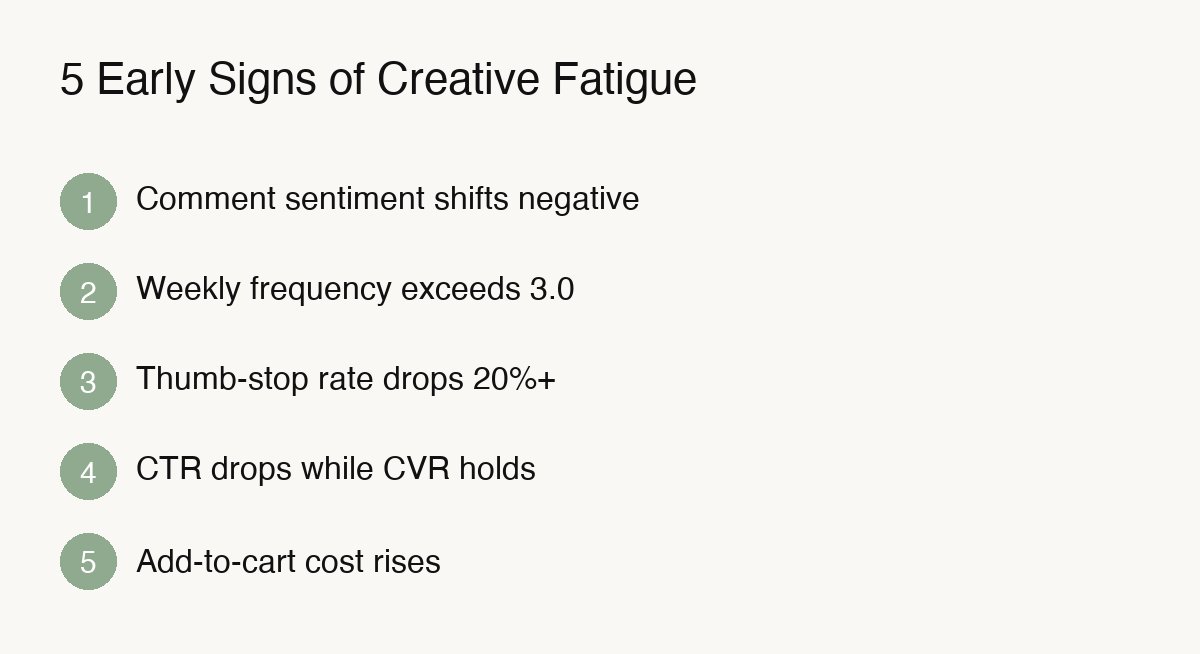
Most teams refresh creatives after the numbers collapse. We refresh before - because by the time the metrics crater, the damage is already done. Here are the five signals we watch.
Signal 1: Comment sentiment shifts
Before CTR drops, comments change. People stop saying 'love this' and start saying 'I keep seeing this' or 'not again'. This is the earliest observable signal of fatigue - often 1-2 weeks before performance metrics reflect it. We check comment sections on all running ads twice a week.
Signal 2: Frequency climbs past 3.0 within the week
Average weekly frequency above 3.0 for a cold or warm audience is a strong leading indicator. It means people are seeing the ad too often relative to the size of the audience. Watch this at the ad set level, not the campaign level.
Signal 3: Thumb-stop rate drops more than 20%
For video and Reels ads - which are the dominant format for fashion in 2026 - a drop in 3-second video view rate signals the hook is no longer stopping the scroll. The rest of the ad may be fine. The hook is the problem.
Signal 4: Landing page CVR holds but ad CTR drops
If your conversion rate on the landing page stays stable while CTR on the ad falls, the store is not the issue. The creative is. This pattern often gets misread as a website problem when it is actually a creative fatigue signal.
Signal 5: Cost per add-to-cart rises while ROAS holds flat
When add-to-cart cost increases but reported ROAS stays flat, the algorithm is compensating - often by showing the ad to warmer, easier-to-convert audiences. This is a short-term cushion that masks real fatigue. It will eventually give way.
Not sure which of your creatives are already fatigued? We run a free Meta creative audit for fashion brands - no commitment required. Book a free call
How Long Does a Fashion Ad Actually Last?
There is no universal answer. Creative lifespan in fashion depends on three factors: budget, audience size, and subsector.
Budget level matters most
At low daily budgets (under €100/day), a creative can run for 6-8 weeks without significant fatigue. The low spend rate means low impression volume per person. At mid-range budgets (€300-1,000/day), expect fatigue to set in around weeks 3-5. At high budgets (€1,000+/day), strong creatives may last 2-3 weeks before signals appear.
Audience size amplifies or dampens fatigue speed
A niche luxury brand targeting a specific style segment in Belgium will fatigue creatives faster than a broad contemporary brand targeting all of Western Europe. Smaller audiences mean more repetition and faster fatigue.
Fashion subsector makes a real difference
Streetwear and contemporary fashion audiences are highly active on Meta and see more ads overall - creative lifespan tends to be shorter. Luxury fashion audiences, while smaller, tend to respond to fewer, higher-quality executions - but when those executions fatigue, the drop is sharper.
Across the fashion accounts we manage, the average creative lifespan before performance degrades by more than 15% ranges from 18 days at budgets above €500/day to 45+ days at budgets below €100/day. Your specific number will sit somewhere in this range depending on audience size and subsector.
What to Refresh First (And What to Keep)
Not every fatigued ad needs a full reshoot. Understanding which element is driving fatigue determines what you touch - and saves significant production budget.
The hook is the highest-leverage refresh point
For video ads and Reels, the first 3 seconds are doing the work. We have seen a fatigued fashion ad return to previous performance levels simply by cutting a new opening - same footage, new hook. This is the fastest and cheapest refresh, and it should be your first move when thumb-stop rate drops.
Primary text and headline refresh has limited value alone
Copy changes alone rarely move the needle on fatigued fashion ads. Fashion is a visual category. The scroll-stop decision happens on the visual, not the headline. Copy changes are a secondary refresh, useful when visual performance is still strong but CTR-to-landing-page is soft.
Visual refresh categories for fashion
When you need a full visual refresh, prioritise by production cost and expected impact:
- New hook on existing footage (lowest cost, high impact for video fatigue)
- New colour treatment or crop of existing images (low cost, medium impact)
- New product focus within same visual style (medium cost, high impact when product is the hook)
- Full new shoot with different model or location (highest cost, highest reset)
Format switch as a reset tactic
Switching from a static image to a Reels format - or vice versa - with similar creative content can effectively reset frequency perception. Meta's algorithm treats these as different placements and different experiences. We use format switching when a concept is working conceptually but the specific format has fatigued.
Working out which elements to refresh - and when - is what separates fashion brands that scale Meta efficiently from those that keep firefighting. Book a free creative strategy call and we will walk through your current creative setup with you.
Building a Proactive Refresh Cycle
Reactive creative refreshes are expensive. You end up in crisis production - rushing a reshoot because performance collapsed on a Monday morning before a sale period. The brands that manage fatigue well build their refresh cycle into their content calendar.
Map your refresh cycle to your collection calendar
Fashion has a natural rhythm: SS/AW drops, key sale periods, campaigns around specific cultural moments. Build your creative refresh schedule around these. New collection drops are natural refresh moments - new product, new hero imagery, new seasonal hooks. Plan for at least two complete creative sets per season.
Maintain a creative buffer
We recommend every fashion brand running Meta at €300+/day maintains a minimum of 3-4 creatives in testing at all times - not running at scale, but in a low-spend testing phase. When a main creative fatigues, you already have data on what to promote. Without this buffer, you are always starting from zero.
Set a calendar trigger, not just a performance trigger
Performance triggers are reactive. Calendar triggers are proactive. A useful rule: every 4 weeks, review your top 3 running creatives and assess whether a hook refresh is due - regardless of whether performance has visibly dropped. Most fashion brands that implement this rule find they prevent at least one performance collapse per quarter.
Fashion brands that maintain an active creative testing budget of 15-20% of their total Meta spend consistently show more stable CPMs over time compared to brands that only test when performance drops.
How Much Budget to Allocate to Creative Testing vs. Scaling
A common mistake in fashion Meta accounts is putting all spend into proven creatives and nothing into testing. This works until it doesn't - and when the proven creative fatigues, there is nothing ready to replace it.
Our benchmark for fashion brands at different scale stages:
- Phase 1 brands (under €250K revenue): 25-30% of Meta spend in testing. At lower budgets, you need to learn faster.
- Phase 2 brands (€250K-€1M revenue): 15-20% of Meta spend in testing. Enough to maintain a healthy creative pipeline.
- Phase 3+ brands (€1M+ revenue): 10-15% in testing is sufficient if you have a structured production rhythm. The volume of spend means data accumulates faster.
Testing budget is not wasted budget. It is insurance against the performance cliff that comes with unexpected fatigue.
Creative Production Workflow for Fashion Brands
The most sophisticated creative strategy breaks down if you cannot consistently produce enough material. Here is the production workflow we recommend for fashion brands at different scales.
Early-stage fashion brands (limited production budget)
Focus on versatility. A single product shoot done well - good lighting, clean background, model on brand - can yield 8-10 distinct creative assets when cropped, formatted, and combined with different hooks. UGC from loyal customers is your second source. Brief customers at the post-purchase stage via Klaviyo and offer a small incentive for video content.
Mid-stage fashion brands (dedicated content budget)
At this level, plan quarterly content shoots aligned to seasonal collections. Each shoot should generate material for at least 3 months of creative testing. Supplement with UGC and creator content via a lightweight affiliate arrangement. The goal is 4-6 new creatives ready to test each month.
Scaling fashion brands (full content pipeline)
At €1M+ revenue, the creative operation becomes a significant investment. A full content pipeline includes monthly shoots, a roster of 3-5 creators producing regular UGC, and an in-house or agency team briefing, cutting, and versioning assets weekly. At this stage, creative volume - not creative quality alone - is the competitive variable.
Frequently Asked Questions
Every brand's situation is different. Creative fatigue timelines, refresh frequency, and production capacity all depend on your budget, audience size, and subsector. If you want to know what the right creative refresh cycle looks like for your specific brand - book a free call and we will take a look at your account together.