Retargeting Strategy for Fashion Ecommerce: How to Convert Browsers Into Buyers

Most people who visit your fashion webshop will not buy. They browse, they scroll, they add to cart - and then they leave. That is not a failure of your ads. That is the normal purchase cycle for fashion.
Retargeting is how you finish the job. In fashion ecommerce, a well-built retargeting strategy is often the highest-ROI activity in your paid media mix - because you are reaching people who already know your brand and have shown intent.
This guide covers how we build retargeting systems for fashion brands across Meta and Google: who to target, what creative to use, how much to spend, and what to avoid.
Key Takeaways
- •Most fashion shoppers need 2-4 touchpoints before converting - retargeting provides those touchpoints at low cost
- •Audience segmentation matters: not all site visitors are equally valuable - prioritise by intent signal
- •Creative for retargeting differs from prospecting - remind, don't re-introduce
- •Meta retargeting works best with 7-14 day audiences; wider windows dilute intent
- •Allocate 20-30% of total paid media spend to retargeting - more than that cannibalises prospecting
- •Frequency matters: 3-5 impressions per user per week is a healthy range - above that, you are burning budget on the same people
Why Retargeting Works Differently for Fashion
Fashion is a considered purchase. Even at lower price points, people deliberate. They check fit guides. They compare colours. They look at the return policy. They close the tab and come back three days later.
This is fundamentally different from impulse purchases or commodity goods. The decision cycle for a 120-euro dress or 180-euro sneaker is measured in days, not seconds. As you scale prospecting spend, Meta Advantage+ Shopping campaigns handle new customer acquisition automatically — keeping your retargeting budget focused purely on warm audiences.
What we see across our client base: the majority of conversions happen on the second or third visit to a product page, not the first. The first visit is discovery and evaluation. Retargeting converts the people who evaluated positively but did not pull the trigger yet.
Based on our work across 40+ fashion brands: the majority of paid media conversions come from audiences who have already interacted with the brand - not cold traffic converting on first contact. Retargeting is where fashion margins are made.
The implication is practical. If you are only running prospecting campaigns and hoping people come back on their own, you are leaving conversions on the table. Fashion shoppers need reminders - and they respond to them when the creative and timing are right.
The challenge is doing this well. Bad retargeting annoys people. Good retargeting feels like a useful reminder at the right moment. The difference is in your audience setup, your creative, and your frequency management.
The Retargeting Audiences That Actually Convert
Not all site visitors are equally worth retargeting. Someone who landed on your homepage and bounced in three seconds is not the same as someone who spent eight minutes reading product descriptions and went all the way to checkout.
Segment your retargeting audiences by intent signal, not just by visit. Here is how we structure it for fashion brands:
Tier 1 - Highest Intent (Prioritise These)
Cart abandoners - people who added to cart but did not complete purchase. This is your most valuable retargeting segment. They selected a product, chose a size, and went to checkout - that is extremely high purchase intent. Target these with 3-7 day windows. Budget here first.
Checkout initiators who did not purchase - they went further than cart addition. Even higher intent than simple cart abandoners. These people were one click away.
Product page visitors (2+ minutes dwell time) - dwell time signals serious evaluation. Pair this with a frequency cap and product-specific creative rather than generic brand messaging.
Tier 2 - Medium Intent
Collection page visitors - they browsed a category but may not have gone deep on any specific product. Use broader creative here - show the range, not one specific item. A carousel showing 4-5 pieces from the collection they viewed works well.
Return visitors - someone who came back to the site twice without converting. This shows ongoing interest worth reinforcing. These people are genuinely considering.
Tier 3 - Lower Intent (Use With Budget Caution)
General site visitors (30+ seconds, any page) - useful for brand awareness retargeting but rarely direct conversion drivers. Works well as a Meta engagement campaign at low CPMs. Not worth spending conversion budget on.
Not sure how your current retargeting audiences are set up - or whether your Meta pixel is capturing the right signals? Book a free campaign audit with our team.
Build your retargeting budget allocation around Tier 1 audiences first. They are a small audience but convert at meaningfully higher rates than general site traffic. Tier 2 and Tier 3 are support layers, not the engine.
One mistake we see often: brands use one large 30-day website visitor audience for all retargeting. This flattens the intent signal and dilutes your most valuable segment into a much larger, lower-converting pool.
Meta Retargeting for Fashion: Platform, Placements, and Bids
Meta (Facebook and Instagram) is where most fashion brands do the majority of their retargeting work - and for good reason. The visual nature of the platform suits fashion products, and the targeting options let you get precise about who you are reaching.
Here is how we set up Meta retargeting for fashion brands:
Campaign structure
Run retargeting as a separate campaign from prospecting. Mixing them into one campaign makes optimisation impossible - Meta will allocate budget based on who it thinks will convert, and prospecting audiences will consistently outbid retargeting in volume while underperforming on intent.
Separate campaigns also let you control frequency independently. Retargeting audiences are small - without a frequency cap, Meta will oversaturate them quickly.
Audience windows
7-14 days is the sweet spot for most fashion retargeting. Shorter windows miss people still in their decision cycle. Longer windows (30-day, 60-day) include too many people who have already made their decision - either they bought elsewhere, or the purchase intent has passed.
For cart abandonment specifically, we often use tighter windows - 3-7 days. Cart abandonment intent decays quickly. A cart abandon from 3 weeks ago is much less valuable than one from 4 days ago.
Placements
Instagram Feed and Instagram Stories/Reels perform best for fashion retargeting. Facebook Feed still converts for older demographics. Facebook Audience Network tends to be low quality for fashion - we typically exclude it or limit spend there.
In our Meta retargeting campaigns for fashion brands, Instagram placements consistently outperform Facebook placements on ROAS - often by a significant margin. The visual-first format of Instagram aligns with how fashion shoppers evaluate and purchase products.
Bidding on small audiences
For small retargeting audiences (under 5,000 people), use cost cap or manual bid to avoid overspending on a narrow pool. Lowest cost bidding on a tiny audience will blow through budget without meaningful reach increase. Set your bids deliberately.
Google Retargeting for Fashion: Display, YouTube, Shopping
Google retargeting plays a different role than Meta retargeting in the fashion funnel. Where Meta interrupts users with visual ads while they scroll, Google recaptures users when they are actively searching - which is a different and high-value intent moment.
Google Display retargeting
Useful as a low-cost brand reminder across the web. Display CPMs are cheap, reach is wide, and it keeps your brand visible while someone is in their decision cycle. Do not expect high direct CR from display - it is awareness support, not a primary conversion driver.
Use tight frequency caps on display: 2-3 impressions per day maximum. More than that crosses from reminder into nuisance.
YouTube retargeting
If you have video creative - even short 6-second bumper ads - YouTube retargeting can be effective for fashion. The bar is creative quality. A poor video will damage brand perception; a strong 15-second video showing the product in use can work well as a mid-funnel touchpoint.
For brands without video assets, skip YouTube retargeting until you have something worth showing. Generic slideshow ads do not perform on YouTube for fashion.
Google Shopping - dynamic retargeting
This is often underused by fashion brands. Dynamic Shopping retargeting shows the exact products a user viewed on your site, in Google Shopping format, when they search relevant terms. The conversion intent here is very high - they are actively looking for a product, and you are showing them something they already evaluated.
Connect your Merchant Center to your Google Ads account and enable dynamic remarketing in your Shopping campaigns. This requires a properly tagged site and a correctly uploaded product feed - but the setup pays off.
Retargeting Creative: What Fashion Shoppers Need to See Again
The biggest creative mistake in retargeting is running the same ads you run for prospecting. Retargeting creative serves a different function: it does not need to introduce your brand - it needs to remind, reduce friction, and move to decision.
What works well for fashion retargeting creative:
Product-specific creative
Show the exact product they viewed or a directly related one. Dynamic ads (Meta Advantage+ Catalog) can do this automatically from your product feed. For high-ticket items or hero SKUs, hand-crafted creative showing the product in context - on a model, in a styled setting - outperforms generic catalog ads.
Social proof in the ad copy
If they evaluated the product and did not buy, they may have hesitation. Objection-handling copy works well here: 'Free returns within 30 days', 'Trusted by 12,000+ customers', 'In stock now - sizes are selling out'. This is different from prospecting copy, which focuses on desire and discovery.
Urgency when genuine
If a product genuinely has limited stock or an active sale, say so. Manufactured urgency ('Offer expires in 2 hours') is transparent and erodes trust for fashion brands. Real urgency ('Only 2 left in your size') works because it is true.
Format variation
Do not hit the same person with the same format repeatedly. Alternate between single image, carousel (showing multiple products or outfits), and short video if available. This extends creative lifespan and reduces fatigue.
When we test retargeting creative that includes social proof or friction-reducing elements (clear return policy, size guide link, trust signals) against product-only creative, the friction-reducing versions consistently outperform on CR. People who already know the product need reasons to act, not a reminder of what it looks like.
Budget Allocation: How Much to Spend on Retargeting
Retargeting is high-efficiency spend, but it has a natural ceiling. You can only retarget as many people as your prospecting and organic traffic generate. Retargeting does not replace prospecting - it maximises the value of traffic you already paid to bring in.
Our general recommendation: allocate 20-30% of total paid media spend to retargeting. Below 20%, you are leaving conversions on the table. Above 30-35%, you are likely saturating your retargeting audiences and would generate more incremental value by scaling prospecting instead.
A common mistake: brands that are not satisfied with their ROAS from prospecting increase retargeting spend to bring the blended number up. This creates a short-term metric improvement while the business grows slower - because you are reaching the same people more often instead of bringing new qualified traffic into the funnel.
Budget by audience tier
Cart abandoners (Tier 1): allocate disproportionately here. Small audience, highest intent, highest return on spend. Do not underinvest here.
Product page visitors (Tier 2): second priority. Use daily budget caps to avoid exhausting the audience too fast.
General site visitors (Tier 3): only if you have remaining budget after Tiers 1 and 2 are well served.
Want to know exactly how much you should be spending on retargeting vs. prospecting for your specific revenue stage? Book a free growth call with our team.
The Retargeting Mistakes We See Most Often
After auditing dozens of fashion brand ad accounts, the same mistakes come up repeatedly:
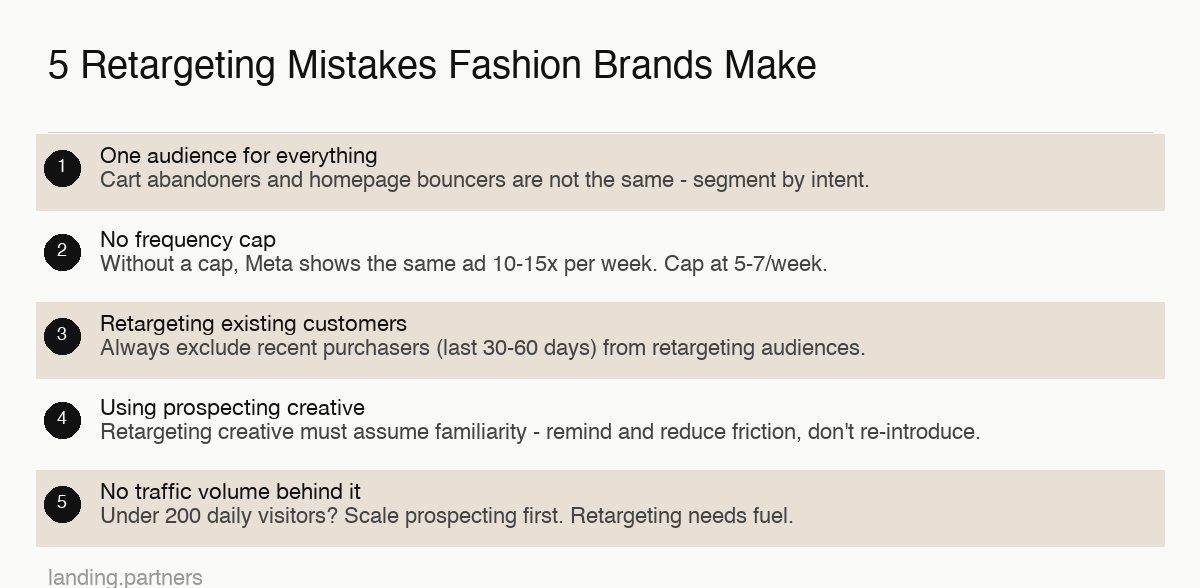
1. One audience for everything
Lumping all site visitors into one 30-day retargeting pool loses all intent differentiation. Cart abandoners and someone who bounced from the homepage are not the same audience. Segment them and treat them differently.
2. No frequency cap
Without a frequency cap, Meta will show your ad to the same person 10-15 times per week on a small audience. Past 5-7 impressions per week, you start getting negative engagement - people hide the ad or mute your account. Cap frequency at 5-7 per week and rotate creative to stay fresh.
3. Retargeting existing customers
This wastes budget on people who already converted and can damage brand perception. Always exclude recent purchasers (last 30-60 days) from your retargeting audiences. You can target existing customers, but that is a separate retention and upsell strategy - not conversion retargeting.
4. Using prospecting creative for retargeting
The person has already seen your brand. Running your awareness ad again wastes the retargeting touchpoint. Use creative that assumes familiarity and moves toward conversion - not re-introduction.
5. Retargeting with no traffic volume behind it
Retargeting requires a steady flow of new, qualified traffic to retarget. If you are getting fewer than 200 unique site visitors per day, your retargeting audiences will be tiny and the impact minimal. In that case, scale prospecting first - retargeting second.
Frequently Asked Questions
Retargeting is not a set-and-forget tactic. Fashion purchase cycles shift with seasons, your creative fatigues, and audience pools fluctuate with traffic volume. Audit your retargeting setup every 4-6 weeks: check frequency, refresh creative, verify audience exclusions are working correctly.
Every brand's situation is different. The right retargeting strategy depends on your traffic volume, your average order value, your product type, and your current attribution setup. If you want to know what the right approach looks like for your specific brand - book a free call with our team.