Klaviyo for Beauty Brands: Replenishment Flows, Skin Type Segmentation and the Education Sequences That Drive Repeat Revenue
Most Klaviyo guides are written for fashion brands. They cover abandoned cart flows, post-purchase sequences, and seasonal sale calendars. If you run a beauty brand, those guides are missing about half of what actually matters.
Beauty has a completely different relationship with repeat purchase. A customer who buys a moisturiser will run out of it in roughly 30 days. A customer who finds a serum that works for her skin type will buy it for years. That lifecycle - predictable replenishment, education-driven loyalty, concern-specific segmentation - is what makes Klaviyo for beauty fundamentally different.
We have built Klaviyo setups for beauty brands across skincare, haircare, and wellness. Here is what the flows actually look like when they are built for beauty, not adapted from fashion.
Key Takeaways
- •Beauty Klaviyo prioritises replenishment timing, not just abandoned cart and welcome flows
- •Skin type segmentation from the first touchpoint makes every subsequent flow more relevant
- •Education sequences that explain ingredients and expected results reduce returns and increase repeat purchase
- •The routine builder flow (cross-sell via 'complete your routine') is the highest-revenue flow in most beauty setups
- •Flows become meaningful at 1,000+ active subscribers - before that, focus entirely on list building
Why Beauty Klaviyo Is Fundamentally Different from Fashion Klaviyo
In fashion, the core retention challenge is getting someone to come back for the next collection or the next season. The purchase trigger is desire - a new drop, a seasonal need, an aesthetic shift. Timing is unpredictable.
In beauty, the core retention challenge is owning the replenishment cycle. Most skincare and haircare products last between 30 and 90 days. If you send the right email at day 25 of a 30-day supply, you can capture the reorder before the customer starts searching elsewhere.
That is the first structural difference: beauty retention is partially time-predictable, and your Klaviyo setup should treat it that way.
The second difference is the role of education. Beauty customers buy based on claims, ingredients, and results. A fashion customer can see a product and decide instantly. A beauty customer buying a retinol serum for the first time has questions: How often should I use it? When will I see results? Can I layer it with my other products? If you do not answer those questions in your email sequence, you will get returns, complaints, and churn.
The third difference is segmentation. In fashion, you segment by category (dresses, sneakers, kidswear). In beauty, you segment by skin type, skin concern, and product lifecycle. A customer with oily skin needs completely different product recommendations than a customer with dry skin. A customer on day 30 of a moisturiser needs a different email than a customer on day 1.
We see beauty brands with structured replenishment flows outperform those without by 35-50% on 90-day repeat purchase rate, based on our client data.
Flow 1: Welcome + Skin Type Segmentation
The welcome flow is where you make or break your ability to personalise everything that follows. Most beauty brands use it to say thank you and share a discount code. That is leaving enormous value on the table.
What the welcome flow should actually do:
First: welcome the subscriber and set expectations for what emails they will receive. Second: ask one qualifying question - what is your skin type? Third: route their answer into a segment that drives every subsequent flow.
The skin type quiz does not need to be elaborate. A simple one-question email with four clickable options (dry, oily, combination, sensitive) tells you everything you need to know to personalise flows for the next 12 months.
Technically, you track this in Klaviyo with a custom profile property. Every time a subscriber clicks 'dry skin,' Klaviyo updates their profile. Every subsequent flow - replenishment, education, routine builder - then filters by that property.
Welcome flow timing for beauty:
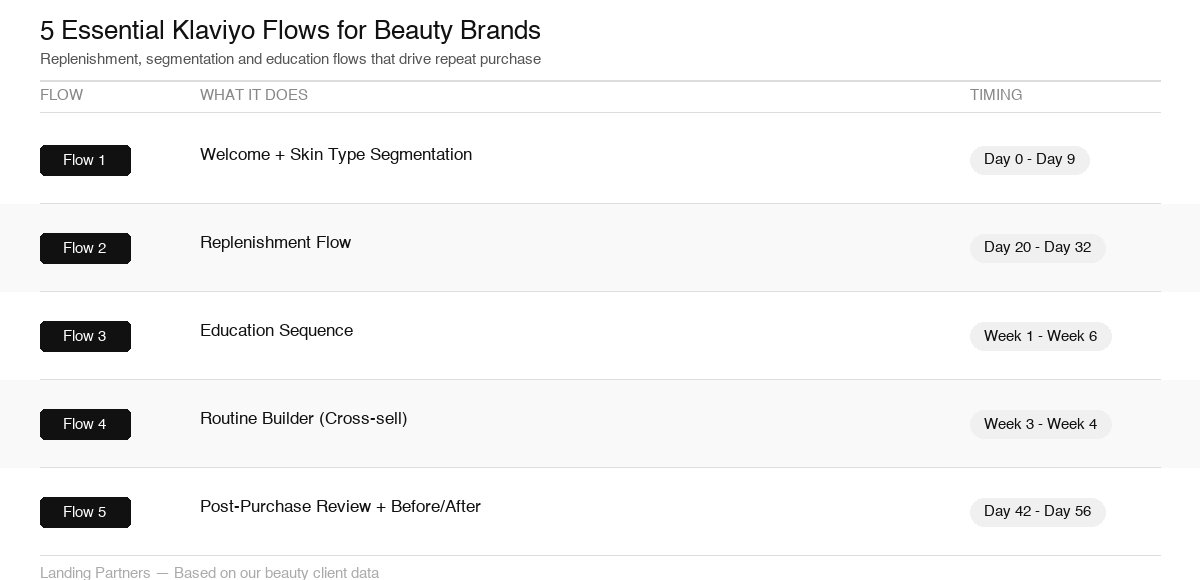
Email 1 (day 0): Welcome + skin type question. Do not bury the question - make it the focus of the email. Email 2 (day 2): Based on their answer, send personalised product recommendations filtered by skin type. Email 3 (day 5): Your brand story - why you started, what makes your formulations different, what results customers see. Email 4 (day 9): Social proof specific to their concern - reviews from customers with the same skin type.
This is where custom profile properties pay off immediately. A dry-skin subscriber sees reviews from dry-skin customers. An oily-skin subscriber sees reviews from oily-skin customers. The content is the same structure but the message is completely different.
Flow 2: The Replenishment Flow
This is the most underused flow in beauty email marketing. Most beauty brands do not have one at all. The ones that do often send it too late - by day 30, the customer has already reordered somewhere else.
The replenishment flow is triggered by a purchase of a consumable product. You know, roughly, how long that product lasts. A 30ml serum used twice daily lasts about 30 days. A 200ml shampoo used three times a week lasts about 6-8 weeks. You build your trigger timing around that lifecycle.
How we structure replenishment flows for beauty clients:
Day 0: Purchase confirmed. This triggers the flow. Day 20 (for a 30-day product): 'Your [product] is getting low - how is it working for you?' Combine a soft reorder prompt with an invitation to share feedback. This serves two purposes: it nudges the reorder and it generates the social proof you need. Day 25: Direct reorder prompt. Clear product image, one-click reorder, simple message. No noise. Day 32 (if no reorder): One final email. Frame it as a reminder, not a sale. 'We noticed you have not reordered yet - here is what other customers with your skin type are reaching for.'
Product lifecycle mapping is the technical foundation here. Before you can build the flow, you need to document every SKU with its estimated days of supply. Once that is in place, Klaviyo handles the rest automatically.
If you sell a range of products with different lifespans, use conditional splits inside the flow to route customers to the correct timing branch. A customer who bought a face oil (60-day supply) goes down a different branch than a customer who bought a toner (45-day supply).
In beauty accounts we manage, replenishment flows generate an average of 18-25% of total Klaviyo-attributed revenue - often with fewer emails than the welcome or abandoned cart flow.
Not sure if your current Klaviyo setup is capturing replenishment revenue? Book a free Klaviyo audit - we will go through your flow structure and identify what is missing.
Flow 3: The Education Sequence
Beauty customers who understand a product are less likely to return it and more likely to repurchase it. That is the simple logic behind the education sequence.
This flow fires after a first purchase and runs over 4-6 weeks. Its job is to answer every question the customer has before they ask it.
Week 1 email: 'How to get the best results from [product]'
Application method, frequency, and what to avoid combining it with - especially important for actives like retinol, AHA/BHA, and vitamin C. Be specific. The more granular the information, the more trust you build. Vague instructions lead to misuse, which leads to returns.
Week 2 email: 'What to expect in the first two weeks'
This is critical for products with a results curve - especially retinol, which can cause purging before it improves skin. If a customer hits the purging phase at day 12 and has not been prepared for it, she returns the product. If she has been told to expect it, she stays the course. **Managing expectations is retention strategy.**
Week 3-4 email: Ingredient deep-dive
One key ingredient per email. What it does, why it is in the formulation, what the evidence says. For customers who are ingredient-conscious - and in beauty, that is an increasing proportion - this is the content they actually want to receive. It positions your brand as expert, not just seller.
Week 5-6 email: 'How are you getting on?'
Invite a before/after photo or written testimonial. Offer an incentive if your margins allow. This generates UGC and also gives you a signal on which customers are getting results - which is exactly the segment you want to target for upsell and routine builder flows.
Flow 4: The Routine Builder
The routine builder is a cross-sell flow triggered when a customer has been using a product for 3-4 weeks and is likely satisfied. Its purpose is to expand their routine with complementary products.
We frame it as 'complete your routine' rather than 'you might also like.' The difference is in how the customer perceives the recommendation. One feels like a personalised tip from a skincare expert. The other feels like an algorithm.
How to build the recommendation logic:
This is where skin type segmentation pays off again. If a customer with dry skin bought your moisturiser, the routine builder recommends your hydrating toner and facial oil - not your oil-control products. The recommendation is filtered by their skin type property in Klaviyo.
A simple three-step visual in the email - Step 1: Cleanse, Step 2: Tone, Step 3: Moisturise - with their existing product highlighted in one step and complementary products filling the others is consistently effective. Customers see exactly where the new product fits into their existing routine.
**The routine builder is the highest average AOV flow in most beauty setups we manage.** Customers responding to routine builder emails typically buy two or three products in a single transaction, compared to single-product replenishment reorders.
Flow 5: Post-Purchase Review + Before/After Request
Reviews are the single most important conversion driver in beauty. A product with 200 authentic reviews and visible before/after photos will consistently outperform a product with a better formulation and no social proof.
This flow is triggered 6-8 weeks after purchase. The timing is deliberate - by week 6, customers using a product consistently should be starting to see results. Asking for a review at week 1 or 2 gets vague responses. Asking at week 6 gets the 'I cannot believe the difference' reviews that convert browsers.
Structure of the review request flow:
Email 1 (day 42): 'How has [product] been working for you?' Soft check-in. Ask if they have questions. Include a low-friction review link. Do not lead with the ask - lead with the care. Email 2 (day 49, only if no review submitted): 'Your experience matters to our community.' Include social proof from another customer with the same skin type. Make the review feel like a contribution, not a task. Email 3 (day 56, only if no review submitted): Optional incentive email. A small discount on their next order in exchange for a review. Only use this if your margins allow - do not train customers to expect rewards for basic feedback.
In our beauty client accounts, review request flows sent at 6-8 weeks post-purchase generate 3x higher review submission rates than flows sent at 1-2 weeks post-purchase.
Beauty Segmentation: How to Structure Your List
Good beauty Klaviyo setups run on several custom profile properties that feed every flow. The four we build for every beauty client:
1. Skin type (or hair type, depending on range)
Dry, oily, combination, sensitive, normal. Captured in the welcome flow via a one-click quiz. Used in product recommendations, routine builder content, and education sequence personalisation.
2. Primary concern
Anti-ageing, acne, hydration, brightening, sensitivity, redness. Captured with a second qualifier - either in the welcome flow or in a post-purchase micro-survey. More granular than skin type alone, and drives the most personalised product recommendations.
3. Purchase frequency
Calculated automatically from Klaviyo order data. Customers who have reordered two or more times are your VIPs. They should receive early access communications, loyalty rewards emails, and the highest-touch retention flows.
4. Product lifecycle stage
Which product they currently have active, and estimated days remaining in supply. This property powers the replenishment flow routing and timing.
Together, these four properties give you the ability to send highly personalised flows without manual effort. Once the segments are built and the flows are structured, Klaviyo handles the routing automatically.
Building this segmentation architecture from scratch takes setup time but the payoff is significant. If you want help structuring this for your beauty brand, book a free strategy call here.
Benchmarks: What to Expect from Each Flow
These are the averages we see across beauty client accounts. They vary by product type, price point, and list quality - use them as directional benchmarks, not universal standards. For broader Klaviyo email benchmarks across fashion and lifestyle — including welcome flows, post-purchase and cart abandonment — see our full benchmarks guide. Every brand's numbers depend on their specific situation.
Welcome flow: 45-55% open rate on email 1, declining to 20-30% by email 4. Above-average engagement is expected here - these are your most recently opted-in subscribers.
Replenishment flow: 35-45% open rate, 8-14% click rate. If your replenishment flow is below 6% CTR, your timing is probably off or the product recommendation is not specific enough.
Education sequence: 28-38% open rate, declining across the sequence. This is normal - expect engagement to drop off by email 4. The first two emails do most of the retention work.
Routine builder: 30-40% open rate, 10-18% click rate. This is typically the highest revenue-per-email flow in a well-built beauty Klaviyo account. Average order value on routine builder purchases tends to be 40-60% higher than single-product replenishment reorders.
Review request flow: 25-35% open rate. Focus on submission rate more than open rate here - the goal is reviews, not clicks.
One important note on attribution: Klaviyo's 5-day click window credits purchases that would have happened anyway, especially in replenishment scenarios where a customer was already planning to reorder. We evaluate flows by flow-specific metrics - open rate, click rate, revenue per recipient - rather than attributed revenue totals, which can overstate impact.
Frequently Asked Questions
Every beauty brand's email setup depends on their product range, customer lifecycle, and where they are in their growth journey. If you want to know what an optimised Klaviyo setup looks like for your specific brand, book a free strategy call here.