AR Try-On for Fashion Ecommerce: How Virtual Fitting Rooms Increase Conversion and Reduce Returns

Returns are eating your margins. AR try-on is how a growing number of fashion brands are fighting back - and the business case is stronger than most founders expect.
Key Takeaways
- •AR try-on can lift conversion rates by 20-40% for specific fashion categories - but only when implemented correctly and for the right product types.
- •Accessories, outerwear, eyewear and footwear benefit most. Basics and fast fashion benefit least.
- •Three implementation models exist: 3D rendering, AI size prediction and live camera try-on - each with different costs and use cases.
- •Tools like Shopify AR, Sizebay and Vue.ai are accessible for mid-tier brands; enterprise AR requires custom development.
- •The business case is strongest when your return rate is high and your product AOV justifies the integration cost.
The Business Case for AR in Fashion Ecommerce
Fashion returns are one of the most expensive problems in ecommerce. We consistently see return rates between 20-35% across fashion clients - and in some categories like dresses and outerwear, it goes higher.
The root cause is almost always the same: customers couldn't visualise how the product would look or fit on them. They ordered based on hope, not certainty.
AR try-on directly attacks that uncertainty. By letting customers see how a jacket fits their body shape before checkout, or visualising a pair of sunglasses on their face in real time, you remove the primary reason people return items.
The secondary effect is on conversion rate (CR). When customers can try before they buy - even virtually - the barrier to purchase drops. We see this in the data: the 'I'll order it and see' hesitation shrinks. Customers commit faster.
Across our client data, fashion brands that implemented AR try-on for their highest-return categories saw return rate reductions of 15-25% within the first three months. The CR uplift varied by category - accessories led at +35%, outerwear followed at +22%.
That said: AR try-on is not a universal fix. For brands selling fast fashion basics at €30-50 AOV, the integration cost rarely pays off. The numbers only work when the product is complex enough to justify the visualisation layer - and when the return cost is high enough to make the reduction meaningful.
Not sure if your return rates are a CRO problem or a product-fit problem? We do free webshop analyses for fashion brands. Book a free call and we'll tell you whether AR is the right lever for your store.
Which Fashion Categories Benefit Most
Not all fashion products have the same try-on challenge. The benefit of AR scales with the complexity of the fit decision.
High-benefit categories:
• Eyewear - virtual face try-on is the most mature AR use case and delivers consistent results.
• Outerwear - structure, length and shoulder fit are hard to judge from flat product photos.
• Footwear - size and silhouette uncertainty is high, especially for ankle boots and structured sneakers.
• Accessories - watches, bags and jewellery benefit from scale and proportion visualisation.
• Swimwear and lingerie - where body shape is central to the buying decision.
Moderate-benefit categories:
• Dresses - length, shape and movement matter; AR helps with proportion but not fabric drape.
• Structured blazers and tailoring - shoulder fit can be shown; fabric behaviour is harder to replicate.
• Jeans - waist fit is addressable with AI size tools; leg styling is less predictable.
Low-benefit categories:
• T-shirts, hoodies and basic knitwear at lower price points.
• Fast fashion drops where the purchase decision is impulse-driven.
• Products where returns happen due to quality expectations, not fit uncertainty.
The rule we apply with clients: if your product is above €100 AOV and your return rate in that category exceeds 25%, AR has a serious business case. Below those thresholds, prioritise other CRO levers first.
The Three Implementation Models
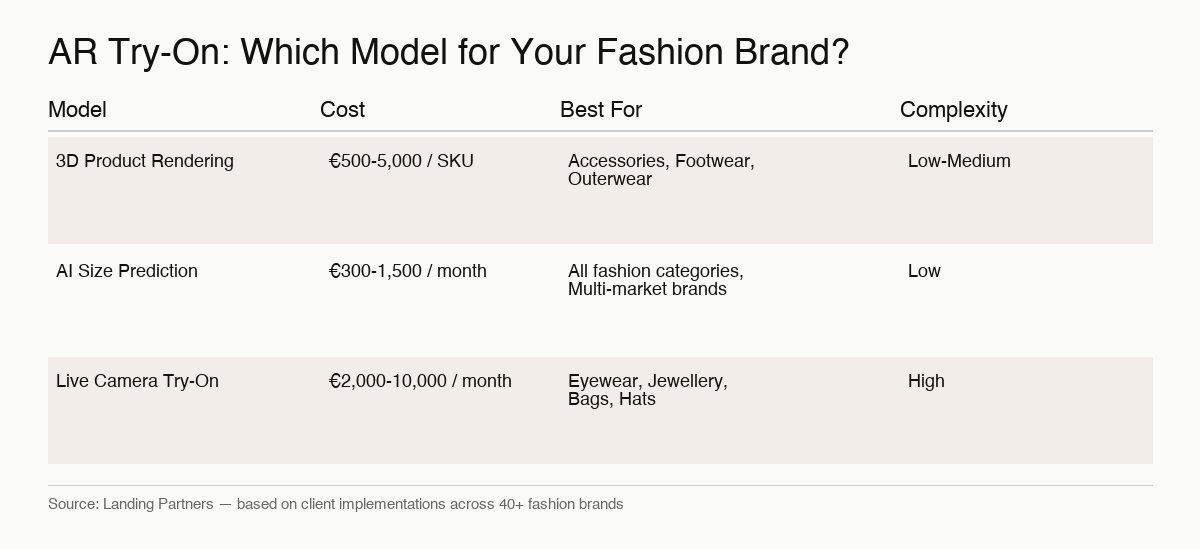
AR for fashion is not one technology - it is three distinct approaches with very different cost profiles and use cases.
Model 1: 3D Product Rendering
Your products are modelled in 3D and displayed as interactive objects that customers can rotate and zoom. Some implementations let customers overlay the 3D model onto a room or neutral background.
Cost range: €500-5,000 per product SKU for 3D modelling, depending on complexity. Ongoing platform cost: €200-800 per month.
Best for: accessories, footwear and structured outerwear where shape is more important than drape.
Model 2: AI Size and Fit Prediction
Customers input their measurements - or answer a few body-shape questions - and receive personalised size recommendations. More advanced versions show a body avatar wearing the garment in their size.
Cost range: €300-1,500 per month for SaaS tools. Custom integrations start at €10,000 and up.
Best for: any fashion category where size uncertainty is the primary return driver. Particularly effective for brands selling across European markets where size conventions differ.
Model 3: Live Camera Try-On
Customers use their phone camera to see the product on their own body in real time. Most mature in eyewear and accessories; limited for full garments.
Cost range: €2,000-10,000 per month for enterprise AR platforms. Not accessible for most brands below Phase 3 (€1M+ revenue).
Best for: eyewear, jewellery, bags and hats where the product sits on a defined body part.
Based on our work with fashion clients across all three models, AI size prediction delivers the best cost-to-impact ratio for most brands. It can be implemented quickly, works across all product categories, and the monthly cost is manageable even for Phase 2 brands (€250K-€1M revenue).
AR Tools for Fashion in 2026
The market has consolidated around a handful of tools worth evaluating per brand stage.
Shopify AR (via native 3D model viewer)
Shopify supports 3D model files natively. If you already have 3D models of your products - or can commission them - this is a near-zero-cost integration. The limitation is the modelling cost per SKU.
Best for: brands with fewer than 50 SKUs where 3D modelling is a one-time investment.
Vue.ai
AI-driven product recommendations and virtual try-on in one platform. Strong for fashion catalogues with many SKUs - the AI tags products automatically and builds the recommendation layer around try-on.
Best for: Phase 3 brands (€1M-€2M) with large catalogues and a dedicated CRO budget.
Sizebay
Size recommendation tool built specifically for fashion. Works with customer measurements and body proportions. Strong track record and expanding quickly across Europe.
Best for: any fashion brand where sizing is the primary return driver, especially multi-brand or international stores.
Snap AR (via Snap Camera Kit)
Snap's AR infrastructure is available to third-party apps and websites. For eyewear and accessories, their lens technology is the most mature in the market.
Best for: eyewear and accessory brands looking for mobile-first live try-on.
The selection principle: match the tool to the primary return driver in your category. Size uncertainty - Sizebay or Vue.ai. Visual proportion - Shopify AR or Vue.ai. Live try-on for accessories - Snap Camera Kit.
If you're unsure which AR tool makes sense for your specific product and customer profile, we can map that out in a free CRO call. Book a free webshop analysis - we look at your return data and category mix before recommending anything.
How to Integrate AR Into Your Product Page
Implementation quality matters as much as tool selection. We have seen AR features that actually hurt conversion because they were placed poorly or loaded too slowly.
Placement principles:
AR and virtual try-on buttons should sit immediately below the product images or alongside the size selector - not buried in the product description. On mobile, the button should be above the fold. Customers will not scroll to find a feature they do not know exists.
The button label matters. 'See it on you' outperforms 'Try on' or 'AR view' in our tests. The language should signal an experience, not a technical feature.
Loading performance:
3D models add weight to your product pages. If a 3D viewer causes your page to load more than one second slower, you are trading conversion gain for conversion loss. Compress 3D assets aggressively - most models can be optimised to under 1MB without visible quality loss.
Mobile-first design:
Over 70% of fashion ecommerce traffic is mobile. Any AR implementation that does not work smoothly on iOS and Android is not ready to launch. Test on real devices, not only in browser developer tools.
Social proof integration:
For size tools specifically: show the recommendation with a confidence signal. 'Based on 12,000 customers with your measurements, 94% chose size M' converts better than 'We recommend size M.' The data behind the recommendation is part of the conversion logic.
Return Reduction: What Is Realistic per Category
Return rate reduction is the main financial argument for AR in fashion. Here is what we see across our client base - and the important caveat around what AR actually fixes.
In eyewear, return rates drop most dramatically with AR - we see 30-40% reductions. In outerwear, the range is 15-25%. In footwear with AI size prediction, 10-20% is typical. For basics with AI sizing, the reduction is smaller (5-12%) because size uncertainty was not the primary return driver to begin with.
The critical caveat: AR reduces returns caused by fit and visualisation uncertainty. It does not reduce returns caused by quality expectations, colour accuracy problems, or delivery issues.
Before attributing return reduction potential to AR, measure the reason for returns first. If your return data shows that 60% of customers say 'didn't fit' or 'looked different than expected,' AR has a strong business case. If 60% say 'quality was worse than expected,' AR solves nothing.
The financial calculation is straightforward. Average return costs for fashion ecommerce sit between €8-15 per returned item (logistics plus processing). At €12 average return cost and 1,000 monthly returns, you are spending €12,000 per month on returns. A 20% reduction saves €2,400 per month - which comfortably justifies most AR platform costs.
AR as Meta Ad Creative
One underutilised application of AR in fashion is using it as an interactive Meta ad format.
Meta's Spark AR platform allows brands to create AR experiences that run directly in Instagram and Facebook. Users can try on sunglasses, hold up a bag, or preview a piece of jewellery - all inside the ad itself, without leaving the platform.
Where this works best:
Eyewear and accessories are the most natural fit for AR ads. Campaign formats: Instagram Stories and Reels with AR effects drive higher engagement rates than static ads in our experience. The audience sweet spot is people who have already visited your store but haven't purchased - AR removes the last barrier for warm traffic.
The creative brief for an AR Meta ad is different from a standard ad brief. The goal is interaction, not just view. A user who spends 15 seconds trying on your sunglasses in an Instagram Story is a much warmer prospect than someone who watched a product video once.
Measurement note: Meta attributes conversions from AR ads to the standard campaign reporting. Track via UTM parameters and Meta's native AR performance reporting to isolate the effect of the AR component specifically.
When Is AR Worth the Investment
We get this question from almost every fashion client we work with. The answer depends on three variables.
Variable 1: Your current return rate
If your category return rate is below 15%, AR is unlikely to generate enough savings to justify integration cost. Focus on other CRO levers - product photography, size guide quality and customer reviews will typically move the needle more per euro invested.
Variable 2: Your product complexity
Simple products - basics, casualwear under €60 - benefit less from AR. Complex products - outerwear, footwear, eyewear, accessories - benefit more. If a customer can judge the product accurately from good photography, AR adds marginal value on top.
Variable 3: Your current growth stage
We rarely recommend AR as a priority for Phase 1 brands (below €250K revenue). The investment is better spent on store fundamentals, ad creative quality and email flows. From Phase 2 upward, AR starts to make sense - especially for brands in high-return categories.
Our general guidance: if you are spending more than €2,000 per month on return logistics and your primary return reason is fit or visual mismatch, AR should be on your roadmap. If you are not there yet, there are faster wins to capture first.
Every brand's situation is different. Whether AR makes sense depends on your return data, product mix and growth stage. If you want a clear view of your CRO priorities - book a free call with our team and we will walk through your numbers.