Weight Management and Metabolic Health Supplements: How to Market GLP-1 Adjacent Products Without Making Prohibited Claims

The GLP-1 revolution did not just change how doctors treat obesity. It created a new supplement category worth billions - and most brands entering it are getting the advertising wrong.
Berberine, inositol, chromium, glucomannan, and high-dose protein supplements have all seen explosive demand growth since GLP-1 medications went mainstream. The consumers searching for them are motivated, informed, and ready to spend. The problem: Meta, TikTok, and Google flag almost every obvious claim in this space.
We work with supplement brands navigating this exact tension. What follows is what we have learned about reaching the metabolic wellness audience without triggering policy violations - and how to build a funnel that converts them into subscribers.
Key Takeaways
- GLP-1 medications created a large adjacent supplement market: berberine, inositol, chromium, glucomannan, and protein for muscle retention
- Meta forbids weight loss claims but allows metabolic health, blood sugar balance, and healthy body composition framing
- 'GLP-1 support' as a direct claim is high risk - reframe around the outcome (metabolic wellness) rather than the mechanism
- TikTok's organic #berberine and #ozempicjourney communities are acquisition channels worth building into your paid media strategy
- Klaviyo flows for this category need goal-based segmentation (weight management vs. metabolic health vs. muscle retention) with longer education sequences than most supplements require
The GLP-1 Revolution and What It Means for Supplement Brands
GLP-1 receptor agonists (semaglutide, tirzepatide) shifted public conversation around weight management more in two years than anything in the previous two decades. For the first time, mainstream media covered metabolic health in detail - AOV, dosing, side effects, muscle loss risk.
That conversation created educated, motivated buyers looking for adjacent products. **Brands that position themselves correctly in this moment are building category authority that will compound for years.**
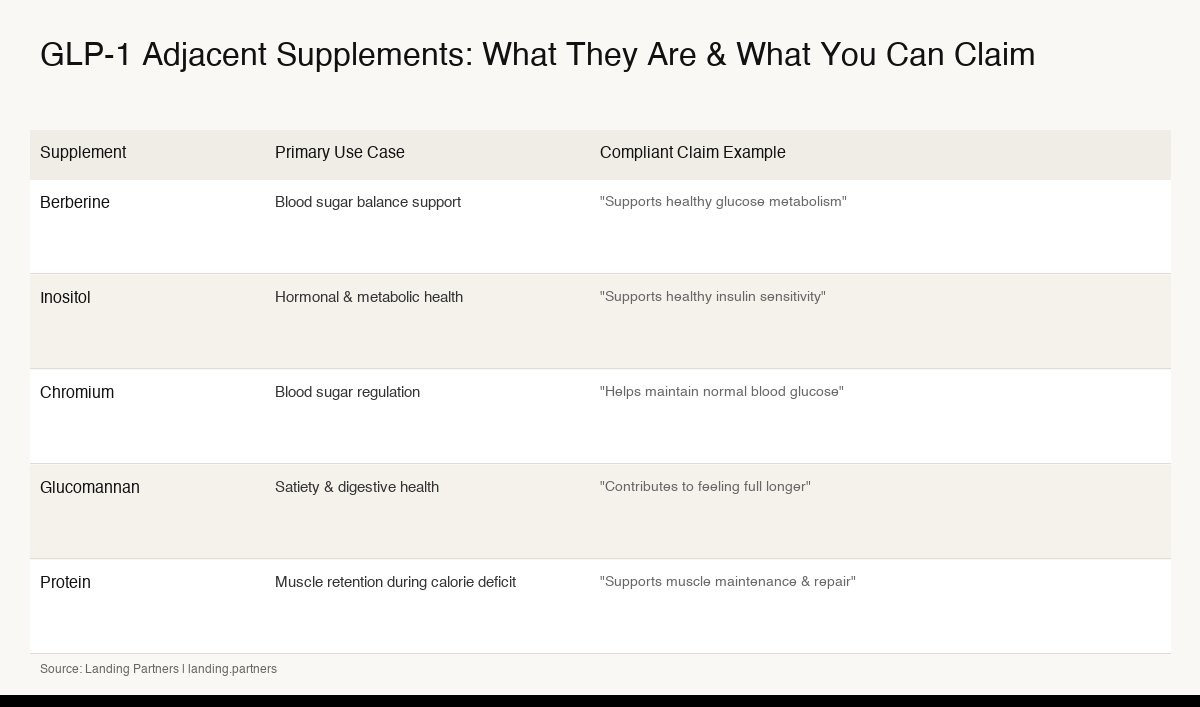
The supplement categories benefiting most from GLP-1 spillover:
Berberine
The most searched supplement of the past 18 months. Consumers discovered it via TikTok comparisons to Ozempic. The mechanism (AMPK activation, glucose metabolism support) is well-documented. Claims about blood sugar support are EFSA-backed if properly worded.
Inositol (especially myo-inositol)
Strong demand from the PCOS community and perimenopause market. Positions naturally around hormonal metabolic balance. High repeat purchase rate once the customer sees results.
Chromium
Established EU-authorised health claim: contributes to normal macronutrient metabolism and maintenance of normal blood glucose levels. One of the few ingredients where the claim writes itself.
Glucomannan and dietary fiber
EFSA-approved claim: contributes to an increase in faecal bulk and reduction of the glycaemic response to a meal. Satiety positioning is strong for this audience.
Protein for muscle retention
GLP-1 users face significant muscle loss alongside fat loss. Protein supplements repositioned around 'supporting muscle during body recomposition' are finding a new audience that previously did not buy sports nutrition.
Berberine Google search volume grew over 300% between 2023 and 2026 - driven almost entirely by organic TikTok content comparing it to GLP-1 medications. The audience exists. The question is how to reach it without triggering policy issues.
Working in the metabolic wellness supplement space? The right advertising structure depends heavily on your product, your margin, and your current list size. Book a free call and we will assess your setup.
Meta Ads for Weight Management Supplements: What Is Forbidden, What Works
Meta's health and wellness advertising policy is where most supplement brands in this space get into trouble. The forbidden zone is wider than most brands expect.
What Meta prohibits
- Any reference to weight loss as an outcome: 'lose weight', 'burn fat', 'shed pounds'
- Before/after imagery showing body transformation attributed to the product
- Claims implying the supplement is an alternative to medication ('natural Ozempic', 'GLP-1 support without a prescription')
- Targeting audiences based on health conditions (obesity, diabetes) - this is a restricted special ad category
What Meta allows
- Metabolic wellness framing: 'support healthy metabolism', 'maintain healthy blood sugar already in normal range'
- Healthy body composition language: 'support your fitness goals', 'maintain lean muscle during your wellness journey'
- Ingredient education that does not make outcome claims: explaining how berberine activates AMPK pathways without saying 'this will help you lose weight'
- Lifestyle content showing active, healthy people - without attribute-to-product transformation claims
**The key mental model: advertise the state, not the transformation.** 'Support healthy glucose metabolism' is the state. 'Lose 10 pounds' is the transformation. Meta allows the former consistently.
In our experience managing supplement Meta campaigns, ads using metabolic wellness framing pass review at roughly 4x the rate of ads using any weight-related language - even indirect references like 'feel lighter' or 'manage your appetite'.
Creative formats that consistently convert
Ingredient education videos (30-60 seconds): explain what the ingredient does, how it works, who it is for. These perform best with cold audiences who are already researching. **Keep the language scientific but accessible - this audience has done their homework.**
Lifestyle UGC: customers sharing their morning wellness routine, the supplements they take, how they feel. No transformation claims, no weight references. Just routine integration content.
Founder or formulator content: explaining why you chose these specific ingredients, what the research shows, what you were trying to solve. This builds trust faster than any ad format for a sceptical audience.
The 'GLP-1 Support' Claim: Opportunity and Risk
This framing is tempting because it speaks directly to what buyers are searching for. It is also one of the fastest ways to get your account flagged.
'GLP-1 alternative' is explicitly prohibited - it implies the supplement replaces a pharmaceutical. 'GLP-1 support' sits in a grey zone that Meta's automated systems increasingly flag, even when you mean it in a nutritional rather than pharmaceutical context.
What we recommend instead
Position around the shared goal, not the mechanism comparison. Your customer wants to support their metabolic health, maintain muscle, manage blood sugar. They are using GLP-1 medications or looking for nutritional support alongside their health journey. Address that goal directly.
Landing page copy can go further than ad copy. Once the user has clicked through from a compliant ad, you have more room to explain the context - including relevant research on the ingredients. This is where the claim strategy opens up.
TikTok's organic platform is also more permissive than TikTok Ads. A creator talking about their berberine experience in an organic video has different rules than a branded paid ad. **Spark Ads - promoting existing organic creator content as paid media - operate in a useful middle ground.**
Not sure whether your ad copy crosses the line? We review supplement brand Meta setups regularly. Book a free call for a quick assessment.
TikTok for Metabolic Wellness: The Community That Does Your Marketing for You
The #berberine and #ozempicjourney communities on TikTok represent something unusual: an organic, highly engaged audience that generates enormous amounts of educational and testimonial content without any brand involvement.
#berberine alone has billions of views. #metabolichealth, #bloodsugarbalance, and #insulinresistance are growing fast. The content is largely creator-driven - people sharing their experiences, explaining ingredients, discussing results.
How to activate this organically
Find creators already making content in these communities. Not macro influencers - the accounts with 10k-80k followers who post genuinely personal content about their metabolic health journey are the ones with the highest trust scores in this niche.
Outreach, gift the product, let them create their own content. **Do not brief them to use specific claims - their authentic language will be more powerful and more policy-compliant than anything you write for them.**
Spark Ads from organic creator content
Once a creator posts organic content about your product, you can request permission to promote it as a Spark Ad. This means you are running their authentic content as a paid ad - it maintains the native feel, the creator's handle, and the comment thread.
Spark Ads from metabolic wellness creators consistently outperform branded ads in our supplement client accounts. The social proof element is doing heavy lifting for an audience that is deeply sceptical of brand claims.
Across supplement accounts we manage, Spark Ads from organic creators generate 35-55% lower CPM than branded creative on TikTok - with significantly higher engagement rates from the metabolic wellness audience.
Klaviyo for Weight Management Supplements: Building Flows That Convert Over Time
The metabolic wellness buyer has a longer consideration cycle than most supplement categories. They have researched. They are comparing. They want to understand the science before they commit.
Your Klaviyo setup needs to match this psychology.
Segmentation: goal-based from the start
The metabolic wellness audience is not monolithic. Three primary segments we build for:
1. Weight management support - the buyer explicitly seeking to manage their body composition alongside diet and exercise changes
2. Blood sugar and metabolic health - often a more science-oriented buyer, motivated by biomarker results or family history
3. Muscle retention during calorie deficit - the buyer using GLP-1 medications or following a significant calorie reduction, concerned about maintaining lean mass
These three audiences need different welcome sequences, different content, and different product recommendations. **Building one generic flow for all three is leaving significant conversion on the table.**
The welcome sequence
For this category, we typically build a 5-email welcome sequence over 14 days, not 3 emails over 7. The first email covers what to expect. The second explains the ingredient science. The third addresses common concerns (is this safe with my current medication - always recommend consulting a healthcare provider). The fourth shares community experiences. The fifth makes the first purchase ask with an offer.
The education flow
After purchase, buyers in this category need reinforcement that what they are experiencing is normal. Results are often slow (4-8 weeks for meaningful berberine effects). **A day-14 'what you might notice at this stage' email reduces early cancellation rates significantly.**
Build flows around the result timeline: week 2 check-in, month 1 milestone, month 3 progress acknowledgement. This audience commits to long cycles when they understand the expectation.
Building Trust in a Sceptical Market
The metabolic wellness supplement buyer has been burned before. The category has decades of dubious marketing behind it. Your job is to be the credible option in a sea of noise.
Third-party testing and transparency
Certificate of Analysis (CoA) from an independent lab is table stakes. Display it on the product page. Link to it. Make it easy to find. This audience will look for it.
Dosage transparency matters more here than in almost any other supplement category. If you are using berberine, what dose per serving? Is it the clinically studied dose? **Buyers in this niche read labels and compare. Hiding or minimising the dosage is a trust-destroyer.**
Clinical evidence on the product page
You cannot make health claims, but you can cite published research on the ingredients. 'Based on research published in [journal]' paired with a link to the study is compliant and builds authority. This audience reads the studies. Some of them have read more research on berberine than most brand owners.
Healthcare provider alignment
Always include language recommending consultation with a healthcare provider, especially for buyers on GLP-1 medications. This is not just legal protection - it builds trust with an audience that is already in the healthcare system and has learned to value that alignment.
Every brand's situation is different. The right supplement advertising structure depends on your product, your margin, and your current scale. If you want to know what the right approach looks like for your specific brand - book a free call.
Benchmarks: What to Expect from Metabolic Wellness Supplement Campaigns
We are deliberately careful about stating universal benchmarks in this category. A berberine brand with a strong organic TikTok presence, an existing email list, and a subscription model will have very different economics than a brand launching cold into paid media with no owned audience.
That said, directional data from what we see across accounts:
ROAS benchmarks
In the metabolic wellness supplement category, blended MER (total revenue divided by total ad spend) matters far more than platform-reported ROAS. Platform ROAS in this category is particularly unreliable - the buying journey involves significant organic touchpoints (TikTok discovery, Reddit research, Google searches) that never get attributed to the ads that eventually closed the sale.
Brands with a functioning subscription model typically see MER of 2.0-3.5x on blended paid spend. Single-purchase brands see higher initial ROAS but weaker long-term economics.
CAC and payback period
The metabolic wellness buyer often costs more to acquire than standard wellness supplement buyers - the consideration cycle is longer, retargeting touch points accumulate. But the LTV profile is stronger: buyers motivated by genuine health goals who see results become high-commitment subscribers.
Brands with subscription models and strong education flows often see CAC payback within 2-3 months. Without a subscription, the economics require a strong repeat purchase rate from the second and third order.
Repeat purchase rate
For supplement brands where results take 4-8 weeks to materialise, the critical window is months 2-3. Brands that invest in education flows during this window see significantly higher second-order rates. Brands that do not lose a large portion of first-time buyers who discontinue before seeing results.