Every fashion founder asks the same question at some point: how much should I actually spend on advertising?. For more on this, see conversion rate benchmarks for fashion ecommerce. If you are planning Google alongside Meta, our Google Ads guide for online clothing stores covers how to split budget between channels.
It's a fair question. And the honest answer is: it depends on your stage, your margin, and what you're trying to achieve. But "it depends" isn't useful on its own.
Based on our work with 40+ fashion brands, we've developed budget frameworks that reflect what actually works at each stage. Not theoretical percentages - real allocations from real brands at different points in their growth.
The Question Behind the Question
When a founder asks "how much should I spend on ads?", they're usually asking something more specific: am I underspending and missing growth? Or am I overspending and burning money?
Both are real risks. We've seen brands spending €500/month when they could profitably spend €5,000. We've also seen brands spending €20,000/month on Meta before their store even converts organically.
The real question isn't the budget number. It's whether your foundation is ready to make use of that budget.
Before we get into the numbers: if your store isn't converting organic traffic at a reasonable rate, advertising won't fix that. You'll just pay to send people to a store that doesn't close. Budget decisions always start with store health.
Not sure if your store is ready to scale ad spend? Book a free webshop analysis - we'll tell you exactly what to fix before you increase budget.
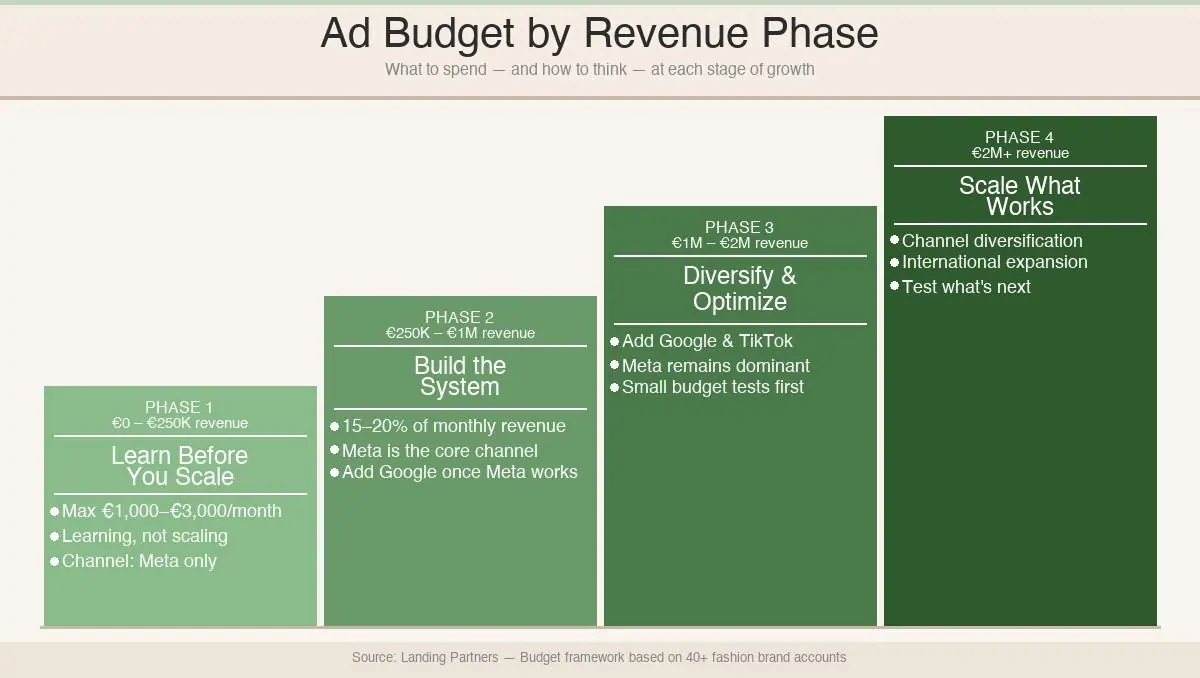
Phase 1 (€0-€250K Revenue): Learn Before You Scale
At this stage, most brands shouldn't be spending large sums on advertising. Not because ads don't work, but because the brand is still figuring out what works.
Our typical recommendation for Phase 1: €1,000-€3,000/month on Meta Ads, with the primary goal of learning - not scaling.
At this stage, you're looking to understand:
• Which creatives resonate with your audience
• What your actual cost per purchase looks like (not estimated)
• Whether your store converts paid traffic at all
• What your real AOV and repeat purchase rate are
Spending more at this stage rarely improves results. It just amplifies whatever is already working or not working. We've seen Phase 1 brands burn €10,000/month with no clear learnings because they scaled before they had signal.
In Phase 1, the most important metric isn't ROAS - it's cost per learning. What does it cost you to understand what actually converts?
Phase 1 brands almost never need Google Ads or TikTok Ads yet. The complexity adds noise without adding signal. Meta alone gives you enough data to understand your customer. When you do add Google, see our Google Ads guide for online clothing stores for Shopping and PMax setup.
Email at this stage is about list building. Klaviyo flows become meaningful once you have 1,000+ subscribers. Before that: focus on your opt-in mechanism and your welcome flow. Don't over-invest in email automation before you have the audience to justify it.
Phase 2 (€250K-€1M Revenue): Build the System
This is where paid advertising starts to play a more structural role. The brand has proof of concept, the store converts, and there's enough purchase history to start optimizing.
Our typical allocation at Phase 2: 15-20% of monthly revenue back into advertising.
At €500K annual revenue, that's roughly €6,000-€8,000/month. At €1M, it's €12,000-€16,000/month. These aren't universal rules - your margin structure matters. A brand at 65% gross margin can afford more than a brand at 40%.

Across our Phase 2 clients, brands that consistently reinvest 15-18% of revenue into paid media tend to reach Phase 3 faster than those that underspend. The critical factor: that spend needs to be paired with active creative testing - not set-and-forget.
Channel allocation at Phase 2:
Meta Ads: 70-80% of paid budget. Still the primary acquisition channel for most fashion brands. Strong visual format, best audience data, highest intent-to-purchase signal for fashion.
Klaviyo (email): no hard budget line - the platform cost is fixed. But invest in a dedicated email strategy. At Phase 2, email should be generating consistent retention revenue through your core flows.
Google Ads: optional at this stage. If you have strong brand search volume, branded campaigns make sense. Google Shopping campaigns for high-intent buyers can work, but only after Meta is running consistently.
TikTok Ads: test budget only. €500-€1,000/month to start building creative learnings. Don't expect TikTok to drive the same direct-response performance as Meta at this stage.
At Phase 2, the biggest budget mistake is spreading spend too thin across too many channels. Pick one and do it well first. Want to know what channel mix makes sense for your brand? Book a free strategy call.
Phase 3 (€1M-€2M Revenue): Diversify and Optimize
Phase 3 is where the channel mix starts to matter more. Meta alone starts to show diminishing returns at higher spend levels. Complementary channels like Google Shopping for online clothing stores become essential. You need complementary channels to maintain efficiency.
Budget benchmark at Phase 3: 15-20% of revenue, but split more deliberately across channels.
A typical Phase 3 split we see working:
• Meta Ads (including Advantage+ Shopping campaigns): 55-65% of paid budget
Google Shopping and Performance Max: 20-25%
• TikTok Ads: 10-15%
• Remaining: testing budget (Pinterest, influencer, affiliate)
At this stage, email is no longer a cost consideration - it's a retention engine that should be paying for itself many times over through flow revenue.
Phase 3 is also where we see brands start confusing channel efficiency with business efficiency. A Meta ROAS of 4 sounds strong until you account for returns, fulfilment costs and organic traffic that Meta is taking credit for. At Phase 3, track MER (Marketing Efficiency Ratio) as your primary north star. MER = total revenue / total ad spend. No attribution complications.
Phase 3 is also when international expansion becomes worth exploring. This is often the right moment to test a new market with a small budget - €1,000-€2,000/month per new market - before committing fully.
Phase 4 (€2M+ Revenue): Scale What Works, Test What's Next
At Phase 4, the budget conversation shifts from percentages to absolute spend and channel strategy. The brand has a proven engine. The goal is to maintain efficiency while pushing volume.
Our observation at Phase 4: the brands that maintain healthy growth continue to treat a portion of their budget as a testing allocation - typically 10-15% of total ad spend on new channels, formats or markets.
The Phase 4 brands that struggle are the ones that lock in a formula and stop testing. Creative fatigue, platform algorithm changes and market shifts mean what works today won't work at the same efficiency in 18 months.
At Phase 4, international expansion is often the primary growth lever. Domestic markets have ceilings. Each new market requires a localized approach - adapted creative, local payment methods, local customer service. The ad budget is one part of that, not the whole answer.
When to Spend More: High-Investment Moments in the Fashion Calendar — and our BFCM email calendar for the full send schedule
Not all months are equal. Fashion has a pronounced seasonal rhythm that should drive your budget allocation, not just your creative calendar.
Moments to increase ad spend above your base allocation:
New collection launches (SS/AW): your freshest creative, your highest organic interest, your best window for efficient acquisition
BFCM (Black Friday/Cyber Monday): relevant for most contemporary and streetwear brands - but not a universal rule. For high-end or luxury brands, participating with broad discounting risks the brand equity built all year. The question is not whether BFCM drives volume - it will - but whether that volume comes at a cost to positioning and full-price behaviour in subsequent months.
Q4 gifting push (October-December): especially relevant for gifting-positioned brands, jewellery and accessories
Brand-specific peaks: your own sale periods, anniversary campaigns, limited drops
Moments to pull back:
• January-February (post-sale hangover) for most women's fashion and streetwear brands
• April-June: typically lower intent for fashion across most segments
• When creative is exhausted: spending more with stale creatives accelerates waste, not results
The exception: kidswear and gifting brands. September (back-to-school) and early Q4 are often their peak periods. Never apply a universal seasonal calendar across different brand types.
One nuance worth understanding: increasing and decreasing spend is not as simple as hitting a MER or CAC target. Most fashion products and collections have a limited time at full price - once the season moves on, remaining stock becomes progressively harder to sell at margin. That means your targets may need to shift within a collection cycle. If a brand holds to a strict MER floor too late in the season, it risks carrying dead stock into the next period - which is almost always worse for the business than selling below the initial efficiency target. Budget decisions in fashion require both performance benchmarks and inventory awareness.
The Budget Mistakes We See Most Often
After working with 100+ fashion brands, a few patterns around budget mistakes keep showing up.
Mistake 1: Scaling before the store converts.
The most common one. A brand increases Meta spend hoping it will kickstart sales, but the store has a fundamental CR problem. The result: more traffic, same conversion rate, higher losses. Fix the store first.
Mistake 2: No testing allocation.
Some brands run the same 3 creatives for 6 months and wonder why performance is declining. Testing needs a dedicated line - typically 15-20% of your Meta spend. Not every test wins. That's the point.
Mistake 3: Treating all revenue stages the same.
A brand at €80 AOV and a brand at €300 AOV can't use the same percentage-of-revenue budget rule. Margin per order, return rate and customer lifetime value all affect how much you can profitably spend to acquire a new customer.
Mistake 4: Chasing channel ROAS instead of business efficiency.
ROAS is a metric that can be optimized within a platform without actually improving your business. A broad attribution window, lower-funnel bid strategy and retargeting-heavy setup can all inflate reported ROAS while actual new customer acquisition stagnates. MER gives you the honest picture.
Across our client base, the highest-performing brands treat their ad budget like a disciplined investor treats a portfolio - with clear allocation rules, active testing, and regular rebalancing. Not "let's see how this month goes."
The KPI Framework: How to Know Your Budget Is Working
Budget decisions need a measurement framework behind them. We recommend tracking:
MER monthly: total revenue / total ad spend. Your north star for overall paid media efficiency.
New customer CAC by channel: how much does it cost to acquire a genuinely new customer, not just any attributed conversion?
Return on ad spend by campaign type: brand vs. prospecting vs. retargeting have very different ROAS profiles - don't blend them in your reporting
Revenue per email recipient (flows vs. campaigns): keep your email attribution separate from paid channel attribution
Creative performance by format: which creative types drive the lowest cost per purchase? This guides your testing allocation.
If you can't answer these questions today, the priority isn't increasing budget - it's building the measurement infrastructure first.
Every brand's advertising budget situation is different. The right amount depends on your margin, AOV, growth stage and channel performance. If you want a concrete budget recommendation for your specific situation - book a free strategy call.