Sleep Supplement Marketing: How to Advertise Magnesium, Melatonin and Sleep Support Brands in the Age of Sleepmaxxing
Key Takeaways
- •Sleepmaxxing has turned sleep into the #1 health search topic of 2026 - and the sleep supplement market is growing faster than almost any other supplement category.
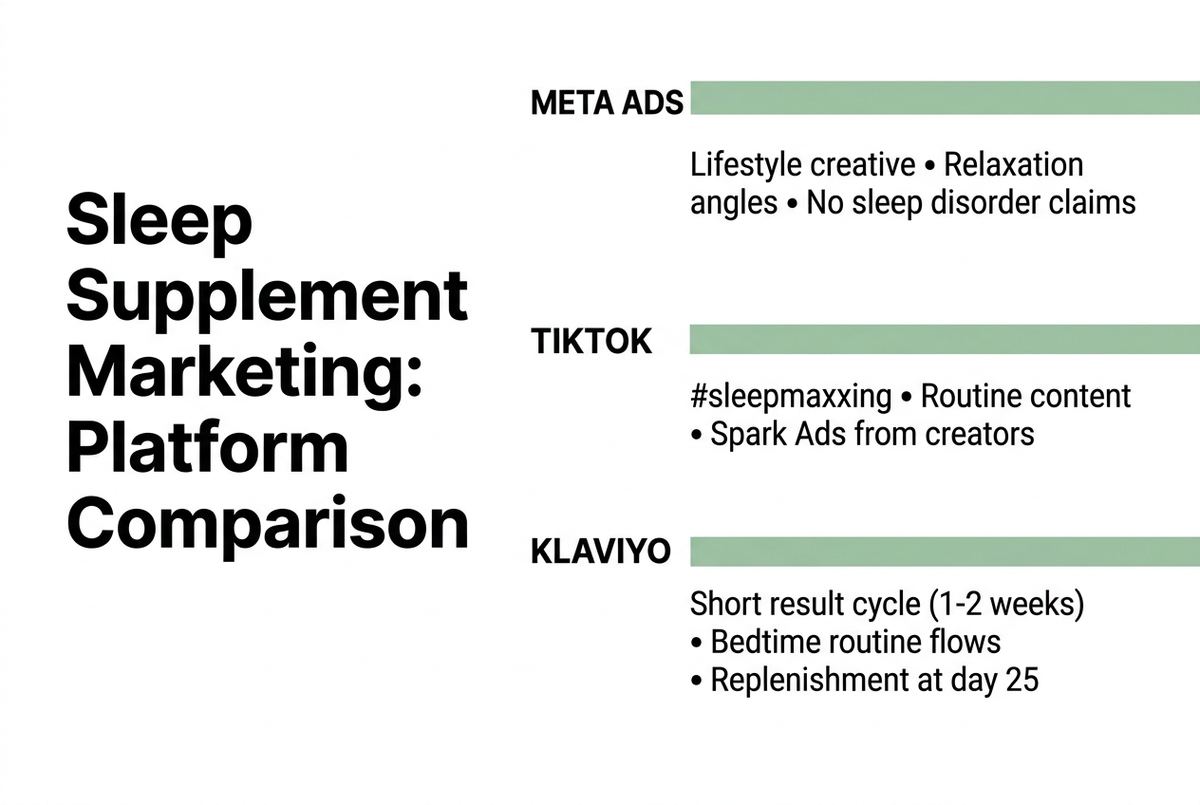
- •Meta allows lifestyle and relaxation angles for sleep supplements, but flags clinical sleep disorder claims. The line between 'supports nightly relaxation' and 'treats insomnia' determines whether your ad runs or gets reviewed.
- •TikTok is the dominant discovery platform for this category - the #sleepmaxxing community is massive, and Spark Ads from organic creator content convert better than branded placements.
- •Klaviyo flows for sleep supplements are shorter than most supplement categories. Results are felt in 1-2 weeks, which changes the entire onboarding and replenishment cadence.
- •Subcategory matters for marketing strategy: magnesium glycinate, melatonin, ashwagandha and herbal blends each attract a different buyer and require a different creative angle.
Why Sleep Is the Supplement Category of 2026
The sleepmaxxing trend did not appear overnight. It built on years of wearable data culture - Oura Rings, Whoop bands, Apple Watch sleep tracking - making sleep metrics visible and gamifiable. When people could see their sleep score drop after a glass of wine or a late Netflix session, they started optimising obsessively.
In 2026, sleep is not just a health topic. It is an identity. The sleepmaxxer is not someone who takes a melatonin tablet and hopes for the best. They are stacking magnesium glycinate with ashwagandha, cutting caffeine after noon, optimising their bedroom temperature, and tracking deep sleep percentages the way a trader watches markets.
Searches for 'magnesium glycinate' on Google grew over 300% between 2023 and 2026. It is now one of the top five most searched supplement terms in Europe.
This is the market you are operating in. The demand is real, the consumer is educated, and competition is accelerating fast. The brands that win are not the ones with the most sophisticated formulations - they are the ones that understand how to position, advertise, and retain a buyer who has already done their research.
What follows is the full marketing playbook for sleep supplement brands in 2026: what to say, where to say it, and how to keep customers once they convert.
Not sure how your current sleep supplement brand stacks up against what we see across our client base? Book a free call with us.
Understanding the Subcategories Before You Write a Single Ad
Sleep supplements are not a monolithic category. Each subcategory attracts a different buyer, with different motivations, different trust thresholds, and different creative hooks. Getting this wrong wastes budget.
Magnesium glycinate
This is the sleepmaxxer's supplement of choice in 2026. The buyer is typically female, 28-45, well-informed, sceptical of pharmaceutical solutions, and looking for a natural approach to better sleep that also addresses underlying stress and muscle tension. She has seen the TikToks, read the Reddit threads, and wants to understand the mechanism before she buys. **The creative angle that works: mechanism + lifestyle, not miracle claims.** Explain why glycinate is more bioavailable than oxide. Show a calming bedtime routine. Do not promise she will fall asleep in five minutes.
Melatonin
Melatonin is the mainstream entry point - widely understood, lower AOV, shorter repurchase cycle. The buyer is less sophisticated and more impulsive. Travel, shift work, and jet lag are strong contextual hooks. The compliance challenge is highest here: melatonin claims can easily drift into medical territory. In Belgium and the Netherlands, melatonin is classified as a medicine above certain doses, which limits what you can legally sell and advertise.
Ashwagandha and adaptogen blends
Ashwagandha buyers are motivated by the cortisol angle - they are not so much chasing better sleep as they are trying to manage the stress that is preventing sleep. This is an important distinction for creative. The buyer is often a professional, male or female, 30-50, who recognises stress as the root problem. **The hook is stress reduction, not sedation.** The sleep benefit is downstream from the primary mechanism.
Herbal blends and valerian-based products
This subcategory skews older (45+) and more traditional. The buyer is familiar with chamomile tea, knows what valerian root is, and is looking for something slightly more potent without going pharmaceutical. Email marketing outperforms Meta for this cohort.
Meta Ads for Sleep Supplements: What Works, What Gets Flagged
Meta's health and wellness policy creates a specific challenge for sleep supplement brands. The distinction that matters most is between functional support claims and medical claims.
What Meta allows:
Claims that position the supplement as a lifestyle and wellness product are generally fine. Phrases like 'supports nightly relaxation', 'part of your sleep routine', 'helps you wind down', 'promotes restful nights', and 'supports stress management' typically run without issue. Lifestyle creative showing calming evening rituals, sleep tracking devices, and morning wake-up energy routinely passes review.
What gets flagged:
Any language that implies treatment of a medical condition will trigger a review. 'Helps with insomnia', 'fixes sleep disorders', 'clinically proven to treat sleep problems', and 'reduces sleep latency' are the phrases we see flagged most often. Ironically, 'clinically proven' is actually more likely to flag than a straightforward lifestyle claim - it implies medical validation in a regulatory sense Meta is sensitive to.
In our experience working with health supplement brands, ads using the word 'insomnia' or 'sleep disorder' are flagged at a rate of over 80%. Lifestyle framing reduces review rates to under 15% while maintaining comparable conversion performance.
Creative formats that convert for sleep supplements on Meta:
The bedtime routine video is the dominant format. A 15-30 second Reels showing a calming night routine - dim lighting, phone down, supplement visible but not prominently pushed - consistently outperforms direct product shots. The hook is the routine, not the product.
UGC testimonials work extremely well for sleep supplements because sleep is a felt experience. When a real person says 'I have not woken up at 3am since I started taking this', that is specific, believable, and compelling. It is not a medical claim. It is a personal experience. **Collecting and amplifying this type of creator content is one of the highest-ROI activities for a sleep supplement brand on Meta.**
Wearable data integration is a newer format we are seeing perform well. Showing an Oura Ring screenshot with improved sleep score alongside the supplement creates a data-driven social proof that resonates with the sleepmaxxer demographic.
Want to know which creative formats are currently driving the best CPM and CVR for supplement brands we manage? Let us run a free audit of your current Meta setup.
TikTok: The Primary Discovery Platform for Sleep Supplements
TikTok is where sleep supplement brands are being built in 2026. The #sleepmaxxing hashtag has accumulated billions of views. The content is native, educational, and deeply trusted by its audience in a way that polished branded content never will be.
The TikTok sleep supplement ecosystem breaks down into a few distinct creator types, each valuable for different purposes:
The biohacker - tracks every metric, shares Oura data, experiments with stacks. High authority with the core sleepmaxxing audience. Ideal for magnesium glycinate and ashwagandha brands targeting the performance-optimisation angle.
The wellness woman - 25-40, focus on hormonal health, cortisol, and natural routines. Dominant in the female magnesium glycinate market. Content is aesthetic, calming, and resonates with a much broader audience than the biohacker creator.
The everyday converter - not a specialist, just someone who tried your product and shares an honest experience. 'I finally slept through the night' content. Lower production value, much higher authenticity, often the best-performing Spark Ad material.
**Spark Ads are the most efficient paid format on TikTok for sleep supplements.** Take organic content from creators in your affiliate programme, boost it as a Spark Ad, and the native feel dramatically improves conversion rates compared to branded placements. We consistently see Spark Ads outperform standard In-Feed Ads for supplement brands by 30-50% on click-through rate.
TikTok Shop for sleep supplements is worth monitoring but not yet the primary channel for most European brands. In-app checkout works well for impulse categories and lower AOV products. Sleep supplements with a strong educational component tend to convert better when the customer lands on a dedicated product page where trust signals, ingredients, and reviews are fully visible.
Klaviyo Flows for Sleep Supplements: A Shorter Cycle Than You Think
The email marketing strategy for sleep supplements differs from most other supplement categories in one critical way: **the results cycle is short.**
A gut health supplement might take 4-8 weeks to show meaningful results. A collagen brand tells customers to wait 90 days. Magnesium glycinate and melatonin? Many customers feel a difference in 3-7 days. This changes everything about how you sequence your post-purchase flows.
Welcome and onboarding flow (days 1-14)
Day 1: Confirm purchase, set expectations. Explain the mechanism in simple terms - why magnesium supports relaxation at the cellular level, what to expect in the first week. No overselling. The customer is already bought in; now you need to make them successful.
Day 3: How to take it for best results. Timing matters for sleep supplements more than most categories - magnesium glycinate 30-60 minutes before bed is a specific instruction that increases efficacy and therefore retention.
Day 7: First check-in. 'How has your first week been?' - this email has the highest open rates in the sequence and catches early churners before they lapse.
Day 14: Build on results. Share customer content, suggest complementary routine habits (sleep hygiene, screen time), begin cross-sell only if the primary product is working.
Replenishment flow
A 30-day supply typically runs out around day 25-27 for a compliant customer. Set your replenishment trigger at day 22-24, not day 28. Customers who have run out and broken their habit are much harder to re-activate than customers who reorder before they run out.
Based on the supplement brands we manage on Klaviyo, the replenishment email sent at day 22-24 has a re-order conversion rate roughly 2x higher than emails sent at day 28-30. The window matters.
Segmentation priorities
Segment by subcategory (magnesium buyer vs. melatonin buyer vs. ashwagandha buyer) and tailor the education flow accordingly. A melatonin buyer needs timing guidance and dose information. A magnesium glycinate buyer wants the mechanism and the science. An ashwagandha buyer is asking 'when will my stress actually decrease?' - acknowledge the cortisol angle explicitly.
Segment also by goal if you collect it at checkout or post-purchase quiz: 'I want to fall asleep faster' vs. 'I want to stay asleep all night' vs. 'I want to feel less stressed before bed' - these are three different problems with three different educational paths.
Audiences and Targeting: Who Is Buying Sleep Supplements in 2026
Stress-driven professionals (30-50)
The largest and most lucrative sleep supplement segment. They are not fundamentally sleep-disordered - they are overwhelmed, overscheduled, and wired when they should be winding down. The cortisol angle (ashwagandha, magnesium) resonates more than sedation messaging. On Meta, this audience responds well to 'you work hard - you deserve to recover properly' framing.
Peri-menopausal and menopausal women (42-58)
Sleep disruption is one of the most common and distressing symptoms of perimenopause. This is a high-intent, high-LTV audience that is dramatically underserved by most supplement brands. **Magnesium glycinate and a combination approach (magnesium + ashwagandha or magnesium + B6) perform extremely well with this cohort.** The content angle: acknowledgement first, solution second. They want to feel understood before they want a product pitch.
Fitness and athletic recovery (25-45)
For this segment, sleep is a performance variable. Better sleep means better recovery, better training, better results. The hook is not relaxation but optimisation. Magnesium and GABA-adjacent supplements work well. TikTok is the dominant channel - this is the #sleepmaxxing biohacker cohort.
Older adults (55+)
Sleep architecture genuinely changes with age - less deep sleep, more frequent waking, earlier morning waking. Email marketing outperforms paid social for this cohort. When running Meta ads targeting this group, favour static images and direct benefit statements over fast-cutting video content.
Benchmarks: What to Expect Per Subcategory
Every brand's numbers depend on creative quality, margin structure, and how well the product actually works. That said, here is the range we see across sleep supplement brands:
For **magnesium glycinate brands** on Meta at steady state (6+ months of data): blended ROAS typically sits between 2.5 and 4.5, depending on AOV and subscription take-up rate. CPM is generally lower than general wellness categories because the audience is more defined.
**Melatonin and mainstream sleep products** tend to have higher CPM (more competitive) and lower ROAS (lower AOV, lower subscription rate). The economics work better when you bundle with magnesium or position as a travel/situational product with a higher price point.
**Repeat purchase rate** for sleep supplements is high relative to other categories - customers who feel genuine results typically reorder 3-5 times in year one. This makes LTV unusually strong if your onboarding and replenishment flows are working correctly.
For specific benchmarks relevant to your product and market, the numbers depend on your margin, price point, and competitive positioning. Every brand's situation is different.
If you want to know what the right ROAS target and flow architecture looks like for your specific sleep supplement brand, book a free call with us - we will walk through your current numbers and show you where the gaps are.
Compliance Without Killing Your Creative
The biggest mistake sleep supplement brands make is writing compliant copy that is so hedged it does not convert. You can be policy-compliant and persuasive at the same time - but it requires deliberate craft.
**Replace condition claims with experience claims.** Instead of 'helps with insomnia', try 'helps you stop lying awake at 2am'. The experience is specific and relatable without implying treatment of a medical condition.
**Replace clinical language with sensory language.** Instead of 'clinically proven to reduce sleep latency', try 'most customers notice a difference in how quickly they drift off within the first week'. Specific, time-bound, and based on customer experience rather than clinical endpoints.
**Use the ritual frame.** Positioning your supplement as part of a sleep ritual - alongside magnesium, a herbal tea, 10 minutes of reading - removes the product from the medical context entirely and places it in the wellness lifestyle context that Meta (and your customer's identity) is comfortable with.
Frequently Asked Questions
Every brand's sleep supplement marketing situation is different. Your subcategory, price point, margin structure, and target audience determine which channels and which creative angles will perform. If you want to know what the right approach looks like for your specific brand, book a free call with us and we will show you exactly where the opportunities are.