
Germany is the largest online fashion market in continental Europe. For Belgian and Dutch fashion brands that have built a working domestic business, it is the most logical next market - but also one of the most misunderstood.
We have helped multiple BE and NL fashion brands expand into Germany. Some grew fast. Others burned budget without results. The difference was almost always the same: the brands that succeeded treated Germany as a separate market. The ones that failed treated it as a copy-paste of their home market.
This guide covers what you need to know before you spend a single euro in Germany.
Why Germany Is the Right Next Market for Most BE/NL Fashion Brands
From a proximity and logistics standpoint, Germany is an obvious next step for Belgian and Dutch fashion brands. It shares borders with both countries, uses the same major carriers, and the cultural overlap is significant enough that your creative assets often require less rework than, say, France or the UK.
The market size is the real argument. Germany accounts for a substantial share of all online fashion spend in the DACH region (Germany, Austria, Switzerland). When we look at the brands in our portfolio, the ones that have successfully entered Germany have typically doubled their total addressable market with a single expansion.
Germany is the largest online fashion market in continental Europe - and most international brands that enter without proper localisation leave significant revenue on the table.
There is also a strategic advantage for well-positioned brands: German consumers respond well to brands that feel considered and quality-focused. If your brand already resonates in Belgium or the Netherlands on those attributes, the positioning does not need to change. The execution does.
Thinking about expanding into Germany? Book a free growth call to see if your brand is ready and what a realistic entry plan looks like.
Understanding the German Fashion Consumer
German online shoppers are different from Belgian or Dutch buyers in two important ways: return behaviour and trust thresholds.
Return rates are structurally higher in Germany
Germany has a long-standing culture of ordering multiple sizes and returning what does not fit - a behaviour reinforced by decades of catalogue shopping. In fashion specifically, we see return rates 15 to 25 percentage points higher than comparable Belgian or Dutch accounts. This is not a problem you can fix with better targeting. It is a structural feature of the market.
Before scaling in Germany, you need to know your margins hold at German-level return rates. If your current gross margin on orders is 60% and you are seeing 20% returns domestically, a 35 to 40% return rate in Germany can turn a profitable channel into a loss-maker. Run the numbers before you start.
Fashion brands entering Germany typically see return rates 15-25 percentage points higher than their home market. This is not a targeting problem - it is a structural feature of German ecommerce that must be factored into your margin model before launch.
Trust signals carry more weight than in most European markets
German consumers are cautious online buyers. Trust signals - recognised payment methods, clear return policies, visible contact details, customer reviews - carry more weight in Germany than in Belgium or the Netherlands. Brands that skip these details see measurably lower conversion rates.
Payment methods matter specifically. In Germany, PayPal, SEPA direct debit, and invoice payment (Kauf auf Rechnung) are expected by a large segment of buyers. If your checkout does not offer invoice payment, you are excluding a meaningful portion of the German market. iDEAL is Dutch-only and has no equivalent in Germany.
Legal and Logistics - What to Set Up Before You Go Live
Germany has specific legal requirements for ecommerce that go beyond standard EU rules. These are not optional - German consumer protection enforcement is among the strictest in Europe.
Impressum requirement
Every German-facing website must have a legally compliant Impressum (legal notice) page. This must include: full company name, registered address, VAT number, contact email, and trade register number if applicable. Missing or incomplete Impressum pages are actively monitored and can result in expensive legal warnings (Abmahnungen) from competitors or consumer protection organisations.
Return policy (Widerrufsrecht)
German law requires a 14-day right of withdrawal with a specific Widerrufsbelehrung (cancellation policy). The wording must follow prescribed legal language - a generic translation of your Dutch or Belgian returns page is not sufficient. Use a German ecommerce legal service to generate compliant copy.
Shipping and fulfilment
For most BE/NL brands, shipping from existing warehouses to Germany is straightforward via major carriers. Delivery expectations in Germany are high - 2 to 3 business days is the standard. If you are currently offering next-day delivery domestically, be transparent about extended delivery windows to Germany in your checkout.
German ecommerce shoppers rank on-time delivery and clear returns policies as the two most important trust factors when buying from an international brand for the first time.
Language and Localisation - Deeper Than Translation
This is where most brands under-invest, and where we see the biggest performance gap between successful and unsuccessful Germany entries.
Translating your Dutch or English website into German is step one. But German-language fashion copy has specific conventions: product descriptions tend to be more detailed and technical, sizing information is expected to be precise, and marketing copy that feels warm and conversational in Dutch can come across as too casual in German.
Product descriptions
German shoppers read product descriptions carefully. Material composition, care instructions, fit details, and size guidance all need to be complete and accurate. Vague descriptions ('relaxed fit', 'soft fabric') without specifics perform measurably worse in Germany than in other markets we track.
Ad copy
German ad copy generally performs better when it leads with the product or value proposition rather than the brand story. In most accounts we manage, product-led copy outperforms brand-narrative copy for cold German audiences. Test both, but know the baseline expectation.
Customer service language
If you are entering Germany, you need German-language customer service coverage. This does not mean a full German support team from day one - a well-structured FAQ page and clear email templates in German will cover most volume. If a German customer emails in German and receives a response in English or Dutch, trust drops immediately and is difficult to recover.
Not sure if your current site is ready for the German market? Book a free webshop analysis - we will review localisation, trust signals and checkout for German conversion readiness.
Paid Media Strategy for Germany
Meta and Google both work well in Germany, but the dynamics are different from Belgian or Dutch accounts.
Meta in Germany
German Meta audiences are larger, which means more room to scale - but also more competition from established German and international fashion players. CPMs in Germany typically run higher than in Belgium or the Netherlands, particularly for women's fashion in the 25 to 45 age range. Budget for a higher cost-per-click during your testing phase.
Creative strategy matters more in Germany because of the trust dynamic described above. Product-first creative - clear imagery, precise product details in the copy, visible price - consistently outperforms lifestyle-only creative for new German audiences. Once you have built a warm audience, lifestyle works. Start with product clarity.
Google Shopping in Germany
Germany is a strong market for Google Shopping. German consumers actively use search to compare products before buying. If you are already running Shopping campaigns in Belgium or the Netherlands, Germany is a straightforward expansion - the product feed and campaign structure translate directly, with German-language titles and descriptions.
Testing budget and timeline
We recommend a minimum 3-month test before making scaling decisions. The learning phase in a new market takes longer than domestic campaigns because the algorithm is building from scratch. Brands that cut the test short after 4 to 6 weeks almost always do so before the data is usable. You need volume to make reliable conclusions.
Email Marketing in Germany - What Is Different
GDPR compliance in Germany is enforced more strictly than in most other EU markets. Double opt-in is not legally required by GDPR itself, but German case law and DPA guidance effectively make it the standard. If you are collecting email subscribers from German traffic, implement double opt-in from day one.
List building first
If you are entering Germany with a new brand presence, your German subscriber list starts at zero. Email flows only become meaningful once you have built a substantial list. Focus on list growth through your paid media and website experience before optimising flow sequences.
Campaign frequency expectations
In the accounts we manage, German subscribers generally tolerate slightly lower email frequency than Belgian or Dutch subscribers before unsubscribe rates spike. The sweet spot tends to be product-led content over brand storytelling, with a slightly less frequent send cadence than your home market. Track unsubscribes per campaign and adjust accordingly - the signal is clear when you overshoot.
The Most Common Mistakes We See
After helping multiple BE and NL brands enter Germany, these are the patterns that show up repeatedly in failed or underperforming expansions:
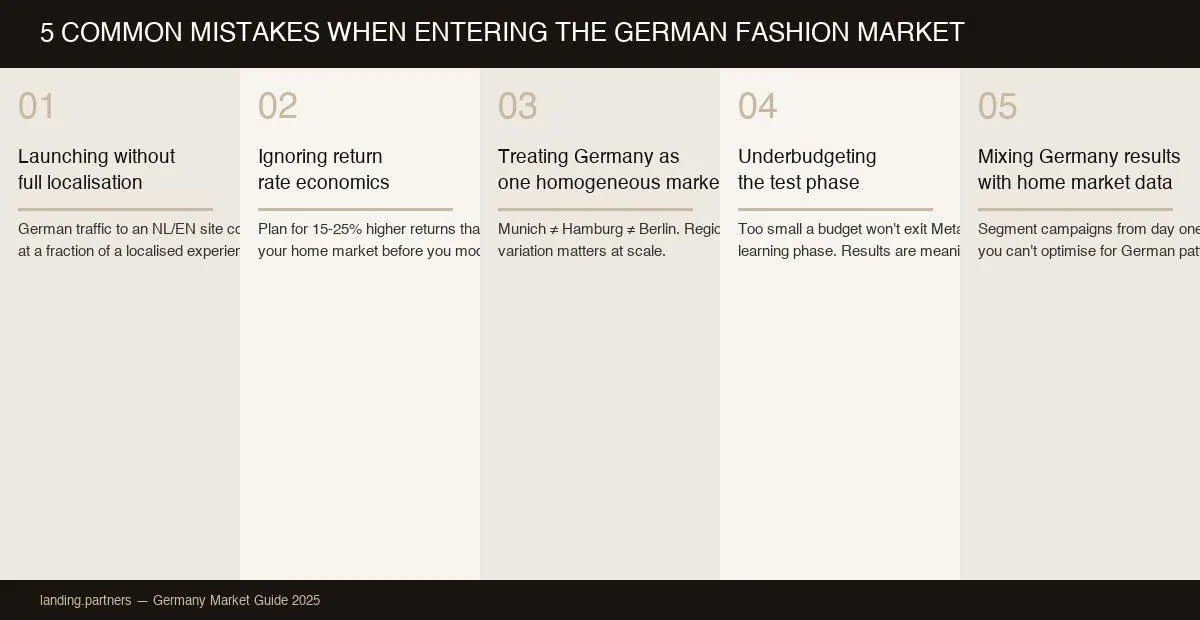
1. Launching without full localisation
German traffic sent to a Dutch or English website converts at a fraction of what a properly localised German experience delivers. The investment in localisation pays back within the first few months of a functioning German channel.
2. Not stress-testing return economics
Brands that model Germany using domestic return rates consistently underestimate cost. Build your Germany model with at least a 15 to 20 percentage point higher return rate assumption. If the margins do not work at that level, fix the economics before you enter.
3. Treating Germany as one homogeneous market
Germany has meaningful regional variation. Purchasing behaviour in Munich differs from Hamburg or Berlin. Creative and messaging that resonates in urban centres does not always translate to smaller cities. This matters more at scale, but worth keeping in mind when interpreting early test results.
4. Underbudgeting the test phase
A Germany test with insufficient budget will not produce usable data. Meta's algorithm needs volume to exit the learning phase. If your test budget cannot generate enough purchase volume per week to exit learning, the results are not statistically meaningful.
5. Mixing Germany results with home market reporting
Segment your German campaigns and email flows separately from day one. If German results are pooled with Belgian or Dutch data, you lose the ability to optimise for Germany-specific patterns - and you risk masking a loss-making channel behind strong domestic performance.
Every brand's Germany expansion looks different depending on your product, price point, and current stage. If you want to know what a realistic Germany entry plan looks like for your specific brand - book a free growth call.