The 7 Klaviyo Flows Every Fashion Brand Needs (And What We See in the Data)
Most fashion brands either set up Klaviyo too early, set it up wrong, or build six flows and skip the seventh - the one that often outperforms everything else. Here is what we consistently see across our work with 40+ fashion ecommerce brands. Once your flows are live, use our Klaviyo open rate and click rate benchmarks to see how your performance compares.
Key Takeaways
- •Klaviyo flows only become meaningful at 1,000+ active subscribers. Before that, focus on list growth.
- •The welcome series is the highest-revenue flow for most fashion brands - not abandoned cart. Check the Klaviyo email benchmarks for fashion brands to see what open and click rates to aim for.
- •Browse abandonment is the most skipped flow, and often the most underrated.
- •Email attribution is inflated: measure flows by open rate, click rate, and revenue per recipient — see our Klaviyo benchmarks for fashion brands for 2025-2026 reference numbers.
- •Every fashion brand has different peak seasons. Your flow timing should reflect your specific brand type - not a generic calendar. Use our fashion email marketing calendar to map the full year.
First: When Flows Actually Matter
We get asked about Klaviyo from brands at every stage. Our answer is always the same: flows become meaningful at 1,000+ active subscribers. Below that, you're optimizing for almost no one.
This does not mean you should ignore Klaviyo early on. Set it up (our Klaviyo setup guide walks you through this step by step), connect Shopify, and activate the welcome series the moment you start capturing emails. But if you have 200 subscribers and you're spending three weeks perfecting your abandoned cart timing, you're solving the wrong problem.
Moving from Mailchimp? Our Klaviyo vs Mailchimp comparison for Shopify fashion brands covers the key differences in flows, segmentation and pricing — and when the switch actually makes sense.
Phase 1 is list growth. Flows follow subscribers, not the other way around.
Not sure where your email programme stands? Book a free Klaviyo audit - we'll tell you exactly what to prioritise.
Flows only become meaningful at 1,000+ active subscribers. Before that, your energy is better spent on list growth than on perfecting abandoned cart timing.
Flows Are a Good Start — But Klaviyo Is a Data Platform
Getting your flows live is a big step forward. But reducing Klaviyo to a flow tool is like buying a high-end camera and only using it for selfies. The real strength of the platform is what it knows about your audience.
Klaviyo is fundamentally a data platform. It collects and structures behavioural data — who opened what, who clicked which product, who bought once versus three times, who has gone quiet — and makes that data actionable. The flows are one output of that. But the bigger opportunity is in how you use that data to decide what to send, when, and to whom.
This is where the platform gets genuinely powerful:
• Segmentation: You can create highly specific audience segments — customers who bought product X but not Y, subscribers who engaged last month but have gone quiet this week, high-AOV buyers who have not been in the top 10% recently. These segments feed both flows and manual campaigns.
• Predictive analytics: Klaviyo's built-in predictive models can identify customers who are likely to churn, customers on the path to becoming high-value, and the expected next order date per subscriber. This moves your email strategy from reactive (someone abandoned cart) to proactive (someone is about to go cold).
• Cross-channel consistency: Because Klaviyo holds your customer data, you can sync segments directly to Meta and Google — meaning your paid ads and email can target the same audiences with consistent messaging. This is especially powerful for fashion brands trying to move customers from first to second purchase.
• Revenue leak detection: When you have clean data in Klaviyo, you can calculate what you are leaving on the table — what a missing flow costs, what an underperforming segment is worth, what the gap is between your current email revenue and what you would expect at your list size. This turns Klaviyo from a cost into a measurable asset.
The brands in our portfolio that get the most from Klaviyo are not the ones with the most flows. They are the ones that treat it as a source of truth about their customer base — and use that data to make smarter decisions everywhere, not just in email.
Want to know what your Klaviyo data is actually telling you? Book a free audit — we will map your audience segments, identify the highest-value gaps, and show you what the platform can do beyond flows.
A Note on Attribution Before We Start
Klaviyo's default attribution window is 5 days after a click or 1 day after an open — worth keeping in mind when comparing results to Klaviyo benchmarks for fashion brands. That means a subscriber who opens your welcome email on Monday, thinks about it, and buys on Thursday - that purchase gets credited to email.
That is not wrong, exactly - but it is not the full picture. Some of those purchases would have happened anyway. Campaigns are the most inflated: a promotional email sent to 10,000 subscribers will always generate some purchases simply because it reached people already thinking about buying.
We evaluate flows by flow-specific metrics: open rate, click rate, and revenue per recipient per flow. For specific benchmarks on what strong numbers look like, see our Klaviyo email benchmarks for fashion brands. Not as a percentage of total store revenue. That number will always look great and will tell you almost nothing useful.
Flow 1: Welcome Series
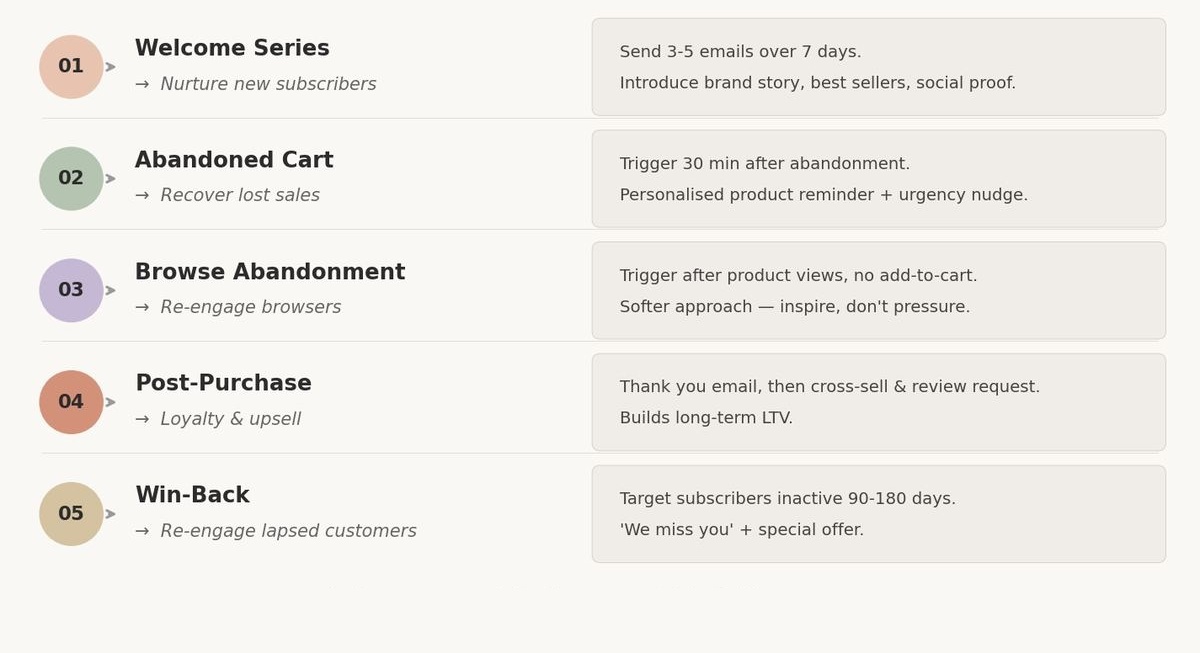
This is the most important flow for most fashion brands. Someone just gave you their email address - they are at peak interest right now. The welcome series converts that interest into a first purchase.
What we see work in fashion: A 3-4 email sequence over 5-7 days. Email 1 delivers the offer (if you promised one) and introduces the brand clearly. Email 2 shows the product range or bestsellers. Email 3 handles objections - fit, sizing, shipping, returns. Email 4 creates urgency if they still have not converted.
Fashion is different from most sectors here because the product is tactile. You cannot try it on through a screen. Your welcome series needs to replace the fitting room experience: strong imagery, clear sizing guidance, a low-friction return policy front and center.
Across our client base, the welcome series consistently generates the highest revenue per recipient of any flow - often by a significant margin.
The welcome series is the most important flow for fashion brands - not abandoned cart. Someone just gave you their email address. They are at peak interest right now.
Flow 2: Abandoned Cart
This is the flow everyone knows about. A subscriber adds to cart, does not complete the purchase, and gets a reminder. The question for fashion brands is not whether to run it - it is how to time it.
Timing for fashion: We generally see better performance with a 1-hour first email than a 24-hour delay for most fashion brands. Fashion purchases are often impulse-adjacent - the interest is there, the friction is the moment. Wait too long and the mood has passed.
Three-email sequences work well: first email at 1 hour (reminder, no discount), second at 24 hours (add social proof - reviews, UGC), third at 48-72 hours (add a small incentive if you want to, but be careful - you train people to abandon cart if there's always a discount waiting).
One thing we watch for: cart abandonment rate is often a CR problem, not an email problem. If 85% of people are abandoning cart, the flow will recover some of them - but fixing the checkout experience will recover far more. Always check the checkout UX before over-indexing on cart recovery emails.
If your cart abandonment rate is above 75% and your checkout has more than 3 steps, let's talk about the webshop first.
Flow 3: Browse Abandonment
This is the most skipped flow we see. And for fashion brands with well-tagged product catalogues, it is often the most underrated.
Browse abandonment fires when someone views a product page but does not add to cart. The intent signal is weaker than cart abandonment, but the volume is much higher. You are reaching people earlier in the decision cycle.
For fashion, this flow works best when: You have strong product-level imagery in the email. You show alternatives alongside the viewed product. You keep the email short - this is not the moment for a lengthy editorial.
When to suppress it: If someone is a repeat buyer who browses frequently, constant browse abandonment emails become noise fast. Set a frequency cap and exclude recent purchasers from this flow.
Flow 4: Post-Purchase
The post-purchase flow is where repeat buyers are made. A one-time buyer who comes back within 90 days has a dramatically higher lifetime value than one who does not.
What we do: Immediately after purchase - order confirmation plus a genuine brand moment. Not a discount. A reason to feel good about the purchase. Three to five days later - care instructions, styling suggestions, a 'you'll also love' product recommendation. Thirty days later - a soft re-engagement, new arrivals, collection drop if relevant.
The mistake most fashion brands make: Skipping straight to a discount in the post-purchase window. You just convinced someone to buy. Do not immediately signal that your prices are negotiable. Build the brand relationship first.
Post-purchase email sequences that lead with brand content before offers consistently outperform discount-first sequences in retention metrics across our client base.
Flow 5: Winback
Every subscriber list has people who stopped engaging. The winback flow is your attempt to re-engage them before you suppress them from your active list (which you should do - sending to unengaged subscribers hurts deliverability).
The threshold for fashion: We typically start the winback sequence after 90-120 days of no opens or clicks, depending on the brand's sending frequency. If you only send 2 campaigns per month, 90 days is 6 emails - that is a reasonable grace period. If you send weekly, you might start winback sooner.
A two to three email winback sequence works well. Email 1: a direct 'we miss you' with your best current offer. Email 2 (7-10 days later): a different angle - new collection, something changed, social proof. Email 3: a final message with a meaningful incentive, followed by suppression if there's still no response.
Suppression is not failure. Removing unengaged subscribers improves your sender reputation and gives you cleaner data. A smaller, engaged list outperforms a large, cold one every time.
Flow 6: Back-in-Stock
For fashion brands with limited runs, seasonal drops, or frequently selling-out styles, this is a high-intent flow that converts at an unusually strong rate.
The subscriber has already told you exactly what they want. When it is available again, the barrier to purchase is almost zero.
Timing is critical: Send the back-in-stock notification within minutes of inventory being restored, not at your next newsletter send time. The window where motivated subscribers act is short - often within the first few hours.
Collection-driven timing: For brands doing seasonal drops, the back-in-stock flow becomes a drop announcement flow. Build anticipation before restock (a waitlist), then hit that list first when stock goes live. This turns inventory management into a marketing moment.
Flow 7: VIP / Loyalty
This is the flow that most brands skip, and it is the one that protects your highest-value customers from going quiet.
The principle: Your top 20% of customers by purchase frequency and value typically generate 60-70% of your revenue. These are not normal customers - they deserve a different experience.
A VIP flow identifies customers who cross a threshold (typically 2-3 purchases, or above a specific spend level) and moves them into a separate track: early access to new collections, personal styling notes, exclusive offers before they go to the full list.
Why this matters for fashion specifically: Fashion purchases are often tied to identity and taste. A customer who has bought from you three times has committed to your brand. Treating them the same as a first-time buyer is a missed opportunity - and a risk.
Seasonality and Flow Timing
One thing that comes up constantly in Klaviyo audits: brands using generic timing that was not designed for their specific type of fashion business.
The right seasonal frame depends on your brand type:
- Women's fashion and streetwear: January sales, July sales, BFCM, and Q4 October onwards are peak periods. April through June is typically the slowest window.
- Kidswear and teenswear: September back-to-school is often a larger moment than BFCM. Many kidswear brands underestimate this.
- Gifting-led brands: Valentine's Day, Mother's Day, and December are the three peaks. Volume in gifting seasons, AOV spikes around fashion weeks.
- Jewellery: A mix of gifting seasonality for volume and fashion weeks for higher-ticket buyers.
Your flows need to reflect your calendar, not a generic one. Flow send times, discount thresholds, and suppression windows should all be adjusted around your actual peak and low seasons.
What to Do With This Framework
If you are starting from zero: prioritise in this order. Welcome series first, then abandoned cart, then post-purchase. These three alone will deliver the majority of your flow revenue in the early stages. If you are still deciding between email platforms, our Klaviyo vs Mailchimp comparison for fashion brands covers what matters most at each stage of growth.
Once those three are running and your list is over 1,000 active subscribers: add browse abandonment and winback. Then VIP. Back-in-stock when your inventory management supports it.
If you already have flows running: audit before you add. We see a lot of brands with seven flows where two are doing 80% of the work and three are cannibalising each other. More flows does not mean more revenue.
Get a Free Klaviyo Audit for Your Fashion Brand
If you have read this far and are unsure whether your own flows are set up correctly, a free Klaviyo audit is the fastest way to find out. We do this for fashion brands every week - here is what the audit covers:
Flow audit: We review every active flow - welcome series, abandoned cart, post-purchase, winback, browse abandonment, back-in-stock, VIP. We check whether they are live, whether the logic is correct, and whether the content is doing its job.
List health check: We look at your active subscriber count, your engagement rate, and whether you have suppression rules in place. A large but unengaged list hurts deliverability - and most brands do not realise it until open rates start dropping.
Attribution review: We check your attribution window settings and help you understand which revenue numbers to trust and which to ignore. Most brands are either over-counting or under-optimising because of attribution confusion.
Gap analysis: We identify which flows are missing, which are cannibalising each other, and what the actual revenue opportunity looks like if the gaps are closed.
Priority roadmap: You leave with a clear, sequenced action list - not a generic checklist, but one built around your specific subscriber count, brand type, and seasonal calendar.
The audit takes about 45 minutes and is completely free. No obligations.
Request your free Klaviyo audit here - we'll get back to you within one business day to schedule a call.
FAQ
Every brand's Klaviyo setup depends on your subscriber count, your product range, and your seasonal email marketing calendar. The flows above are the ones we build first for every fashion client - but the timing, content, and thresholds need to fit your specific situation. If you want to know what the right setup looks like for your brand, book a free Klaviyo audit.