TikTok Ads for Beauty and Skincare Brands: Creative Strategy, Benchmarks and What Works in 2026
TikTok is the most powerful discovery engine for beauty and skincare products in 2026. Brands that figure this out early are building audiences and revenue that take years to replicate. Brands that treat it like Meta - same brief, same targeting logic, same optimization - get mediocre results and conclude the platform doesn't work for them.
The difference is the creative approach. Beauty on TikTok is education-first. That changes everything.
Key Takeaways
- •TikTok beauty content is education-driven, not aspiration-driven - skin demos and ingredient explanations outperform lifestyle imagery
- •CPM on TikTok for beauty runs lower than equivalent Meta placements, making it cost-efficient for top-of-funnel awareness
- •TikTok Shop converts well for serums, SPF, and tools under €50 - high-AOV routines need more touchpoints before converting in-app
- •Before/after claims and specific skin results are restricted under TikTok's health advertising policy - brief your creators explicitly before they film
- •TikTok and Meta serve different roles in the beauty funnel - running them together is where the real compounding happens
Why TikTok Works Differently for Beauty Than for Fashion
Fashion on TikTok is aspirational. You see a look, you want the look. The purchase decision is often emotional and fast.
Beauty on TikTok is educational. Someone discovers a serum because a creator explains exactly how it works, which ingredients do what, and shows the results over 30 days. That process builds far more purchase intent than any lifestyle ad could.
**This education-first dynamic is not a limitation - it's an advantage.** Beauty brands that lean into it create content that travels organically, gets saved, gets shared, and drives purchase intent that persists long after the video ends.
We see this pattern consistently across our beauty clients: organic-style educational content in paid placement outperforms polished brand-produced ads by a significant margin. The closer the paid creative looks to what a real person would post about a product they love, the better it performs.
The TikTok Beauty Consumer in 2026
The TikTok beauty shopper is research-active before she buys. She watches multiple videos, reads comments for real feedback, checks the brand's own TikTok page, and often encounters the product on TikTok Shop before deciding.
**The purchase journey is longer than fashion, but the intent at conversion is higher.** When someone buys after a TikTok beauty discovery, they usually know exactly what they're getting and why.
Key behaviors we observe across our client base:
• She trusts creators more than brand ads - UGC and creator content consistently outperforms polished brand video in every test we run
• She actively looks for ingredient information - 'does this have niacinamide?' is a comment we see on nearly every serum ad
• She compares products in-app before leaving - TikTok's search and 'more like this' features keep her on the platform longer
• She is more likely to buy lower-priced products (under €50) in-app via TikTok Shop - higher-priced routines typically need a website visit to close
Not sure how TikTok fits into your beauty brand's acquisition strategy? Book a free call and we'll walk through your current channel mix and what TikTok could realistically add.
Creative Formats That Work for Beauty Brands
Skin demos and application content
Show the product being applied. Show the texture, the absorption, the immediate effect on skin. This is the single highest-performing creative format for skincare on TikTok. It needs to look real - not a studio production.
The best-performing versions we've seen: a creator with good lighting showing the application on their actual face, talking through what they're applying and why, in a natural tone. 45 to 90 seconds. No forced script.
Ingredient education content
**Ingredients are how beauty buyers make decisions.** 'Why I stopped using vitamin C in the morning' or 'The one ingredient that changed my skin routine' - these hooks consistently outperform generic brand messaging in every creative test we run.
Branded ingredient explainer content works well in paid placements. Keep the creator's point of view, have them explain the hero ingredient in plain language, and connect it directly to a skin concern your target buyer recognizes.
Routine integration content
Show how the product fits into a routine. Morning or evening. What it replaces. What it stacks with. This does two things at once: it answers the 'do I need this?' question and it seeds cross-sell behavior at the same time.
UGC testimonials
Real customers showing real results, without making specific claims. Focus on the experience: how the skin feels, the texture they love, how easy it is to use. More on policy boundaries below.
Across our beauty clients on TikTok, UGC-style creative generates 2-3x higher click-through rates than polished branded video. The more the paid creative looks like something a real person would organically post, the better it performs in paid placement.
TikTok Shop for Beauty: What Converts In-App
TikTok Shop is a meaningful revenue channel for beauty brands in 2026, particularly in the UK and increasingly in Belgium and the Netherlands as the rollout matures. But it doesn't convert everything.
Products that convert well in TikTok Shop:
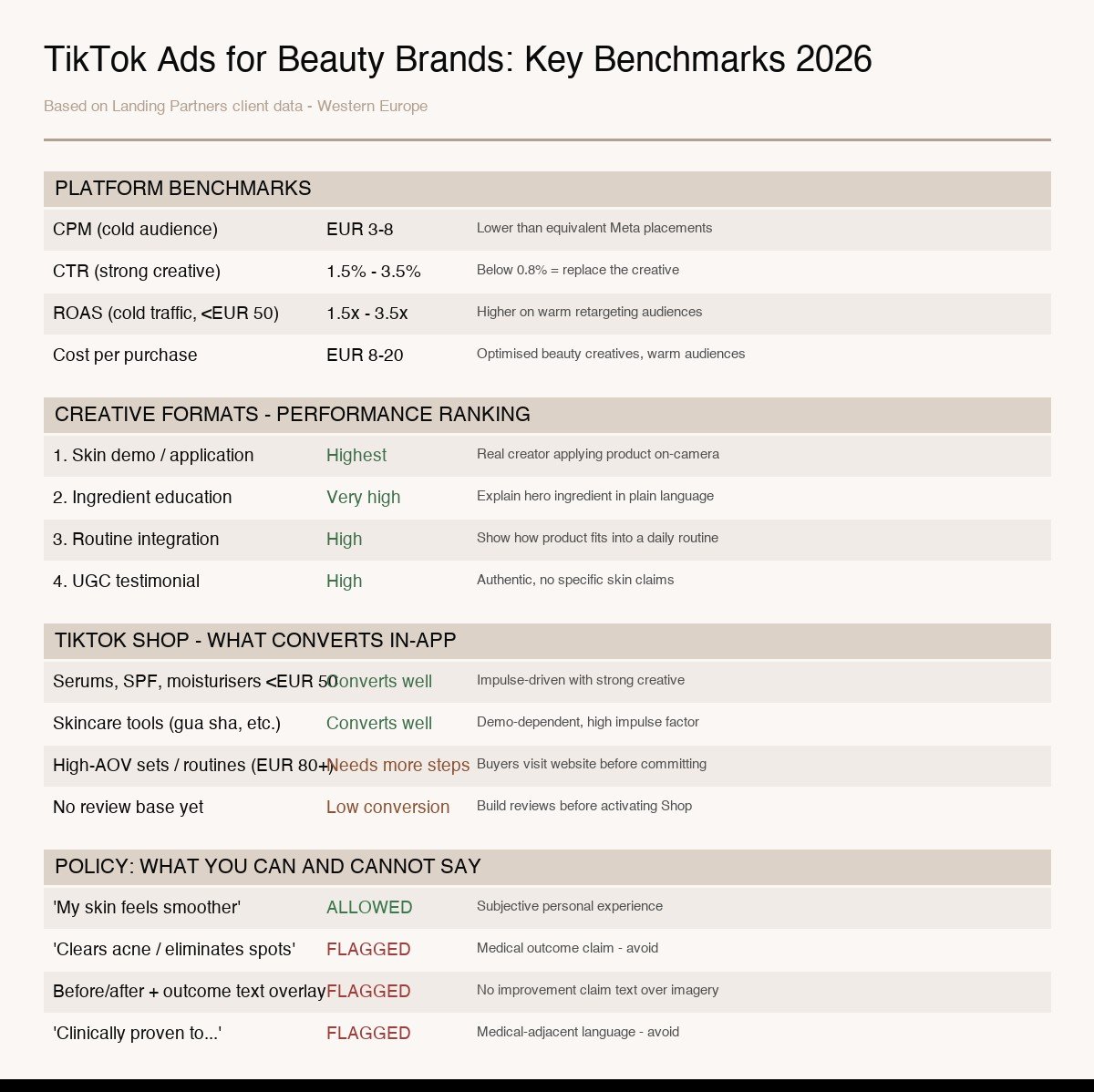
• Serums, moisturizers, and SPF products in the €20-50 range
• Skincare tools (gua sha, ice rollers, LED devices) - often impulse-driven when the demo is compelling
• Single-step products with a clear and simple use case
• Bestsellers or products with strong review volume already in place
Products that need more funnel touchpoints before converting in-app:
• High-AOV sets or routines (€80+) - the research behavior around complex routines means buyers typically visit the website before committing
• Prescription-adjacent products - anything touching clinical dermatology territory requires more trust-building before the first purchase
• New brands without a review base - TikTok Shop buyers are review-dependent and entering Shop without social proof significantly limits conversion
Beauty brands with a strong review ecosystem see meaningfully higher TikTok Shop conversion rates than brands launching cold. Building your review base before activating TikTok Shop is not optional - it is the foundation the in-app conversion relies on.
Benchmarks: CPM, CTR and ROAS for Beauty on TikTok
**These numbers come from our client data. Your results will vary based on creative quality, audience size, and product price point.** Use them as directional reference points, not fixed targets.
TikTok CPMs for beauty brands in Western Europe currently run lower than Meta for similar audience profiles. This makes the platform cost-efficient for awareness and upper-funnel activity. ROAS at the product level is more variable than Meta because TikTok's conversion efficiency is more dependent on creative quality.
What we typically observe across our beauty client accounts:
• CPM: €3-8 for broad cold audiences (generally lower than equivalent Meta placements)
• CTR: 1.5-3.5% for strong beauty creative; below 0.8% is a signal to replace the creative
• ROAS: 1.5-3.5x on cold traffic for products under €50; stronger on warm retargeting
• Cost per purchase: €8-20 for optimized beauty creatives targeting warm audiences
A note on attribution: TikTok's in-platform ROAS tends to show lower than Meta for the same product because TikTok's view-through and assisted revenue shows up in Meta and organic channels. Look at your blended MER (total revenue divided by total ad spend) when evaluating TikTok's real contribution to the business - not the in-platform number alone.
Want to benchmark your TikTok beauty ads against what we see in the market? Book a free performance call and we'll review your current numbers.
TikTok Beauty Ads Policy: What You Can and Cannot Say
This is where beauty brands consistently get burned. TikTok's health and wellness advertising policy restricts specific categories of claims, and beauty sits in a grey zone that requires careful navigation.
What is generally acceptable:
• Showing skin condition before applying a product, then showing skin after - without text overlay claiming a specific improvement
• Describing the product's sensory qualities: 'this feels lightweight', 'absorbs quickly', 'leaves skin looking glowy'
• Describing ingredients and their general known properties: 'hyaluronic acid draws moisture to the surface of the skin'
• A creator sharing their personal experience in subjective language: 'my skin has felt smoother since I started using this'
What consistently gets flagged or rejected:
• Direct claims about treating or curing skin conditions: 'clears acne', 'eliminates dark spots', 'reduces fine lines by X%'
• Before/after imagery with text overlay claiming specific improvement
• Medical-adjacent language: 'dermatologist-recommended for rosacea', 'clinically proven to...'
• Specific measurable outcome claims within a time frame: 'see visible results in 3 days'
**The rule of thumb we use with our beauty clients: describe the experience, not the medical outcome.** 'My skin looks more even' is acceptable. 'This product faded my hyperpigmentation' will get flagged. Brief your creators on this explicitly - this is not something you can correct after the fact.
Approximately 20-30% of beauty ad creatives we audit contain at least one flaggable claim. This is one of the most common reasons for rejected ads and account reviews. It is preventable with a clear creator brief that specifies language boundaries upfront.
How to Write a TikTok Beauty Creative Brief
A TikTok beauty brief is fundamentally different from a Meta creative brief. Meta briefs often focus on the product, the offer, and the call to action. TikTok briefs need to lead with the creator's genuine experience.
What your brief needs to specify:
• **The hook** - the first 3 seconds determine whether someone keeps watching. Give the creator 2-3 hook options. 'Why I threw out my €80 moisturizer' or 'The one ingredient your skin routine is probably missing' - curiosity-driven, not product-first.
• **The hero ingredient or benefit** - which one thing do you want the viewer to remember? One ingredient or one use case per video. Never a product catalogue.
• **The claim boundaries** - list explicitly what the creator cannot say. Provide alternative phrasings they can use instead. This is not optional.
• **The call to action** - 'link in bio', 'find it in TikTok Shop', or a specific product URL. Keep it natural, not forced.
• **The length** - 45 to 75 seconds performs best for educational beauty content. Under 30 seconds often does not give enough time for the education arc to land.
What your brief should NOT do: dictate the script word for word. Give the creator space to be themselves. The authenticity is the performance driver - over-scripted content reads as an ad and loses the native quality that makes TikTok work.
TikTok + Meta: Running Both as One Beauty Funnel
**The most common mistake beauty brands make when they start on TikTok: treating it as a competing channel to Meta.** They serve different roles in the funnel and amplify each other when run together.
TikTok's role in the beauty funnel:
• Discovery and education - reaching new audiences who have never heard of your brand or product
• Social proof building - high-view content builds brand credibility that transfers across channels
• TikTok Shop in-app conversion for impulse-category products under €50
Meta's role in the beauty funnel:
• Retargeting TikTok viewers who visited your site but did not purchase
• Catalog retargeting for people who added to cart
• Lookalike audiences built from TikTok purchasers
• Direct response for warm audiences with existing purchase intent
The compounding effect is real: **brands running TikTok and Meta together consistently see better Meta performance than brands running Meta alone.** TikTok pre-warms audiences, builds brand recognition, and increases the probability of conversion when the Meta retargeting ad appears. For Meta Ads benchmarks specific to beauty and skincare brands — CPM, CTR and ROAS — see our dedicated guide.
A typical setup we build for beauty clients: TikTok runs education-first creative to cold audiences. Meta runs retargeting with product-specific creative to everyone who has touched the brand. The two platforms are connected through shared audiences and performance is tracked on blended MER.
Frequently Asked Questions
Every beauty brand's situation is different. Your TikTok strategy depends on your product category, price point, current creative capacity, and where you are in your channel mix. If you want to know what the right approach looks like for your specific brand - book a free call.