Email List Growth for Fashion Brands: How to Build a High-Converting Klaviyo List with Pop-ups, Style Quizzes and Waitlist Opt-ins
Most fashion brands focus on getting more traffic. The brands that actually scale focus on capturing the traffic they already have.
Your Klaviyo list is the difference between a brand that owns its audience and a brand that rents it from Meta. Every time a visitor leaves your site without opting in, that relationship depends entirely on paid media to rebuild. That cost compounds over time.
We've built Klaviyo setups for fashion brands from zero - luxury labels, streetwear brands, kidswear, contemporary women's fashion — across Belgium, the Netherlands, Germany and the UK. What we've learned is that list-building is not a passive activity. It requires the same intentionality as your ad creative or your product photography. The opt-in moment is a conversion, and it deserves the same attention.
This guide covers what we actually see working across our client base: which pop-up formats convert, when to use a style quiz versus a discount, how to capture subscribers through waitlists and drops, and what the benchmarks look like per channel.
Key Takeaways
- •Your email list is your most durable asset - Meta audiences change, your Klaviyo list is yours
- •Pop-ups convert 3-8% of visitors depending on placement, timing and offer type
- •Style quizzes outperform discount pop-ups for luxury and contemporary fashion brands
- •Waitlist opt-ins convert at 15-40% because they capture high-intent visitors
- •SMS opt-in can be layered on top of email opt-in without cannibalising conversion
- •List quality matters more than list size - a 5,000-subscriber list of engaged buyers outperforms 20,000 passive email addresses
Why Your Email List Is Worth More Than Your Ad Account
Fashion brands lose their entire paid media history when an ad account gets restricted or an algorithm changes. Your Klaviyo list does not reset.
We've seen fashion brands with 8,000 engaged subscribers generate more revenue per month from their flows than brands with 50,000 subscribers who never invested in list-building strategy. The difference is not size. It's the quality of the opt-in moment and the segmentation that follows.
**The compounding effect is the real argument.** Every subscriber you capture today costs you nothing to reach tomorrow. A Meta ad to that same person costs you CPM, CTR, and conversion - repeatedly. A Klaviyo flow to a subscriber who opted in through a style quiz already knows your brand, already indicated a preference, and is significantly more likely to convert than cold traffic.
For fashion brands specifically, the list becomes the primary owned channel that bridges seasonal gaps. July is slow for most fashion brands. If your list is strong, your July flows still generate revenue from people who bought in April and are ready for their next piece. Without the list, July is entirely dependent on paid spend.
Across our fashion clients, brands with 10,000+ active Klaviyo subscribers see 20-35% of their total monthly revenue come from owned channels - flows and campaigns combined. Brands under 5,000 active subscribers average under 10%.
Pop-up Strategy for Fashion Brands
The pop-up is still the highest-volume list-building mechanism for fashion ecommerce. Done correctly, it captures 3-8% of your site visitors. Done incorrectly, it irritates visitors and suppresses conversion.
Timing: exit-intent, scroll-triggered or timed?
Exit-intent pop-ups (triggered when the cursor moves toward the browser bar) show intent to leave. They convert at 2-4% because they catch the visitor at the moment they've decided the current experience wasn't enough - and give them one more reason to stay connected. For fashion, exit-intent works well on the homepage and collection pages.
Scroll-triggered pop-ups (after 50-70% of page scroll) indicate content engagement. If a visitor has scrolled through your lookbook or product collection, they're interested. A pop-up at this point feels less intrusive and converts at 3-6% for fashion brands.
Timed pop-ups (10-15 seconds after page load) are the most used and the most abused. If your site takes 3 seconds to load and the pop-up fires at 10 seconds, you're interrupting a visitor who has seen almost nothing. We recommend a minimum of 20-30 seconds, or combining time with scroll depth.
**The format that wins for fashion:** a combination trigger - scroll depth (40%) AND time on site (20 seconds). This filters out bounces and captures visitors who are genuinely engaged.
Not sure which pop-up setup is right for your store? Book a free Klaviyo audit and we'll review your current capture rate and show you what's possible.
Discount vs. content lead magnet
The conventional approach is a 10% discount pop-up. It works. But it attracts discount-seekers, trains your audience to wait for offers, and erodes margin at the top of your funnel.
For luxury and premium contemporary fashion brands, a discount pop-up is often the wrong move. We've seen luxury brands increase their pop-up opt-in rate by switching from 10% off to 'be the first to access our new collection' or 'get early access to our SS26 drop.' The subscribers who opt in for exclusivity are more likely to buy at full price.
For streetwear and mid-market fashion brands, a 10% first-order discount still converts well - typically 5-8% of visitors. But we recommend capping the welcome flow at one offer and not repeating discounts in the first 90 days. You're building a relationship, not a discount habit.
In A/B tests across three fashion clients in the €80-150 AOV range, switching from a generic 10% discount pop-up to a 'join our style community' content offer with a style guide download increased list quality metrics: open rate in the welcome flow went from 38% to 54%, and revenue per recipient in the first 30 days increased by 22%.
Placement beyond the homepage
Most fashion brands only show their pop-up on the homepage. That means visitors who land directly on a product page via Meta or Google never see it.
We configure pop-ups across four placement contexts:
1. Homepage - welcome pop-up, 20-second timer or exit-intent
2. Collection pages - scroll-triggered at 50% scroll depth, framed around collection access
3. Product pages - exit-intent only, lower friction, framed around stock notification or style quiz
4. Blog/editorial pages - content-matched opt-in ('get more guides like this')
Each placement should have its own copy that matches the context. A generic 'join our newsletter' pop-up on a product page is a missed opportunity.
Style Quiz as Opt-in: The Most Powerful Fashion List-Building Tool
A style quiz is not just a list-building tool. It is simultaneously your highest-converting opt-in mechanism and your most powerful segmentation input.
When a visitor completes a style quiz and opts in, you know their style preference, size range, price comfort, and aesthetic before they've bought anything. That information goes directly into Klaviyo and determines which welcome flow they enter, which products you recommend, and which Meta Custom Audience they feed into.
**Why quizzes outperform discount pop-ups for fashion:**
Visitors who complete a quiz have spent 60-90 seconds engaging with your brand. They've answered questions about themselves. They feel understood. The opt-in at the end of the quiz does not feel like a marketing capture - it feels like the logical next step to receive the personalised result.
Completion rates for fashion style quizzes sit at 60-75% of people who start them. Of those completers, 70-80% opt in at the end. That's a significantly higher-quality subscriber than someone who entered their email for a 10% discount.
We've seen fashion brands with a well-structured style quiz generate Klaviyo welcome flow revenue per recipient that is 2.8x higher than brands using a standard discount pop-up opt-in, within the first 60 days post-subscribe.
What makes a fashion style quiz convert:
Keep it to 5-7 questions. More than 7 and drop-off increases sharply. Questions should feel like a conversation, not a form.
Use visual answer options where possible - showing aesthetic images rather than text options ('which of these looks most like you?') increases completion rate and reduces cognitive load.
Ask about both style and purchase intent: 'What are you most looking for right now?' (new season pieces, a specific occasion, basics) feeds directly into Klaviyo segmentation and determines the first email they receive.
The opt-in screen should come at the end, after they've seen enough of their personalised 'result' to want to receive it. Never ask for the email before showing any value.
Building a style quiz for your fashion brand? Talk to our team about how we connect quiz data to Klaviyo flows and Meta Custom Audiences.
Tools for fashion quizzes
Octane AI integrates natively with Klaviyo and Shopify. It's the strongest option for fashion brands that want quiz data to automatically flow into Klaviyo profile properties and trigger segmented flows. Pricing starts at around $50/month.
Typeform is more flexible and visually clean. It requires a Zapier or native Klaviyo integration to pass data automatically. Good for brands that want more design control.
Jebbit is built specifically for ecommerce and handles visual quiz formats well. It has its own analytics suite and integrates with Klaviyo.
Our recommendation: for fashion brands doing over €500K in revenue, Octane AI is the right investment. For earlier-stage brands, a well-configured Typeform with a Klaviyo integration achieves 80% of the result at lower cost.
Back-in-Stock and Launch Waitlist Opt-ins
The highest-converting opt-in mechanism we see in fashion is also the least discussed: waitlist opt-ins.
When a product is sold out or an upcoming collection is not yet available, the visitor arriving at that page is among the highest-intent visitors your store will ever have. They found the specific product they want. They want it now. They can't have it yet.
A waitlist opt-in at that moment converts at 15-40%, depending on the desirability of the product and the clarity of the value proposition.
**Back-in-stock alerts:** These are the lowest-friction opt-in in fashion ecommerce. 'Notify me when this is back in stock' requires minimal commitment and delivers obvious value. Visitors who opt in for back-in-stock alerts convert at 20-35% when the stock returns, significantly higher than any cold traffic source.
In Klaviyo, the back-in-stock flow should trigger within 30 minutes of restock and include: the specific product with a direct link, social proof (how many people were on the waitlist), and urgency where appropriate ('this sold out in 48 hours last time').
**Collection launch waitlists:** Before a new collection drops, a dedicated landing page with waitlist opt-in serves two purposes: it builds the email list and it signals demand to your team. Positioning matters here. 'Be first to shop our AW26 collection before it goes live' is stronger than 'subscribe for updates.'
We've seen fashion brands generate 500-2,000 new Klaviyo subscribers per collection launch from waitlist opt-ins alone, with zero paid media cost. The key is promoting the waitlist on organic social and in existing email flows before the drop date.
In our client base, waitlist opt-in subscribers have a first-purchase conversion rate of 28-41% within 7 days of a collection launch - compared to 2-5% from cold Meta traffic to the same collection.
SMS Opt-in Alongside Email: Adding the Second Channel Without Adding Friction
SMS has higher open rates than email for fashion - 85-95% vs. 35-55% for a well-maintained Klaviyo list. But SMS requires a separate opt-in by law in Europe, and adding a phone number field to a pop-up increases friction and reduces overall opt-in rates.
The approach we use for fashion clients: separate the email and SMS opt-in moments rather than stacking them.
**Step 1: Email first.** The pop-up or quiz captures the email address. No phone field.
**Step 2: Post-email SMS opt-in.** Immediately after email capture, a second screen offers SMS opt-in: 'Add your number to get drop alerts by text.' This is optional and clearly positioned as a bonus. Conversion to SMS at this step: 15-25% of email subscribers.
**Step 3: Welcome flow SMS ask.** Email 3 in the welcome flow includes an SMS opt-in prompt for subscribers who didn't convert on the post-pop-up screen.
This approach keeps the initial email opt-in rate high (no friction from phone field) while building an SMS list on top. The subscribers who opt in for SMS at step 2 are your highest-intent audience - they've already given their email and taken a second action.
For Klaviyo SMS in Europe, you need to be registered with the relevant carriers and the opt-in language must be explicit about SMS marketing. Klaviyo handles the compliance mechanics once configured correctly.
List Hygiene: How to Grow Without Degrading Your List
Growing your list is only valuable if you maintain list quality. A large, disengaged list is not an asset - it's a liability. It raises your Klaviyo bill, suppresses deliverability, and inflates your reporting.
**The suppression rule:** Anyone who hasn't opened an email in 180 days should move to a sunset flow. If they don't re-engage after a 3-email win-back sequence, they should be suppressed. This is not losing subscribers - it's protecting your sender reputation and your cost base.
**The engagement indicator:** A healthy fashion Klaviyo list has a 30-45% active rate (opened at least one email in the last 90 days) for brands with regular cadence. If your active rate drops below 25%, your pop-up is capturing too many unqualified subscribers and your suppression flow is not running correctly.
**Avoid shortcut tactics:** Purchasing email lists, adding emails from customer export without explicit consent, or using overly aggressive pop-ups that fire before any engagement all inflate your list size while destroying list quality. We've audited accounts where 70%+ of the 'list' was unengageable - the result of years of bad practices.
Want to know your actual list health metrics and capture rate? Book a free Klaviyo audit - we'll pull your real numbers and show you where the gaps are.
Opt-in Rate Benchmarks Per Channel
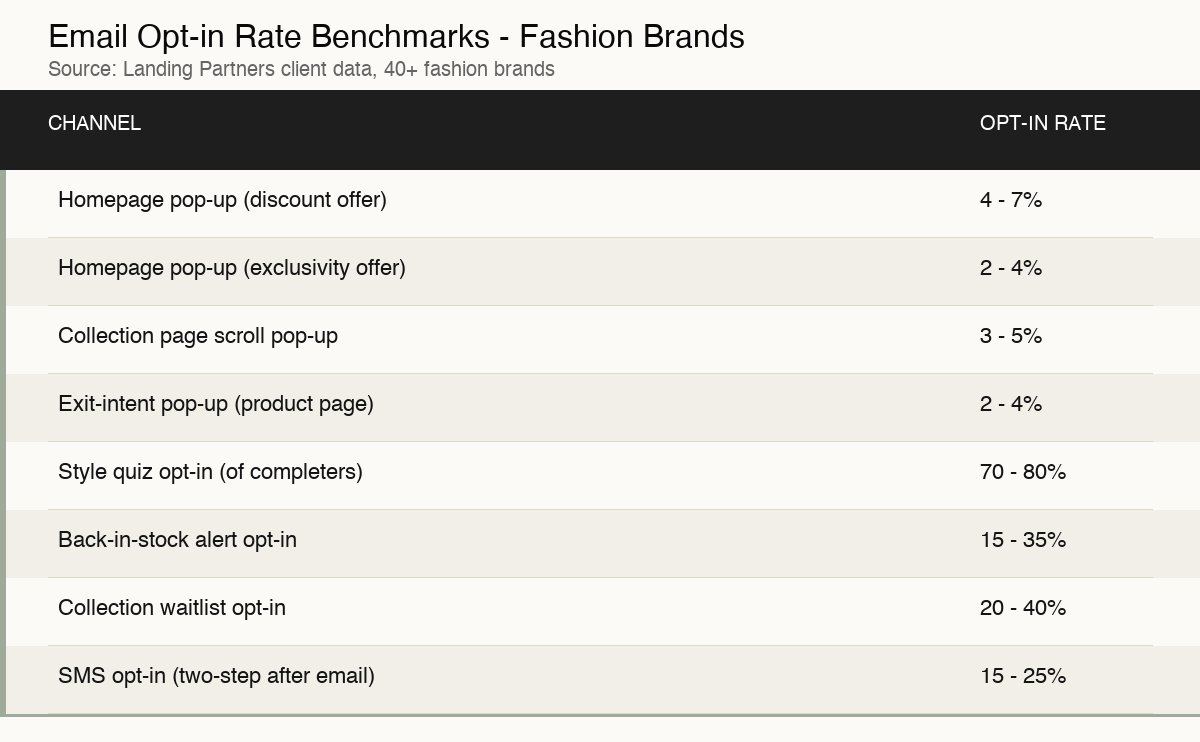
These are the benchmarks we see across our fashion client base. They vary by brand positioning, AOV, and offer type - use them as directional targets, not universal standards.
Homepage pop-up (discount offer, €80-150 AOV brand): 4-7% of visitors
Homepage pop-up (content/exclusivity offer, €150+ AOV brand): 2-4% of visitors
Collection page scroll-triggered pop-up: 3-5% of visitors
Exit-intent pop-up (product page): 2-4% of visitors
Style quiz completion rate: 60-75% of starters
Style quiz opt-in rate (of completers): 70-80%
Back-in-stock alert opt-in: 15-35% of visitors on a sold-out product page
Collection waitlist opt-in (dedicated landing page): 20-40% of page visitors
SMS opt-in after email capture (two-step): 15-25% of email subscribers
Email 3 of welcome flow SMS ask: 8-12% of email subscribers
Every brand's situation is different. These benchmarks depend on your AOV, brand positioning, and how much work has gone into the opt-in copy and design. If you want to know what's realistic for your specific brand, book a call.